Latest Comments

Guest - Max Mustermann The True Cost of Driving a Car.
06. November 2026
Great breakdown — the non-fuel costs are exactly the bit most people forget when they compare cars. ...
Guest - Harma Phew. Now it gets involved!
21. Oktober 2026
Have fun at these events.
Guest - Aislinn Dyestuff Citizen Science.
09. Oktober 2026
This is a great project. I look forward to the results. Thanks for letting us know.
Guest - Aislinn Time for...
09. Oktober 2026
Looks delicious!
Guest - Katrin Sprang Discussion
18. September 2026
Hi Rachel, I have looked for more photos of you, but that was not very successful. I found a link on...
JULI
07
9

If I could have a Superpower...

There's this thing about superheroes: They have superpowers. Each, usually, their own, and they range from superstrength (Hulk smash! Superman! And don't forget Pippi Longstocking) to mind-reading to throwing fireballs to flying to freezing things and whatnot else.

Well. Flying and smashing and being superstrong might all be cool... but if I'd get to choose a superpower, it would be Universal Incredible Language Skills - as in speak, read, and understand any language like a talented native speaker. toBecause that would make things so much easier. Archaeologists still publish their research in their home language, usually, so if you are looking for things outside your own country or language area, you need to at least know about some basic terms in your goal language to have a chance of finding stuff.

On a side note - there's pros and cons for publishing in your home language as well, of course. If you publish in English, you might have colleagues in your own area who don't find the research; if you publish in your language, it won't be as visible from outside your language area. Unless, of course, your home language is English. Then you're lucky - though you might then be one of the people who, when young, never got far with learning a foreign language because you could always get by with your own...)

Anyways, I was able to find a lot of non-German and non-English articles and books and publications when I was working on my thesis, and had to brush up my language reading skills considerably to be able to handle them. For some of the very exotic things, I had help from friends and family (my Dad was able to help with the Czech articles, and I had friends and fellow students help with Polish, and Icelandic; plus people to ask about the finer points of Middle High German. I also had some help for the not-so-exotic-but-still-hard-for-me Italian.

I was a lucky lady to find all that help. It didn't hurt either that I quite like languages, and that I had lessons in English, French, and Latin in school (though I was so bad at Latin that it doesn't really count), and learned a bit of Dutch, Spanish, and Swedish while at Uni. In most of the languages I can read, my passive understanding skills are way, way, WAY better than my active skills - which is to say I can read simple everyday things in newspapers and more or less understand the gist of them; I can read archaelogical papers and understand them (better than the news in most cases, funnily); but I will have a hard time understanding spoken language and will probably not be able to speak beyond very limited, very simple short sentences. I also have a sort of mashed-up language slurry in my brain for some groups; for instance, I read "Generic Scandinavian" and it will take me a while and some thinking to be able to tell Danish or Norwegian apart. Telling those apart from Swedish is easier, but I will still have to take a second look. My Spanish is so bad that it once took an Italian guy about 15 minutes of me talking at him to realise it was Spanish, not Italian. (It was a fun conversation nevertheless.)

So. Superpower of choice - Universal Language Skills.

In case you should happen to have them, or in case you happen to read Finnish, you can find the original documentation of excavations, plus a lot of other resources, at Kulttuuriympäristön Palveluikkuna. Have fun!
0
JULI
06
1

Leeds IMC is running...

... and even though it's virtual, I'm not there. If only because I heard about it too late - apparently, there was a very quick, very large rush of people registering for the conference, and the organisers had to cap it due to bandwith and virtual logistics limits.

Which, I think, is a very good thing - it does show that virtual conferences can be a thing, and maybe we'll have more of that in the future. I definitely hope so.

That said, there's a few free things on the programme, and you might want to check it out here - things are marked "open to the public" if you can get access without a IMC registration. Check the performances and tours & exhibitions parts if there's anything of interest for you!

The U of Leeds also posted this article about 8 ways to get a cultural fix back in April.
0
JULI
03
0

Linky Time.

Time to clear up some of the gazillion tabs here again!

First of all, if you're feeling slightly nerdy, here's an article on medium.com on a visualisation of the global development of COVID-19. It involves a few steps (and reading the instructions in the Medium article), but then you can have the thing plot a lot of different developments for you. What makes these plots really interesting is that the numbers have been normalised to the population size - so we're looking at the relative case numbers and their development, not at absolutes. This really is way cool. (I got the link sent by a neighbour who was involved in the project, by the way. The things you learn.)

Another neighbour was involved in some of the translation work done for a current virtual exhibition in Nuremberg: "Menschen machen Stadtgeschichte" - People making the city's history. Scroll down a bit for the English explanation and link to the English version.

Even more from people I actually know: My colleague Alexandra Makin has interviewed my other colleague Gwen Owen-Crocker for her new blog series "Early Medieval (mostly) Textiles". Go check it out here.

Yet another friend has pointed me to the (virtual) International Medieval Congress site, where I browsed through the conference programme and found a link to a modern Decameron - ten days with ten stories each, so a hundred altogether. The individual stories are rather short, so if you need a little something to watch and listen to now and then, go have a look. You can find the full list of videos here, and here's the very first one with the introduction for your convenience:

0
JULI
02
0

Procrastinating. Helpfully.

I have to do tax stuff. Which, as you probably know, is not my favourite task of them all... so I've been procrastinating this morning.

At least I've been procrastinating in a productive way - finding a slightly better way to get bibliographical data attached to the many .pdf articles that I have in storage (but not yet in the bib database I use), and doing some cleanup and maintenance work on said database. That includes correcting special characters that have not transferred correctly. A pain in the neck, especially if they are not the simple, regular ones that can be typed easily on my standard German keyboard.

I used to have a specialised keyboard when I was writing my thesis, adapted to include Danish, Polish, and Czech special characters, but that has not survived the changes of computer hardware and operating system that happened inbetween, and I haven't gotten around to setting that up again. For the moment, I've found a handy character list on the 'net to copy and paste the single individual characters; it's here, and includes HTML and ASCII codes, if you find those handy.

I've also looked into some other database stuff, though not quite as successfully yet. There's a few things I would like to organise better, so that I can use and access the information I have more easily, but haven't found a really good solution yet. The optimum would be something that also allows cooperation with colleagues via the 'net, while easy to use, linking things both online and in local storage together, and searchable. I might have a lead on something that sounds promising, but haven't looked into it much yet... and I shouldn't, today, since - see above - someone has to do my tax work... and the cat, while purring helpfully and being very cuddly as she currently lies on my arm (the left one, for a change, very unusual) refuses to do that.
0
JULI
01
0

Phew. Back online.

The shop is back online, after a short break overnight to implement the change in VAT rate that is in effect here in Germany starting today.

I think the change was one of these ideas that are well-meant and sound really good at first, but are not as brilliant on a second, closer look. For me, it was rather easy to implement, with a smallish shop and a decision on how to handle it that makes things much easier for me. Changing the tax rate was, in my case, quick and easy to do. The prices, though, will remain the same, as the shop fixes the brutto price (including the tax). As I have both things with reduced tax rate in the shop as well as normal rate things, and the printed matter is partly bound to the price (there's a German book price law, which means a new book will cost the same no matter where you buy it, and the price is fixed by the publishing house), I can't just slap a general discount on.

My solution is to offer a discount code - you can enter this in the appropriate field shown on the shopping basket page - and you'll get the price reduction on all the eligible items. (Or you can just pay the full price, if you want me to have a bit more revenue from your purchases, which will also be welcome.)

Other vendors have not had it this easy, though. Especially if you have an automatic cashier desk or similar things, I've heard that things could be very complicated, and nerve-wracking. In quite a few branches of trade, there's a lot of confusion on how to handle this, and whether it's better to pass on the reduction to the customer, or to keep the little extra revenue. It should be clear in gastronomics (which was, I think, the primary reason for the VAT rate reduction), but in other businesses, I wonder if the extra amount of work and hassle will really be worth it. It's extra-complicated in the book trade, due to the fixed-price law!

Just like in so many other circumstances, only time will tell whether this stunt will actually do something for German economy. In the meantime, you can enjoy the discount and with it the accompanying "krumme Preise", as we say in German - non-round, slightly weird numbers for the prices.

And that's it for the current behind-the-scenes report...
0
JUNI
30
0

The Pandemic is taking its toll.

After thinking about it for weeks turning into months, and trying to put off the inevitable, I've finally succumbed and faced the facts: There will be no European Textile Forum in 2020.

I'm really, really sad about this, as this week of absolute textile research craziness is one of my highlights each year, but the situation worldwide is still insecure, and there's no way to predict where we'll be in November, and what things will be allowed, or possible, or sensible. In addition, though it's a small conference, it is one where we are a very international crew and work closely together - including physically close. This, together with the shared space to eat, sleep, and work, are part of the charm of the Forum, and play a large role in making it as effective and special as it is.

With all the tools and materials, sometime quite exotic, that are brought either by myself or by other participants so that everyone can work together on a project, and with the hands-on approach to so many things, there is no good way to just lift this over into virtual space either (as many other conferences have done). My own personal ample experiences with video meets and webcams have also shown that they won't be really suitable to showing things in high detail, which means that sharing ongoing work with each other would be much harder than just handing over the thing, or having someone else come over and take a look.

So rather than bending our concept and trying to make something work that is not suited well for the virtual space, we'll take a break, and hopefully everything will be under control enough for a normal Forum in 2021.

I'll miss it, though. A lot.

 
0
JUNI
29
0

More Green Things.

Today was busy with shopkeeping things - printing, sorting, re-stocking, and sorting stuff. Plus bringing parcels to the post office, which is one of the tasks I feel are very pleasant; not only is there a feeling of accomplishment when things are sent off, it also means a nice little walk to the post office and back, sometimes accompanied by a short hop into the shop across the road to stock up on things. Which might include something nice and sweet for the afternoon coffee.

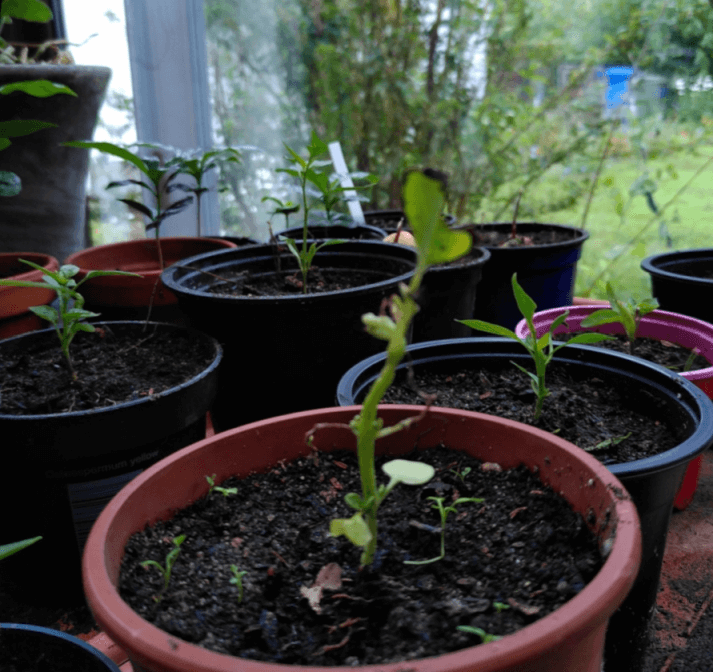
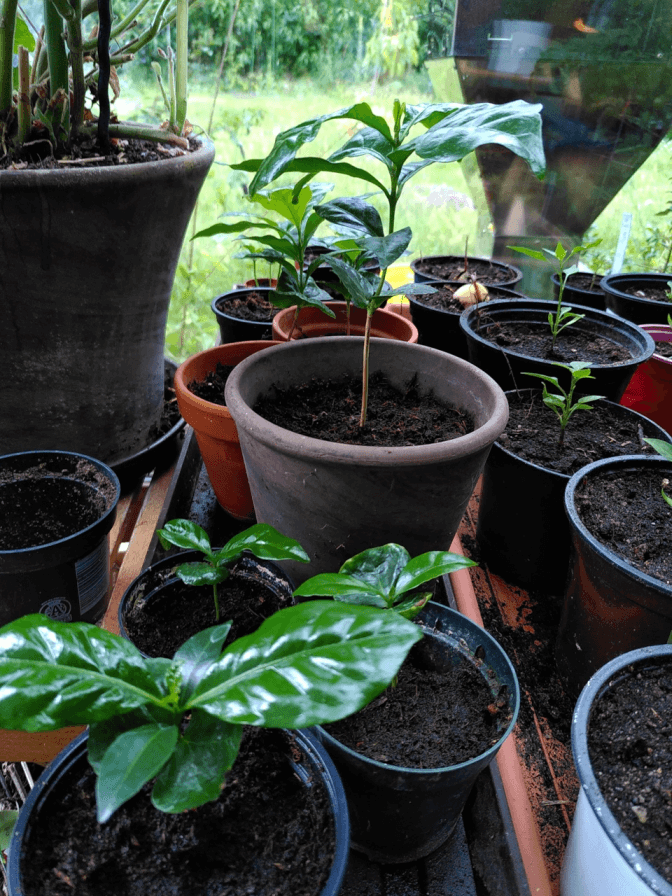
Speaking of coffee, my little coffee plants are coming along nicely:


Some of the batch have gone to a new home (with my mum, and aunt, or friends) and I'll see how the rest does. At least this time I know that they like light, but no direct full sun, and that they need acidic soil (the lack of which probably killed them last time around).

The chili plants are also coming along, though slowly. I already had most of them moved to outside, so they'd have direct sun and fresh air and rain and overall outsideness... but they are back in the wintergarden now, after some losses.

You see, at night... the snails came. They feasted on the chilis, and also on the basil, which is the sorry blurry thing you can see in the foreground here:


Another reason for moving the plants back inside: One day, we came home from a walk and saw a hare hopping through the garden, and I'm pretty sure that he or she's to blame for two chili plants that were bitten off right above the soil! They probably won't come back, as they were still quite young... but I'm determined not to feed the hare with more of my capsicum plants, so inside they'll stay.

 
0

By accepting you will be accessing a service provided by a third-party external to https://pallia.net/

Kontakt