Latest Comments

Guest - Max Mustermann The True Cost of Driving a Car.
06. November 2026
Great breakdown — the non-fuel costs are exactly the bit most people forget when they compare cars. ...
Guest - Harma Phew. Now it gets involved!
21. Oktober 2026
Have fun at these events.
Guest - Aislinn Dyestuff Citizen Science.
09. Oktober 2026
This is a great project. I look forward to the results. Thanks for letting us know.
Guest - Aislinn Time for...
09. Oktober 2026
Looks delicious!
Guest - Katrin Sprang Discussion
18. September 2026
Hi Rachel, I have looked for more photos of you, but that was not very successful. I found a link on...
NOV.
29
0

Franconian Comfort Food.

It's drab and grey outside, there's lots and lots of rain (though no snow at all), December is almost around the corner, the festive season is getting ready to waft its gingerbread-smelling tentacles into our general direction...

which all means that I'm slowly getting ready for the baking spree. For which I've posted almost all of my recipes during the past years. So today, for a change, you get the recipe for a kind of comfort food, Franconian style.

If you've ever visited the area, you will probably know that local food is rather heavy on pork products - there's lots of meat dishes. There are also onions (grown in great quantity, traditionally, around Bamberg, which is called "Zwiebeltreterland" - "land of the people stepping on onions"). There's also wonderful pure rye bread.

And then, Franconia is divided into two parts: the beer part (where I come from, and where Bamberg still counts to) and the wine part (which is not very far from here, and has mostly white wines, and mostly dry ones).

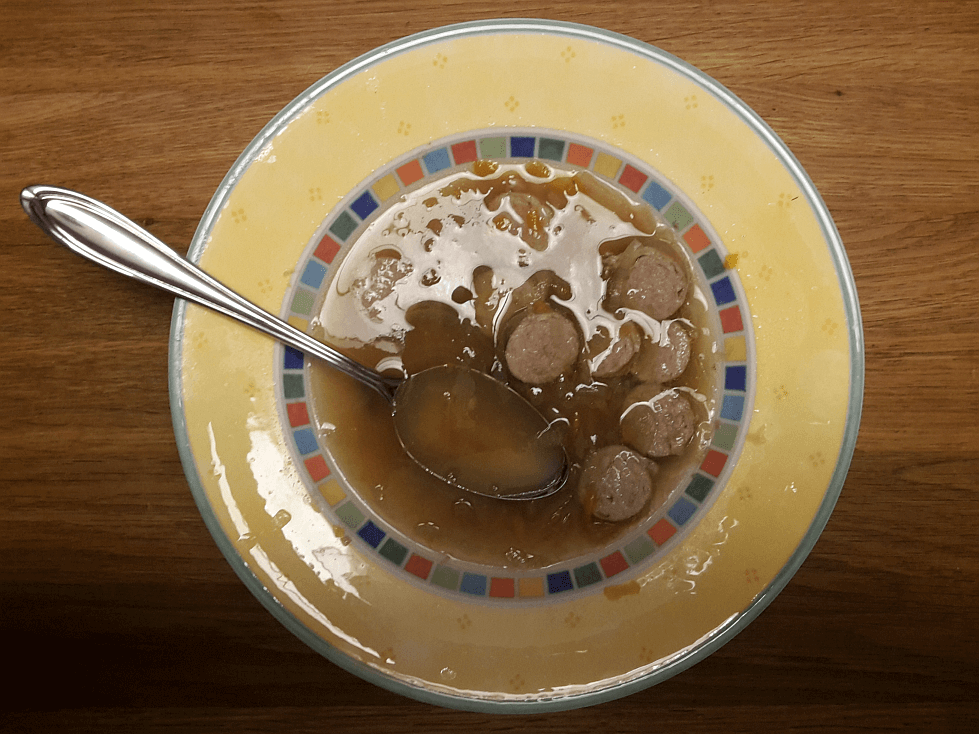
Now... if you add pork sausages, onion, bread and wine together, throw in some spices and some vinegar, you get a dish called "Blaue Zipfel" (Blue ... well... ends. As in sausage ends.)

Success of this recipe depends on you being able to get good (or at least decent), fresh Bratwürste - that are sausages intended to be fried. The best of all of them, of course, are Franconian ones - they are, typically, pork, have a rather coarse consistency of the filling, and are seasoned with herbs, though not overwhelmingly so. For this recipe, they are not fried, but gently heated in a hot acidic broth until done.

The broth for four persons is made by mixing a litre of water (or a bit more), 200-500 ml of (preferably dry, preferably Franconian) white wine, 200-500 ml of white vinegar, and a bit of sugar to taste (recipes vary between no sugar at all and up to 100 g). Add about 1 teaspoon of peppercorns, 4 laurel leaves, 10 juniper berries, 10 cloves, 1 teaspoon of salt, and 1 tablespoon mustard seeds. The wine can be replaced by a bit more vinegar (or just left away completely), but it will add to the taste of home. At least if you're from hereabouts!

Peel and cut onions into half rings (recipes vary between one large onion per person to 250 g of onion per person). If you like to have more colour and more veggies, you can cut carrots into julienne strips as well (make sure they are not too long, so they can fit onto a spoon easily).

Bring the broth to a boil, add the onions and optional carrots, and simmer until the onions are done but still have a little bit of bite left. Then turn the temperature down even more, add the sausages (2 per person) and let them sit in the hot broth for 20-30 minutes.

blauezipfel

This is traditionally served with rye bread (preferably, you guessed it, Franconian bread). It's not looking like much, it's quite acidic, it's warming, it's lovely - and for me, a true autumn-winter-comfort food.
0
NOV.
28
0

So many rags!

I almost forgot that there's a blogpost still due today - I've gotten rather sidetracked with both the desk work (where finally the email and paper stacks approach something like normal-ish dimensions) and the Bernuthsfeld tunic project work.

Where I have started on the front of the tunic, since the back is almost finished - there's a few small things still to do on the back, but they need some more thinking and possibly finessing, so they will be taken care of later. Putting the front together also has some interesting spots, as there's missing bits here and there, and the stuff that remains (including seams that run through what once was the patch underneath a missing piece) are not all very clearly indicating size and shape of the missing bits... not to speak of the colour and cloth type at all.

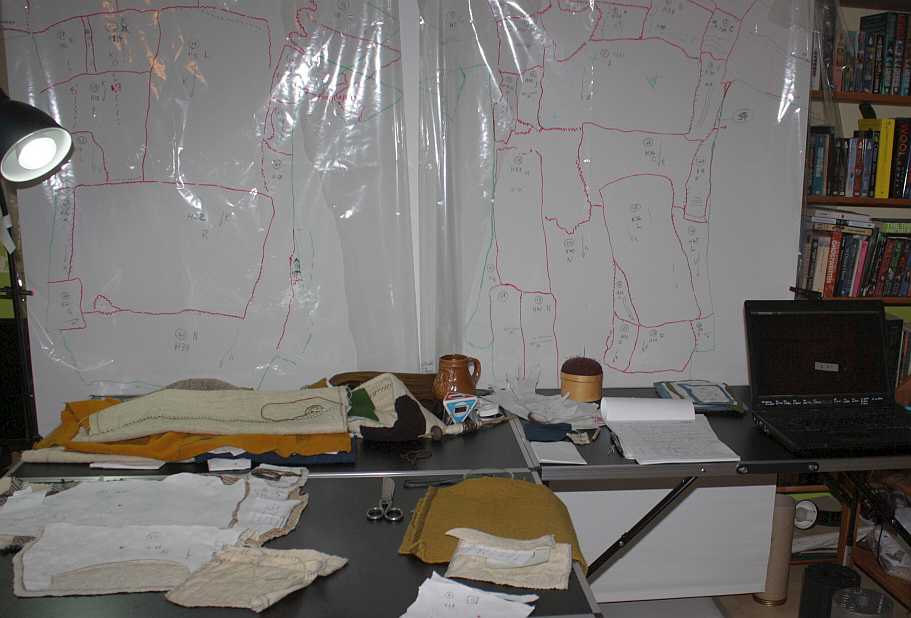
Anyway, there's progress. And this is what the place where the progress takes place looks like:

workspace

The computer with pictures to keep track of details, and to check things. Bits and pieces of cloth, partly already sewn together, partly only cut, partly not even cut yet. Lists and more lists - of seam types, cloth types, numbers and pieces. Plus the usual tools - scissors, shears, pins, needles, charcoal and chalk to mark lines, and lots and lots of paper pattern pieces. And, of course, the overview plan taken directly from the original.

Can you tell I'm having fun?
0
NOV.
27
0

Things to read!

The 2017 issue of the Archaeological Textiles Review is out, and as usual, it contains a number of interesting articles. You can read the table of contents here, and you can order it via the webshop, where you buy a membership for the Friends of ATR and get sent the print copy of the Review.

In case you haven't stumbled across them yet, the back issues (starting with issue 57 from 2015) can be downloaded for free from the ATR website. Which is a totally great thing!
0
NOV.
24
0

Progress...

Today, there's progress going on with the Bernuthsfeld project - finally, after the conference and event marathon of the last few weeks. It's nice to settle down again and get some actual textile work done for an actual project, and I'm thoroughly enjoying the lasting smell of birch leaf dye on some of the fabrics.

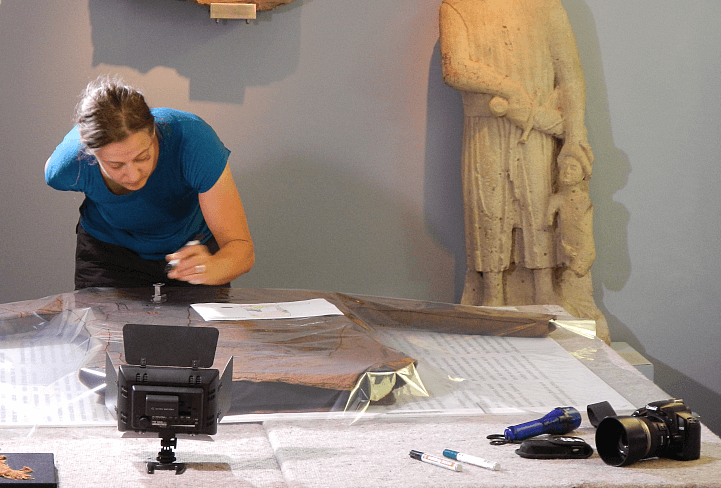
It's also, as always, utterly fascinating to see how many details you need to know to replicate something, or at least get close to replicating it. I'm very sure that the original maker of this tunic, made out of previously used fabric pieces, didn't bother about many of the steps, or was indifferent regarding which piece of fabric got to sit on top of its neighbour and which got to sit underneath... but for us, trying to keep as close as possible to the original, this is of course a thing to think of (and to look for in the many lists and photographs we made during our documentation session).

[caption id="attachment_3477" align="alignnone" width="721"]Snapshot of me doing documentation of the patches of the original tunic - which was then turned into a pattern... Snapshot of me doing documentation of the patches of the original tunic - which was then turned into a pattern...


There's no such thing as a perfect replica of a historical fabric, due to oh so many reasons - and one of them is that you never get all the data you would need. As I've recently told somebody, it's not a question of if you forget to look for a given detail, or take a note, or manage to take a decent picture of a detail that you later on need - it's a question of when you discover that you missed this something, and how many of these discoveries you make, and how bad the missing links are for your overall picture and process.

That said, up until now, there've been a few hitches - some of them due to misunderstandings or misinterpretation of the conservation reports, one of them due to an actual error in them, and none of them really ruinous. I'm hoping like hell it will stay like this!
0
NOV.
23
1

Exhibition "Expedition Mittelalter"

As one of the programme points during the Textile Forum, we went on an excursion to see the special exhibition "Expedition Mittelalter" at the Schnütgen-Museum in Cologne. If you can arrange it, I heartily recommend going there, as you will get treated to a lot of beautiful things usually buried in the archives. This includes, obviously, textiles.

Among them: a puzzling (at least to me!) embroidery of a horse or unicorn on a black (yes, black) linen background, dated to the 15th century. An incredibly beautiful reliquiary bag embroidered with silk in counted stitch and with a flat gold strip (also puzzling, because I have no real idea on how that strip was stitched in, and oh what would I give to see the back of that thing!). Plus a plethora of other textiles. Oh, and the Anno chasuble - a samite cloth dyed with real mollusc purple, dating to about 1000.

As opposed to most special exhibitions in German museums, in this case all the objects are from the hosting museum's own archives, and so you are allowed to take photographs for private purposes (no flash and tripod, so come prepared with a steady hand).

The only downside is that there is no catalogue. There's a comic book that you can complete with a kind of treasure hunt during the exhibition, which is nice and fun in its own way, but nothing even remotely helpful if you're trying to learn more about the individual objects. But yes, that's the only downside, and the pieces themselves are really making a visit worth its while.

The exhibition will run until January 28, 2018, so there's still a bit of time to travel there.
0
NOV.
22
0

Almost back to normal.

The stacks on my desk have shrunk a bit (at least enough so that I don't get an instantaneous flight reflex when entering the room), the cat is happily draped over my forearm again, putting her paw on my touchpad at the most inopportune moments, and most of the stuff that I dragged half across the country is back in its proper place on the storage shelf.

Not that I'm out of things to do, mind you - there's more sorting to do, the stack of emails is still towering, and of course after the season is before the next one. Which means there's planning for events, planning for markets, and planning for the next Textile Forum.

Especially the latter is interesting, as we're considering making a few changes to the programme structure, and to the conference as a whole. The aim of these changes will be to become more accessible to participants who can't spend a whole week at a conference. Of course, we want to get it right, so I'm currently working on a little survey to send around. There are also plans to slightly re-structure the website and to add some more things as information about past experiments, tests, trial runs and topics. It's all very exciting, and I hope the survey will give us a good amount of feedback on which to act, so that our little conference can saunter on into the future, doing an even better job at connecting people from the practical side of historical crafts to researchers looking at the actual pieces.

Like everything, making a survey turns out to be a time-eater, though. And even if I'm tempted to go on straight away working on it... I've already done enough survey drafting for today - I need to get a few other things done.

Such as putting the remainder of the goods into their place. And finally finishing an article that is due...
0
NOV.
21
1

Still here. Still breathing.

I'm back at the work desk, trying to battle my way through stacks of paper that needs to be taken care of, as well as stacks of email that has to be dealt with. It's amazing how many mails can run up in just a few days of not-really-in-the-office time!

The symposium last weekend, by the way, was an utterly wonderful thing - not only did I get to meet a lot of lovely people again that I meet way, way too rarely, there were also a number of new faces to finally connect with the names I've been reading here and there, over and over again during the last years.

Add to this a number of really interesting and well-presented papers, a concert featuring medieval music in the beautiful Marienkirche with its astounding acoustics (and I still have a selection of earworms from that), a wine tasting with wines made from old grape varieties (including the wine that saved Oswald von Wolkenstein's life as he held on to the barrel when shipwrecked, and a wine that has been processed following exactly the instructions in the Capitulare de Villis, down to reconstructed tools), common meals both in the conference place as well as in the evening, and you have a wonderful event that I would call wildly successful - and I do hope that it will not have been the only or last one of its kind!

Now, though, the season of events and conferences is finally over for me, and there's hope of things becoming a little calmer again. Which includes a chance of actually getting back on top of the things stacked here, both physically and virtually...
0

By accepting you will be accessing a service provided by a third-party external to https://pallia.net/

Kontakt