Latest Comments

Guest - Max Mustermann The True Cost of Driving a Car.
06. November 2026
Great breakdown — the non-fuel costs are exactly the bit most people forget when they compare cars. ...
Guest - Harma Phew. Now it gets involved!
21. Oktober 2026
Have fun at these events.
Guest - Aislinn Dyestuff Citizen Science.
09. Oktober 2026
This is a great project. I look forward to the results. Thanks for letting us know.
Guest - Aislinn Time for...
09. Oktober 2026
Looks delicious!
Guest - Katrin Sprang Discussion
18. September 2026
Hi Rachel, I have looked for more photos of you, but that was not very successful. I found a link on...
SEP.
15
1

An encore to yesterday's ornament.

I posted yesterday about a small gold ornament embroidered on fabric, and the post received this comment:

Looking at your ornament, I realized that because I had seen that particular technique only separate from the fabric ground, and because I was thinking about it as structurally similar to macrame and rope knotting techniques, it had never occurred to me that it might have been created using the ground fabric to help create and maintain the shape, rather than being created "in air" and then attached to a ground fabric by sewing. I'd been making them (and teaching people to make them) by using pins on a board with the wire wound in pairs on bobbins, as if I were making a sort of bobbin lace. I'll have to experiment with this approach. I'm curious: given that some of the surviving pieces using this technique are quite long, what would your approach be to dealing with the lengths of wire needed, if they need to be loose in order be able to "sew" them through the fabric as you create the knots?

Well. This does need more than just a few words in reply, so I'm making it a blogpost.

Firstly, and most importantly, this is a special form of gold thread embroidery and not a wire ornament, so if you are thinking "knots in wire", you have the wrong material in mind.

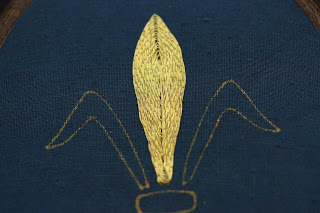
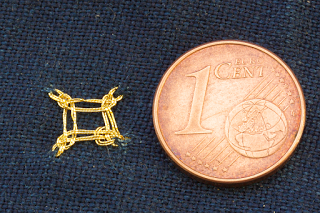
Let me show you - here's the ornament again:


And here's the thing in closeup.
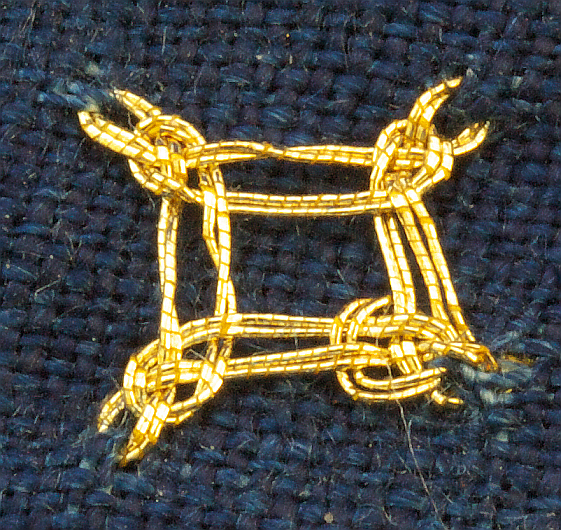
Gold thread is a pain to photograph - but it's so pretty when it works!
You can clearly see that it's not a wire, but a spun gold thread - a thin, narrow strip of gilt silver wound around a silk core. You can also see how the threads go through the fabric at the corners; start and end of the ornament are in the lower right part of the picture.

Hopefully you can also see that it is a real knot, not a braid or bobbin-lace-like crossover between a braid and a weave.

I thus have no clue on how you would be able to do this particular knot in wire, over pins, with the wire wound on bobbins, as there's not only crossovers - it is basically real knotwork that is stitched through the fabric at the corners, and the gold thread goes through loops.

I can tell you how I do it, though: I snip off a piece of gold thread in the length needed (that took about 16-17 cm), fold it in half and tie an overhand knot into the very end. (I feel very badass when I do this. Knots! In gold thread! It's the fastest way to really anchor the gold, though, and it doesn't take up a lot of material, so it's an efficient thing to do, but it still feels like a badass move.)
Then I take a (rather thick) needle and a piece of (thin) linen thread. The linen thread goes through the gold thread loop, then both ends of the linen thread are threaded through the needle's eye.

Now I have the gold thread secured to the needle, with enough slack via the linen helper thread to comfortably do the stitching. Pulling the gold thread through using the linen loop needs some care, but it works really well that way, and it's a rather quick way of making the ornament. After the last knot of the work is done, I just pull the end to the back of the fabric, pull out the linen thread, and that's it.

I don't think this approach would work with wire, though; spun gold thread is a lot more pliable than solid metal, even if it's fine solid metal that has been nicely softened.
1
SEP.
14
3

Oh the many things.

I spent a good part of the weekend working on the instructions (they're coming along) and shooting even more photos of even more steps. More and more ideas on what would be nice to add are creeping in, and it's a little sad to smash them down, but the thing has already grown a lot from my first estimate (around 30 pages) to now (probably 44-48 pages, and hopefully not more).

I couldn't resist to put this in, though:


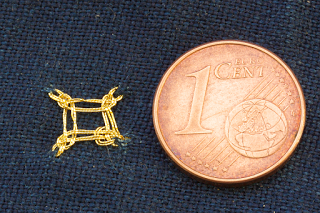
It's a tiny gold thread ornament, modeled after an archaeological find from a bishop's grave dating to the 12th century, in approximate original size. A small enough extra to squeeze in!


In other news regarding the process, cover design is on its way (I'm getting a little help from a dear friend with this), and I have feedback from several lovely proofreaders already, with more to come soon.

Final word on the pictures of original pieces is still out, though, so I'll keep my fingers crossed that I will get permission and won't have to do without the pictures showing close-ups, either because I'm denied permission or because I'd have to pay too high a fee.

And after the weekend work, I'm now a little tired and worn out, so I'm rather happy that there are some errands to run this afternoon, plus a little more embroidery to work in preparation for the last photographs, and that I might just take it a bit easy for the rest of the day.
0
SEP.
11
0

Thank Goodness It's Friday.

This was a busy week, and today was sort of weird and hectic* with a health checkup and a friend visiting and mail to get out and oh my goodness am I looking forward to some cake now, and some quiet time, and the start into the weekend. The embroidery instructions are almost done, and now it's time to get some feedback on them (shoot me an email if you'd be interested in proofreading/testreading, though I'd need to get it back soon). A few more pics need to be taken, and then there's the layouting to be done, but I will take care of all that next week.

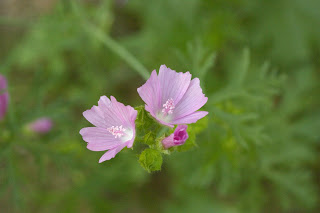
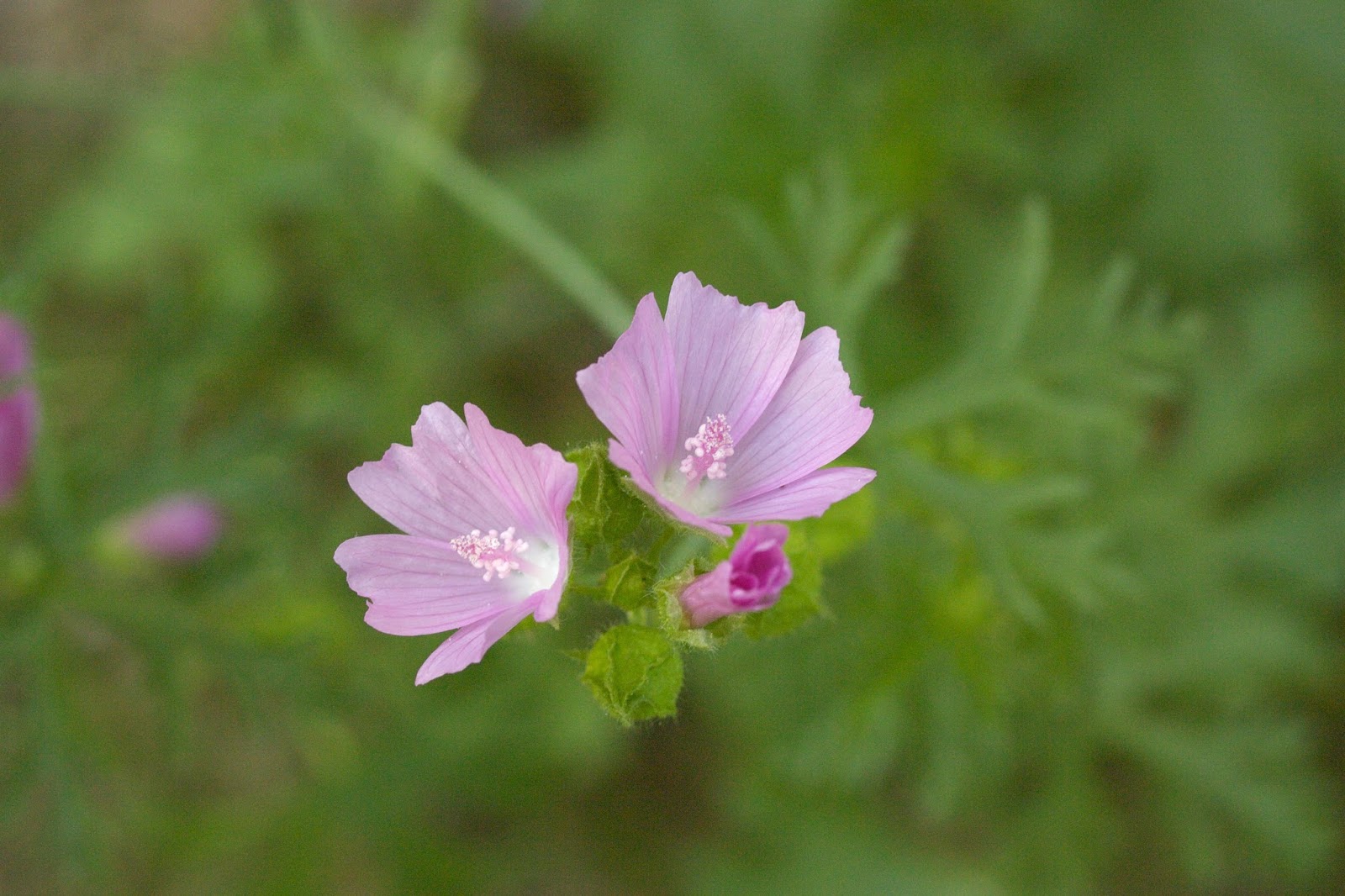
Friday Flower!
For the rest of today, my plan is to have coffee, and eat cake, and relax and do nothing. Nothing. At all. Now doesn't that sound nice?


*Weird and hectic includes this blog going up way later than planned, due to me not getting around at first and then blogger acting up. I have prevailed, though. Arrrr!

0
SEP.
10
0

Product development craziness.

It feels like Friday today, and while I'm happy that it actually isn't tomorrow yet (as that gives me a day more to do stuff), I also think that I'd totally be due a Friday today, and a nice weekend.

I've fallen into the gold embroidery instructions thingie, or to put it differently, it has eaten All. The. Time. Product development is two words that sound rather innocuous, but oh, the things that hide behind them. Things you have planned, or are working on and developing, have a tendency to... well, grow. Or suddenly present you with utterly unexpected problems, costing lots of brain power and occasionally some nights of sleep. I've hinted on it on Monday, but here's the long version:

I want the fleur de lis embroidery kit to be as accessible to beginner (gold) embroiderers as it possibly can be, and that includes good, detailed instructions with lots of photos so you will really know what to do, and how it might look. We do have a decent printer, and that's why I can print the one-page or two-page instructions for the spinning kits and for the distaffs at home, but printing multi-page things such as these instructions is an entirely different beast.

So I was planning on writing the instructions and then having them done up by a printer, in some form of a booklet (which is much nicer than individual sheets with their tendency to separate and land in entirely different parts of the room. Or world, if you're like me). So far, so good - but I don't know if the kit will fly or not, so I'd better not plan for insane numbers of it. Especially as it means investing in things that I do not usually have in stock and that are not easily, if at all, saleable on their own. So I've planned to do a single, smallish batch of kits and see how it goes. If it goes very well, I'll do another batch. If it builds a little nest on my shelves never to leave again because it's so nice and comfy where I store my non-sellable ideas... well, I'll be out some money and a lot of time, but I'll live.

Here's the thing, however. The lower your number of copies to be printed, the higher the cost per item. For the low number of embroidery kits that I will make for this first batch, and with the need to provide instructions in two languages (German and English)... well, let's say printing prices for these would be through the roof, and would definitely leave me with a number of copies in the language less sought after.

The solution? Make a single version of the booklet containing both languages. This does lower the printing costs per copy somewhat, but it's still rather expensive.

So at some point last week, towards the end of it if you want to know it all in detail, it occurred to me that I could do a general instructions booklet, suitable for sale separately from the kit, stick that into the kit and provide an additional single sheet with the kit-relevant additional information.

This, I still think, is a very nice solution to the conundrum of print prices and guessing how many copies in each language will be needed. It has a catch, though: General instructions are much more work and need much more writing than specific ones. They also need more pictures, and different ones, including those that need permission to be published.

Thanks to very nice people all around who answered questions and are looking into pictures, though, it looks like I might be able to pull this off in time. I've taken oodles of photos yesterday, stitched, read, looked up terms (textile terminology is always a pain in the neck), stitched more, translated, and done picture processing. The German text is almost done, the English version is halfway there, and I'm about halfway through the piccie issues as well.

One of the many pictures taken yesterday - supplies for gold embroidery and the embrodery kit prototype.

Now I'm hoping the remaining issues will clear up in time - and then there's only (hah!) layout and pre-print checks to be done. Wish me luck.
0
SEP.
09
1

Linkage.

Time again to clear out some of those open tabs and pelt you with links!

Here's a comic explaining how the desperate situation in Syria developed.

PhD Scholar blogs about finding answers to questions she didn't have through research - oh, how I know that effect!

Viveka Hansen writes about Nordic Iron Age clothing and dyes on her blog TEXTILIS.

If you are interested in textile conservation, check out the online workbook "Clothes tell Stories", intended to make aware of conservation issues and help with choices in museums and collections where there's no access to a professional conservator to help.

Andrea Phillips has a lovely and thoughtful post about Equal-Opportunity Objectification.

And one last women-/gender-related link: Doug posts about a conference session regarding professional women in archaeology, with links. Highly recommended!


0
SEP.
08
0

Shoes.

You know about that thing about shoes that women are supposed to have? As in buy a lot of them? Happily this is not the only thing that defines gender, or I'd be very, very male indeed. (My shoes have to fit, and they have to be practical. And preferably last a long time so I don't have to go shoe shopping again soon.)

There's one shoe-ish exception to my usual "meh" stance, though - and these are medieval shoes. For reenactment or living history, shoes are one of the tricky bits. Modern shoes don't cut the mustard at all, as they are constructed absolutely differently, and the materials aren't right either. Going barefoot is of course an alternative (though we don't know how common walking barefoot for grownups would have been, and I've also read interpretations of shoe finds that hint towards shoes having been very, very common) but not a very viable one for every modern person in every weather.

Which means shoes are one of the checklist items when trying to gauge the overall quality of a Living History performer or group.

Years ago, in the course of trying out lots of different techniques, I actually made a pair of medieval turn-shoes myself. It took a fair amount of time and I did have fun doing it. The resulting shoes were useable, but far from good quality in regards to the fit (and also in regards to the materials, which were sort-of-suitable leathers I had lying around at that time). It did make me appreciate proper shoe-making work, however, and wish for shoes that fit properly.

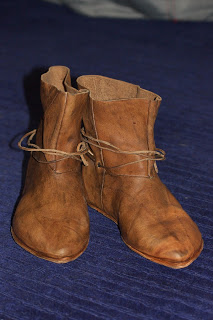
Fortunately I have a friend who makes medieval shoes for a living. I've worn a pair of nice, low-cut shoes that Stefan made for a few years now, and am still deliciously happy with how they look. However, they are not very warm, and they do not fit over warm socks, so now I have a pair to change into when it gets colder:


They fit over warm socks, and this type of shoe is one that runs for a rather long time. They also have that lovely smell of new leather shoes, and the neat stitches that I love so much in Stefan's work.

Now I'm looking forward to cooler evenings on events!
0
SEP.
07
0

Monday! Things! Hugo! Embroidery! Coffee!

This will, more (more embroidery) or less (shoes will come tomorrow - they deserve their own spot)
, be the blogpost I intended to do on Friday... so here goes:

After my long Hugo ramblings, I did some more reading, and I'm obviously notthe only one trying to see the kerfuffle as the basis for a new awareness of the Hugo, and maybe dragging it into the Century of the Fruitbat (or whatever we have, currently). Ken Marable has made a blog to collect recommendations for things you consider nomination-worthy for the Hugo, for all categories, and open for everyone - or, as the blog itself puts it, "The Non-Slate: Just Fans Talking about What They Love". Go read his post about the blog and moving forward - I think it's a wonderful idea, and I'll make sure to visit the site.

In embroidery kit news, I've hit a snag - I have planned and put together the materials for a first batch of embroidery kits, and intended to make nice, colourfully illustrated instructions to show precisely what to do and how to do it. However, the kit will come at a price, as there's a lot of work involved in preparing the materials, and there's quite a bit of material cost as well. Making an appropriately small print run for a batch of instruction booklets would sort of still be possible, but rather in-efficient, and would add unneccessary costs. So after figuring this out, I'm now planning to make a general how-to booklet with instructions that will be part of the kit or available separately, plus an extra sheet of kit-specific information.

Work in progress. I've come a lot further since, though!
Unfortunately, the kit was on a deadline before, as I want to get it ready for the Nadelkunst. With the original plan, that deadline was sort of not too bad... but with the change of plans, the writing project has now grown considerably. Which means I'm now trying to get it all put together in time. Frantic typing, emailing, picture searching and embroidering ensues. Wish me luck. (Also, I am having lots of coffee and chocolate. Always helps.)
0

By accepting you will be accessing a service provided by a third-party external to https://pallia.net/

Kontakt