Latest Comments

Guest - Max Mustermann The True Cost of Driving a Car.
06. November 2026
Great breakdown — the non-fuel costs are exactly the bit most people forget when they compare cars. ...
Guest - Harma Phew. Now it gets involved!
21. Oktober 2026
Have fun at these events.
Guest - Aislinn Dyestuff Citizen Science.
09. Oktober 2026
This is a great project. I look forward to the results. Thanks for letting us know.
Guest - Aislinn Time for...
09. Oktober 2026
Looks delicious!
Guest - Katrin Sprang Discussion
18. September 2026
Hi Rachel, I have looked for more photos of you, but that was not very successful. I found a link on...
JUNI
02
0

Back from NESAT.

Even though I had a few days off to relax and take a breather afterwards, the NESAT is still on my mind. It was a wonderful time with old colleagues and friends and the opportunity to meet new people, and I enjoyed every second of the conference.

NESAT is special, and this year it was extra-special, with the opportunity to visit the archaeological excavations in the bronze age salt mines, and a tour around Hallstatt. In case you haven't been there and have no idea about how it looks there, let me tell you: Hallstatt is spectacular, in more than one way. You have alpine scenery with those big, imposing mountains all around; the Hallstatt lake which is large and quite clear and very beautiful; and the combination between those two is really breathtaking. The weather throughout the week was wonderful, hot and sunny, and only very slightly overcast on some days, so we all got to enjoy summery weather. That included ice cream splurges and sitting outside for dinner in the evening.

The papers and posters were very interesting, and everybody kept to the time, so we all got to enjoy the breaks as scheduled (with minimal changes here and there, as is usual at a conference). It was so nice meeting and chatting with all the other textile folks - and the days went by in a blur, they passed so fast. At the end of the conference, I was quite happy that it was over, while at the same time very much regretting that it was already over. (A brain can only take so much archaeological textiles at a time... even if everything is wildly interesting.)

It's a pity that NESAT is only every three years, and then only for about four days. On the other hand, it's a big thing to organise, and handling all this every three years only is obviously much easier for the NESAT board than doing it every or every second year. I'm already looking forward to the next one in 2017, myself - it will be in the Czech republic, that time, and getting to see and to know some more of the Eastern colleagues will be a wonderful thing.

(Sorry for the very late blog post - sometimes my Firefox acts up, and it takes beyond forever to load a page... that was the case this morning, so internet work got delayed.)
0
MAI
19
0

My wait is over. Your wait begins.

There's this conference, started years ago by two textile archaeologists who felt it was a lonely occupation. It's taking place every three years, and it has grown a lot over time. Once upon a time, after it started, it was a smallish, private-ish conference where you needed to know someone to get in, and give a paper too. By now, it has become much more open (starting with the one in Copenhagen 2008, the first one that I attended), and you can just register and participate... provided you can stand the idea of having a large bunch of textile archaeologists talking textile, textile, textile, for several days in a row.

I'm talking about NESAT, of course. The wait is over, and after spending the weekend frantically getting everything that needed to be done before end of next week wrapped up, I am now on my way to Hallstatt. Where I will meet lots of lovely colleagues again, and finally get to see the glorious salt mines of Hallstatt. Where I will probably stay up way too late and chat way too much and have loads and loads of fun. Where I will have absolutely no time, and no inclination, to write a blog post for you (sorry, but that's the plain truth).

So I'm taking a blog break until June 2 (I'll be taking a few days off after the conference). Have a good time until then!
0
MAI
16
1

Friendly Friday List of Links

It's Friday, hooray! And since it's Friday, you are getting a list of links. Friendly links. That might or might not begin with an F, such as:

Fablab. I've posted about my visit to the FabLab Nuremberg, and just in case you are interested in learning more about these labs, here is the website of the international association of FabLabs, and here is a list with all of them, sorted by location. In case you are planning to make something on your first visit, I'd recommend checking out the website of your intended lab and preparing as much as possible - for instance, drawing the thing you're planning to lasercut or 3D print beforehand; these things eat more time than expected as a rule.

Finalist list for the Hugo Award, with links. I'll be going to LonCon this summer, together with Margit from Alte Künste, and that means I'll be a Hugo voter. I've linked to this list before, but in the meantime, I have actually managed to read some of the pieces, and they are delightful reading, so I link it again. Plus Finalist starts with an F.

Friends, as painted by Bob Ross. I've never watched more than a small snippet of his videos or shows, but this article about statistics in Bob Ross' work is delightfully geeky, and I enjoyed it a lot.

Fernsehen. That's German for Television, but if you need me to tell you, this link is not for you - it's a show of a series of educational television called "Experiment Mittelalter", with each episode about 15 min long. I've taken a glimpse into the first one and I'm not so sure about whether to link to this or not: It's a mix of commonplace knowledge without mentioning the many nuances, living history scenes that are not really bad but still cater to quite a few typical expectations and misconceptions (such as rough-hewn undecorated stone walls in the dining parlour and drab brown garments worn by almost everyones), but also nice glimpses at modern crafters working on replica pieces and with historical techniques. I'd recommend taking what is said with a grain of salt, maybe a bit more than a grain, and enjoy the pretty pictures - especially those of the crafters doing their thing. Having said this, go take a look and decide for yourself what you think of it, and I'd be happy to hear your opinion. It's here, and it's all German.
0
MAI
15
0

Registration for the Textile Forum is open!

The time has come - the Call for Papers and the registration form for our next Textile Forum are online. As usual, you can find them at www.textileforum.org.

This year, our conference will take place from 3-9 November, and our focus topic is "Plant Fibres: Materials, Techniques, Problems". We've touched on plant fibres now and then in the previous Forums, but there's usually much more been said and done on wool and silk, so we would like to have this as the focus topic for a change.

Just like we did last year, we're planning to make it a combination of papers and practical sessions, and we're looking forward to the suggestions and proposals coming in.

If you're interested in the Forum, or know someone who might be interested, please pass on the Call for Papers - we're happy to see it spread out!
0
MAI
14
2

A textile mill, abandoned.

This has been going through facebook, where I stumbed across it - a textile mill that closed in 1980 was abandoned with all its machinery still standing, and has recently been photographed. Go see the pictures - it's stunningly beautiful and sad at the same time.

Also: How Football sounds to people who don't care about it. (Hint: The article replaces football with archaeology.)

And that's it for today, since I am taking a day off, in preparation of work this coming weekend (I will be in Bietigheim-Bissingen on Sunday, demonstrating spinning) and the NESAT conference soon after. I want my batteries full for that!
0
MAI
13
0

Fabulous fabrication.

We have a regular (weekly, usually) session of "get excited and make things". It's a fixed day and time of the week, and most of the time, one or several friends drop by. They bring their projects and we all sit together and work on our things - knitting, sewing, woodworking, paper-related stuff. There's been miniature painting and programming done, too, as well as the very mundane task of mending socks and darning clothes.

Last week, our meeting went on an outing - into the FabLab in Nuremberg. Just in case you have never heard about a FabLab, it's short for "fabrication laboratory". Usually, a fablab is an open workshop where you can make things, for a very small fee.

Most fablabs have a set of tools for mechanical and electronic stuff, a laser cutter, and a 3D printer. You might also find a large drill, a CNC machine, a sewing and/or embroidering machine, a few computers, and some other stuff. Plus a stash of materials you can buy for your projects.

So, last week, I sat at the FabLab, designing new whorls and a new flyer and new bobbins for my little Finnish spinning wheel. I got that wheel back in 2012, and it's been running with the roughly tweaked flyer and bobbins since. They do work, but they are a waste of space in the spinning assembly, since the flyer is huge and the bobbin is tiny. (The wheel seems to be called the Varpapuu Toika, and someone else was so nice as to post a video of it.)


As you can see, the flyer is... less than elegant. A waste of space, and energy, and I am going to replace it with a lighter one, with longer wings to accommodate a bigger bobbin. I'll space the hooks closer to each other too, and fit it with smaller whorls. Someone at the FabLab has offered me help with the metal axle, and the rest... I'll laser cut wooden parts for the bobbin ends and the flyer, probably drill holes through some leftover dowels for the bobbin cores, and the whorl bits will be 3D-printed. (3D-printing takes ages, AGES, so as I'm an impatient person and want several bobbins, I will just print the whorl disks.)

If you have a FabLab in your region - go check it out. They are fabulous!


0
MAI
12
3

The thing with looms.

There's two things I like to moan and groan about when chatting fabrics - number one: you just can't get the yarns anymore (or the guys to weave these yarns), and number two: there's a lot of modern fabrics that have no proper selvedges anymore.

And that's to do with the looms. Thing is - if you want to sell cheap fabrics, you need to have a loom that is fast, and work with materials that don't have a life of their own. Which means limp yarns, not spun as tightly old-fashioned hand-spun ones, in
a loom that is really, really fast... and these things will not give you proper selvedges.

Back when weaving was done with a shuttle, and where it is still done in this manner, you pass the shuttle through the shed, change sheds and pass the shuttle back. The thread, thus, makes a U-turn around the outermost thread(s) of your fabric. Adding in an extra thread or two to strengthen the selvedge was a well-known and quite commonly used thing, and having good selvedges that run straight and are even are a sign of good quality weaving.

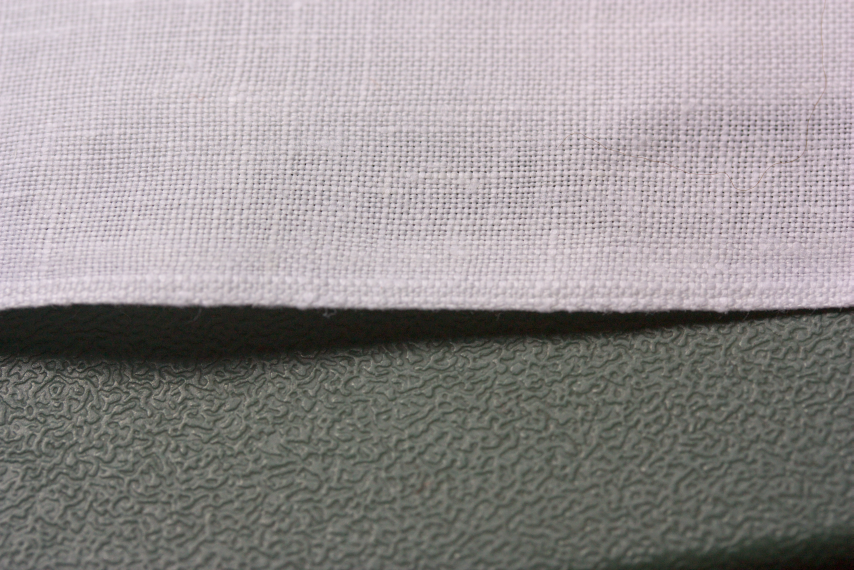
If you want a fabric that meets all the criteria of a historical fabric, you have to have a good old-fashioned selvedge like that. Which also explains why I'm always happy to get something like this:


That is a proper, nice selvedge; a little bit stronger than the rest of the fabric but not too different in weave or density, and there's no plastic strengthening thread added to it. You can join two of these selvedges with overcast stitch just like it was done back in the Middle Ages and be happy.

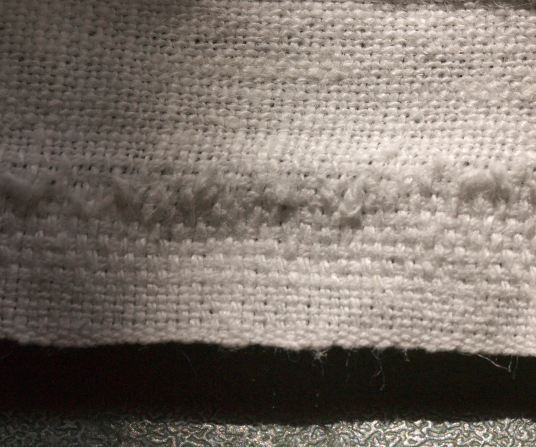
The next best thing, and a type of selvedge more commonly found in modern fabrics, is looking like this:


It's still a proper selvedge, though not as nice and sturdy, and quite wide if you don't want to have the change in weave type show on the surface. There's also often a messy-looking area between the weave proper and the selvedge, also nicely showing in this specimen here. I wouldn't join two of these with overcast stitch if the join will be visible later.

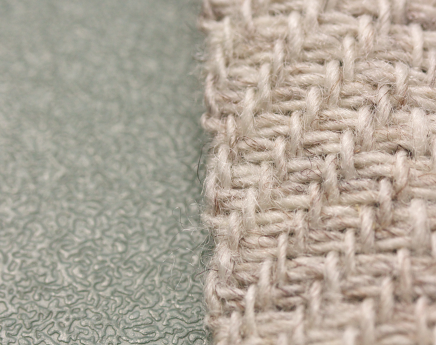
Now let's go a bit more modern, yes? Proper selvedges require shuttle looms. These old-fashioned shuttle looms are slow, and modern industry likes its stuff to be faster - time is money and so on. So there's another type of fabric edge which really can't be termed "selvedge" any more... this one.
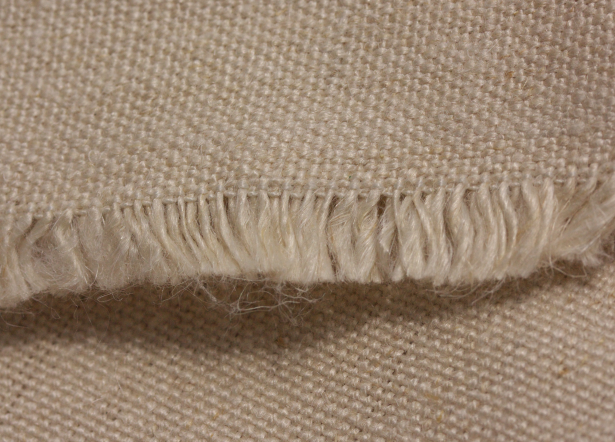

These are done with help of jets or projectiles, requiring cut threads as the weft. These weft threads, if fine enough, can be even carried by an air jet or a water jet. The result? A very, very fast loom (these are the fastest type today) but no selvedge whatsoever. The edges are, basically, cut edges with a little fringe and maybe some stabiliser thread along the edge. If you wanted to use the selvedge for extra strength somewhere... you're out of luck with this fabric type. If you wanted it to show somewhere... same thing applies. If you were planning to cut down on your sewing and hemming time with use of the selvedge, you just got a nasty surprise. You will have to treat every edge of this fabric like a cut edge, because that is what it is.

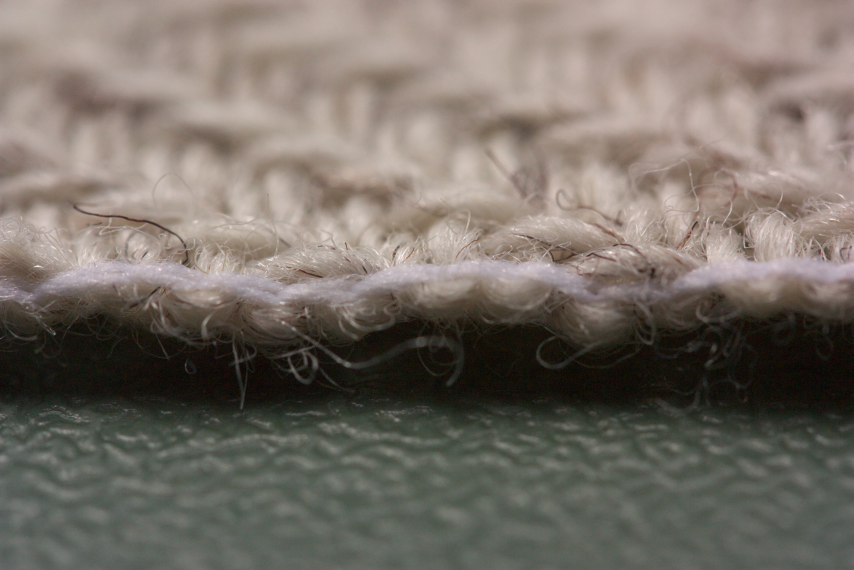
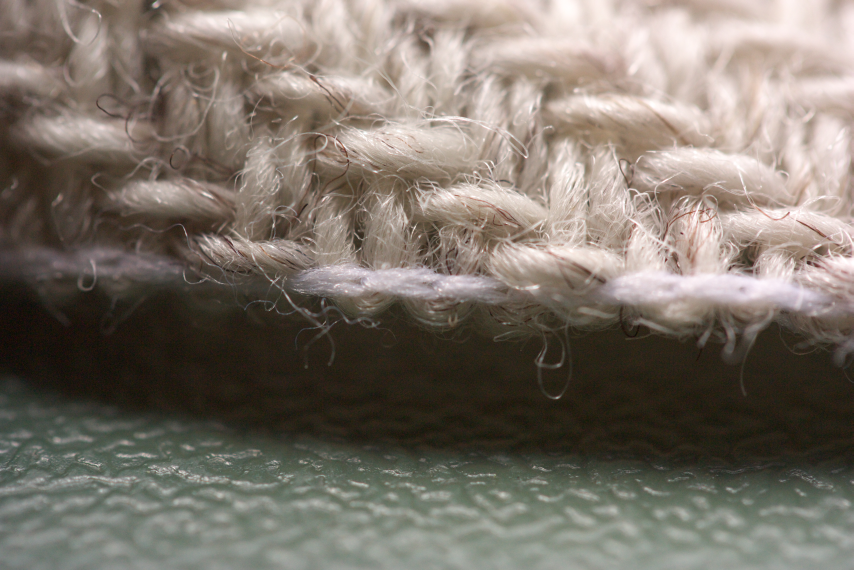
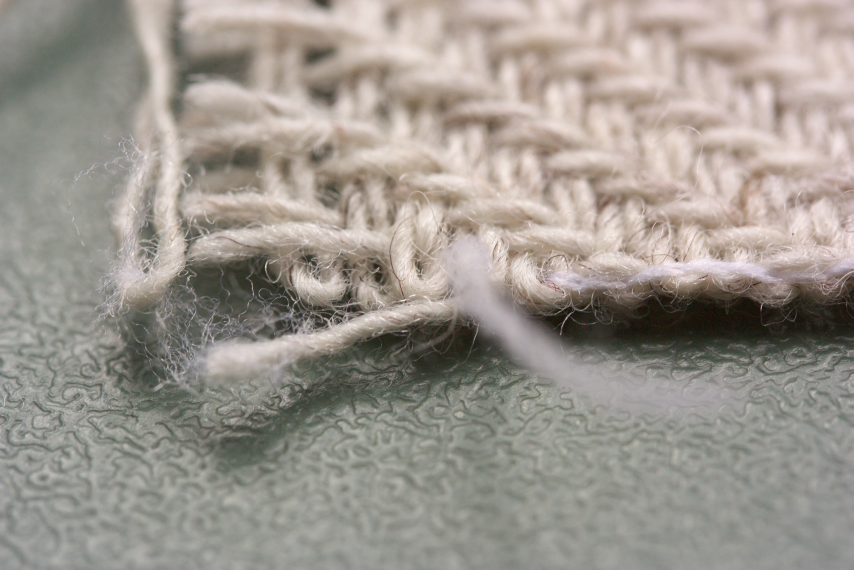
And then there's another little nasty surprise if you are looking for pure wool fabric in narrow widths. One of the two edges is a perfectly fine, normal selvedge, usually not reinforced by a double thread or anything.


The other edge, however... is not a proper selvedge. In fact, it's more like one of the cut-thread edges, only with a fold in the thread instead of the cut. The edge is held together by a fine, tiny crochet chain, usually done with a very fine thread made from man-made fibre.


It's not very obvious, and won't be visible or noticeable to most people, but it's not acceptable in case you want to have an as-authentic-as-possible equipment. If you remove the chain, you also remove the structural integrity of that edge.


If you want to have a pure wool band without that chain, though, you can take a sufficient length of the weft thread, a needle with a blunt tip and a large enough eye, remove the crochet chain and thread the extra thread through each of the edge loops. It might be advisable to remove the outermost warp thread for that, and to stock up on enough chocolate and motivation-enhancing drinks before.

Fun. Right? Thank goodness there are still some old-fashioned shuttle looms running!
0

By accepting you will be accessing a service provided by a third-party external to https://pallia.net/

Kontakt