Latest Comments

Guest - Max Mustermann The True Cost of Driving a Car.
06. November 2026
Great breakdown — the non-fuel costs are exactly the bit most people forget when they compare cars. ...
Guest - Harma Phew. Now it gets involved!
21. Oktober 2026
Have fun at these events.
Guest - Aislinn Dyestuff Citizen Science.
09. Oktober 2026
This is a great project. I look forward to the results. Thanks for letting us know.
Guest - Aislinn Time for...
09. Oktober 2026
Looks delicious!
Guest - Katrin Sprang Discussion
18. September 2026
Hi Rachel, I have looked for more photos of you, but that was not very successful. I found a link on...
JAN.
15
9

How I dress my distaff.

The following is a photo report (wow, this word makes me think of my youth and those crappy romance photo stories in teen mags) of how I dress my distaff. Please be aware that this is a work in progress and a technique still in development, and that there are probably fifteen gazillion other methods that are at least as suitable as mine, if not better.

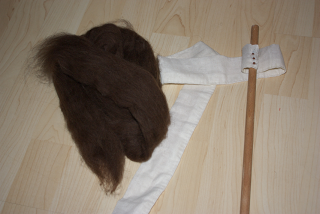
I start off with my distaff, which is a stick with a few notches cut in at the top to reduce slippage. The notches are a horizontal cut at the bottom, then a sloping cut downwards to meet the notch, resulting in something like a tiny shelf. Attached to the stick is a linen band about 1.5 m long (I used small copper nails to attach it). The band helps to secure the fibre evenly and give the necessary little friction.
I start by placing the distaff somewhere suitably flat; a table or the floor will do. I've chosen mixed brown wool for this, about 42 g of it.

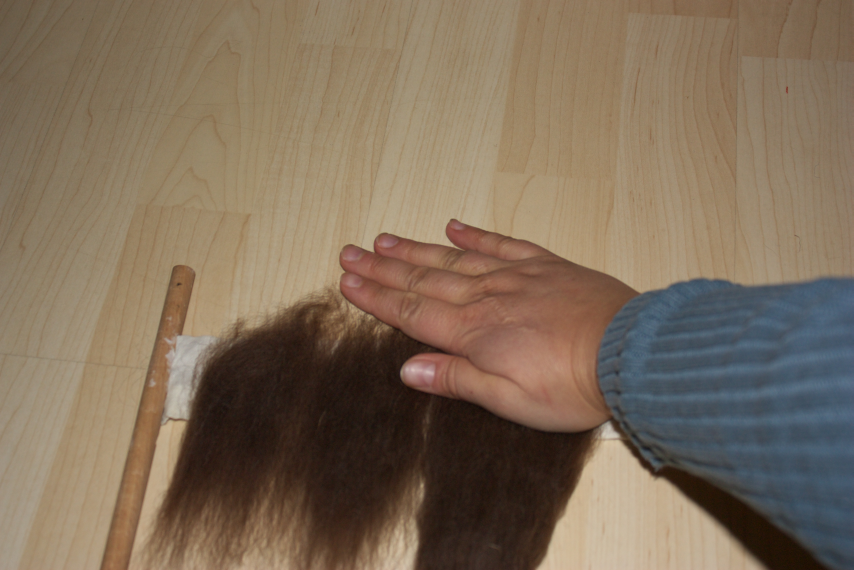
In my experience, you can use the fibre that sticks out from the bottom of each band and the fibre still touching the band, but usually not the fibre sticking out above the top. So I position my wool accordingly: I place the end of my top at the upper edge of the band, put my hand down on the band and pull the top away, leaving a bit of fibre on the band.
I work myself along the band in this way with a first layer of fibre.
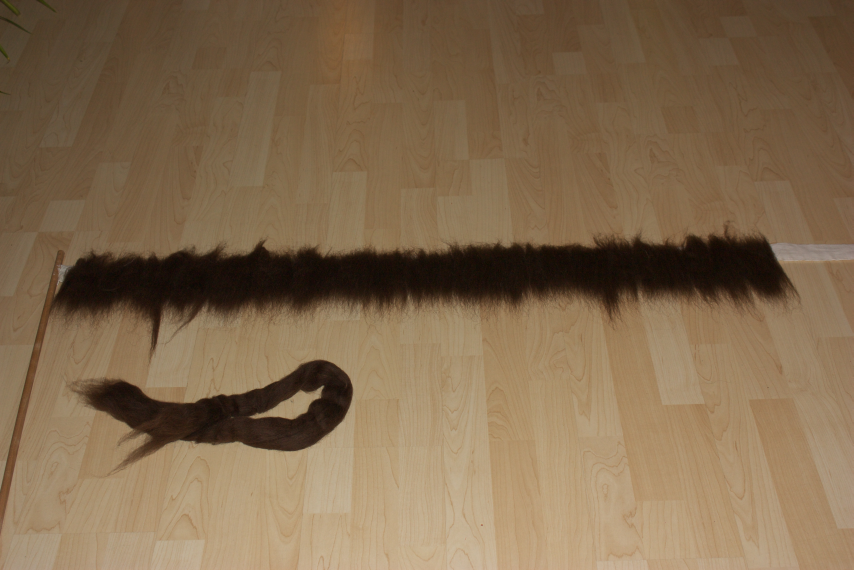
I then go back and forth, evenly layering the fibre into the thinner spots, not going too thick with the layers. (I have not gathered enough experience yet to know how much you can load on without it getting awkward.)
I leave the last hand width worth of the band without fibre
and then I start rolling up the distaff.
Rolling is done with only the gentlest pressure, and without tensioning the band (at most, I put on enough tension to just keep it properly straight). You can roll up with tension, but that may prevent you from drafting out easily - I've had more success with going easy on the distaff when rolling it.
Roll until you can roll no more, resulting in something like Cousin Itt with a nice headband, and secure the end of the band (I used a modern pin for it here).
That's it. You can go spin now. The band may shift with spinning, developing into a spiral that sort of droops down the distaff. Thus, after a while of spinning, it might be necessary to adjust the distaff - I do that by gently unrolling and re-rolling the band.

If you try this method or a similar one, I'd be delighted to hear about your experience!
0
JAN.
14
0

Who needs bridges, anyway?

I have managed to empty out my distaff yesterday, so I was actually planning to go and take photographs of the dressing this morning. Then, however, I read some blogs. And was stunned.

Imagine you have a bridge that was built in the 13th century. There were repairs, sure, and major restauration after the war, and one of the three arches was then re-built with a larger opening for better passing of ships. Still... it's a piece of history.

There's such a bridge in Tournai, and it's in danger of being torn down to make way for a new bridge with even larger openings, in preparation of a channel whose realisation is not even a sure thing yet.

Luckily, we live in the Age of the Internet, and there's a petition against the demolition. (For those of you not reading French, "je signe" means "I sign", so that's the button you want.) The person who started the petition has also written up some info about the bridge and the project, and that's in English.

The usual remains to say - please sign, share, and nag your friends with it...
0
JAN.
13
4

Spinning like "back then".

A good week ago, I received a nice email from somewhere in the US, asking me this:

I do living history demonstrations, and since I am learning to spin, I will be adding spinning to what I demo. I've seen the pictures of the long double tapered spindles with distaff, it looks like there was either no spindle whorl, or it was a bottom whorl.

 My problem is trying to learn how they actually spun the wool on the spindles.  Do you know where I can get enough information on how the spinning was done so I can demonstrate it correctly?


First of all, I am thrilled that demonstrators pause and think about what tools were used, and how exactly they were used. Thrilled! Because (as I have learned, and to my great chagrin much too recently) that modern-style spinning, even with a distaff, is a long way removed from how medieval spinning pictures look.

So how do you spin medieval-style? First of all, the caveat: This is the attempt to reconstruct a spinning style from, basically, pictures and a few surviving tools. Spinning is, at its core, a very basic thing (adding twist to fibres) and this thing can be achieved with a myriad of tools, and a myriad of techniques; there is no guarantee that everybody in the MA spun alike, and there's no guarantee that we as modern people trying to reconstruct it actually hit the correct version(s). Even if it works really, really well, it's no proof. (It is a strong indication that it may be right or close, though.) If I'm talking about "medieval spinning" in the following text, it may refer to pictures and other sources or the reconstructed technique, so please read accordingly.

Typical modern spinning is drop-spindle spinning, where the spindle travels down, hanging freely from the hands and wandering towards the floor; the hands stay close to the fibre supply. Drafting takes place between the two hands. The spindle is flicked periodically with one hand (which leaves its normal drafting place for this).

In contrast to that, medieval spinning always keeps one hand close to the spindle tip and one hand close to the fibre supply. Drafting takes place between the top hand (drafting hand) and the distaff, which is indispensable for this kind of spinning; the other hand keeps the spindle in motion.
The spindle can either be kept in the hand and turned between the fingers or suspended right below the twisting hand from the thread already spun. In both cases, there is an almost continual twisting action done with the twisting hand.

And because you will probably be all confused now, here's a video of me spinning in that technique.


I am indebted to Cathelina from the 15thcenturyspinning blog, who has done a lot of research on the reconstructed technique. She also has some videos on her blog, most of them showing the in-hand spinning, not the close-to-the-hand-suspending that I prefer. Especially this slo-mo one is worth watching.
If you want an overview on spinning pictures, I can also recommend her pinterest board.

With this technique for spinning, you can use a spindle with a whorl (giving a little more heft to the spindle and making for a better twist when spun suspended) or without a whorl (in my experience, nice to do when the spindle is already quite full, or when you are spinning long fibres such as linen). You do definitely need a distaff, either a free-standing one or one that you tuck into your belt, or place beside you.

You try to draft an equal amount of fibres from the distaff, letting the twist enter these fibres as fast as needed (the twist travels upwards from the spindle). As every style of spinning, it takes practice - but it's a lovely and quite fast style in my experience. The well-dressed distaff with well-prepared fibres is crucial for this. I'll try to do a blog post on how I dress my distaff one of the next days, since it's different from Cathelyne's version.

For now, though, I hope this helps to shed some light on medieval spinning!

1
JAN.
10
0

Random thoughts.

I've barely started on the current big project, and first complications have already arisen, hooray - there is an issue with the fabrics I had planned to order. If I am lucky, I can get very similar replacements for them. If not... well. We shall see. At least it starts out quite, quite interesting.

There are bits and pieces I can get started on, though, and I am firmly planning to do so today, with just one single other point on my agenda.

(Sorry for the vagueness - if things work out, I'm planning to de-vague it soon, and you will be along for the ride.)

So while I'm feeling a little torn about how things will work, here are some scattered random links for you.

The Yarn Harlot writes about a baby sweater, and how only love could buy it. Yes. This. (Fits right in with the Fair Prices stuff that I blatantly plugged again yesterday.)

If you read German, Archaeologik posts about an excavation of a modern ceramic firing pit (pit was courtesy of a school project). If you don't read German, there's piccies.

Random fact of the day: I'm still doing yoga. My standard go-to site is doyogawithme.com, which I still highly recommend. There are pay-for sites that are by far not as nice as that one. And online yoga is a business with quite a bit of money to be made, as noticed by a company called YogaGlo... who have, apparently, patented a certain layout of the room for video classes.
This has led to hubbub and kerfluffle with the other yoga class sites, among them Yoga International. How is that interesting for you, you ask? Go read their open letter - and then you might want to enjoy their offer of all their classes for free (offer stands with undisclosed end time, but probably not forever).
0
JAN.
09
1

Blogging Archaeology Carnival January

Dear Doug, thank you so much for your January question. This was a welcome excuse to go waste a lot of time finally catch up on my blog statistics again. Though I confess that I am a slight bit confused by them...

To keep those of you not checking into Doug's summary up to date, January’s questions are:
What are your best (or if you want your worst) post(s) and why? Compare and contrast your different bests/worsts.
I leave it up to you to define what best is. We bloggers have all sorts of different stats available to us.
(Doug then gives a list of suggestions on what could be defining best and worst.)

So naturally, the first thing I did was look at stats. As all bloggers, I have the blogger stats available to me, plus I have an extra statcounter installed. Both are somewhat... lacking, to my taste, in giving a good and complete overview - the blogger one tells me that some of my early posts (from back in 2010 and 2009) have never received a single visit, which I find hard to believe. This one here, for example - which is admittedly not one of my most brilliant posts ever. However, at least the most patient husband of them all usually reads my blog every day, so it should have at least one view, right?

According to blogger stats, most of my relatively current posts get hits somewhere between the high twenties and low sixties, with outliers (often linky posts that get handed on by others) that are solidly in the one- to twohundred hit range. This is probably not counting any rss feeds, though I am not sure how many of you get this via feed.

The most viewed post of all time (9485 views) is actually a link post - this one here, linking on to instructions for unwinding a small skein of yarn. Follow-up with 6586 hits is my own post about how to untangle a skein of yarn, which has been popping up as the most viewed one consistently since I wrote it back in November 2009. I still like it, too - it's long and tries to be a little humorous as well. So that's probably what I would consider one of my best posts, in terms of effort spent to views gained, and possibly also helpfulness (at least I hope so).

Much lower in the hitcount lists are other posts that were a more than average effort to write, like the Skjoldehamn neck flap one (2775 hits). Pictures from this, however, have been turning up across the 'net (and not always with acknowledgement).
On a more positive note for me, posts about the Textile Forum (and there's many of them) are consistently getting higher hit counts than my normal posts, too - and since that conference project is one very close to my heart, this makes me very happy. They are not always what I'd consider a splendid piece of writing, though.

And some of my favourite posts in the blog are the ones about fair prices for crafts - all tagged under "fair prices for crafts campaign". They did get a good share of love (and hits), ranging somewhere between almost 500 and 1340 hits for the posts in the main series (the one also linked to on the sidebar).

That's about what I would consider the best posts of my blog. I won't go into the worst ones, though - with trying hard to post weekdaily all year around, there are bound to be plenty of non-brilliant posts just telling you that I ran out of ideas, or giving a random link and two lines of uninspired writing. I am sorry for those, and I feel a little bad about it every time I post such a one, but really - it can't be helped, and putting on pressure to be totes brill all the time... just won't work.

If you will tell me about your favourite post (or your least favourite one!) on this blog in the comments, though, I'd greatly appreciate that!
0
JAN.
08
0

Catching up.

I am settling back into a normal work rythm after the winter break, though with more incentive to settle in quickly and efficiently this time - I have a deliciously large project on my desk.

In addition and as usual, this time of year is also interesting in regards to finishing stuff (such as the bookkeeping and tax stuff) and preparing stuff (such as fixing event dates for the coming months, and preparing for the big taxes thingie).

Finally, there's catching up to do - some catching up on the news, some on emails, and some on - you guessed it - interesting (or possibly interesting) links. So here you go:

Doug has summed up the archaeology blog carnival responses for December. It's a long post, and I was thrilled to be in there almost at the top. (I read all the way through it, though - it is worth it.) I'll post my reply to the January question one of the next days - once I have managed to look at my blog stats a bit...

If you are in the US and thinking of getting started in a conservation career, here's a grant to help.

There's a new book out, called "Clothing the Clergy" - it does sound interesting, but I have not been able to check it out yet.

If you are a language freak or just plain interested in the relation between languages, here is the graphic for you - and the blog posting that might then also be worth a closer look.

In case you are more interested in typology, you can play the kerning game here.

And as a final link for today, even though we're far away from Easter still, here's a post about the bioarchaeology of crucifiction.
0
JAN.
07
0

A Happy New Year to all of you!

I hope you had a good start into 2014, with friends, family or loved ones.

A lot of people I know have had to struggle in 2013 - things going wrong, and especially health troubles seem to have been around more than usual. I've heard similar things from all around, from people I don't know too well, so much that it seems to become one of the themes of 2013. So here's my wish for you for 2014:

I wish for you to receive lots of good news this year and little of bad news, and find more friends than you will lose. I wish that you will have joy, and peace, and a bit of spice in your life.

I hope that you will be healthy and that you appreciate your health if you are; and that your loved ones are healthy too, and able to share their life and their joy with you a while longer. I wish that whenever things look bleak and bad, you will still be able to think of something positive, and look forward to better times, and never lose your hope. I hope that you will find the time, or take the time, to do things that make you happy, and to spend time with people that make you happy.

May 2014 bring us all joy, wealth, and happiness.
0

By accepting you will be accessing a service provided by a third-party external to https://pallia.net/

Kontakt