Latest Comments

Guest - Max Mustermann The True Cost of Driving a Car.
06. November 2026
Great breakdown — the non-fuel costs are exactly the bit most people forget when they compare cars. ...
Guest - Harma Phew. Now it gets involved!
21. Oktober 2026
Have fun at these events.
Guest - Aislinn Dyestuff Citizen Science.
09. Oktober 2026
This is a great project. I look forward to the results. Thanks for letting us know.
Guest - Aislinn Time for...
09. Oktober 2026
Looks delicious!
Guest - Katrin Sprang Discussion
18. September 2026
Hi Rachel, I have looked for more photos of you, but that was not very successful. I found a link on...
JULI
11
0

Miscellaneous Stuff.

First of all, one of those links I mentioned a good while ago: the Cambridge Digital Library. There's actually two sites, and older and a new one, listing some books that are digitised either partly or (in case of the newer site) cover-to-cover. The link goes to the old one (which has a link to the new one right on top).

Unfortunately, my standard tests of searchability (using the terms "spinning wheel", "spinning" and "spindle", sometimes also "wool" and "distaff") did not yield any results, and it does not seem as if there are keywords matched to the pages or illuminations. Still, it's old books with pics, online for free.

More old books, online for free (provided they are already public domain) can be found in the HathiTrust Library. There is the possibility to create a login and put together a collection of items, or browse others' collections. That includes 18th century cookbooks, for those of you who favour an old-fashioned roast.

And speaking of books... have you ever wondered why some folks offer out-of-print (or even still in print) books on amazon for really, really ridiculously high prices? It seems that pricing algorithms are to blame. Those companies don't even set the prices themselves, they are having a programme do that, which can lead to interesting results - as described here.

That was not so miscellaneous, right? I can change that.

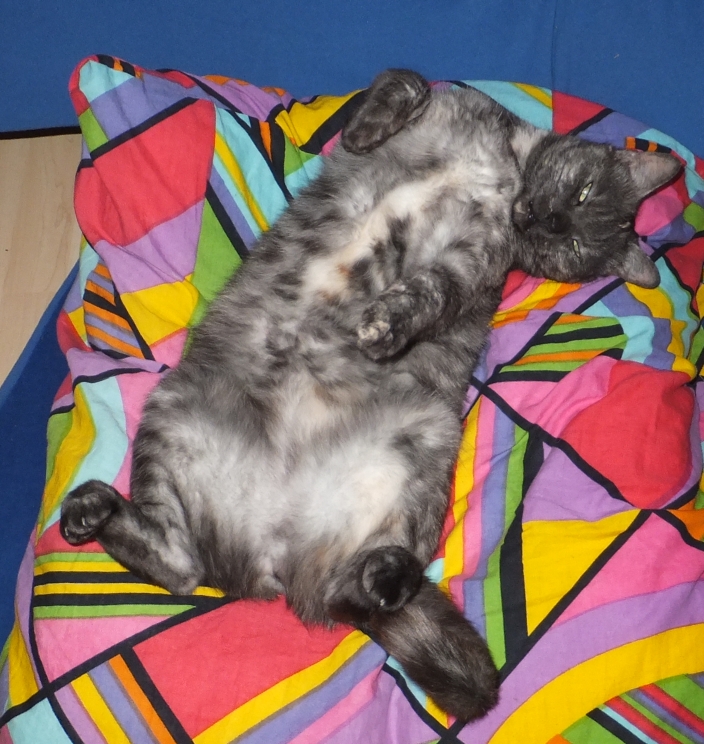
Here. Gratuitous cat pic.

0
JULI
10
1

Spinning Output, part 3

I have done half an hour spinning with each of my treadled spinning wheels now. One of them is single-drive, quite small, lends itself well to fast treadling, and has a ratio of approximately 5.4 : 1 for spinning. That's the old wheel that I learned how to spin on, and I managed 41.5 m in the 30 minutes.

The other wheel is a double-drive second-hand spinning wheel manufactured in Finland sometimes in the seventies (last century, of course) and originally has a ratio of wheel to whorl of about 10 : 1. I have, however, tuned it to a ratio of about 18 : 1 for spinning high-speed, high-twist fine yarns and managed to churn out 73.5 m in the half hour on the tuned wheel. That was quite demanding (partly because it's not perfectly aligned and tuned yet, but mostly because that means really fast drafting).


So my order of output is:
hand-spindle (as would have been expected) - 47 m/h
single-drive treadled wheel ratio 5.4:1 - 83 m/h
Great Wheel replica (yes, it was a production tool) - 129 m/h
double-drive treadled wheel tuned for the occasion, ratio 18:1 - 146 m/h

Now... for the fine print. The tools I know best and have worked with the most are my hand-spindle and the small single-drive wheel. Both are tools that I could use in my sleep, or at least a very sleepy state, and that I can wield with great precision.
Both the Great Wheel and the double-drive treadled one are rather new, have not been used much for spinning yet by myself, and I am convinced that at least the Great Wheel has quite a lot of potential in regards to speed.

I have not decided on how I will do a quality assessment on the four bits, but I will probably ply them and then use the last metre or so of the middle, un-plied, to wrap it onto a survey card for comparison. Another thing I have not decided on is where to ply, possibly I will take my small wheel for all four samples to have good control and a little more speed than on the hand-spindle. It remains... not a mystery, but quite exciting!
0
JULI
09
0

Pesky prickings.

Today's work day will be a tad shorter than usual, since I have to go to the doctor's to refresh vaccinations - TBE (FSME, for the German readers) and tetanus are more than due, though thankfully not that overdue that I would need a new basis vaccination.

We're living in an area with infection risk for TBE, which is basically all of Southern Germany, and I like being outside, so that as well as tetanus is a smart thing to have. Both are infections that are not easy to treat once you have them, but with a very good protection by the vaccination... so off I will go to get myself protected.

And tomorrow... I will tell you about the outcome of my spinning tests, which are now more or less finished!
0
JULI
06
0

Hortulus Journal Call for Papers

Well, I'm too old for this - but maybe it's interesting stuff for some of you?

Hortulus: The Online Graduate Journal of Medieval Studies
Volume 8, number 1 (2012)

Call for Papers: General Issue
SUBMISSION DEADLINE for Vol. 8, no. 1: 15 August 2012

Hortulus: The Online Graduate Journal of Medieval Studies is a refereed, peer-reviewed, and born-digital journal devoted to the culture, literature, history, and society of the medieval past. Published semiannually, the journal collects exceptional examples of work by graduate students on any theme, discipline, subject, and period of medieval studies. We also welcome book reviews of monographs published or re-released in the past five years that are of interest to medievalists.

Our upcoming issue will be published in the autumn of 2012, and we are now accepting submissions on any topic of medieval studies. Possible topics may be drawn from any discipline: history, art history, archaeology, literature, linguistics, music, theology, etc. Work from every interpretive angle is encouraged – memory, gender, historiography, medievalism, consilience, etc. Most importantly, we seek engaging, original work that contributes to our collective understanding of the medieval era.

Contributions should be in English and roughly 6,000 - 12,000 words, including all documentation and citational apparatus; book reviews are typically between 500-1,000 words but cannot exceed 2,000. All notes must be endnotes, and a bibliography must be included; submission guidelines can be found on our website: www.hortulus-journal.com. Contributions may be submitted to Diese E-Mail-Adresse ist vor Spambots geschützt! Zur Anzeige muss JavaScript eingeschaltet sein. and are due August 15, 2012. Queries about submissions or the journal more generally can also be sent to this address.
0
JULI
05
1

Spinning Output, part 2

Yesterday afternoon, I got to have half an hour of quality time with my favourite hand-spindle - one of my spindle sticks and a whorl that I bought somewhere, ages ago, and that remains my firm favourite for about any hand-spindle spinning tasks I get.

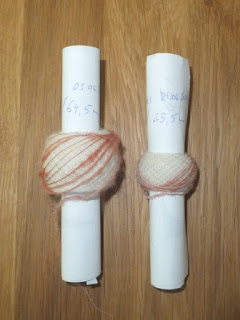
The results? Half an hour of concentrated spinning with spindle (and distaff, naturally, need I even mention that?) yielded 23.5 metres of worsted yarn.

Here's the two little balls of yarn side by side:


Next up: doing the same with my treadled spinning wheels...
0
JULI
04
0

Spinning Output, part 1

I did the first of the spinning output tests yesterday, using the Great Wheel. I had settled on trying for half an hour spinning for each test, and that was quite enough for untrained me on the Great Wheel.

To have the material as alike as possible I will be using industrially prepared Merino top for all the tests (at least four of them, one with each spinning implement). That is, naturally, nothing really spinn-able for the Great One, so I transformed a portion of it into rolags for long-draw first, using my hand-cards.

And the result of half an hour spinning were 64.5 m of yarn (which would add up to 129 m per hour). I aimed for rather thin yarn (to match what I will be doing with the other tools) and for rather high twist (since that is historically more correct than low twist), and once the spinning tests are all done, I plan on plying each sample to have them in a more stable condition - I want to take them with me for demonstrations.

So. When you are reading this, please keep in mind that they are all very, very squishy figures - it's just one spinner, my tools and their quality are unknown to you as is my proficiency with each tool, and you only have my word that the wheel is functioning quite well and that I have not had much practice at all yet with the Great Wheel. (All of which, by the way, are reasons this post is not labeled Experimental Archaeology!)
0
JULI
03
0

Links!

First of all a link to an archaeological find (h/t to Cathy, who blogged this first ): Unique find at Viking Burial Place (with textiles).

Then there's an ebook library with lots of free ebooks, including some about archaeology. As with one of the library links I posted before, there's unfortunately no proper "about" info - the site footer is written in something that looks like kyrillic script to me. Use with your own conscience and smarts intact, and please consider buying a version of a book through your book dealer of preference in case you really like one of the books.

And finally, a link to one of the databases that I wrote about a few days ago: the Contini-Volterra Photographic Archive, with images from the 12th to 20th century. They have a searchable database with descriptions, though "spindle" and "spinning" are not in there, and all pics I have seen in my glance at it were black and white. Still, lots of pictures and searchable by, for example, saints' names.
0

By accepting you will be accessing a service provided by a third-party external to https://pallia.net/

Kontakt