Latest Comments

Guest - Max Mustermann The True Cost of Driving a Car.
06. November 2026
Great breakdown — the non-fuel costs are exactly the bit most people forget when they compare cars. ...
Guest - Harma Phew. Now it gets involved!
21. Oktober 2026
Have fun at these events.
Guest - Aislinn Dyestuff Citizen Science.
09. Oktober 2026
This is a great project. I look forward to the results. Thanks for letting us know.
Guest - Aislinn Time for...
09. Oktober 2026
Looks delicious!
Guest - Katrin Sprang Discussion
18. September 2026
Hi Rachel, I have looked for more photos of you, but that was not very successful. I found a link on...
SEP.
09
0

1 sqm flax...

"1 qm Lein" is the German and Austrian version of a Swedish project to keep knowledge about growing and processing flax alive - and to build a community around this at the same time. 

The project "1 qm Lein" provides you with flax seed for one square metre, plus instructions on how to grow and later harvest the plants. And then the plan is for participants to meet up and process their harvest together - with the result being a hand-woven band or something else. (1 square metre will not be enough for a shirt, even though "shirt" is mentioned in the teaser texts. That's explained in the FAQ section. A shirt would take about 10-15 sqm, approximately.)

If that sounds like a project for you, you can find out more via the website https://1qmlein.de/ and also  join in there, either as a single grower, or as a regional partner. There's also a map there, with quite a few museums, gardens and other groups. The project is open to register as participant until November 3 - after that, the packages will be packed and sent out.

0
SEP.
06
0

More Stitching, More Planning.

Today was more or less split up between stitching loops to the dyed fabric swatches and doing some maintenance, tidying up, labeling of photos and planning for the next events - a sewing workshop for a group centering around the time of 1000, for instance, and of course the European Textile Forum (aka my Week of Madness). 

All that fortified by some lovely tea. And though it's been fun to work on all of these things, I'm quite happy that the weekend is now very near, and looking forward to it! Though I might even try to finish stitching the loops today. I can tell you, those colours are lovely, and it's really nice to see how similar colours from different plants can come out and how different from the same plant. Also always high on my list: the direct comparison between posh black and cheap black. You can really feel the difference in the fabric, not just see it, as the iron does diminish the shine of the wool and makes it feel... "stumpf" you'd say in German, which would be blunt if talking about a knife, but "dull" would probably match the meaning range best here. Not as nice as the wool dyed with more fibre-friendly stuff, in any case!

I'm already looking forward so much to hanging this in the exhibition. A wall full of brightly coloured wool swatches, it will look so impressive!

0
SEP.
05
0

Rainbow prep.

I have another lovely job in relation to the upcoming exhibition in Bamberg: Prepping the Rainbow. 

I have a stack of beautifully dyed fabric swatches here, and since they are to be attached to rods in the exhibition, I will get to snuggle a little bit with each of them while attaching loops for hanging them.

Rainbow, here I come! 

0
SEP.
04
0

Really Weird Fish.

 Once in a while, the Most Patient Husband Of Them All stumbles across something amusing, and then he shares it with me (so we can both be amused). Like the fact that there's a fish that has three fins on which it can stand on the (deep sea) ocean floor: The Tripod Fish. You can also read more about it (and see a nice picture) on the Australian Geographic website.


0
SEP.
03
0

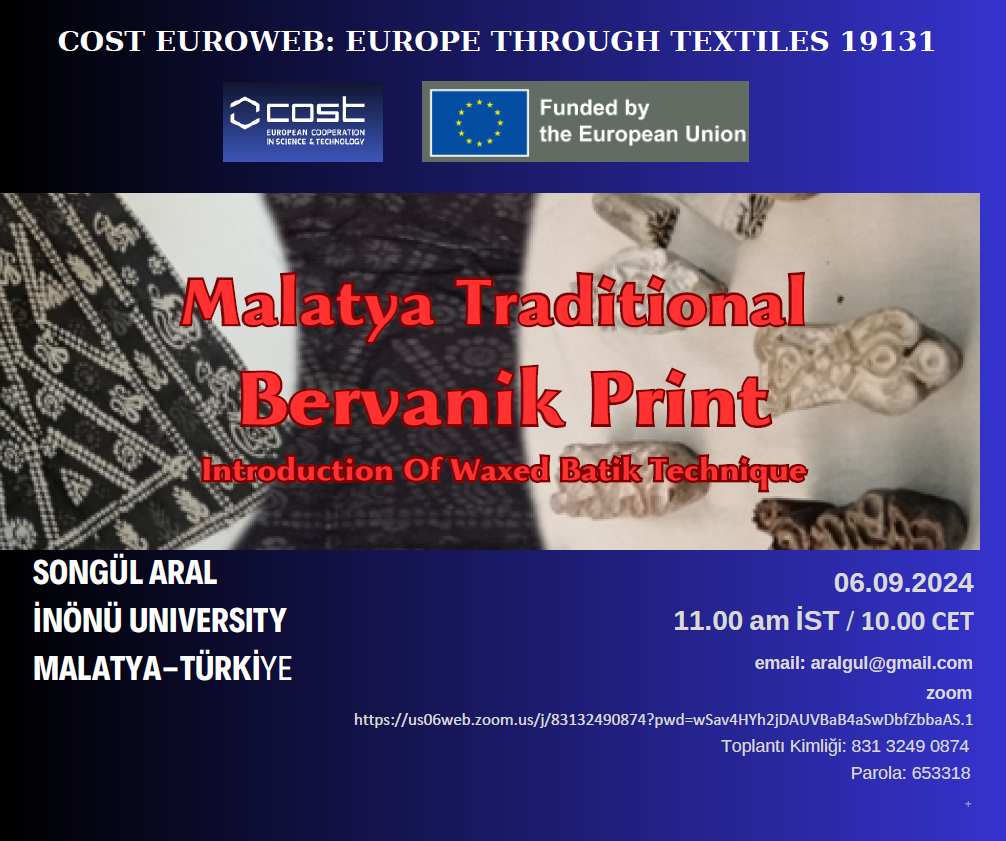
Webinar Traditional Bervanik Print

EuroWeb has something more coming up: A webinar on traditional wax batik printing! It will take place on September 6, 10 am CET start.  

I'm already looking forward to this - it's always interesting to see traditional textile techniques!

0
SEP.
02
0

Back home...

The Great Wheel had its little outing, I once again got to appreciate how much more evenly I can spin with the spindle and distaff as compared to the wheel, and on the other hand how much faster the wheel is. 

As usual on an event like this, I got to take one quick break (when the guys from the next tent over were doing their fighting show) to dash out of my spot, re-fill my water bottle, get a coffee and a bite to eat, and go back. It was also very sunny on Sunday, so even though the tent provided shade, it got quite hot. Enter the Glorious Medieval Cooling System: The linen underdress and linen headwear will be very, very cooling if wet. Thus part of my water bottle's contents did not go inside of me, but into my dress to wet some of the underdress, and on my head. That worked very well, and kept me comfortable even through the hottest bits of the day.

Then, at the end of our festivities, I found one of the friendly museum ladies to take some pictures of me spinning:

As you can see on the floor, I didn't even make too much of a mess! 

0
AUG.
30
0

The Travelling Wheel.

The thing about a medieval-style Great Wheel? It's really Great, as in Large. Looking at images, the wheel appears to be really huge, compared to the spinners. And when one thinks about it, that is sort of understandable - after all, the aim is to get a lot of twist quickly, and there are no gears involved. So the size difference between the wheel and the disc on the spindle (often called whorl, but I find that confusing) has to be as large as possible.

When I built my reconstruction, I was thus looking for a size that would compare to the illustrations we have, and of course with a look at its intended use - demonstrations. Which meant it also had to come apart easily, and the single pieces had to fit into the car. 

Which they do. The wheel itself has its own special spot right under the roof, where it's built to fit perfectly:

The board end in the foreground belongs to the bottom (main) board. The rest is one box with the small pieces (like the wedges, drive band, and spindles) and one pack with legs and the holders for spindle and wheel. 

So now I just have to add the rest of the equipment, and we're ready to roll!

(Ingelheim. Sunday. See me there if you can, and say hello!)

0

By accepting you will be accessing a service provided by a third-party external to https://pallia.net/

Kontakt