Latest Comments

Guest - Max Mustermann The True Cost of Driving a Car.
06. November 2026
Great breakdown — the non-fuel costs are exactly the bit most people forget when they compare cars. ...
Guest - Harma Phew. Now it gets involved!
21. Oktober 2026
Have fun at these events.
Guest - Aislinn Dyestuff Citizen Science.
09. Oktober 2026
This is a great project. I look forward to the results. Thanks for letting us know.
Guest - Aislinn Time for...
09. Oktober 2026
Looks delicious!
Guest - Katrin Sprang Discussion
18. September 2026
Hi Rachel, I have looked for more photos of you, but that was not very successful. I found a link on...
JAN.
12
0

New Year, New Adventures.

I'm back from the winter break - and ready for the next year to start off properly, and for new adventures. There's a stack of things already in planning, and to my great delight, I have managed to catch up on a few things in the meantime.

One reason why my breaks (both in winter and in summer) may seem rather long is that I'm not relaxing and taking time off all the time - there's also a good amount of behind-the-scenes things going on during these weeks. For the end of the old year and start of the new, these include a lot of paperwork. New numbers for the invoices, book-keeping for the end of the year, doing the tax paperwork. That, for me, always means quite a bit of checking, as VAT has to be paid for the last quarter, then I double-check if I have caught everything during the year (sometimes a receipt slips past and turns up after its accountancy period), then the car costs have to be figured in. Why the car costs? Well, it's the company's car, and due to German legislation that means if I use it for private purposes, it counts as income and I have to pay VAT on that. So that's another thing to book...

The good thing is: Once that's all finished, there is not a lot more left to do for filing the "proper" taxes, as in the income taxes, which have to be paid on top of the VAT. And this year I've managed to finish all the paperwork and tax prep work in the winter break, which is a very nice thing. It always gives me a good feeling to have sent off the last quarter's VAT, and have all the books in order.

The next step was taking stock of things in stock, and replenishing where necessary. That's mostly done, too, with a few items still on the waitlist because the suppliers are busy, or there's issues with raw materials, or other reasons out of my own control. But having sorted that means I can now take care of orders that came in during the break.

And then... planning. Plans for this year include a reprint of my Gold Embroidery book (that sold out during the last year), there's two articles about tablet weaving coming up in two different places, and I might be travelling to Lübeck again in spring for some more collaboration with the ever-lovely Hansemuseum.

The next European Textile Forum will be in Mayen once again, with a focus on dyeing - the date is not fixed yet, but hopefully will be rather soon. 

What has a fixed date, though, are the next in-person workshops I will be giving. 

First up, from February 3 to February 5: A selection of workshops at the "Historischer Nähtreff" at Burg Rothenfels, near Würzburg. I'll be offering a number of workshops: Hand sewing (medieval seams and stitches), historical spinning, sprang (which is braiding in a frame) and fingerloop braiding as well as weaving on a bow loom. If you're interested, here's more information, including how to register:


The second one is a big tablet-weaving workshop taking place in Tüchersfeld, in the stunningly beautiful Franconian Switzerland. That is going to take a full weekend, enabling us to cover tablet-weaving from the basics up to weaving patterns based on diagonals, freestyle, no pattern draft required. The course will be in German, and if you're interested and free on March 3-5, book your spot here.

Examples for diagonal-based patterns... they are just as fun to weave as they are beautiful to look at. Well, at least that's my opinion!

Apart from that, I have some tasks left on my list from last year - such as finishing off the website migration, and some writing tasks are to be done as well. Which means the new year has started off nicely, and promises to not be boring at all! 

0
DEZ.
21
1

Happy Holidays!

The obligatory yummy things have all been baked, there's been tea and spiced hot apple juice and Currywurst with fries at the "Historic Christmas Market"; the last invoices for the year have been written and the last packages are getting sent out.

A few last bits and bobs are to do, and then it's time for the winter break here - some relaxing, some seeing friends and family, and some clandestine behind-the-scenes work before the next year starts, and new adventures beckon. It's nice to slow down when everything else outside is slowing down too, all asleep beneath a layer of snow, quietly waiting for the sun to come back in its glory, and for the warmth to return.

And of course, there's the obligatory seasonal picture of the cat with a hat:

I hope you have a nice end of the year, whether you celebrate something or not - with a bit of time to wind down and enjoy a slower pace, and with a bit of time to do things you enjoy and have people around you that you love. 

The blog and shop will be on winter break until January 16 - when I'll be back with more cat pictures, more ramblings, and of course my eternal lists of things to do that are way too long for the time there is...

0
DEZ.
20
0

Workshops Next Year!

I'm utterly delighted that there will be workshops next year - one set at the Nähtreffen Rothenfels, which is running for the 5th time now, and the tablet weaving workshop in Tüchersfeld.

Rothenfels will take place in February, from Friday 3 to Sunday 5. I have a number of workshops on the list, including the sewing introduction and sprang braiding - and there's other workshops as well, plus there will be music, and good company, and lots of fun hanging out with nice people. I'm very much looking forward to it already.

If everything works as it should, you can read more about it in the pdf on the right, which also contains information on how to register for the event.

The tablet weaving workshop is in March in the Fränkische Schweiz-Museum Tüchersfeld, on Friday 3 to Sunday 5. We'll cover tablet weaving from the basics to free pattern weaving with diagonals - and in some cases, participants in this course even proceeded on to the basics of 3:1 broken twill weaving, also without a pattern.  

The workshop can be booked via the museum website; the price includes materials and lunch on Saturday and Sunday.

0
DEZ.
19
2

How on earth did they do it?

If you're looking at medieval embroideries, you will, sooner or later, stumble across one that has been embellished with pearls. Seed pearls. As in tiny, miniscule specimens of pearls, smaller than anything you will easily get today. (Or get at all, in some cases.)

A while ago, I was looking for a source for pearls to do embroidery medieval style, but to no avail. The company that I found which in theory offered small pearls (with a diameter of 1 to 1.5 mm, as that's the size we're talking about) told me, on my inquiry, that they don't have pearls that small at all, and if they had, nobody would be able to drill a hole into them.

That was done, however. I'm wondering, together with a lot of other people, how medieval and early modern and modern people managed to drill holes into pearls so small that it seems you can hardly see them. With techniques possible in the Middle Ages...

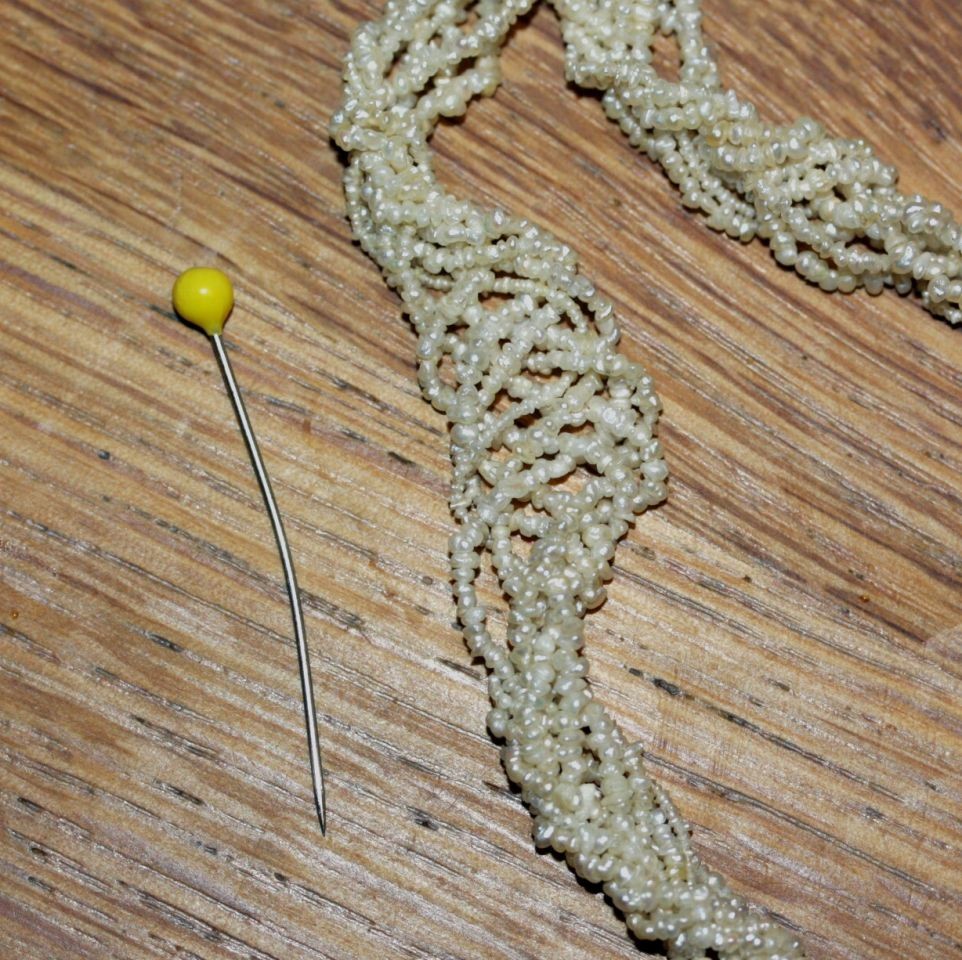
To give you an idea of the tinyness of these things, compare the size of these seed pearls to the size of the modern glass-headed pin:

They are utterly, utterly tiny, and if anyone has an idea of how the holes might have gotten into these pearls, or how they may have been strung up, or sewn to a textile (these haven't, of course, but others did) they would be more than welcome! 

0
DEZ.
16
0

Slowing Down.

The year is winding down, and while there's a list of things still to do before 2022 ends, there's only one larger and hard-deadlined item left on the list, with a "finish before winter break" tag on it. That is a really, really nice thing... and I very much enjoy the feeling of winding down and slowing down a bit too.

The one item? I have (not too foolishly, I hope) agreed to write a little article about tablet weaving. It's actually two, but one is finished, and there's only one left to do... so I've made some photos, and something vaguely resembling a plan, and there's an outline, and hopefully there's an article soon.

The really fascinating thing about this is that every time I look at the topic, there's another little aspect that I can see. Especially when I try to explain something, or describe something. This sharpens the eye in a way that nothing else does. There's a German idiom that more or less says "you learn when you teach", and that is really true. (Well, provided that when you teach, you try to explain things so that the audience understands them, and not just teach the motions and rules to be learned by heart and followed... because then, you will learn nothing.)

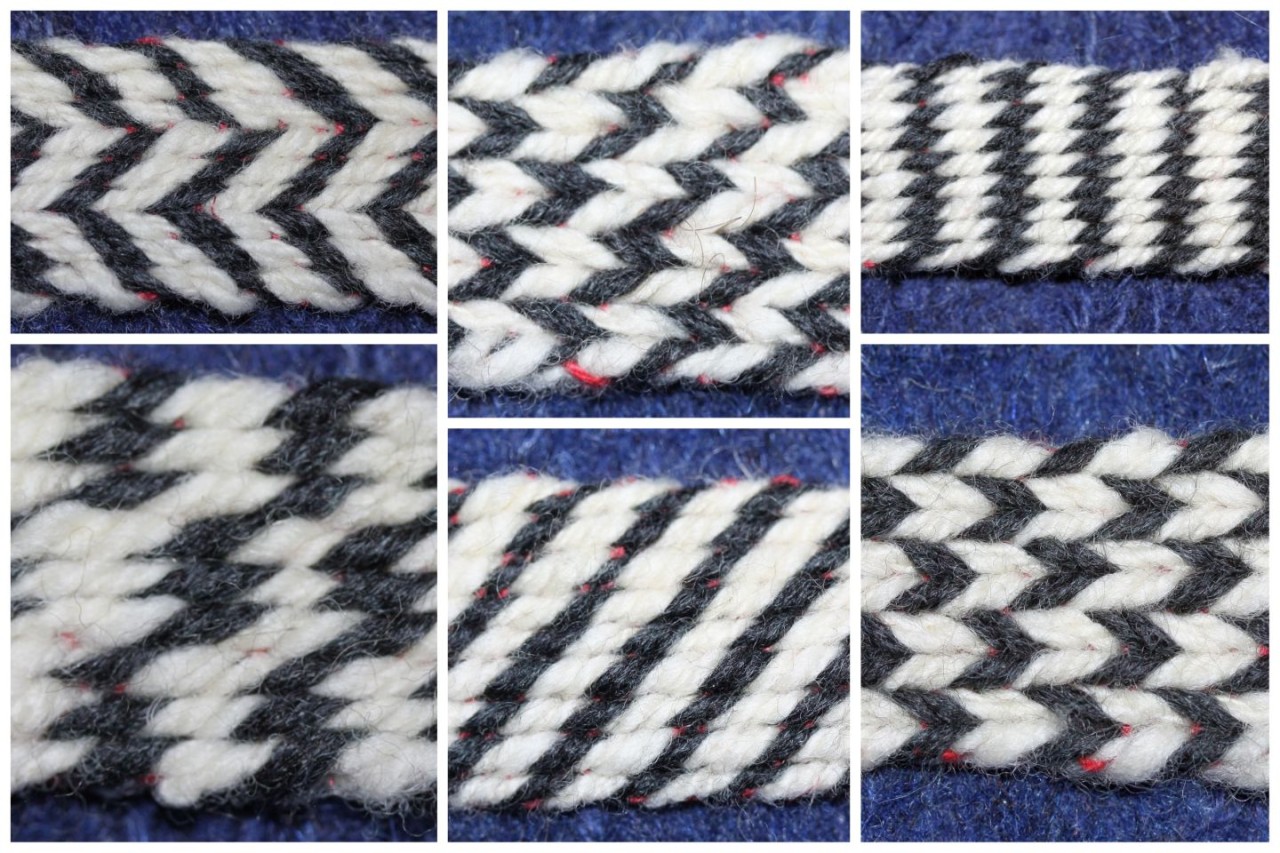
For the tablet weavers among you: The two middle images show the same setup and were woven the same way - only on top, the tablets are threaded alternatingly s and z, and on the bottom, all are threaded the same way. Like all of you, I know that the s and z are important and will change how the black and white line up. But I still find it amazing how much the alternate threading changes the line-up and the optical impression of the band. 

0
DEZ.
15
0

Glorious Painting Pictures!

I think I may have blogged about this before, but I can't really remember - and that means it's not a bad idea to revisit the "Projekt Tafelmalerei" of the Germanisches Nationalmuseum in Nuremberg. 

The GNM has a very large collection of late medieval paintings on wood, and there's a project to research these paintings and make the information about them accessible on the Internet. The whole thing can be found at tafelmalerei.gnm.de and features 148 paintings, starting in 1260 and ending in 1520. So if you're interested in late medieval artwork, you might want to check it out.

The platform is German only; you find the paintings under "Objekte", and then there's preview images for all the items.

Especially interesting: There's a painting by the Meister von Uttenheim showing the Birth of Mary, and there's a lady dressed in a green gown that has a similar cut to one of the Lengberg dress fragments. Plus she's wearing a headdress with a geometrically ornamented inset - maybe something similar to a cap like that also found in Lengberg?

0
DEZ.
14
0

A Curious Recipe Book.

We were wondering about old-style recipes for cakes a while ago, inspired by some quite old (Art Deco) tableware, which had rather small plates for the cakes (or whatever else would have been served on them).

So I did as you do when wondering about stuff like that - I went into the Internet Archive and the Open Library and had a rootle around for recipe books from the end of the 19th century.

One of the books I came across was a really curious example, with a lot of advertisements, and a lot of recipes, but not just for cooking, no, for about everything from dyeing wool to dyeing hair to cleaning stuff to baking to curing sick horses. It's called the Brill's Family Recipe book. 


I'm not sure if I will actually try one of the cake recipes - but it was definitely very amusing to leaf through this curious mixture, and it does give an impression of what was considered important or necessary recipes back then. 

0

By accepting you will be accessing a service provided by a third-party external to https://pallia.net/

Kontakt