Latest Comments

Guest - Max Mustermann The True Cost of Driving a Car.
06. November 2026
Great breakdown — the non-fuel costs are exactly the bit most people forget when they compare cars. ...
Guest - Harma Phew. Now it gets involved!
21. Oktober 2026
Have fun at these events.
Guest - Aislinn Dyestuff Citizen Science.
09. Oktober 2026
This is a great project. I look forward to the results. Thanks for letting us know.
Guest - Aislinn Time for...
09. Oktober 2026
Looks delicious!
Guest - Katrin Sprang Discussion
18. September 2026
Hi Rachel, I have looked for more photos of you, but that was not very successful. I found a link on...
JUNI
14
0

Linkapalooza!

It's time for some links again - here you go:

Alex Makin has new things up on her blog about (mostly) Early Medieval Textiles. This time, the textiles are (mostly) a bit later - Milena Bravermanová, Helena Březinová and Jana Bureš Víchová present textiles found in the tomb of St Wenceslaus in Prague Castle. Do check them out - they are fabulous fabrics!

If you're into Medieval cookery, you might want to check out this recipe book in the OpenLibrary - it's the edition and translation of a late medieval recipe book from Naples, dated to the end of the 15th century.

If you're up for a fight, or maybe just up for reading about military mobility equipment, there's a nice article about chariots and related wagon-like things here.

Prefer more friendly things? There's an investigation into fragmented ring ornaments used in the 4th millenium BC in Finland, which may have been something resembling "friendship pendants" - rings that were made, then intentionally broken and used or worn by two people. The article is open access.

I hope there's something for you in that selection!

0
JUNI
13
0

The Joy of a New Wheel.

We are, as you might know, cyclists. Erlangen is a place where there's a lot of cycling going on, and in most cases, it's the quickest way to get from A to B within the city (just like in so, so many places). You can park right where you want to go and don't have to find a parking space, get the ticket, put it into the car, and then walk to wherever you planned to be.

Apart from that, it's healthy (at least healthier than sitting in a car), more quiet, and more sustainable. Also it's fun, especially with a nice bike that is easy to ride.

If we are going somewhere together, we're taking the tandem, if it's at all possible. We've also spent a few holidays on the bike... so it has seen a few replacements over the years, pieces that were worn out, pieces that got upgraded, pieces that broke.

The latest piece that broke? The flange on our rear wheel hub. On one trip, we heard a "ping" sound like when a spoke breaks - and yes, two spokes were loose. But not because they themselves had broken. A part of the flange had taken exception to staying with us and went its merry way somewhere into the bushes.

Ouch. That is not how a wheel hub should look like.

Fortunately, it was still possible to use the bike, though with a bit of caution. And last Friday, the replacement wheel arrived. We now have a shiny new wheel, and the Most Patient Husband of Them All also replaced the chains, and there's a new sprocket cassette, and now the whole thing is running like new again. Plus the freewheel of the new wheel is really, really quiet - in fact, you can only hear it in some instances, and the sounds of the chains running when we pedal are actually louder than the freewheel sound. 

The last hub lasted about 33.000 kilometers. So now we can work on wearing the new one out...

0
JUNI
10
0

Should you? Or not?

Sometimes you hear about an event just in time - that happened to me with a paper on a (hybrid) conference yesterday. I read about said conference about half an hour before the thing started, and an hour before the paper that was of special interest to me - and luckily, I got sent the link for the login really quickly, and was able to join in.

At said conference, there was mention of a TED talk about whether you should kiss with lipstick... or not.

Since it is, sort of, well, related to historical dyeing, here you go:

0
JUNI
09
0

More Images!

Well, not here, but on this site called "Medieval Wall Painting in the English Parish Church: A Developing Catalogue".  I'm not sure about how up-do-date the "developing" is, since the copyright notice says "-2018", but it is a very nice collection of murals in churches. 

I've stumbled across it looking for Genesis scenes, which are a premium source for images of Eve spinning. (I've learned, though, that it's not always the spinning woman in those scenes, sometimes she has other occupations.) I hope you enjoy having a look at the paintings.


0
JUNI
08
2

More Spinning Stuff - Évangiles de Quenouilles

If you're on Facebook, and interested in distaff spinning, there's a lovely group there called Evangelical Church of Distaff Spinning. Not too much traffic, lovely people, and from time to time someone turns up a gem. So thanks to that group, I can now point you to the Évangiles de Quenouilles on the BnF site. If you click on the small image, you can read the original version - if you can read Old French, that is. (The script is, to my eyes, not too hard to read, which is nice - I find it superhard to try and read something in a hard-to-decipher script and in a language I do not know well.)

Apparently there's an English edition to these Évangiles, too (available as an ebook). Here's a review (mostly behind a paywall) of the book.* My quick search via google Scholar has not turned up much more - there's a Dutch version that you can access online, with the text from a 1910 edition/transcription. 

The contents are advice - the "gospels" that are passed on between women as they meet for spinning. A lot of them are medical or concerning health. You can read a bit more about the medical advice in this paper.


* I do wonder about this passage in the review: 

"The 'distaff' of the title is the rod – or 'staff' – from which yarn is wound onto a spindle. In figurative terms, it is the mechanism by which the thread of the oral narrative – a collection of folk wisdom (or 'gospels') told by a group of peasant women (the evangelists of the title) – is spun into a written text by the male narrator, an unidentified cleric." 

Weird mis-explanations of distaff function, or distaff use, or how spinning is done pop up again and again. This, to me, is really irksome and I do wonder - are other techniques and their tools mis-explained just as badly and frequently as spinning and its tools, and it's just an awareness bias that I have, or is spinning really more of a victim than other techniques?


0
JUNI
07
0

Gender Ponderings on Spinning, Part II.

I've mentioned the Bible as one of the gender-spinning-question related items in the last post (before the long weekend of Pentecost - just in case you wondered about yesterday's blog silence). 

There are a few mentions of spinning in the Bible. Finding them is made relatively easy by the helpful BibleHub site, where you can look for keywords and then get information about them, and related terms as well. 

One of the mentions of "spinning" is in Exodus 25:35, and it goes:

And every skillful woman spun with her hands, and they all brought what they had spun in blue and purple and scarlet yarns and fine twined linen.

Exodus 25:35, English Standard Version

The BibleHub site also lists the different translations, another very helpful feature. 

So. Here it's "woman" in all versions. Another interesting bit, for our intents and purposes, is Proverbs 31:19, which is from a passage about the virtues of a noble woman: 

In her hand she holds the distaff and grasps the spindle with her fingers.

Proverbs 31:19, New International Version

In this part, spinning is closely linked to women, and especially virtuous (as in good) women. The making of yarn, and cloth, and further on in the passage clothing the family, is something mentioned as a positive aspect. 

If that connection was seen as a strong one (which would be sort of standing to reason, given the importance of textiles and textile manufacture), it is not a great jump to using it as a kind of symbol in artworks to signal that a specific woman would be one that is virtuous/good/productive.

Spinning can also be seen as negative, though - it depends on the context. You can read more about the topic in "Equally in God's Image: Women in the Middle Ages". 

However, in both cases it's very much associated with the female gender.

The question remains: How much of the women-only impression that we get from our sources is due to representation bias? Were there men spinning in the Middle Ages, in relevant numbers? How about children - male and female? It would be really, really interesting to know more about this - also because finding out whether there's a strong representation bias in this case might give an insight in possible other representation biases.

0
JUNI
02
0

More Bronze Age Stuff.

There is still some Bronze Age stuff going on - stitching, to be precise.

Because, well, after the Egtved things have been all wrapped up (and literally wrapped up and sent off to the museum), work went on with the men's garments, modeled after the find from Trindhøj. 

One of the pieces is a cloak, shaped like a half-oval. That, by itself, does not sound very spectacular. However, what makes it spectacular is both the size of the woven fabric. The cloak is approximately 126 cm long and 243 cm wide, and it's cut out, so the minimum size of the woven fabric must have been larger still.

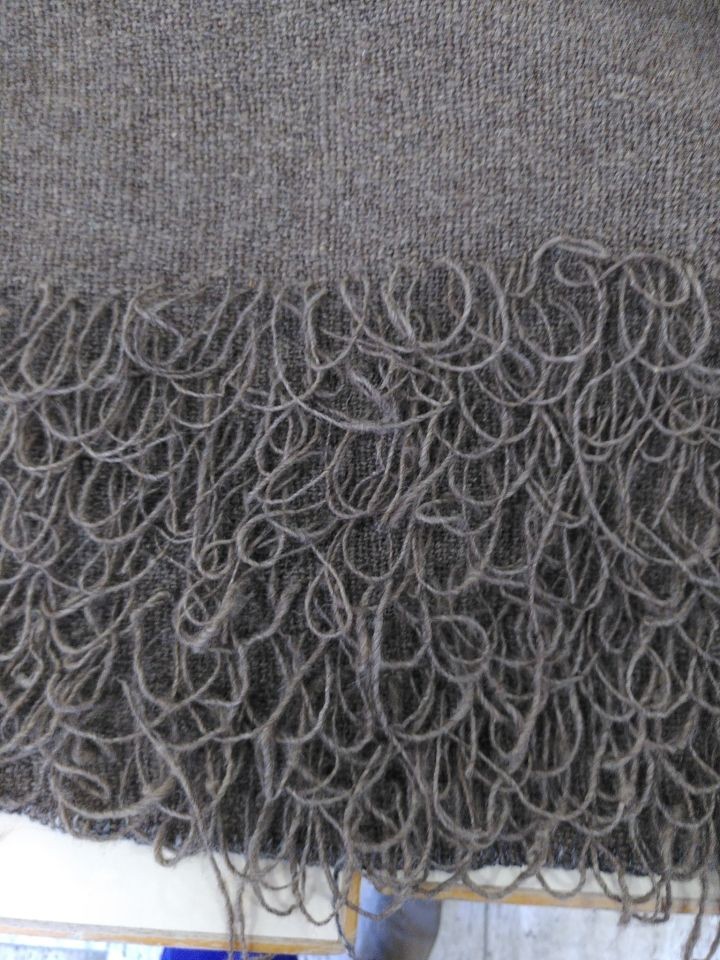
The other thing making it special and rather spectacular? It was finished with a sewn-on pile made from yarns. And this is what I'm working on right now:

It's rather pleasant work and each stitch does not take very long, but it's a large piece, and I am not yet at the thirdway point, according to my estimates. So... more stitching to do.

Also, there's several things that itch me in this: Because there's not much left of the pile, it's hard to tell how dense it was, how long the individual pile threads were, and if they were loops or cut open after being sewn on. There's also no good documentation or analysis of the stitch used to apply them that I could find. Which means I'm sort of making it up as I go along - or, in other words, I've tried around a bit after orienting myself after the reconstruction attempts done before, and analysis of another stitch used for pile, and found a process that feels good to me. Which I'm now sticking with.

All this is, again, a nice example of how one may have the impression that everything is known about a given textile... but once you start to re-create it, all the small and large gaps in our knowledge emerge. It's fascinating, and it's humbling, and it's always, always the case.

0

By accepting you will be accessing a service provided by a third-party external to https://pallia.net/

Kontakt