Latest Comments

Guest - Max Mustermann The True Cost of Driving a Car.
06. November 2026
Great breakdown — the non-fuel costs are exactly the bit most people forget when they compare cars. ...
Guest - Harma Phew. Now it gets involved!
21. Oktober 2026
Have fun at these events.
Guest - Aislinn Dyestuff Citizen Science.
09. Oktober 2026
This is a great project. I look forward to the results. Thanks for letting us know.
Guest - Aislinn Time for...
09. Oktober 2026
Looks delicious!
Guest - Katrin Sprang Discussion
18. September 2026
Hi Rachel, I have looked for more photos of you, but that was not very successful. I found a link on...
OKT.
07
0

Testing.

Today was mostly spent spinning - I'm doing test yarns for a fabric reproduction project. One that has me very, very excited - it's Bronze Age fabrics, and making the yarns for this is one of the tasks coming up for me now.

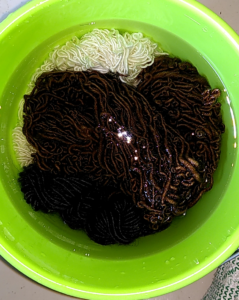
So I'm doing test spins currently, trying to get a feel for the different fibres that come in question (all of them compromises, because of the lack of real Bronze Age type sheep with their very special type of fibres) and getting a feel for the thicknesses and twist levels that should be suitable. Once the test skeins are done, they get a bath:


and then they are hung up to dry.

Afterwards, I weigh them, label them, calculate the Nm value (that is purely out of curiosity, though), document how long it took me to do that amount of yarn, and once the last batch will have gone through this, weaving tests can start.


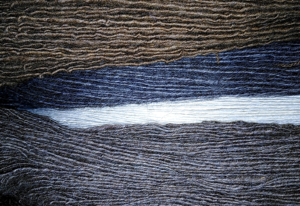
It's always fascinating to see how different types of wool spin out differently, and have different properties afterwards (like the Nm count) - even if the yarns have about the same thickness and the same amount of twist.
0
OKT.
06
0

Things That Happened During Summer Break (part 7)

After the Textile Forum, there was a little bit of a breather, and then there was - NESAT! Only online, sadly. I had been looking forward so much to a trip to northern Finland with friends, and then hanging out and meeting in person all the lovely people that I only see every three years there... but due to the insecure situation with the pandemic, the conference organisers had opted for the online-only version.

Our presentations were all pre-recorded and available on the conference platform a bit before the conference proper started, and the sessions were discussion-only (with a very short summary of the papers to refresh memories). There was a large variety of topics, and it was really, really nice to at least virtually see the friendly faces of all the colleagues, and to hear about current research.

My personal conference was made so much better and more enjoyable by joining up with a friend to attend together - and we even managed to have some Finnish sweets and some snacks made after Finnish recipes, along with the obligatory too-large amounts of coffee that have to be drunk at every conference.

After the conference, some of the presentations were made public, and they are listed on the NESAT website - the presentation I did with Beatrix Nutz is among them, so feel free to enjoy some slightly weird tablet-woven bands from Early Modern mining sites. I also very much recommend watching the video about medieval seal bag textiles, which I found very, very fascinating!
0
OKT.
05
1

Hooray!

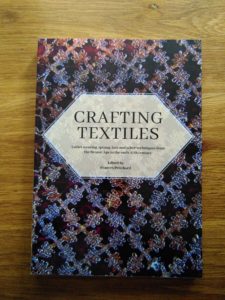
To my great delight, I received an author's copy yesterday - "Crafting Textiles" is now out. It's the conference proceedings from a conference in honour of Peter Collingwood that took place some years ago.


It's always really nice to get an author's copy... it somehow feels like a birthday present.

If you're not as lucky as me and want to order the book, you can do so at Oxbow Books or, of course, at the brick-and-mortar bookshop of your choice. (When buying books, by the way, usually most of the money goes to the place where you buy it - so you can decide for yourself whether you want to support the publisher, your bookseller of choice or, in case they sell themselves too, the author.)
0
OKT.
04
2

Things That Happened During Summer Break (part 6)

(continued from part 5)

There was, of course, even more stuff about looms and weaving. Together with Florian, who works at Lauresham, I'd been pondering and planning a loom made from hardware store parts - things you'd easily get at a typical German Baumarkt. The aim was to have an affordable loom from parts you can get without having special stores, and it should of course also be easy to build.

[caption id="attachment_6419" align="alignnone" width="300"] Putting together the two uprights - since we had the luxury of a lot of clamps, we used them. The boards are glued together, and then secured additionally with a few screws.
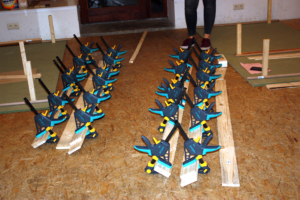

Most of the cutting-to-length of the parts can be done in the hardware store, where there's usually a cutting service point. That greatly reduces the amount of work and time necessary for making the loom - most of the tasks that are left is assembling the bits by glueing and screwing.

There's still some details to fine-tune, but overall, our little side project was a definite success. The hardest part about this loom is squaring off the ends of the round beam - it would be possible to use another solution, but the square ends will sit very securely in the upper part of the loom, and getting the sawing done was successfully undertaken by someone who does not have a lot of practice with this.

[caption id="attachment_6418" align="alignnone" width="300"] The upper part of the loom, with the square end of the round beam sitting nice and snug in the uprights. For the first test, another beam with a weave already attached was used - for "proper" weaving, you'd attach your weave to the beam directly or via a narrow slat or rod that the starting border has been stitched to.
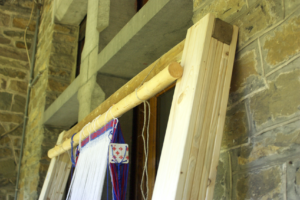

The loom comes in at about 80-90 € for the materials, plus the cost for the loomweights. I did manage to find something hardware-store-y for that as well, though it might need pre-ordering, as it's not an utterly common item. Curious?

It's a certain kind of pipe connector that weighs about 120 g each, is about 3 cm wide, and can be strung up easily. So for someone who prefers to buy weights instead of getting hold of some clay and forming, then drying them, this is a viable alternative. They come in at about 3-4 € per piece, which means that if you want to do a very wide weave, it will cost you quite a bit of money. On the other hand, it also means you can get them from a suitable supplier and will have no work at all with them.

The finished loom is a full-size thing, with 140 cm between the uprights, and a bit more than 2 m in height. It's heavy enough to stand securely in our first tests, and it should be possible to adjust loom position to keep the shed size large enough for easy weaving even for beginners. The prototype is still being tested.
0
OKT.
01
0

Things That Happened During Summer Break (part 5)

(continued from part 4)

The special thing about the pharaoh band is that there's extra heddles and extra warps that, when lifted alternatingly with the regular warps, form a pattern in the middle of the band. It's fascinating, and beautiful, and surprisingly difficult to get everything sorted out and aligned and moving like it should and behaving. You need to have the heddles straight so they can glide down or let the other threads glide up, but they can't be really pulled because you want the other shed.


And, as usual, when somebody skilled at this does it, everything looks easy...

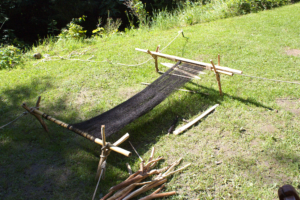
What I personally found much, much easier to do was weaving with goat hair on a Sudanese ground loom reconstruction. That was a very coarse weave, and there was only the natural shed, the countershed had to be picked out with a stick each time. With only a few and very thick plied threads per centimetre, though, this was relatively quick and easy to do. I had a stint of weaving on the loom early one morning, and a second bit of weaving on a sunny afternoon, and I really enjoyed the feel of the smooth, warm goat hair yarn on my hands.

 
I've been wondering about that kind of yarn ever since I read Hald's article about Bedouin spinning and weaving with goat hair for tents, and now finally I've touched it and worked with it. That was definitely one of the many, many "hooray!" moments I had at this Forum.

 
0
SEP.
30
0

Things That Happened During Summer Break (part 4)

(continued from part 3)

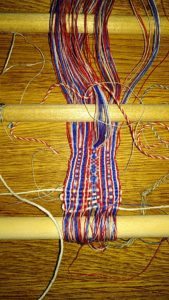
The pieces to practise on? I have a narrow band that I already set up before the Forum; a wider band (or a very narrow strip of cloth, if you'd prefer); and another band (or two, actually) that I call "The Pharaoh".

These are all three quite different from each other, and I'm feeling a bit challenged with each of them, though The Pharaoh really wears the crown. It's a much simplified version of Tutankhamun's collar that Marie Ekstedt Bjersing researched and taught to us, done in a thicker yarn. Thicker, in this case, means a linen yarn in 60/2, which is still freaking thin.

Here's a picture of it:


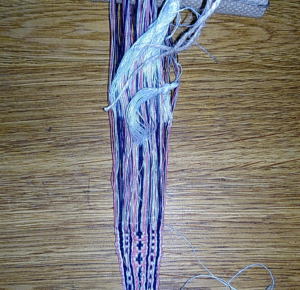
You might notice that this lacks its heddles - that's because I had a heddling mistake in my setup, and decided that re-heddling would be a very smart thing to do. Then Marie told me that I might as well do a second warp, because it's quick and easy to do, and, well, so I did. That is why I now have two pharaohs.

This is the second one:

 
That does have all the heddles - I had to re-do the small bunch (for the special shed), but now it works quite fine. Apart from the two white warp threads that I still have no clue where they rightfully belong. They got missed, somehow, during heddling, in addition to two red-coloured warps. I figured out  where the latter really belong, though, and got that fixed by now.


The second pharaoh, by the way, even got to accompany me on our holidays as my crafty thing to do. Usually I take some knitting along, but the current project (dubbed the Neverending Ink) is way too heavy and voluminous at its current stage, and the bike will only accommodate something nice and small...
0
SEP.
29
0

Oopsie.

Sorry for the blog silence yesterday - I completely forgot to post! That happens only rarely, but this year, I had the very interesting idea of scheduling workshops fairly soon after the summer break, and together with the catching up on things that is still going on... well, it totally slipped my attention. Even though "blog" is on the list of daily things to do. But just like calendars, lists are of limited use if you don't look at them...

There's quite a bit going on here at the moment, behind the scenes. There's a newsletter to write for September, I'm preparing the items for the next online sewing workshop (on October 10, and there's still spaces free if you'd like to learn about medieval stitches and seams, in German), and both of these meant taking some photos yesterday. There's also a new thing for the shop, hooray! (Which obviously needs to go in as a listing before the newsletter goes out.) Oh, and I figured out how to solve the broken image problem on the blog - they should all be back now. (For some reason, there was a 1 added to a lot of picture file names, and deleting that meant the pics, which were on the server, could be found again.)

I'm also doing some spinning tests for the next reconstruction project - a museum would like to have Bronze Age fabrics for visitors to touch, and try on garments made from them. This is a lovely project, and a wonderful task, and it means a lot of spinning, which also means a bit of test spinning. Once I have the tests finished, they will go to the weaver to see if they are suitable, and give me some feedback, and then spinning for real will start. I'm very, very excited!

Other news? The vote in Germany is over (that was last Sunday), and now we're waiting to see who is going to run (or ruin) the country for the next 4 years. Mathematically, a lot of party constellations are possible - not, unfortunately, those that I personally would have favoured most. We might still end up with the "traffic lights" - that is SPD, FDP and the Green Party, which is the one I'd prefer out of the options left. It's definitely living in interesting times...
0

By accepting you will be accessing a service provided by a third-party external to https://pallia.net/

Kontakt