


Search the Blog
Latest Comments
Aaand... another one out.
Sometimes you run across the saying "publish or perish" in regards to academic settings. I have my issues with that phrase, but I am always delighted when colleagues publish their work - because then it's out there, and accessible, and that is a very, very good thing.
So, putting my money where my mouth is, or rather trying to live up to my own ideals, I do try to publish my stuff as well. It's not always worked out, and sometimes it turns out a little different than expected, but one of the important bits is that it's there somewhere and people can look for it and read it and then, most important thing in my opinion, they can get into contact and start a discourse if they so like.
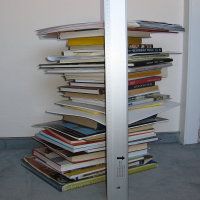
All this is mainly the preamble to let you know that I've published an article together with my dyer colleague Micky Schoelzke, and it's out now in an anthology published by Springer, and they even sent me fancy pictures and instructions on how to promote it. I will, in fact, use one of them here:

Of course, I will also give you the link to the book page that they provided me with. I would have preferred, actually, to provide you with a kind of affiliate link that would earn me 30% provision of the book price in case you'd buy that book via the link provided, but alas, the marketing company they are working with has decided that my website is irrelevant to the advertising needs of Springer, and so I cannot get a link, and cannot get money from it.
This is, in one perspective, not a big deal, as chances that people would go off and buy that book en masse are, well, slim, so I'm not having the feeling that I will be missing out on a lot of money here. I'm a little miffed still. (Mostly, probably, because I got dismissed as irrelevant.) Springer (just like Brill, and DeGruyter, and so many other notable academic publishers) is not best known for their cheap books, whether print or ebook. I'm all for books that are fairly priced, which is rarely really cheap, as there's a lot of people and a lot of work involved in making and selling a book. However, Springer does not pay any of their academic authors (at least not to my knowledge) and also not their editors. Basically, writing and editing for them is done for free, for the pleasure of having a book published. There may or may not be payment to the publishing house involved in some cases; I know that I have heard about at least one of the bigger German publishing house names taking quite a sum for publishing a PhD thesis about a decade ago, so I might be outdated, and things may be different there and now.
But the thing that remains is: These houses depend on the writers handing their work in for free, on peer reviewers working for free, on editors working for free. Then they do sell the books at a price that's not, well, very low, and while they do offer that 30% provision (that's not more than a bookshop would get as their cut, by the way) it is, as I have found out, not so easy to access it.
The whole system depends on people either being paid for their writing, editing, proofreading, and reviewing work by their academic employer, so a university or other place of work; or they depend on these people doing the stuff on their own time, unpaid. In both cases, I think it's not entirely fair (but especially not in the second one).
Books are not a get-rich-scheme anyways, and no author that I know (who has done authoring work and is not just dreaming of becoming the next Rowling, income-by-books-wise) is expecting to get lots of money from their work per book. It would be nice, though, to get at least a little, not just because money is nice and, well, rather useful if you want to keep on living, but also to have more of a feeling of being paid and appreciated, and not just... useful. Even if you're irrelevant (to the publishing house, like me).
Rant over. If you get your hands on the book, any which way, I hope you'll enjoy it!
Comments 2

Congratulations on the publication!
However, yes, totally agree with you on the dystopia that is academic publishing. It relies on the free labour of so many. To add insult to injury, at least in the sciences, to publish an open access article generally has a fee (last time I checked the standard was 2,000 or 2,500 USD). So, if you are working for a poorer university or on a less-prestigious project or you are an independent researcher your only choice is to publish in a way such that *even you* cannot access your own published article as it's behind a pay-wall. (And don't get me started on the costs of those paywalls!) It's such a mess and means that we actively do less good research because we cannot access the work of others.
Yes. It's ridiculous really.
I'm quite happy that there's portals like researchgate and academia.edu, but that, of course, depends on whether the authors are on there and able to share (because the publishers are, who would have thought, trying to restrict that sharing as well, in some cases).
It's hard enough to stay on top of research in respect to a topic without having to struggle with paywalls, so yes, I am entirely with you: This makes research just so much harder.
By accepting you will be accessing a service provided by a third-party external to https://pallia.net/