



Search the Blog






Latest Comments
The Intricacies of a Good Tool.
If you are crafting, you will (usually) have tools. Sometimes these are what you were given by the teacher, or what you bought somewhere, and some will be grand from the start, while others will take some time getting used to.
For crafts that are well-known and widespread, it's usually possible to get a large range of tools in somewhat different shapes, sizes, and materials, so you can find whatever you prefer for your own preferences (and budget). Normally, there's a range of variation that will work, and all the tools (if they are good ones) will stay within that range. If you know what you prefer, you can keep an eye out for the variants that suit your style.
It gets much more interesting when you are trying to re-make a tool with little or no previous experience on how it should feel. Back in the day when I was first exploring filet netting, I had, of course, the images of archaeological netting needle finds; I also had the instructions on how to work the knot (which, to practise, you can also do with a normal blunt sewing needle).
The first netting needle attempt that I ended up with, thanks to the help of a friend, looked like this:
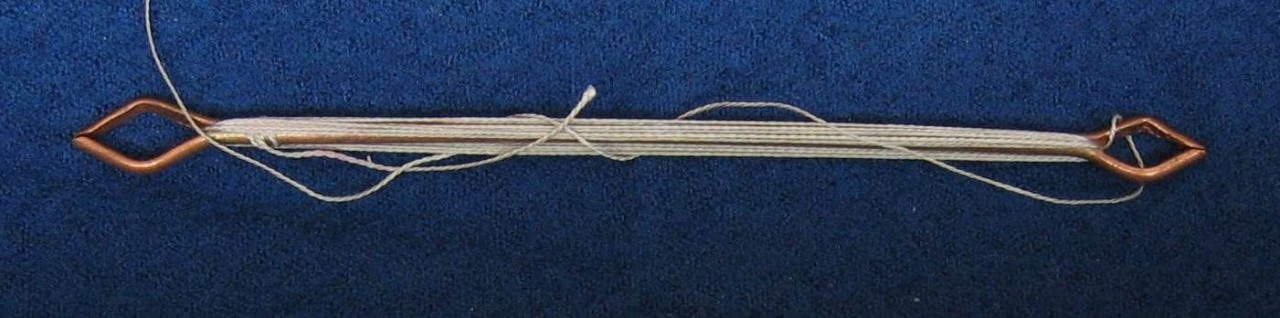
Well. It did work, but not very well. Why? Because I had seen the general shape of the archaeological find - which was somehow rhomboid ends on a stick - and interpreted it into this version without really seeing the crucial details. The needle was rather short, which reduces the length of thread that can be wound onto it; but more importantly, the pleasingly symmetrical ends turned out to be rather unpleasing in their functionality.
A good part of netting is going into the correct mesh of the previous row with your needle. For this, unless you are working with very well-behaved and rather stiff material in a room without air currents, you will probably need to fish for it. This can be easily and nicely done with the tip of the needle... provided it's the right shape. And, spoiler alert, the pleasingly symmetrical rhomboid is not it! Like in a spindle stick, you want one end to be more bluntly tapered (to provide room for the threads you wind up on your needle), and one end to be nice and long and slender (to help with fiddling your way into the correct mesh).
This is something that became clear to me only after I had worked with this first attempt - and only after that did I realise that the surviving needles were usually not symmetrical in their ends, but had the widest part closer to the shaft.
Which brings us to the core of why it can be quite hard to reconstruct tools - because sometimes, a tiny detail that seems insignificant or weird is actually important for the function, but to see it and realise its importance, we have to learn how to use the tool. Which, in turn, gets harder if we know less about the process and the exact use of said tool.
Like I said... interesting! (Fortunately, filet netting is known well enough that it's only a question of evaluating the tool attempt and then realising why it failed, with no necessity to reconstruct the process to go with it.)
Comments
By accepting you will be accessing a service provided by a third-party external to https://pallia.net/