



Search the Blog
Latest Comments
Weft Carriers.
When you start to dabble into weaving today, one of the standard things that comes up as "important tool" is... a shuttle. And with "shuttle" I mean that iconic piece of wood (or other material, but more rarely) which looks like a little board with two deep indentations at each end. A little like a comic drawing bone, but with less bulk at the ends. I'm pretty sure you know what I mean - it's part of every "learn how to weave" children's loom, after all.
Some are curved a bit, some have a different shape, some are more like netting needles, but - with the exception of the loom shuttles for wider fabric looms or specialised mechanised band-weaving looms - they are everywhere where you are looking for weaving tools.
Unfortunately for those of us who both like this type of shuttle and want to do historical weaving, there's about next to no evidence for this type in medieval artworks. When this form of shuttle is so well known today, it is rather safe to assume that an archaeologist looking at a wood find could identify it correctly. But do we have such finds? Well... nope. With a little nope cherry on top. (At least that's my current knowledge - if you know of any of these "classic" shuttles in the archaeological record, especially the medieval one, please do let me know.)
The thing is, though - as far as I remember reading somewhere, that type of shuttle - the long, narrow board with two indentations at the narrow ends to help hold the weft - is a rather recent (as in 19th century) development. Unfortunately I am still looking to find that source again, but this would explain very easily the lack of this tool-type in the medieval finds.
It's also, if you ask me, rather... impractical in a lot of cases. If it's short, you can easily handle it, but if you want to weave something a little wider, it gets weird - because if you want to have some more weft, you are always getting one full shuttle length worth of weft thread. No more, no less. That might work okay if you have a shuttle about the same length as your weave is wide, but if your shuttle happens to be a good bit longer than your weaving width, it's extra awkward. (Disclaimer: I never liked these shuttle types much, and so I have avoided working with them as much as possible, with the result of being not very practiced in how to handle them, which might make stuff more difficult than necessary.)
And there's so many other ways to carry your weft. You can just have a length of thread that you flick through, and place a new length fairly often. You can do a butterfly (works very well if you have good butterfly-making technique). Or you can use a stick. I am very fond of the general idea of the stick shuttle, as you can unwind as much or as little as you'd like. (I also like to use a reed spool for some instances, especially when I will have the weft dangling from the weave because I have need for both of my hands at other spots, and the reed is lightweigt plus will allow me to cut a notch in it where I can secure my weft. So it, you know, dangles and doesn't fall to the floor. Because that is annoying.)
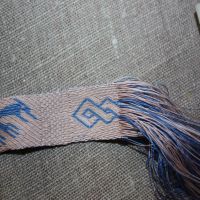
The Swedish inkle looms, which are made for the rapid home production of bands, are a very nice example where a kind of small stick shuttle is used:
Comments
By accepting you will be accessing a service provided by a third-party external to https://pallia.net/