Latest Comments

Guest - Aislinn Dyestuff Citizen Science.
09. Oktober 2026
This is a great project. I look forward to the results. Thanks for letting us know.
Guest - Aislinn Time for...
09. Oktober 2026
Looks delicious!
Guest - Katrin Sprang Discussion
18. September 2026
Hi Rachel, I have looked for more photos of you, but that was not very successful. I found a link on...
Guest - Beatrix Sprang Discussion
15. September 2026
That lozenge pattern element is not a photograph, but a scan. So it should be to scale. But I pinned...
Guest - Katrin Sprang Discussion
15. September 2026
I was not referring to Rachel's reconstruction (is the reconstruction you refer to the one photograp...
SEP.
03
2

Humans will be human.

When you study history in any context, it becomes clear rather quickly that, well, history tends to repeat itself. Mostly, if you ask me, because humans are human, both in the best and in the worst meaning of this.

If things are getting tough and scary and there's not enough to go on living as one did before, there's always a good chance that someone will get the idea that a war is the best solution for this. After all, it means you have a clear-cut enemy now who is, if in doubt, the reason for everything going wrong. Also one could just, well, take their stuff, since it's war. Easy way out. (Also a rather stupid way out in most cases, as it's not really a way out, but if you are reading this blog, I probably don't need to explain this to you.)

On the other hand, when something happens - a natural desaster, or a death in the family, or an illness, or another of the endless possibilities how one's life can be upturned - it can well be that friends and family and complete strangers suddenly stand there to help and support as best they can. There's been outpourings of help both financial and with time and labour after almost any catastrophe.

So where am I going with this article? Actually, I only wanted to write a preamble to this link to a rather, um, manly find from medieval Bryggen in Norway. Because some things, well, they just do not change, and that includes the wish to have some fun occasionally, and with help if necessary. Humans will be humans, and human ingenuity has never stopped at that, which the find is beautifully proving, in an anatomically correct and not too short way. (NSFW, just in case you haven't clicked on to this yet.)

0
AUG.
25
2

Weird ways to put your hood on.

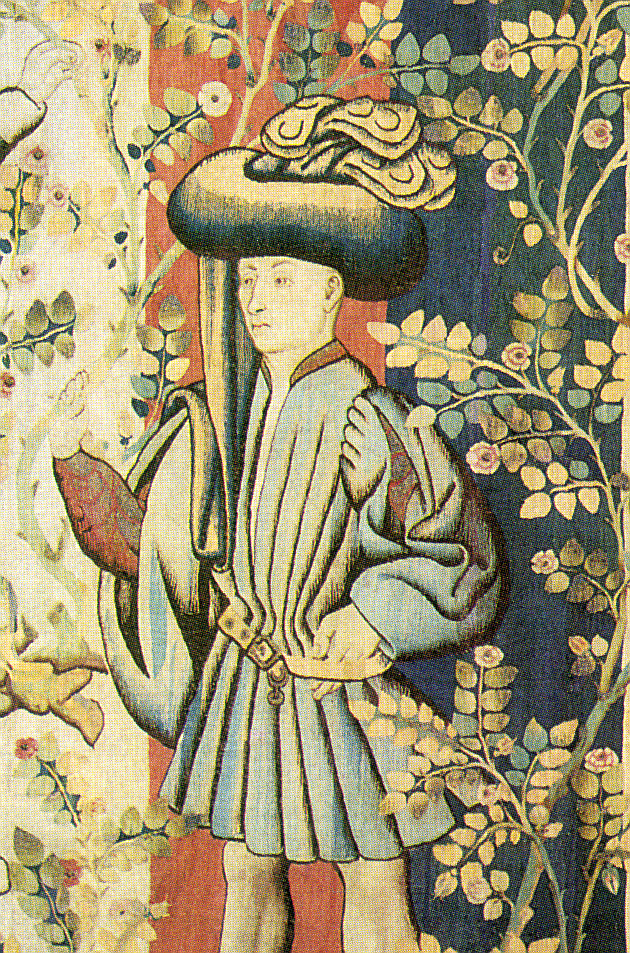
Inspired by yesterday's comment, here's a little elaboration on why I think the red thing Oswald is wearing is a hood.

Around the 1400s and into the earlier part of the 15th century, there's a plethora of hoods being worn, in all kinds of shapes and sizes. There's hoods with no liripipe or a very short one, there's buttoned hoods (sometimes worn open), and there's a number of hoods with a long, wide liripipe, sometimes as long as the wearer.

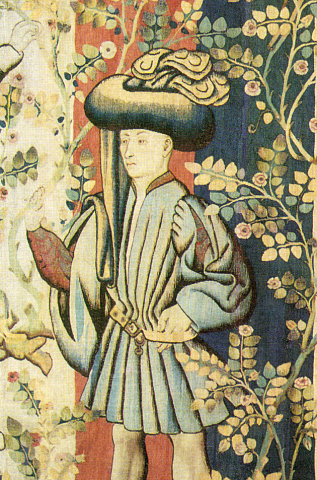
These are, obviously, not the superpractical functional garments anymore. Instead, they are worn in some rather inventive ways, with the liripipe draped fetchingly across the upper body, the shoulders, the arms. Sometimes the face opening of the hood is stuffed to form a nice shaped ring, like a fabric donut in superlarge, but narrow. Sometimes they also overdo it a bit with the stuffing, like here:

Southern Netherlands, c 1450-1455. Detail from a tapisserie worked in wool, silk and metal threads, 2,89 x 3,25 m. New York, The Metropolitan Museum of Art. Image from Camille, Michael 2000. Die Kunst der Liebe im Mittelalter, Köln, Könemann.

You can see the long liripipe (not dagged in this case) draped across the right shoulder, hanging down in front in a loop and then going to the back. There's the super-overstuffed ring that would once have been the face opening, and it sits on the head, with what would once have been the cape part sticking out on the top with a bit of decorative dagging. 

This is one of the more extreme examples where it's clear that this is not going to function like a normal hood anymore. There's quite a lot more where the modifications have not gone as far, but they do have heavy dagging on the cape, and often a very long and also dagged liripipe.

This long thing can be draped across the shoulder and arm, or sometimes it is wrapped around the head turban-style. There are a few images where it's pulled through one sleeve, coming out near the hand like a decorative fabric waterfall. Unfortunately these are, indeed, rare - but the playing cards from Stuttgart provide several examples, both men and women. You can find the whole series here on the museum digital pages. 

As the colour and style (patterning) of the thing coming out at the sleeve always matches the hood worn, I am convinced that this is the liripipe being drawn through the sleeve. It works very well; I have a few reconstruction hoods with a similarly ridiculously long dagged tail, and it's quite easily possible to wear them this way, unless your sleeve is super fitted. I have done tests with modern sweaters, and it works just fine. 

On the other hand, while we do have images of extra sleeves being worn by women, these are not, to my knowledge, documented for men; and usually they are also not extra long and spilling out (I only have one layered outfit in mind where it might be the case, that's all). 

My big issue with good old Oswald is thus only the two spilling tails - as a double-tailed hood is not something I have ever come across. However, the Most Patient Husband of Them All suggested yesterday it might be only one, but draped a little weirdly. So can this be?

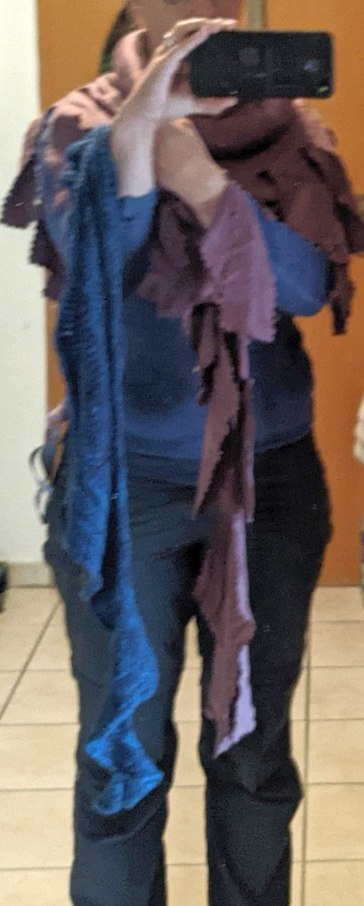
Obviously, this has to be tried out. Unfortunately my hoods do not have the right type of liripipe, so I had to simulate long dagges with a second piece of fabric - but yes, it seems to work. Both the blue scarf and the purple liripipe are coming out of my left sleeve, and one just happens to drape over my right arm. Tree hugging was suspended in favour of holding the phone to make this rather blurry picture, but I hope you can see all the relevant details well enough to be as happy as I am with this possibility!

0
AUG.
20
0

Literature Hunting Fun.

I have the nagging suspicion that I will be hunting literature on new(er) finds, or their re-evaluation, for quite a bit of time. Today was spent on trying to hunt down some Spanish things with more details about the garments worn by the Archbishop Rodrigo Ximenéz de Rada, who happened to have very nice hose in his grave. There's an image and a short description in Vestiduras Ricas, but nothing more - and I would like to know more now.

So, literature hunting, someone may have ordered a book in the process (and downloaded things that now need sorting and checking out), and now the next thing is to find a copy of the Ärkebiskoparna Bremen book by Margareta Nockert - which I also, to my dismay, still lack.

There's not much else to report; all this finding and reading and digesting written stuff is slow work too. Which I now have to put aside for a bit to take care of some shop things as well, and probably also check up on the cat to give her a cuddle. The things you have to do, you know. 

0
AUG.
18
0

New Euro Banknotes.

There's been a design contest for new Euro banknotes, resulting in ten different designs that were shortlisted. Now there's a public survey on the ten options, and hopefully we'll end up with a nice new design.

You can read more about the redesign here, and click your way further to look at all the options and then take part in the survey. 

0
AUG.
17
0

If you don't know where to put your old ship...

... maybe do like some medieval folks in Konstanz. Use it as ceiling in your house.

I'm not pulling your leg - that's the new and kind of sensational find recently made: A basement ceiling that can be dated to 1244 mostly consists of part of a ship. There's not so much detail to be found on the 'net yet, but if you read German, there's a little bit here at the SWR page. 

0
JULI
14
0

Summer Break!

It's time for a summer break!

I will be off the blog until August 17. If you wish to see me in the meantime, you can come to the Archaeotechnica in Brandenburg, where I'll be taking a break from the break and work for a weekend.


0
JULI
09
0

Chocolate, only in not so tasty.

Chocolate was, apparently, always a thing for the military. There was Pervitin laced into pralinés dubbed "Hausfrauenschokolade" (housewife chocolate), and it was also mixed into chocolate bars as "Panzerschokolade" (tank chocolate). And in case you are wondering now what that Pervitin brand name stands for - it's meth. (Yeah.)

A different kind of chocolate, also for military use, but not used as a drug delivery agent, was the D ration chocolate bar. That is, well, mostly harmless or so it seems, and if you are intrigued now, Tasting History has a podcast about it:

0

By accepting you will be accessing a service provided by a third-party external to https://pallia.net/

Kontakt