Latest Comments

Guest - Aislinn Dyestuff Citizen Science.
09. Oktober 2026
This is a great project. I look forward to the results. Thanks for letting us know.
Guest - Aislinn Time for...
09. Oktober 2026
Looks delicious!
Guest - Katrin Sprang Discussion
18. September 2026
Hi Rachel, I have looked for more photos of you, but that was not very successful. I found a link on...
Guest - Beatrix Sprang Discussion
15. September 2026
That lozenge pattern element is not a photograph, but a scan. So it should be to scale. But I pinned...
Guest - Katrin Sprang Discussion
15. September 2026
I was not referring to Rachel's reconstruction (is the reconstruction you refer to the one photograp...
AUG.
03
0

Monday!

Today is one of those days where I have a list of things I planned to do, and then end up doing completely different stuff. Ah, well, as long as something gets done... which, in today's case, was some bookkeeping (and that is always a nice thing to have dealt with).

So while I'm not-quite-procrastinating, here's a link for you in case you read German: Cattle (highland cattle, to be precise) are grazing in Augsburg to keep larger vegetation away from the archaeological evidence buried under their meadow - because their roots would do damage to the things buried below.

Now that's a very good way of keeping the area clear!
0
JULI
21
0

Hiking.

We finally managed this weekend to go on a "more-than-one-day" hiking trip - more or less right outside our front door, less than 50 km away as the crow flies. There were spectacular rocks and lots and lots of flowers in full bloom (which meant that the walking was periodically paused, and time was spent admiring the flowers, and the scenery).
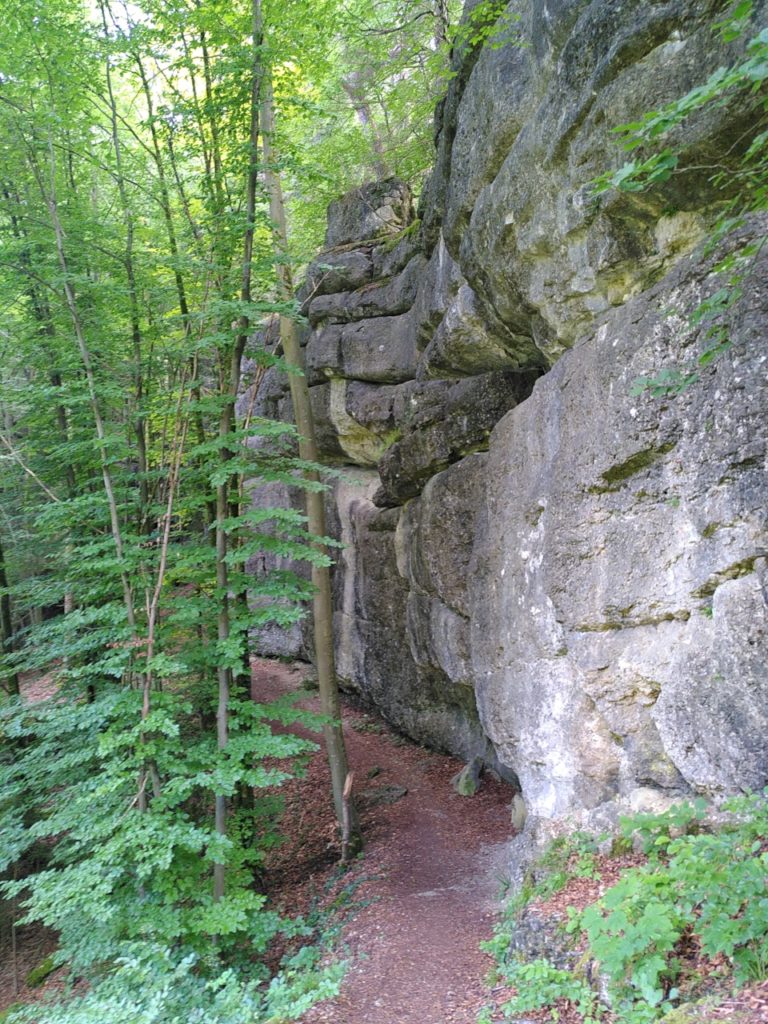


To our great delight, we also saw a few rare flowers - Türkenbund and Waldvögelein - as well as lots of (rather common) fish. One Anguis fragilis crossed our path, and there were many butterflies, some of which we hadn't seen for so long that we both didn't remember their names (like the "Kaisermantel", literally "Emperor's Cloak", Argynnis paphia). There were also a few fields lying fallow or, rather, planted with cover crops - these cover crops being bee-friendly flowers, and blooming abundantly. In the non-fallow fields, there were more flowers growing than a decade or two ago, pointing to the use of less herbicides these days. All in all, it did make me feel that there still might be hope for our world and its wildlife. On our last evening, we also spied some signal crayfish (unfortunately not proper European crayfish, but the invasive North American species).
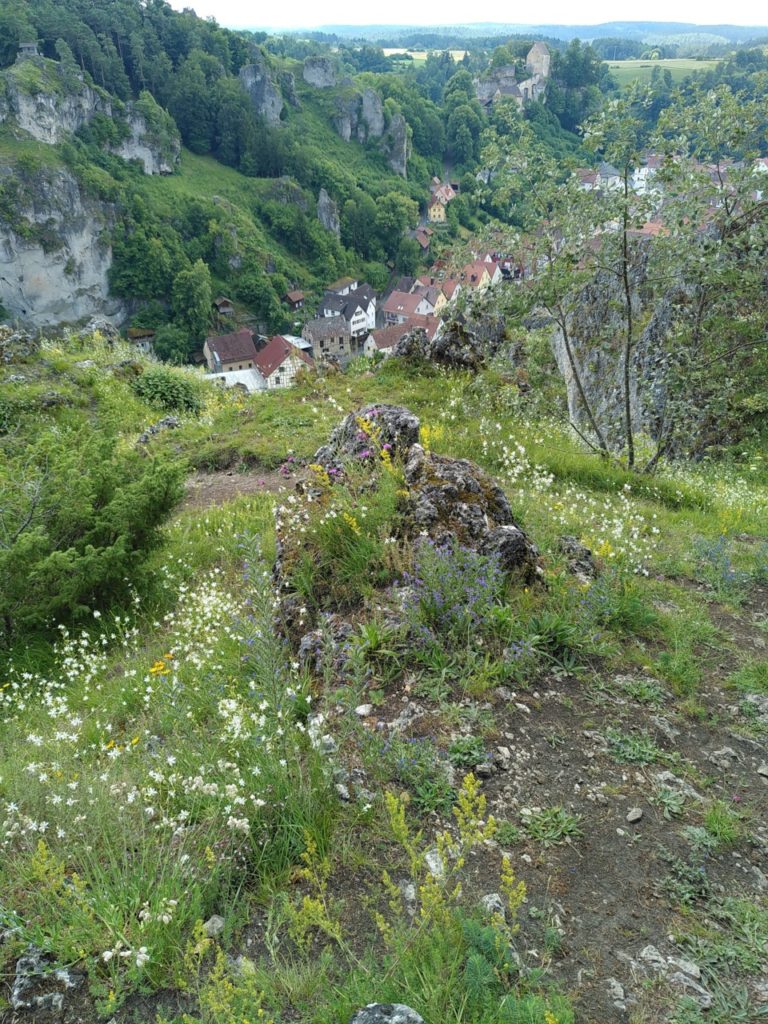


I didn't take many photos, so you've now seen most of the actual good ones that I did take. I'm not very good with using the phone camera; in fact, I'm not very good with a lot of cameras, my "proper" one being the exception. It's rather large and heavy, especially with my favourite macro lens, though, so I'm only taking it along when I plan to actually focus on taking pictures, and not on most holiday ventures.

I've also found out that I look at things differently when planning to photograph, and that I have a different mindset as well. I like taking photos in general, and I do enjoy hunting for good motifs, and good angles, and getting lovely pictures. Especially macro and portrait photography do tempt me, and I've hade a lot of fun with both. However, when on holidays, I have found that both the way of looking at things to evaluate their picture-worthiness and the corresponding mindset are, for me, at odds with winding down and enjoying the scenery. This is the main reason why I have stopped to take a lot of photos when on holiday trips. Occasionally I will pull out the phone, or take our (small) camera and snap some pictures, but it's mostly the Most Patient Husband of Them All who does the holiday photography, and I'm very content with that.

 
0
JULI
08
4

Language Learning Thoughts.

As you can guess from yesterday's post, I have a bit of experience learning languages - to different stages, at different times, in different ways, and for different goals. So here's a few things that I meta-learned about language learning over the course of this, maybe you find them helpful.

Do keep in mind that I'm not one of those incredible people who speak 5 or 6 languages fluently - but I have managed to get enough skills in the appropriate areas to handle my needs. These are, mostly, reading archaeological papers about textiles - which can be done with just basic understanding of the language, passive skills only, the necessary special vocabulary and the enthusiastic use of (online) dictionaries. Reading about other topics, especially scholarly material that is not as down-to-earth as archaeology reports usually are, will require a higher language skill.

So, here you go - my insights about language learning:
  1. Find out what you want, and aim for that. If you only need to read-understand things, it makes limited sense to get a conversation course. For reading understanding, I have had good results with getting a basic overview about the language through the first chapters of a beginner course book, then switching over to actual reading. I learned how to read Middle High German and Swedish by getting a book in the original language, plus the German translation, and reading those in parallel with, again, enthusiastic use of a dictionary to support word identification. (The books were the Nibelungenlied, by the way, and Ronja Rövardotter.) I'd consider a book optimal for this approach if the original was written in your language of choice, and you already know the translation of the book, and you love it.
    With this approach, you can end up with fairly good reading skills. You will probably be quite helpless when trying to understand spoken language, though, and your active skills will be somewhere around zero, not just because of lack of practice in actively using vocabulary and grammar forming sentences, but also because pronounciation is actually a thing in most languages.
  2. If you are going for active skills, get started on them at once. This means actual conversation with actual people, at least in written form, better in spoken and written form. Whether you practise with a study buddy or with a teacher, or talk to your cat, or to your chair - as long as you form sentences and talk about things, it's good. Best is, of course, a native speaker teacher who is willing and able to correct you, but anything is better than nothing. There's platforms online where you can look for a conversation partner or study buddy, if you don't happen to have a native speaker among your friends who's willing to have their mother tongue smattered.
  3. This also means that a book course by itself, or a computer course with no additional real-life real-time interaction will probably not be the best choice for learning a language for active use. Though these can be very good tools to learn grammar, vocabulary, and phrases, my impression is that these courses then tend to build up a repertoire of fixed phrases that you will be able to understand and use - but no real language use practice.
  4. Speaking of practice: I find it easiest to learn a language when there's a use-case for it, and when the topics interest me. I do not need to learn how to order cask-drawn beer as opposed to bottled beer. I am vastly interested, though, in learning about different kinds of chocolate, climbing gyms, bicycles, and tablet weaving. So ideally, your conversational partners have similar interests, and you can stumble your way into the new language through topics that have relevance and value for you.
  5. Try to do something every day. Instagram, as I've recently discovered, holds a wealth of hashtags for language learners - giving you lots of small posts with images accompanying snippets of language info. Which is just brilliant for learning a little bit every day. Films and Youtube videos are also a nice way to learn, with the added bonus of hearing actual normal people speak the actual spoken version of the language at more or less normal speed!
Those are my findings - do you have any insights from your language learning adventures? Let me know in the comments!
0
JULI
03
0

Linky Time.

Time to clear up some of the gazillion tabs here again!

First of all, if you're feeling slightly nerdy, here's an article on medium.com on a visualisation of the global development of COVID-19. It involves a few steps (and reading the instructions in the Medium article), but then you can have the thing plot a lot of different developments for you. What makes these plots really interesting is that the numbers have been normalised to the population size - so we're looking at the relative case numbers and their development, not at absolutes. This really is way cool. (I got the link sent by a neighbour who was involved in the project, by the way. The things you learn.)

Another neighbour was involved in some of the translation work done for a current virtual exhibition in Nuremberg: "Menschen machen Stadtgeschichte" - People making the city's history. Scroll down a bit for the English explanation and link to the English version.

Even more from people I actually know: My colleague Alexandra Makin has interviewed my other colleague Gwen Owen-Crocker for her new blog series "Early Medieval (mostly) Textiles". Go check it out here.

Yet another friend has pointed me to the (virtual) International Medieval Congress site, where I browsed through the conference programme and found a link to a modern Decameron - ten days with ten stories each, so a hundred altogether. The individual stories are rather short, so if you need a little something to watch and listen to now and then, go have a look. You can find the full list of videos here, and here's the very first one with the introduction for your convenience:

0
JUNI
26
0

Cat-Related Content

Just in case you need some music, or some cat-related content, or both, to get you nicely into the upcoming weekend - here's the thing for you. The Ukulele Orchestra of Great Britain has made another video, "Lovecats" this time:


Enjoy, and have a nice weekend!
0
JUNI
23
0

Cooking over Fire.

If you're doing Living History, or maybe LARP, or if you just like fire, you might have done some cooking over fire. You'll know, then, that it's quite different from cooking on a modern stove.

There's quite a few things where you can fall into traps - and I've been at numerous events where the cook in our group ran into a mishap, with the result of food coming to the table several hours later than planned. We've had events where it rained a lot the weeks before, and the wood we could get locally was so wet you had to add barbecue charcoal from the supermarket to get it to burn. I learned a lot about a lot of different things regarding fire, and cooking, and frying... often by making mistakes. Of course.

For those of you reading German and interested in cooking over a fire at events, here's a German-language blog called Herdstelle with some interesting and helpful things.

And if you're not reading German, here's the "Sad Songs and Honky Tonk" by the Scarlet Duchess on Spotify, and some of their songs on Soundcloud. (And yes, there is a connection. Even though I can be Queen of Non Sequitur at times!)
0
JUNI
19
0

Online Market Tomorrow!

There's a second "Mittelaltermarkt Online" tomorrow, starting at 11 am German time - and I'll be there!

This is a funny little thing: You register (free), then you can click yourself along the market paths (which reminds me of a simple game dungeon), look at the stalls left and right, and chat with the stall owners, look at their goods, and maybe buy something.

I was there last month for the first one, and it was curious, but also fun, so of course I decided to go there again. Stop by if you wish, and have a chat with me, either typed at the stall or via Jitsi Meet as a video meeting!
0

By accepting you will be accessing a service provided by a third-party external to https://pallia.net/

Kontakt







