







Latest Comments

Guest - Aislinn Dyestuff Citizen Science.
09. Oktober 2026
This is a great project. I look forward to the results. Thanks for letting us know.
Guest - Aislinn Time for...
09. Oktober 2026
Looks delicious!
Guest - Katrin Sprang Discussion
18. September 2026
Hi Rachel, I have looked for more photos of you, but that was not very successful. I found a link on...
Guest - Beatrix Sprang Discussion
15. September 2026
That lozenge pattern element is not a photograph, but a scan. So it should be to scale. But I pinned...
Guest - Katrin Sprang Discussion
15. September 2026
I was not referring to Rachel's reconstruction (is the reconstruction you refer to the one photograp...
JUNI
03
0

Assorted Links, Once Again.


Here's a collection of links for your delectation!


The weird ways of the Internet occasionally show me things. One of the things that occasionally turn up are figures re-imagined as somehow changed figures - and sometimes, this is interesting, and sometimes it's weird, and most of the times I just go "meh" if I bother to look at it at all. But this is definitely the weirdest re-imagining I have yet seen: Disney Princesses, re-imagined as Cement Mixers.


As you might know, I'm not the tallest person around. Actually, I'm rather small - I'm still shorter than the average German woman who stands 166 cm tall according to here. And that even though I have somehow grown 2 cm in length, bringing me from 161 to 163 cm. (Thank you, bouldering core strength gain and yoga, with your joint result of a much better posture.) From time to time, this means I'll heartily complain about being just not tall enough. There are also days when I wish I could eat more of some deliriously delicious thing, but there's only so much energy I can use up in a day. However, as this article about female astronauts clearly shows, it is not always a bad thing to be small and female, and thus rather energy-efficient. (Which of course doesn't mean that there have been lots of women in space... yet. Hopefully that will change in the future; at least there is awareness about the topic these days.


One more science newsy thing: Alzheimer's might be caused by gum bacteria. I find this both scary (gum bacteria! Of a kind that lots of people have!) and hope-inducing (once you know the reason for something, it's so much easier to find a way to heal or help).


And finally to round this off with something a little textile-related: Have an image of 17th century Spinning Sows, courtesy of the Rijksmuseum, plus an explanation of the motif.


Enjoy!
0
MAI
31
0

Find me on Instagram!


After seeing quite a lot of people doing amazing and fun stuff on Instagram - such as Margit or Alex, who is now posting pictures about her Cuthbert Embroidery project, which I had the joy of providing threads for, the itch to join that crowd was growing. Growing a lot.


So a few weeks ago, I have finally taken the plunge and made myself an Instagram-account! Now I am slowly getting familiar with the thing, though there's still a lot of the "very new" feeling going on. If you are among the Instagram-ing people, you can follow me there, under katrinkania.


The cunning plan is to occasionally post some interesting pictures - we'll see how that works out!

0
MAI
29
0

The German Clock Museum Furtwangen presents...


You might know the "Kuckucksuhr", that typical German clock that has a bird coming out on the full hour, making a cuckoo sound?


Well, that is not the only type of clock with a figure declaring the time of day - and there's a virtual exhibition called "Tick Tack Trick - Schwarzwalduhren mit Figuren" (Tick Tack Trick - Black Forest Clocks with Figures). While the text is all in German, there's a little video for each of the clocks that are featured, and those are all without text, but with clock sounds - and thoroughly enjoyable!


While we're at the topic of time - tomorrow is a public holiday here in Germany, so you'll get no blog post. See you on Friday!

0
MAI
20
0

Medieval Woodworking - Log Splitting


There's so much knowledge that we have lost about medieval crafting - but some of it has been re-discovered, or has been revived. Watching these old crafts come to life again is something utterly fascinating, and I always find it amazing how much time and effort goes into something that, at first glance, seems quite simple. Such as a rafter holding up a roof.


A Swedish museum has posted this video on Youtube, and if you have twenty minutes to spare, it's amazing:


0
MAI
17
1

Elections are coming up!


If you're a European citizen, please remember that the European Elections are coming up - and voting is a right and a privilege that we all should make use of.


If you're not sure how this all works, you can have a look at the European Elections webpage, where you can also find country-specific information and instructions by selecting your language. If you cannot get to a voting place on the election date, it might still be early enough for you to request mail voting.


If you are a German citizen and you are not sure what to vote for, I find the Wahl-O-Mat incredibly helpful. It asks about your personal opinion on a number of topics, and then you can compare your stance with that of different parties. If the party has given a reason or explanation for their answer, it is also listed in the results. (By the way, reading the explanations given by "Die PARTEI" was hilarious. Also wonderfully sarcastic in some cases.)


While the Wahl-O-Mat is a purely German thing, it's not the only voting advice application around - follow the link to find a wikipedia list of a number of them.


And whatever you choose - please go vote. Every vote counts.

0
MAI
09
0

Books, books.


Books. Aren't they always nice to have? To leaf through? Can one have too many books?
Well, the obvious answer to this is both yes and no. So in case you are currently tending more towards the no, here are two books that might be interesting for you:


If you're interested in braiding, Noemi Speiser's book "Manual of Braiding" has been reprinted last year and is available via Haupt Verlag. It costs 39.90 € in Germany for the hardcover book. If you follow the link, the "Leseprobe" tag lets you have a look into the book.


If you are interested in medieval metalworking, there's a new book out, published in French, on copper and copper-alloy workplaces discovered in Saint-Julien in Douai. The book is called "Travailler le cuivre à Douai au XIIIe siècle. Histoire et archéologie d’un atelier de proximité", by Lise Saussus (dir.), together with Nicolas Thomas, Marisa Pirson and Benjamin Jagou. Douai et Louvain-la-Neuve, 2019. Here's the abstract, in French and English:


De 1983 à 1987, une fouille archéologique rue Saint-Julien à Douai révèle un atelier et ses quelques milliers de déchets témoignant d’un travail du cuivre et de ses alliages au XIIIe siècle. Cette publication examine l’unité de production à la lumière des sources archéologiques, mais aussi de sources écrites et archéométriques. Elle présente le cadre de la découverte à l’échelle de la ville jusqu’à celle de la parcelle en s’intéressant à l’intégration des métiers du cuivre dans le tissu urbain. L’étude de la stratigraphie et des structures composant cet atelier dans un vaste espace de près de 1 000 m² précède l’analyse du mobilier métallurgique, des techniques variées, en particulier celles des réparations de vaisselle, mais aussi des alliages mis en œuvre. Enrichie par l’examen du travail du fer, associé à celui du cuivre, et d’une partie de la vaisselle en céramique consommée sur le site, l’étude illustre un de ces ateliers de proximité qui ont subsisté à côté des grands centres de production tels ceux de la vallée de la Meuse. Voué à l’entretien des vaisselles, enclin à répondre à des commandes variées, ce type d’ateliers actifs aux échelles locales, celles de la ville et de ses alentours, profite de la circulation des productions de masse mises sur le marché à une échelle globale.


From 1983 to 1987, an archaeological excavation along the rue Saint-Julien in Douai revealed a workshop and its several thousand pieces of waste, testifying to the work of copper and its alloys during the 13th century. In this book, the workplace is examined in the light of archaeological sources, but also of written and archaeometric sources. It presents the framework of the discovery from the global scale of the city to the particular plot by focusing on the integration of the metalworking professions into the urban fabric. The study of the stratigraphy and structures composing this workshop in a vast space of nearly 1,000 m² precedes the analysis of the metallurgical finds, of the various techniques, in particular those of cooking and table utensil’s repairs, but also of the alloys used. Enriched by the examination of the ironwork associated with the copperwork, and part of the ceramic tableware consumed on the site, the study illustrates one of these local workshops that have survived alongside major production centres, such as those in the Meuse valley. Dedicated to the maintenance of crockery, inclined to respond to various demands, this type of workshop, active at the local level of the city and its surroundings, benefits from the circulation of mass productions placed on the market on a global scale.


The book has 277 pages and costs 30€ plus shipping costs; you can order it (and inquire about shipping costs) at either Diese E-Mail-Adresse ist vor Spambots geschützt! Zur Anzeige muss JavaScript eingeschaltet sein. or Diese E-Mail-Adresse ist vor Spambots geschützt! Zur Anzeige muss JavaScript eingeschaltet sein..

0
MAI
01
0

(Soap) Packing for the Fair.


I'm prepping for the Nadelwelt fair - checking all the things that need to be checked, charging all the batteries, topping up the stock stuff that needs to be topped up.


Also, of course, packing the overnight things - which always include the Three Magic Wellness Things: the travel yoga mat, my current knitting project, and something to read (which usually means the e-book reader). It also always includes, of course, the washbag... which this time around put me in front of a slight problem.


As this is also what goes with me on cycling and paddling holidays, and has to fit into rather small bags for that, my washbag is supposed to stay as small as possible. Unfortunately, over the years, it has grown a bit, due to my wanting to take some additional stuff. Such as a pair of glasses for when the lenses are out. Or more skincare products. Age, here, is definitely leaving some traces!


So in the quest of keeping it small and manageable, most of the things are packed into small containers. Which means my soapbox is an old small box for peppermint candies, and it will only fit a very slim piece of soap. Which, in turn, means I occasionally transfer a piece that has shrunk enough into my travel washbag, and replace the shrunken piece with a new big one.


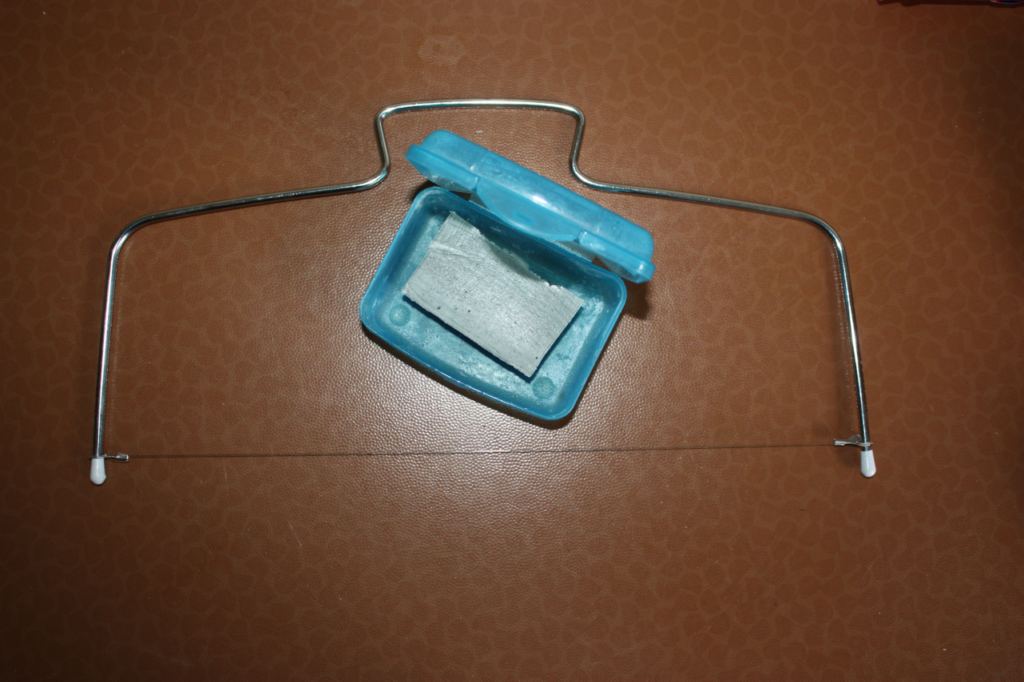
This time, the small piece came from the soapbox that I take with me to the bouldering gym... but the new piece of soap, bought from a soapmaking manufacture, was so large that it didn't fit that box either. A quick internet search later, and now I know how to divide a piece of soap.


The easiest way to do this without the soap splintering is to heat it up in the oven, at about 100° C for at least half an hour; this softens the piece. Then you can either cut it by pressing through it with a very sharp knife, or try using a piece of thin, strong string, or - probably the best method - cut it with a thin wire. I used the wire from a cake cutting device that hangs out in our kitchen, and it worked very well indeed.


One quarter of the huge piece that I had to cut apart, and the cake-cutting wire device thingie. Which, by the way, also works fantastically on cake.


So now my soap round-robin is done (and I have three more pieces that will fit the box, too) - on to the rest of the packing!

0

By accepting you will be accessing a service provided by a third-party external to https://pallia.net/

Kontakt