







Latest Comments

Guest - Aislinn Dyestuff Citizen Science.
09. Oktober 2026
This is a great project. I look forward to the results. Thanks for letting us know.
Guest - Aislinn Time for...
09. Oktober 2026
Looks delicious!
Guest - Katrin Sprang Discussion
18. September 2026
Hi Rachel, I have looked for more photos of you, but that was not very successful. I found a link on...
Guest - Beatrix Sprang Discussion
15. September 2026
That lozenge pattern element is not a photograph, but a scan. So it should be to scale. But I pinned...
Guest - Katrin Sprang Discussion
15. September 2026
I was not referring to Rachel's reconstruction (is the reconstruction you refer to the one photograp...
OKT.
18
2

Walking in the Middle Ages.

There's been this video going more or less viral, about how people walked differently in medieval times. It's spread a lot, and it finally arrived at the rock that I live under, and I watched it.

And went Aaaaaaaaaaarrggh.

In case you haven't seen it, it has been posted over at Boingboing. In case you don't really want to watch it, there's a guy dressed in late medieval stuff telling you that medieval folks walked on the balls of their feet, and because we are stupid lazy modern shoe-wearing people, we are not doing that anymore, even though it is much healthier and cooler and whatnot.

Okay. Here's the thing. In list format. With numbers, to hide the fact that it's not very structured rambling...
  1. "People in the Middle Ages walked differently than we do today" - yes, probably. Just like modern people who walk barefoot mostly or all of the time walk slightly differently than shoe-wearers. There are studies about that, like for instance this one: The effects of habitual footwear use: foot shape and function in native barefoot walkers (K. D’Août et al, Footwear Science Vol. 1, No. 2, June 2009, 81–94). The very short version: Habitually barefoot people have the same high-pressure spots on the sole when walking, but pressure peaks are a bit lower, and it's not completely clear how that is achieved. There's another paper looking at sandals, flip-flops, barefoot and shoes here. It's fascinating stuff!
  2. The fact that there are differences between habitual barefoot walkers and shod people, however, does not mean that the completely exaggerated way the guy in the video shows is "natural". There are situations when you put the ball of the foot first, yes - like when you are tip-toeing to be silent, or don't want to touch much of the ground, or if you are running at high speeds. Now if there were a typical very strong difference between placement of the foot ball-first or heel-first in barefoot people and shoe-wearers... don't you think some of the studies about differences in gait would mention this?
  3. Also, "walking heel-first is actually detrimental to your health"? Erm. Humans are plantigrades, just like their colleagues over in the ape section, and a lot of other mammals. We change from the sole to the ball of the foot when running, or dancing, or fighting, yes - but usually, the heel comes first. And guess what? It is actually constructed for this, with a strong heel bone under which there's cushioning stuff.
  4. "When we can be lazy, we are." Well. Yes. Maybe. But why on freaking earth would the medieval people then not have been lazy? Anyone? Grrr. Either lazyness is a basic human trait, then there's no reason at all why medieval people would have been less lazy, or it's not, then there's no reason why people would not still walk that other way today.
  5. Shoes with framed construction and lightweight shoes both influence how you walk; there might be a difference in how much they do this, but the medieval shoe does not count as no footwear. See, for instance, this paper about how even minimalist footwear influences running.
  6. If you've ever tried walking this way, you will quickly realise that it does not feel natural and it also does not feel efficient. Also, I can ball-silly-walk even with a really bad posture no problem. So can the most patient husband of them all.
  7. Medieval artwork that shows people on the balls of the feet shows them in specific situations. Fencers are still on the ball of their foot today, just like dancers. Other people depicted with a nice sexy foot sticking out of their garments? I'd say it is important for this to keep in mind that what the sixpack-belly is for today's sexiness scale, the leg used to be in medieval times. Sexy legs were... sexy. Nobody cared for your belly definition. (Well, nice extra, probably. But legs were the thing.) Which might explain a few of the displayed non-dancing, non-fencing legs in artwork.
As stated before: Aaargh.
0
SEP.
22
2

Internet Translation!

If you are trying to read things that are not in your language on the Internet, there's a few more or less helpful tools to use that offer machine translation. I'm sure you have all been victim of those already - as sometimes, things get quietly murdered translated and appear, for instance, in a facebook feed or on a shop webpage and you wonder about the curiously bad grammar and the utterly weird choice of words, or find it completely incomprehensible.

There's a new kid on the block, though, and it's called DeepL. I've tested it a tiny little bit, and so far, it has been really, really good - and perfectly comprehensible up until now, even if the English I've translated the German to is not always perfect.

So in case you need something translated from or into the languages German, English, French, Spanish, Italian, Dutch and Polish, give it a try. It's definitely a large step up from what you'd get on Babelfish and other machine translators.
0
SEP.
19
2

Stuff out of the Net.

And here you go again, with an assortment of links in various flavours!

Maybe you have seen the claims that the Voynich manuscript has been deciphered - this has been debunked right away. Bonus article about how it's not been solved.

BBC Travel has a post about the last woman who works with byssus (the silk-like fibre harvested from the mollusc pinna nobilis).

In case you ever wondered where you'd end up if you could tunnel straight through the planet (who hasn't?), here is Antipodes Man and his map to finally solve this for you. (Spoiler alert: Chances are high you'd be swimming. Better pack those swimming clothes, and probably even better: a boat.)

If you're in the UK, UK Handknitting has a workshop list for all kinds of courses and workshops around knitting and crocheting... just in case you are looking for one (or maybe want to offer one).

And that's it for today. I hope you found something of interest!
0
SEP.
15
2

Bielefeld spinnt!

Today, I'm off to Bielefeld, to set up the shop there, give a workshop on spinning and have a fair amount of fun.

Today, by the way, is also my one year anniversary of reaching my goal weight, and I'm happy to say that I am still in the goal weight range (with fluctuations, depending on water retention levels, which are closely connected to stress levels), and still very, very happy about it.

While most of the time I manage quite well, there are times when it's not as easy for me to keep the right balance between eating enough and eating not too much. Especially in these times, I can really feel that both the years of being overweight and the wild ride I took as the weightloss phase certainly left their traces, and I get really odd trains of thought. These things usually happen when I have a good bit of water retention that is hard to explain and stays for more than a few days, making me rather... anxious. Yes, even if I can be pretty sure it's water, and will go away, and even though I know that in some cases it will take at least two weeks before it starts flowing out. In these times, I sometimes also have problems estimating how much food I'll need (with not-so-nice side effects if I underestimate too much)

Overall, though? Everything is fine and dandy. And I am happy.
0
SEP.
08
0

More Stuff from the Net.

Some more stuff, while I am prepping for Bielefeld in the background and still trying to get on top of the heap...

Here's a free Dragon Lace pattern - for you knitters among us. The really fun thing about it is that its creator, Naomi Parkhurst, uses a special method to encode a word into a knitting pattern - and in this case, it really looks like dragon heads...

If you prefer to be creative in a totally different way, there's a competition thingie run by the EU parliament. Your goal is to de-bunk one of the EU Myths (such as "cucumbers have to have a certain shape to be able to sell them") in a comic or caricature. The page I found is German only, and it seems it originates from Austria - but if you read German enough to understand what you can do, you should be able to join in, I think. It's the EU, after all.

If you are using Twitter and have received the note about a change in the TOS, and are now wondering about said changes - a kind soul has made a difference check that you can see here.

EscapePod, my favourite science fiction story podcast of all time, has put up a list with a few suggestions for new listeners... so in case you need a story or two, that might be a place to start.
0
AUG.
29
0

Back home again!

I'm back from a truly wonderful summer break - time with dear friends, time in foreign countries, time out in nature, lots of coffee and geekdom and things. And knitting!

So - let me start at the beginning, and tell you a bit about WorldCon - the reason our holidays this year were a city trip to Helsinki.

WorldCon is, apart from the place where the Hugo Awards are being awarded, a really huge convention with lots and lots of programming around science-fiction and fantasy. There's also an art exhibition (where you can also buy artworks if you feel so inclined) and a dealer's hall, where you can buy stuff. Books, obviously, but also jewellery, trinkets, clothes, artwork, toys, and usually various other things more or less connected to SFF. As WorldCon is in different places, there are usually more or less regional vendors there.

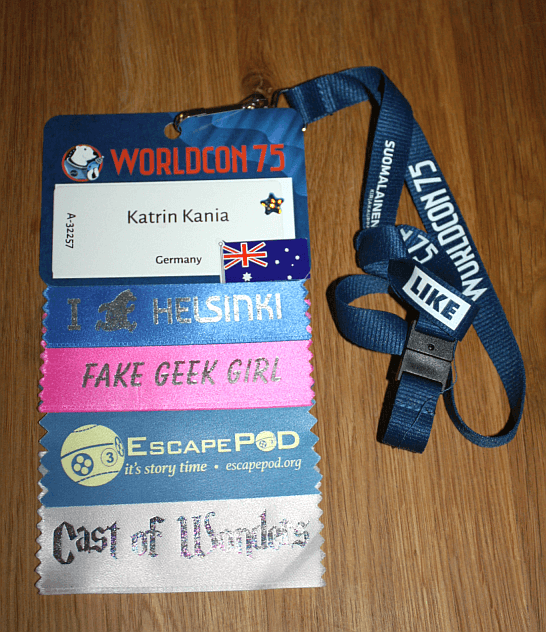
[caption id="attachment_3305" align="alignnone" width="403"]badge_2017 My WorldCon badge - you get the badge with your name on it, which is your passport into the Con - and then you can get ribbons to stick underneath. I actually managed to get more of them at LonCon, in spite of having much less time to walk around!


Since the last WorldCon I had been to was London in 2014 and I had a stall there, this was my first proper WorldCon as in "getting to enjoy all the programming". There was a little issue with that on the first two days, though, as the rooms were too small for many of the panels, and people queued up in huge lines outside of the rooms to be turned away when the room was full. This, understandably, led to quite a bit of frustration - but on Friday morning, the WorldCon team had relocated the panels to bigger rooms, and after that, I had no more problems to get into the panels I wanted to get into, even though the queues sometimes seemed insanely long.

Queueing sort of transformed into something like an art form, though - and certainly into something that felt like a characteristic feature of the event. Signs told you where to start queueing, and in some cases (and for some rooms) there were "end of queue for Room XXX" signs passed on to the last person in line, so that everyone would know which line it was. There was about 15 minutes time between panels, usually long enough to transition from the room you were in to the end of the line for the room you wanted to go to; then you'd stand (or sit) in line for a while before the doors were opened and people could go inside the room. The panels all starting on the full hour meant that there was a lot of people in the corridors at transit times, which was making the con feel very crowded at those times - it had the advantage, though, as someone rightly pointed out to me that there was no half-time overlap between things you'd want to see.

The programme items I went to were mostly really nice and entertaining, or at the least... interesting. I left two or three, overall, because they were so much not my cup of tea - and I soon found that one of the key things to enjoying WorldCon programming is not to have too much, or too precise, of an expectation. You see a title and a blurb in the programme, and it's either a presentation (usually by a single person) or a panel (which is more or less a podium discussion with a moderator) or a concert or show, or some activity thing where you can participate. You never know exactly what you will get, though, especially when it's a panel and the topic is wide, or vaguely defined. The panelists might end up talking about a side aspect for half an hour (and thus almost all the panel time), so if you have been wanting to hear about another side aspect, you're out of luck. Going in there with an open mind, though, happy to hear about any aspect of the topic and curious where the panelists will go with it? That made it really enjoyable in almost all instances.

Panel moderators, by the way, can really make a panel outstanding and awesome - or help it tank and deviate off-track. We figured this out pretty soon as well, and that helped me decide in a few cases which of the parallel programme items to pick (hint: those with the moderator that was an interesting person, or that I had seen in a previous panel, and both proved to be very good ideas).

One of the big programme items of WorldCon, of course, was the Hugo Award Ceremony - which we went to. I remembered the one from London as being rather long, but still entertaining and interesting - but in Helsinki, the Hugo itself was extended (a new category "Best Series"), and in addition, there were several add-on awards: a Finnish one and a Japanese one. This, together with the many different presenters that were introduced and in some cases had a bit of an interview as well, meant that the ceremony took a very, very, VERY long time, way too long for my taste. There also wasn't any show insert or similar thing to break things up a little once the ceremony really go going, apart from the thank-you speeches of some of the winners (thank you, Ursula Vernon, for your whale story!), and I am quite convinced that while a funny thank-you speech is a good thing and will always be appreciated, it is not the task of the Hugo winners to provide entertainment in an otherwise very long and relatively dull awarding ceremony. So next time, I'll spend the Hugo Ceremony time somewhere else and will check the livestream.

Altogether, though, the WorldCon was really, really enjoyable for me. It was half-similar and half-different from my experience in London, but I'll definitely consider going to another one in the future. Maybe Dublin in 2019? Maybe even with a market stall for the Dealer's Hall? Who knows...
0
AUG.
07
1

Time for the Summer Break.

It's already the start of August, and thus it is high time for a summer break! Our time off will include some time spent abroad with friends, and I'm so looking forward to that - usually we have the summer break a bit earlier in the year, and it really was noticeable somehow.

So, just like every year, this blog will go on summer break too, to relax, recuperate, and forget that things like work even exist.

It will magically update again on August 29 - when I will hopefully have caught up with accumulated email, wrestled down all the things that popped up during the break, and there will be new things to be looked at, and new exciting stuff to be undertaken.

So - have a good summer, everyone, and I hope you'll be back at the end of August, just like me!

 
0

By accepting you will be accessing a service provided by a third-party external to https://pallia.net/

Kontakt