







Latest Comments

Guest - Aislinn Dyestuff Citizen Science.
09. Oktober 2026
This is a great project. I look forward to the results. Thanks for letting us know.
Guest - Aislinn Time for...
09. Oktober 2026
Looks delicious!
Guest - Katrin Sprang Discussion
18. September 2026
Hi Rachel, I have looked for more photos of you, but that was not very successful. I found a link on...
Guest - Beatrix Sprang Discussion
15. September 2026
That lozenge pattern element is not a photograph, but a scan. So it should be to scale. But I pinned...
Guest - Katrin Sprang Discussion
15. September 2026
I was not referring to Rachel's reconstruction (is the reconstruction you refer to the one photograp...
MäRZ
19
0

It's... Lent.

I'm a little late to the party talking about things that one might do during Lent, seeing that it's already more than a week since Ash Wednesday - but better late than never, right?

Fasting times such as Lent is one of the things that fascinate me in a way as they are obviously a religious thing, but can also have a very practical aspect. This time of year is one of scarcity - before we had canning plants and freezers and large climate-controlled storage facilities and an overall abundance of food available all year round, the time of year just before Spring proper was when food supplies were running out, but there was little or no fresh food available yet. So having a period of fasting with severe food restrictions in this time of year was actually less of a harsh restriction than it would have been at other times.

It does still serve, however, as an opportunity to look again at what one has, and what one may eat and drink. In turn, the release of the restriction still means some extra enjoyment and festive feeling when Easter comes around (with fresh foods as well) - so the period of restriction enhances the impact of the feast, helping everyone appreciate what is available again.

In our modern days, there's no scarcity due to the season anymore, so the restriction for Lent might feel harder today. On the other hand, having a restriction with more impact probably does a better job at reminding how comfortable life usually is - which is also why quite a few modern people do not follow the "traditional" Lent rules, where there is no meat allowed, but make up their own fasting rules. One of the quite popular choices is to drink no alcohol during this time, another to forego all sweets. The idea behind this is that something convenient, or dear, is given up for a while; something that feels hard to give up, as a form of penitence.

The BUND Naturschutz (which is one of the eco organisations in Germany) has taken this year's Lent as an opportunity to ask people to "fast plastics" instead of alcohol, or sweets, or meat (or, of course, in addition to that). Plastics, especially single-use plastics, are everywhere in our consumer society, and they pose a huge environmental problem. So the BUND asks us to look at what we buy, and use, with an open and critical eye for this Lent period: Is the stuff packaged in plastics? If yes, is there a way to avoid it? Maybe something packaged in plastic can be made at home, with little effort and for less money than when buying it; maybe avoiding plastic is as simple as bringing a canvas bag; maybe it's just choosing another brand. Some things, such as milk, are available both in a tetrapack and in glass bottles; yoghurt can be bought in glass jars instead of plastic tubs.
While there are some people who actually try to go "zero plastic", I find it really hard or impossible to non-plastic in some cases. So I still buy some plastic-wrapped stuff - but I am trying hard to reduce it, and even if I am still creating quite a bit of waste this way, every single bit of the stuff that is not used helps.

So... are you fasting? If so, what? Or trying to reduce plastic? Or both, even?
0
MäRZ
13
2

Germany and Speed Limits.

If you are (or have been) in Germany, and drove a car, you will probably have made your acquaintance with it. If you've never been to Germany, chances are high that you have at least heard of it, and probably tried to imagine how that works...

...I'm talking about the lack of a speed limit on the Autobahn.

German Autobahn has no universal speed limit. So if your car goes insanely fast, you are allowed to go insanely fast. 300 km per hour? You're good to go.

Unless, of course, there's a speed restriction because of construction. Or because of a dangerous bend. Or too dense traffic. Or noise prevention. Or rain. So a good amount of the Autobahn is actually limited in speed (though there's also a good amount of drivers who just don't care about that, and go over the limit anyways).

In those areas where there is no restriction, you can go as fast as you like, provided you endanger nobody else. So if there's more traffic... well. You are supposed to slow down to a safe speed. Actually we do have the "Richtgeschwindigkeit", which is the recommended speed, and that is 130 km/h. Which, of course, is not the speed for lorries, as they are only allowed to go 80 km/h (which means they do about 90-110, depending on what they can get away with).

So driving on the Autobahn in areas with no speed limit means that you will have to overtake a lorry, or several of them, now and then - and that while you are in the left lane, something may come toward you insanely fast, much faster than you are.

That difference between speeds actually is what makes the Autobahn both more dangerous and, ironically, more prone to traffic jams that hold up everything - because these very fast cars have to brake hard when there's some slow driver (like me!) blocking their path, and that always means they slow down more than to just the speed of the car before them. If you get this a few times in a row (which is no problem on a medium-busy Autobahn), you have a so-called "Spontanstau", a traffic jam rising out of nowhere... which would be completely avoidable through, you guessed it, a universal speed limit.

There's a lot of solid, nice evidence for the general smartness of a general speed limit, and most countries have one. It means lower impact on the environment due to less emitted CO2, fewer traffic jams, and more safety as the number and severity of accidents drops. (Here's some info in German about this.)

Unfortunately, there is a strong lobby in Germany that does not want the German Holy Cow to be restricted in any way - and that includes speed limits. (About as smart as US weapon law... but I guess every nation has their brain fart.) I once got rid of a car club membership salesman in record speed when I told him I'd join their club in the split second they started advocating the general speed limit on the Autobahn. He was gone at high speed!

There is, by the way, one "car club" that does promote the speed limit - it's the VCD. Which also offers an accident and breakdown cover that not only applies to the car, but also to your bicycle, should you be on a cycle tour. (We're members. You guessed that, right?)

If you are in Germany, you now have the chance to join in on a petition to finally get a universal speed limit on the German Autobahn. There is an official petition running at the e-petition portal of the Deutscher Bundestag; you will need to register for that portal once, and then you can add your vote to the petitions listed there.

If you, too, think that this is a good idea - please spread the word!
0
SEP.
18
0

Please help save our forest.

One of the last old forests in Europe, the Hambacher Forst, is currently in danger of being razed.

The Hambacher Forst is about 12 000 years old. Yes, twelve fucking thousand. Its earliest mention in written sources is in a document by Otto II, Emperor, dated 973. The oldest trees currently standing there are 350 years old, and more than one hundred fourty highly endangered species live in that forest. You can read more about the forest on Wikipedia.

Now, if you are wondering why something like this is going to be felled... because RWE is of the opinion that the thing that we all need much more than a historic forest and really important habitat for endangered species of plants and animals is... brown coal. Yes. Brown coal. That dirtiest, most stupid source of energy that you can use these days.

Currently, the federal government of the substate of Germany the forest is in uses the police to clear the forest of activists, who are protesting against the raze. RWE plans to fell trees starting on October 1. The protests of countless people who want the forest to stay remain unheeded.

Yet.

There's still hope, and I hope that you are willing to help! Maybe, together, we can save the forest.

So what can you do?

Sign the petition on Change.org.
Send a letter protesting the forest raze via the BUND website.
Visit the Facebook page of the local government and leave a message there telling them you cannot believe they are doing such a thing.
Send a tweet to @ArminLaschet and/or @inascharrenbach with the same message. It need not be long. It need not be elaborate - it just needs to be another voice, and another, and another. (You can use the hashtag #hambibleibt if you like.)

And, of course, spread the word so others join in as well.

I'm here. I'm hoping. Please help.
0
AUG.
15
3

Wax Cloth in the Kitchen

For ages now, I've wanted to try out wax cloth, but somehow, I never got around to making it, or to really use the piece that I had, gifted to me from a friend years ago.

A while ago, though, things conspired to change that. First of all, during the Bernuthsfeld Man project, Jens and I made some wax cloth from linen (plus some tryout pieces from cotton) for the snack we had our Bernie double eat for the little film clip we did. Then, a bit later, another friend brought two bee-goodie cloths (German website) as a gift - these are handmade beeswax cloth pieces intended to replace clingfilm and metal foil. Most importantly for me, they had instructions for their use... and now I'm totally hooked on this alternative to foils, silicone lid thingies (which somehow never really worked for me) and clingfilm.

Basically it's cloth impregnated with beeswax, maybe with some oil or other wax mixed in. The cloth is relatively stiff, but that means you can form it around the rim of plates or bowls, and it will hold its shape when folded around other food as well. After use, you rinse it with some lukewarm water and maybe some dishwashing liquid; let it dry off and voilà, it's ready for its next use. It's a splendid alternative to clingfilm and plastic food bags, and with Earth Overshoot day this year happening on August 1, reducing this use of ressources a little is a good thing, definitely.

I've been using these to cover bowls, wrap food to take with me, and wrap food for storage in the fridge, and I'm not sure how life was before having these. They are really practical - and nice. The current extreme heat might not be the best circumstance to just pop things wrapped with wax cloth into a pocket, but there's always trusty boxes for that. And it will surely get cooler again. The only real issue I do have with them is that they are made from conventional cotton cloth - which means I won't buy any extras and instead make my own when I feel I need more of these.

Since I did not use clingfilm before, they are not reducing plastic usage in my case, but they do beat covering things with plates for sure. Plus it feels pleasingly medieval to wrap food in wax cloth...
0
JUNI
19
1

Another reason not to buy from Amazon.

I've written about Amazon and its shitty work ethics before, and I've been not ordering things from there for years now. But I was totally and utterly flabberghasted and shocked when I heard that Amazon is flat out destroying returned goods. The reason behind this, it seems, is that it's more lucrative for them to not sort returned goods ordered online back into the warehouses, but to just throw them away. Period.

This really floored me. I'm in the lucky situation that I very, very rarely get a return of goods (though you have the right to return stuff bought online, of course, if it does not meet expectations, based on German law), but I'd never have dreamed of throwing things away due to this. Admittedly, my "warehousing setup" is very small and very easy to keep track of... but, well.

It seems that the Big River Store is not the only one throwing away things that are returned - a study by the EHI Retail Institute shows that 55% of the retailers questioned destroy returned goods.

And there goes my happily ordering things online mindset. From now on, I'll always wonder what happens if I return something... and I used to order things in several sizes when I was not sure about which size would fit me.

If you want to read more about this, here's an article about it in German, and here a similar one in English. Also, Greenpeace is running a petition to illegalise the destruction of new and als-new goods.

 
0
MAI
28
4

The Tandem!

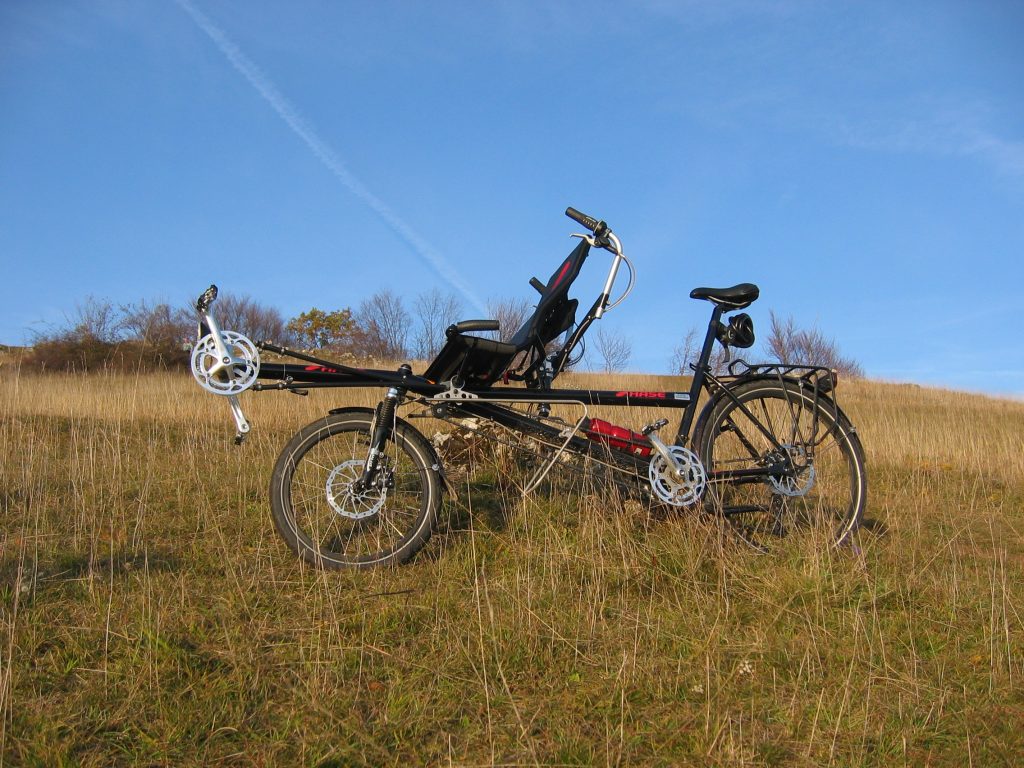
I didn't realise the tandem would be such an interesting thing, and get several comments right away! It is such a normal piece of life for us, and has been for years, that I don't think twice about it anymore. And yes, hauling stuff is very easily done with this contraption (but transporting wool was not the main reason we got it).

Back in about 2004/2005, the Most Patient Husband and I realised we would both like to go on bike holidays together, but our performance on bikes was, how shall I put it: slightly dissimilar. Slightly as in that famous race between the hare and the hedgehog, only without the hedgehog trick. (I was the hedgehog, by the way. Still am.) So the obvious solution was trying out a tandem, and we started right away to look for one with good luggage capacity to get holiday equipment onto the bike without having to add a trailer (which is the usual solution for tandem vacations).

We stumbled across a slightly unusual bike that way - the Hase Pino. Which was a semi-recumbent, and we'd never had contact with 'bents before, so it was all very weird and new. On this, you have the usual luggage rack that will fit three bags (two panniers and a topcase), plus an optional lowrider underneath that will fit another two large and two small panniers. Which sets you back a bit compared to two single bikes, but not so much.

So we went to our local bike dealer for special bikes, ZoxBikes - and he did have one of the tandems... so off we were for a test ride. The first metres were very weird, and the first corners doubly so, as the stoker (the one not handling the steering stuff) sits on top of the front wheel. Which means the captain (the one who does handle the steering stuff) has to guess where the wheel is, and the stoker has the feeling of going straight into a wall or the abyss that you can get when you sit in a bus right in front.

A little test round an a slightly larger test round later, we went home... and we got our tandem in October 2005.

Daniel_IMG_5068

It's a relatively pricey bike (you pay extra for exotics), it does have quite a few flaws (there are some technical details that are, well... questionable), but we haven't regretted our decision for a single second. We've gone on tours long and short, we've hauled all kinds of stuff with it, we've spent wonderful vacations in Spain and (most often) in England with this thing. We also use it as our main daily means of transport when we go somewhere together, year round - on spike tires in winter for safe riding.

So. That's the tandem story - or at least the first part of it. If you have questions, ask away in the comments, and I'll write more!
0
APR.
16
0

Oillight videos.

When I'm at the fairs, it's always fun to explain the simple yet ingenious principle of the oillight to people. A lot of them get just as excited about these little things as I am - especially those with a bit of a green soul and a bit of a love for tea on teapot-warmers, as it's possible to replace tealights with the oillight.

Explaining these things, I quickly learned that most of the visitors are really new to this old concept that's almost forgotten today: place a swimming wick-holder on top of some vegetable oil which in turn floats on some water in a glass of your choice. The wick will burn until the oil is used up (or you extinguish it).

Because the concept has been almost forgotten today, I ended up taking an explanatory video that runs on a little tablet in my booth - to help explain the thing, and show how the lights actually look when in use (safety restrictions keep me from just lighting one - no open fire allowed at any of the fairs).

Now I've finally managed to go over the oillight videos and get them embedded into my shop, and while I was at it, I did a translation of both of them (which for the German fairs were, obviously, subtitled in German). Yay! So you can now watch the show on my Youtube channel, when you are looking at the oillights in the shop... or right here:


0

By accepting you will be accessing a service provided by a third-party external to https://pallia.net/

Kontakt