Latest Comments

Guest - Aislinn Dyestuff Citizen Science.
09. Oktober 2026
This is a great project. I look forward to the results. Thanks for letting us know.
Guest - Aislinn Time for...
09. Oktober 2026
Looks delicious!
Guest - Katrin Sprang Discussion
18. September 2026
Hi Rachel, I have looked for more photos of you, but that was not very successful. I found a link on...
Guest - Beatrix Sprang Discussion
15. September 2026
That lozenge pattern element is not a photograph, but a scan. So it should be to scale. But I pinned...
Guest - Katrin Sprang Discussion
15. September 2026
I was not referring to Rachel's reconstruction (is the reconstruction you refer to the one photograp...
DEZ.
01
3

Pre-Festivity Baking: Gingerbread.

Due to my sort-of-newly discovered food intolerances, the baking this year is both a little different and, in a way, a little more important than usual. Having the typical cookies for the season was always important for me, and baking them became one of my personal traditions years ago - I think it is more than a decade by now. (Wow. Time really flies.)

Traditionally, though, I only made cookies. A few things were not home-made, but bought - such as Lebkuchen (gingerbread). You might have heard of the Nuremberg Gingerbread, which is a speciality, and apart from the few very big producers of said food, there are small bakeries that have even better gingerbread. Which, however, always includes a few things that I cannot or do not want to eat these days, such as wheat flour (in the wafer at the bottom and usually also a little in the dough), soy lecithin (in the chocolate covering) or glucose-fructose syrup (in the candied orange and lemon peel, as well as in the apricot jam sometimes added).

That is a pity. And a bad thing, because this season without gingerbread? It's unthinkable for me. Which is why I had to trawl the 'net for different recipes until I found one that comes close to the recipe of our previous favourite gingerbread maker. I reduced the sugar content, though, and upped the amount of nuts and almonds.

Just in case you want to make some, too - here you go:

8 egg whites
200 g brown sugar
10 g salts of hartshorn
200 g marzipan (I use marzipan paste which has less sugar and more almonds)
200 g hazelnuts
600 g almonds
100 g lemon marmalade with peel (substitute for the candied peel)
100 g orange marmalade with peel
120 g honey (use an aromatic one)
50 g apricot jam
30 g gingerbread spices
pinch of salt
flour as necessary

Beat egg whites and sugar for several minutes, until the sugar has dissolved completely. Grind nuts and almonds (I use half of them finely ground, half more coarsely). Mix all the ingredients into the beaten egg-sugar mixture; tear the marzipan into small pieces first so it will dissolve better.

The dough should be viscous and sticky. If it's too liquid, you can add in some flour of your choice, or more finely ground nuts. Let it stand in a cool place overnight (or at least for a few hours) before baking.

For baking, place portions onto a silicone baking sheet, baking paper, or place portions of the dough on the traditional wafer thingies. Bake for c. 10 mins at about 200°C. The gingerbread should be slightly toasted brown on the outside, but still moist on the inside.
0
OKT.
15
1

Autumn has come.

These days, the light has become golden, and leaves are starting to fall off the trees in nice autum colours. Mornings and evenings are colder, and I'm waiting for the first leaves of our willow fence to fall off, too - they are still hanging on, but are getting yellow more and more.

Now, autumn is definitely pumpkin season. Not only because of yummy things you can do with pumpkins, but also because of the pumpkin art that is done around Halloween (and yes, Germans do enjoy that too). If you are looking for some inspiration, look at this gallery of pumpkin carvings.

And should you be one of those that like a bit of garlic in their pumpkin meal, here's a nifty trick for peeling a lot of garlic, really quickly:


0
SEP.
16
0

Gratuitous Cat Pics.

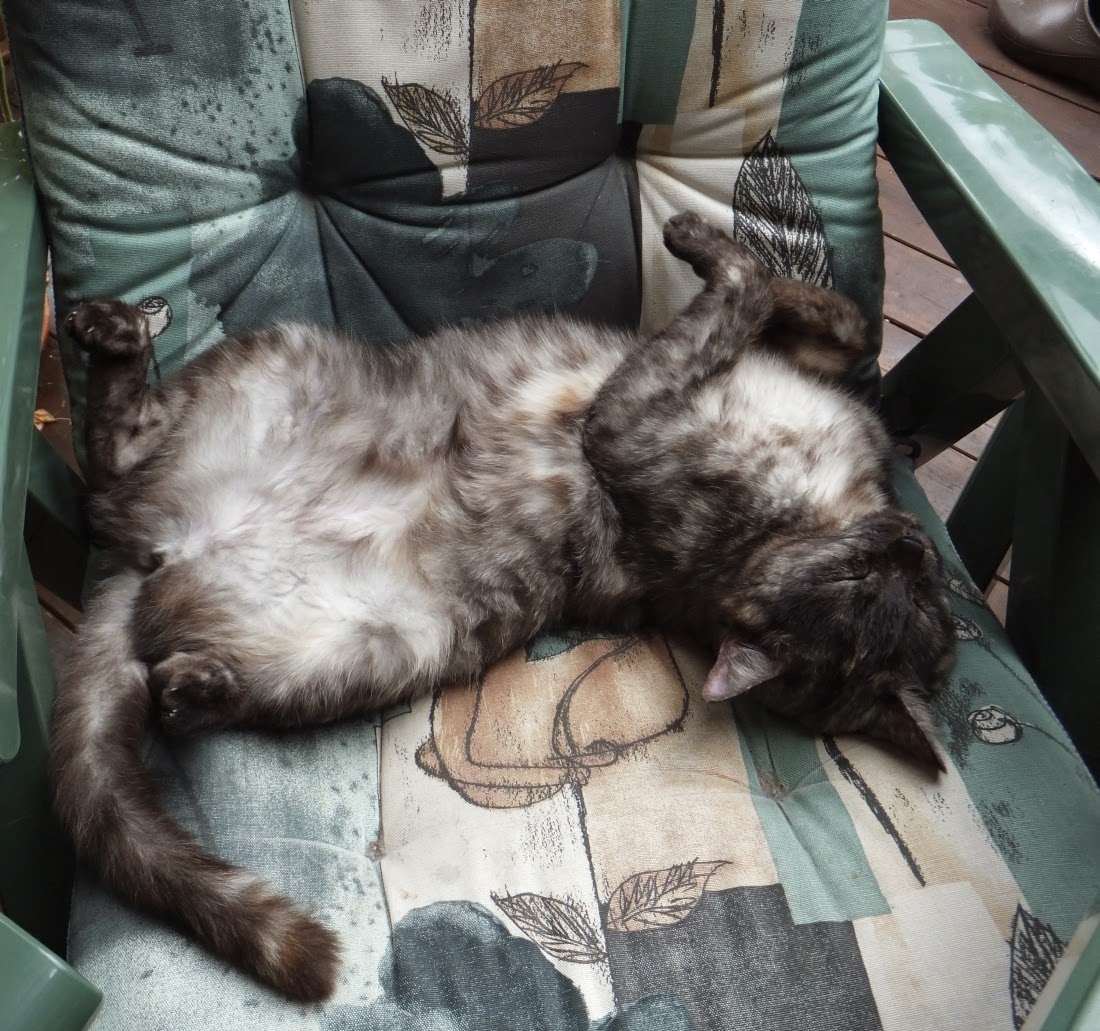
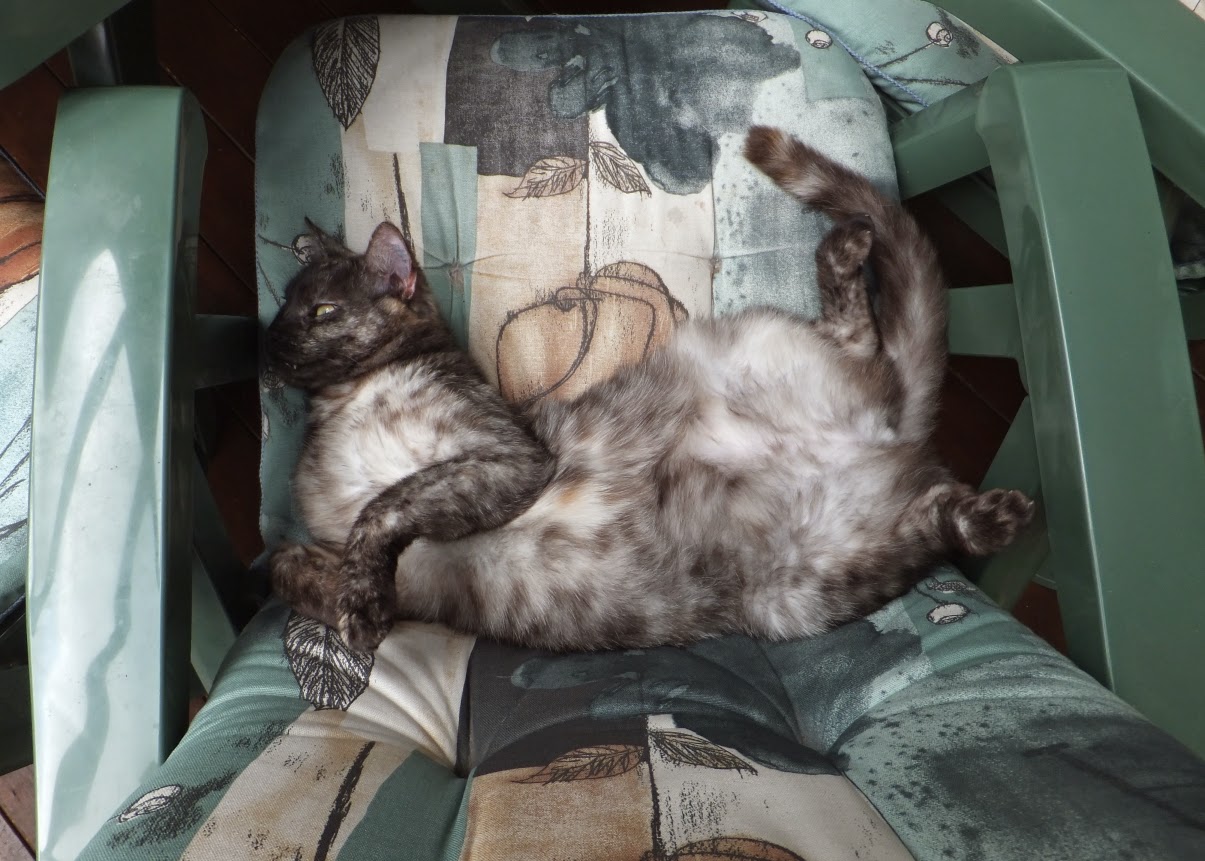
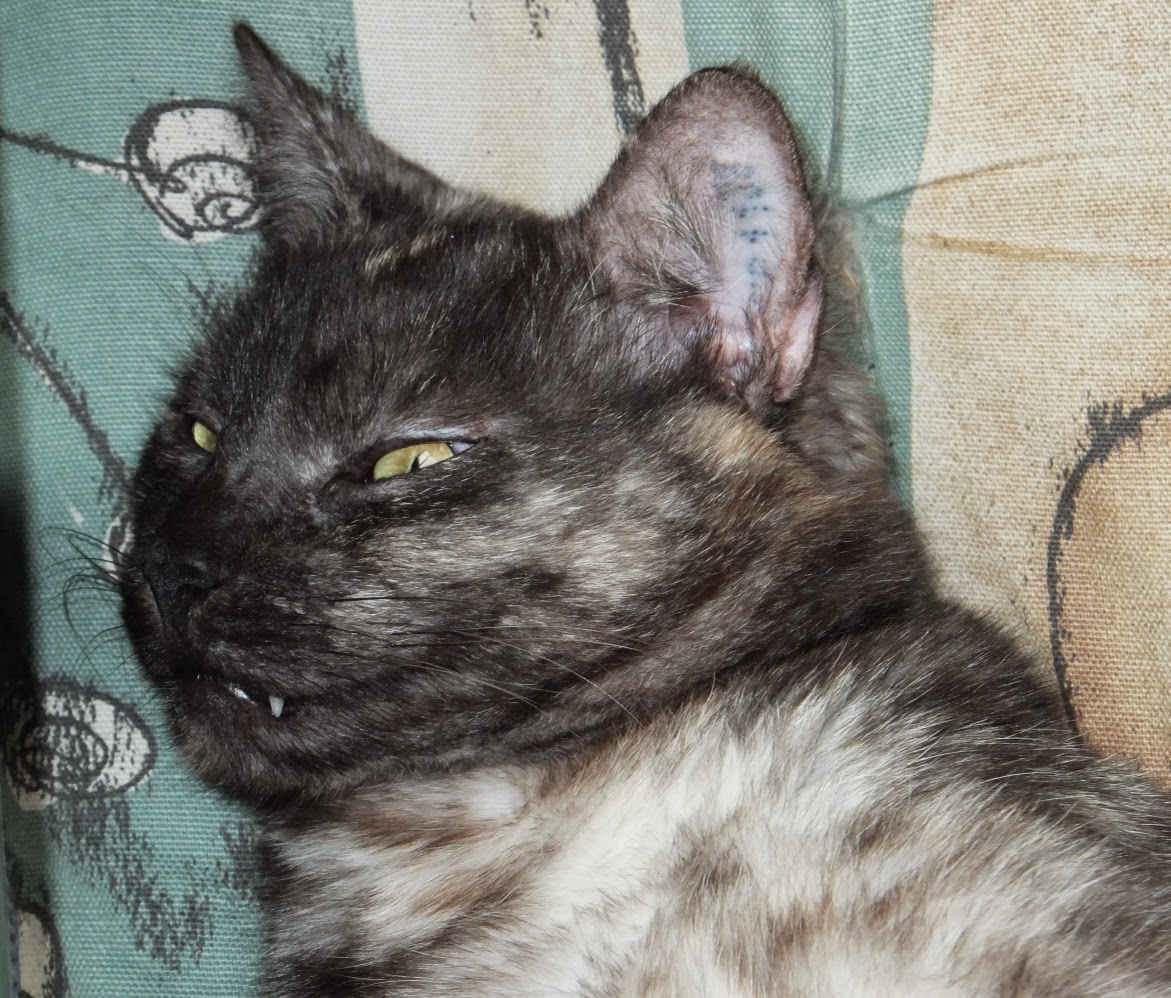
It has been way, way too long since the last cat pictures here. And this weekend, Madame was sleeping especially... um... curiously, so here you go.


Portrait of a Sleepy Cat with Vampire Teeth:


Sleepy Cat Snoozing on her Back:


Not Elegant, But Oh So Comfy:


She's having a vet appointment today, so she'll be less relaxed and comfy this afternoon... but surely everything will be fine again in the evening.
0
SEP.
09
0

Foooood.

I've been blogging about food before. Naturally, since it is a thing that I enjoy a lot. (Especially baking. I've been called a "cake extremist" recently, and man, I'm proud of that. My cakes tend to feed legions.)

With my recent forays into different-nutrition-land, due to the elimination diet, I have read what feels like gazillions of articles about food and what you should eat, and what not. Eliminating a lot of the previous staples and mainstays of a diet does pose a challenge, and I was happy to find that there are a lot of suitable or almost-suitable recipes out there already. You can find them if you search the 'net for "paleo AIP recipe". AIP stands for "Auto-Immune Protocol", and that's basically the elimination diet scheme. It is a sub-section of eaters who eat what they call "paleo".

Now. I'm of the opinion that "who heals is right" - no matter what the approach. But I am also, due to my profession, attentive to things such as proper terminology. And calling a modern diet "paleo"... that just... gah. GAH. (I'm not alone in that, by the way! See here. Or here, where "archaeologists officially declare collective sigh over the paleo diet". I'm in!) I have enough colleagues who try to learn more about diets from the past - medieval, 19th century, and inbetween - and if you talk to them at any length, one of the things guaranteed to come up is the impossible task of sourcing raw materials that are like they used to be back then. (Just like in textiles. Ah, I can so relate.)

Mind you, we're talking about foodstuffs less than 300 years old, in some of these cases. Or less than 2000 in most. Paleolithic stuff? That's at least 12 000 years ago. More than twelve thousand! Folks! We know about nothing on how food was back then! (I blogged a very nice video about that ages ago, by the way. Here.)

There are a few other things that irk me. Some are due to personal tastes, such as the liberal use  of coconut flour about everywhere where baking is concerned, or the liberal use of other coconut products. (I like coconut a lot - but only in very specific circumstances. Not everywhere.) Some are due to a different personal stance on things, such as the declaration that sugar is really, really bad because it's so nutrition-poor and has been processed so much - but then these same authors happily use stevia (processed) or other weird sugar replacements, also very much processed; or honey which is less processed and yes, not as nutrition-poor as honey, but not that far away from sugar either. (There are some who agree with me in that stance, though. Like this one.)

So. My summary? There's this scene that calls itself "paleo". While the name still makes my hackles rise, a lot of the articles and essays on nutrition for healing are interesting, helpful, and do give food for thought. As always, though, every person is different, and different things will work for each and everyone, so finding out things for yourself is still the thing to do. That said, the recipes - both "normal paleo" and AIP - are really worth looking at, if only for interesting combinations of things to cook or prepare. And if you suspect having a food intolerance, they will be insanely helpful when you try to figure out what to eat and what to forego.


0
SEP.
01
5

Personal.

This post is personal, and it's health-related. If that is the last thing on earth you want to read on this blog, I'm sorry and suggest you go somewhere else for today's reading. It's personal, and I usually try to limit personal things here, due to different reasons - but this is something I feel a need to blog about.

There's such a thing as invisible illnesses. Invisible illnesses are, well, invisible (just like the name hints), and that is one of the hardest things about them.
If you break your leg, you go to the hospital and get a cast - and everyone can see that you have a damaged leg and will thus not be able to do some things. However, if you have an invisible illness...

And there are many, many invisible illnesses - in all levels of severeness. Diabetes. Lupus. Chronic Fatigue. Hashimoto's. Depression. And lots and lots more. Being invisible, it's quite probable that nobody will tell you to go see a doctor. To make things even more nasty, these things can sneak into your life better than any ninja - they can come on so gradually you never even realise something might be wrong, until you suddenly realise that things are so bad you can't do this, or that, and that too.

I've been losing energy and instead gaining weight slowly and steadily over the past few years, with no discernible changes in my eating patterns. I've also started getting slightly swollen feet in summer heat. It crept in really slowly, really gradually, and I could not see any pattern to when my feet would be bloated and when they would not. Movement helped, sometimes, as did propping them up. Since my legs are too short for most chairs, I thought maybe sitting on too-high seats was partly to blame. I tried drinking lots and I tried drinking little, without effect, and finally I just sighed and thought it might be a part of getting older, and the body's changes that go with it.

Then the last bit of last year and the start of this year got very, very busy - big museum projects, preparing events, and the NESAT conference. I was feeling fatigued before, but after NESAT, it seemed like I just could not recover. I had no energy left. I woke up thinking about the things to do that day, feeling good enough to tackle them all, but by the time I had been to the bathroom and found my way the 6 or so metres to my desk, I was all tired and lackluster again. Clearly, something was wrong. Really wrong. The ninja had finally stumbled into the spotlight.

So I did what I always do when something is wrong, or a problem: I read the Internet. This time, I read what felt like all of it. And found out that I might have issues with my thyroid, and possibly general hormone levels, and that both might be connected to auto-immune problems. And those, in turn, might be connected to food intolerances that are so low-level, or developed so gradually, that I just never keyed on to them. I got myself a doctor's appointment, but that would be about two weeks of wait. Clearly, something had to happen before that.

Since I had already read about all the Internet (haha), I had stumbled across lots of sites connecting gut health to overall health, especially to auto-immune issues and disorders. They all recommended special diet versions that differ in details, but are all basically aiming to rule out anything that might irritate at first, then gradually re-introducing elements to test whether they are tolerated or not. So I decided to take the plunge, and I opted for one system recommended by a doctor that specialises in hypothyroid issues. (Basically, it was just to pick one of them. A proper strict one, because I like to jump into things full throttle. Even when I'm sick.)

That was a diet that rules out about everything except vegetables, meat, fruit that are not too sweet, and herbs. That was a large change, but to my great relief, it did work almost instantly. I won't count the first three days or so of it, because you never know how much of a placebo-effect that was, but after the first days, I lost quite a bit of water weight, the swelling in my feet went down, and I had more energy again. Still not up to normal levels, still needing more rest than usual, but it was definitely an upward trend.

Meanwhile I had that doctor's appointment, and nothing looks so very bad - I lacked a few vitamins and minerals, and thyroid levels were not perfect, but also not too far out of the ordinary. Now I am in the stage of figuring out what is good for me, food-wise, and what is not. That is a lengthy process with a goodly amount of documentation and deduction (and some guesstimates), and it makes eating not at home a little difficult - so I have turned into a person that lugs food around, just in case. The first few culprits are already found, too - though my tastebuds really love fried or cooked onions, the rest of me does not agree that they are a good thing. And then I had two oat biscuits recently, which tasted lovely but raised havoc later. There are a lot of things left to test and try, but at least I can find out what works and what doesn't. (There is, by the way, no other sure way to determine food intolerances but the elimination-provocation approach; any tests are iffy at best, a waste of money at medium, and harmful due to wrong outcomes at worst.)

The curiousest thing, to me, is that I never had any discernible issues with any of the foods that are now off-limits or suspect before. It just drained my energy and made me less healthy overall, to a point where I could not function well anymore. If this happened to me, it could happen to someone else, with as little clue about why things become harder as I had. And that, dear readers, is why I think this is an important thing to share.

So... should you suspect a food intolerance doing bad things with your guts and your life, I can tell you, from my own experiences, that an elimination diet may sound awful, but might be just what you want. I won't say it is easy - you have to go without a lot of things for a few weeks, after all, and with many things for quite some time until you have re-introduced them. It's not all bad, though. My appreciation for high-quality foods, my cooking-fu, my knowledge about the human innards and the human immune system, and my resourcefulness in packing food* have all benefitted from this diet change. As has my appreciation for my friends, who after a short second of being shocked did their very best to support me and went several extra miles, in some cases, to make sure that I could eat with them. Friends are wonderful. Feed them to the best of your abilities - they might return the favour one day when you really need it.


* Very soon, I developed a more-or-less-healthy apprehension that I might get hungry and not find something that I could eat, resulting in packing emergency food (and plenty of that) in case of travel. The masses of food that I brought to Herzberg? Ridiculous. (Just enough, though.) Considerable amounts of food also travelled with us to England, and then through England, for our vacation. (Optimised for packing space and weight-to-nutrition-ratio, of course.)
For parties and similar things, I also found that it is immensely helpful to have something to eat that is both delicious or appealing to me and safely within the limits of the current diet - just in case everyone else enjoys something I cannot have. Food envy, to me, was the thing I feared most, and the "pack your own" strategy works beautifully for that.
0
AUG.
29
0

Almost done. Down to books now.

I have told you about the people, the podcasts, my presentation... but not, yet, about the books. As was to be expected, there were a lot of books at LonCon, at various places. There was a library where everybody was invited to take home a book (or as much as you could carry during the last two days). There were plenty of book-seller stalls in the Dealer's Hall, offering everything from used books for small money to signed special editions, wrapped in cellophane. (I did not enquire after their prices. For me, books are there to be read, and while I try to treat them kindly, I do not mind if they look used after a while. That's their point - to be read. At best, again and again and again.) And, of course, a lot of new ones, freshly out.

Such as my friend Gillian Polack's new time travel novel Langue[dot]doc 1305. Obviously, I had to get a copy of that one. A time-travel novel written by a proper historian! And so new it's not even the real book yet, but the uncorrected proof version. Only very few of these were printed, so if you want to give that a read, you should be quick... or have to wait for the final version. Gillian, by the way, has a lovely quirky evil sense of humour, which I know all too well through our endless chat conversations when we work together on our co-writing project. Go buy her book, it will make her happy, and she deserves that. Go buy all her books, while you are at it.

Our two right-hand table neighbours also sold books - Clare Davidson writes YA fiction about hidden races in our world, and you can have a look at what she writes and read excerpts here. Chuck Ian Gordon writes fiction about near-future AIs in MMORPGs, and there are excerpts of the German original and the English translation on his website, too.

I also went to one of the used book stalls and made good use of a ten-pound note and their offer to get a 6th book for free if you buy five. Well... I scored a book by Spider Robinson that is not from his Callahan chronicles (which, if you like puns, is a total must-read). And then I picked things that sounded interesting and that I did not know yet - one book by David Brin, who with "Rivers of Time" now has become one of my favourite authors. The "Exiles Trilogy" by Ben Bova, and that is another author I want to read more of. Plus some others that I have not read yet and that did not ring any bell. Yay surprise books!
0
AUG.
27
0

More from LonCon.

LonCon was lovely, as I already told you. Unfortunately, as announced on the LonCon website, the next two worldcons will both be in the US of A - way, way too far away for me to go. (Seems that there is a very strong bias towards Worldcon in the US, something that has been criticised before - why call it "Worldcon" if it's "Mostly Americon"?)

I do hope it will be in Europe again in 2017, and I don't care whether it's Helsinki or Dublin. Both are comparatively fast and easy to reach from good ol' Germany, as opposed to about anywhere in the States.

But enough moaning - here's one more gem that made us laugh and go "ooh" in awe, both at the same time. Diagonally across from our table, on the front end of the next table island, sat an artist demonstrating her work: SoMK. She was featured on the LonCon Artist list, but of course I didn't read that. She had things in the art show, but I almost didn't manage to go in there in time... so I feel lucky that her table was so close to ours, or I might have missed her. Go look at her art on Deviantart - I especially loved this one, and it was even possible to buy a postcard with the print. SoMK also has a flickr collection.

(If you fall in love with one of her pieces - there are prints of a few of them, and there's a message function in Deviantart. Also, the originals in the LonCon art show were very, very fairly priced in my opinion, should you prefer an original...)
0

By accepting you will be accessing a service provided by a third-party external to https://pallia.net/

Kontakt