







Latest Comments

Guest - Aislinn Dyestuff Citizen Science.
09. Oktober 2026
This is a great project. I look forward to the results. Thanks for letting us know.
Guest - Aislinn Time for...
09. Oktober 2026
Looks delicious!
Guest - Katrin Sprang Discussion
18. September 2026
Hi Rachel, I have looked for more photos of you, but that was not very successful. I found a link on...
Guest - Beatrix Sprang Discussion
15. September 2026
That lozenge pattern element is not a photograph, but a scan. So it should be to scale. But I pinned...
Guest - Katrin Sprang Discussion
15. September 2026
I was not referring to Rachel's reconstruction (is the reconstruction you refer to the one photograp...
SEP.
26
3

Reading the correct version of instructions... helps.

There are a few never-ending things in my life. The Neverending Spinning Experiment, for instance. Or the Neverending Quest for a Publisher for the English Version of my thesis (though there is some movement on that front recently, I have not given up!)

Now, I'm thinking of adding one more item to the list: the Neverending Skew Socks. Skew is a pattern that was published in Knitty back, oh, about four years ago.

It clicked with me straight away. Now, I'm not a big knitter, and I'm not fast, but I like socks. So I ventured out to knit me a pair of Skew socks... and found, quite quickly, that they do not fit my foot. At all. My instep is way too high for them as written.

However - I wanted those socks. Really badly. So I ripped back and fiddled and thought and measured and math-ed some and then some more, and at last I came up with a method that worked. I knit a pair of socks and placed the instructions to the side - for later use.

Time passed, our vacation came up, and I wanted to take some knitting - something small, half-mindless, and nice. I typed off the pattern and took a ball of sock yarn. I knit and knit... and there was that bit in the pattern where I wondered, huh, that looks a bit weird... but I knit on.

Back home, I found that I had skipped into the wrong line when typing the hand-written pattern into the computer. So I ripped back... both socks (two-at-a-time magic loop). Quite a bit. And I knit that part again... correctly, this time. And progressed into the part that I had had almost finished before.

Then I proceeded into the heel part. I knit a bit, and then some more, and then some more... but not much more before I realised that something was decidedly wrong. I was missing stitches. Not only 6 stitches (as before) - this time, it was twenty of them. Now, 20 stitches at sock gauge... that's a lot. A freaking lot.

I went to look for the missing stitches. Had I skipped a section when copying the pattern? Nope. After a goodly while of checking, I found it... I had written a sequence of pattern lines into my hand-written notes, marked them and smeared something like "This!" at their side... but not crossed out or corrected the old version. The old version that had, you guessed it, 20 fewer stitches. And when copying the notes, I had not looked beyond the valid-looking set of instructions...

So the next step in my Skew journey: Correct my digitised instructions, print them out again, and rip back both socks (again, gah!) to where the mini-gusset increase starts. Sigh. The Neverending Skew Socks. If only they weren't so funny...
0
SEP.
24
1

Things are developing.

While the garden slowly goes into Autumn Mode (less flowers, more seeds - which also brings more birds), things in the house and in my brain don't. Well, there might be more craving for hot chocolate (or normal chocolate), but otherwise there is no rest for the wicked notoriously curious.

One of the developing things: Plans for the next Textile Forum. Yes, I know, I haven't wrapped up the last one yet - but still. Another one is a joint project with three other people, and it is sort of an offspring of the eternal Spinning Experiment. More is to come soon, and it will include the possibility for spindle spinners to again join in some research. (It will possibly also include me becoming a bit more active on Ravelry.)

In other news: Cathy has thoughts about Neanderthals and clothing, as well as a linky bit to a nalbinding article in a journal on her blog.

There has been a textile find (link goes to a German newspaper) from 12th century in a German church as well - I hope that we'll get a more detailed account about that soon, too!
0
SEP.
20
2

There should be a law.

One of the topics in the Forum this year was embroidery - a lovely topic. It was also a wonderful and really fascinating piece in the focus of the paper. The only unfortunate bit? The piece (an embroidered late antique tunic from the RGZM Mainz) had been conserved and placed onto a stand in the main exhibition so that the back of the embroidery is not accessible - and there are no photos of the back.

Now, if you are an embroiderer, you will know that the frontside shows the picture and the backside tells the story. Which stitches were used? In what direction were they worked? How were starts and stops (or larger gaps between similarly coloured batches) handled? Was the worker sloppy or neat? Which parts were worked first? All this... discernable only from the backside.

So I will repeat the There-should-be-a-Law thing that I posted already ages ago - I mentioned it at the Forum, and there was general agreement, by the way.

There should be a law that makes anyone writing about an embroidered piece to post at least three good quality photographs, showing a) the complete piece with measurements given in the text; b) a close-up (or several) of a detail, showing all the stitch techniques and materials used on the piece, together with a ruler or other size indicator on the photo; and c) a close-up of the back side of exactly these said details, also with a size indicator on the photograph.
Because it's the backside that tells the story, and the detailed view that makes it possible to listen to that story.

Now we only need to make it a real law. Any helpful suggestions on that?
0
AUG.
28
3

Ah. The old myth.

It's been a while since I last heard (or read) it, but today was the day. Someone on Facebook, in a group for Experimental Archaeology (including Experience Archaeology) posted it.

"Unfortunately, the modern tailors just do not stitch as fast as people who started as children and have sewn all their lives."

I've heard this a lot over the years. Now that I think of it, though, I get the suspicion that it was predominantly textile stuff... spinning, especially, as well as sewing.

Well. Here's what I think.


Modern crafters are not necessarily slower than their historic counterparts. First of all, individuals have different working speeds (then as now). Once you have reached the end of your working speed development, there you are. I've tried sewing as fast as I could, so I'd see how much of a difference it would make. The result? I was not faster at all compared to working at my relaxed normal speed, only the seams were not as nice. Unless I have to get acquainted with some new fabric, or fiddle with a particularly difficult bit of seam (such as a weird corner), my normal sewing speed has reached my personal maximum, and that's where it will stay.
 
It's perfectly logical, too. Think about it: If you are running every day to become a faster runner, you will at one time find your maximum - and that will be it. There'll be fluctuations, of course, but there's an end point to speed.
Similarly, crafting speed has a limit somewhere and you can't get indefinitely faster with more practice. If that would be the case, it should not be possible to see the needle, or shuttle, or hammer, or saw of a very experienced crafter with 30+ years of daily practice anymore, because that thing would move that fast. Just like our materials have limits, and our tools have limits, so does the range of movements and the maximum possible speed of going through those movements while still efficient.

Thirdly, "crafting speed" is hard to compare between individuals, as you do not know the exact circumstances of the work and the exact materials. There's a difference between spinning raw wool fresh from the sheep or clean combed wool. There's a difference between forging something from iron or from high-carbon steel. There's a difference between sewing a heavy silk or a loosely woven linen. There's a difference between carving a spoon from wet hazel or dry oak. And that's not even taking into account the use of different tools, or working styles.

I am firmly of the opinion that there is no reason why a practised crafter today should not be as fast as a practised crafter from 10, 50, or 500 years ago.
Case in point: There is an attempt at calculating the approximate time spent on sewing types of garments in Textiles & Clothing (the London publication) from documented garment prices and tailor wages. The times do roughly match the times that I need for tailoring and hand-sewing the same types of garments. (The day I discovered this? That was a happy day for me, and the first time I really started thinking about this "we are never as fast as they were" thing.)

What do you think? Have you been told that we can never reach the fantabulous speed of those gone by? And, most interesting to me: Have you ever heard that applied to something outside of textile context?
0
AUG.
26
1

Dear Internets...

Dear Internets,

a goodly while ago, I was a very happy woman because I found a picture. Those of you who have been researching stuff and looked for helpful pictorial sources will know exactly what I mean with that. (For those of you who don't: Imagine finding a winning lottery ticket that buys you a lovely evening out with your loved ones.)

I found a picture of a textile-related contraption. It was perfect bliss.

And then I did the Stupidest Thing Ever to do with sources just found. Those of you who have been researching stuff will probably know exactly what that is. The STE is the following thought: "Oh wow, finally! This is very good. And now I know where to find this source. I WILL BE ABLE TO REMEMBER WHERE IT IS." followed by the corresponding action, as in not writing down in at least one place where one can reliably find the info again where it was. Or marking the book. Or both. Plus, maybe, adding a few hundred more notes in other places.

I did one little test run with something cobbled together very vaguely resembling the basic concepts of that contraption. It seemed to work. I put it away to do some more research and test driving and planning to eventually do a reconstruction.
Then, things happened just like they tend to do: Stuff came up, stuff had to be dealt with, stuff was dealt with, more stuff came up, the projects in the drawer stayed in the drawer.

All that must have been more than a year ago in the meantime, and I cannot find that picture again. So it's time for me to bleg for some help - maybe you have seen the picture (or a similar one).

The contraption was for weaving tape (ribbon, band, narrow-wares) with a rigid heddle. It was basically a board lying on a table, the rigid heddle firmly set onto that board at about the front, and behind it with some space between them was a short upright round piece of wood. The warp was wound around that upright dowel and ran through the heddle; the woman weaving held the band (obviously moving it up and down to change shed) in one hand and shuttle and/or other tools in the other hand. I think the already finished band was also wound around a dowel that she held in her hand.
That's what I really remember (or am quite sure about). The rest of it? I think she was blonde, sitting with mostly her back turned toward the viewer, in the foreground of the picture, and I think she was wearing a green dress. It's having a late-medieval feel in my memory, and it may or may not have been a depiction of Mary.

So, dear Internets, I would be so, so happy if you could help me find that piccie. Because you know, yesterday I set down and fiddled with something prototype-like, and it totally works and is lovely to work with... and I'd so love to compare with the picture before I do a final version.
0
JULI
17
2

Experimental stuff - it keeps you on your toes.

One of the things I love about archaeology, and especially experimental archaeology, is how it keeps you on your toes and gets you to suddenly learn stuff about things you never tended to think about before.

As in - did you know that beeswax actually starts to melt at around 40°C, not the 60+ that are usually stated as its melting point? And that the temperature depends not only on the species of the bees and maybe their location, but also on who made the wax and how old it is? I learned about that yesterday. I was not as successful in finding out the melting point of natural pinus pinea resin, though (if you should have a helpful hint, I'd love to have it).

Today, I am trying to find out about the temperatures used in traditional batik techniques. Looks like they dye above the onset of melting of beeswax... and tomorrow, if everything goes according to plan, I will finish the thinking and planning and write down a plan to follow for the actual testing. There's a few sticky points still to solve - how to get the mixture out of the cloth again, how to make sure that everything is dyed at the same temperature but with no bad side effects from stuff touching, how to ensure an uniform temperature for the mixture application, and some more pesky details like that.

And now... on to more hunting of .pdfs, and finding out about melting points and possible sources and temperatures and processes. 

(For those of you who have not guessed it yet: It's all about the resist dye technique test runs at the Textile Forum.)
0
JUNI
28
4

Hairnets.

For years now, one of the almost forgotten techniques that are dear to my heart is (filet) netting. If you've seen one of those dainty, almost-nonexistent hairnets in the medieval part of a museum exhibition? Those are made by netting.

Contrary to what some people think (and some write), this is not the knot and the technique used for making fishnets. It's a different tool, a different method, and a different result - fine, small-meshed nets that can be used as hairnets as is or embellished with embroidery.

To keep the technique from dying out, I've tried to do my part - I sell the filet needles (replicas after a find from 14th century London), I demonstrate netting, and I teach the technique. Since many visitors do not know what that peculiar double-eyed needle is for, I usually place a finished hairnet close to the netting needle in my stall.

And occasionally, I will get The Question. The Question is a variation of "Do you make these for sale?" or "How much is such a net?" and is hard to answer - because most of my demonstration hairnets are ones that I used to try out a new technique, or material, or embellishment (like the ones with the pearls). Some of the work time was also clocked during demonstrations or at events, and you never work full speed on events, due to all kinds of distractions. That means that even though I recorded the time needed, it's not the realistic time for making one simple full net with suitable material, in the surroundings of the home workshop.


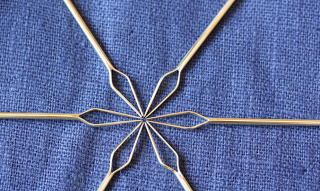
Netting needle eyes.

This has happened more often lately, so I have set out to do exactly that: Make a reference net of sturdy, white silk thread, in 4 mm mesh, aiming for the finished measurements of the late 13th century hairnet from London. I have started out yesterday, and I've about finished the crown part - next will be the interesting bit of doubling the number of mesh. (This, together with the start, is one of the fiddly bits in making a hairnet in the round.)

The clock is running. A hairnet, let me tell you, is not a thing made in an hour or so... it takes its sweet chunk of time. I'm not sure on whether it will be saleable, as it is - I have been pondering some alternatives to making it completely by hand, in order to offer a more affordable variation, but that will need some more planning.

If you have considered getting a hairnet, or have made one yourself, I would be happy to hear your input - such as how much you would be willing to pay for a (completely handmade) net, or how long it took you to make yours. Cheers!
0

By accepting you will be accessing a service provided by a third-party external to https://pallia.net/

Kontakt