Latest Comments

Guest - Aislinn Dyestuff Citizen Science.
09. Oktober 2026
This is a great project. I look forward to the results. Thanks for letting us know.
Guest - Aislinn Time for...
09. Oktober 2026
Looks delicious!
Guest - Katrin Sprang Discussion
18. September 2026
Hi Rachel, I have looked for more photos of you, but that was not very successful. I found a link on...
Guest - Beatrix Sprang Discussion
15. September 2026
That lozenge pattern element is not a photograph, but a scan. So it should be to scale. But I pinned...
Guest - Katrin Sprang Discussion
15. September 2026
I was not referring to Rachel's reconstruction (is the reconstruction you refer to the one photograp...
APR.
01
0

Busy busy.

I'm busy as a bee this morning, with all the usual last-minute packing and sorting for a workshop to be done. The printer is churning out my workshop papers right now, there's a goodly sized heap of stuff sitting here waiting to be carried into the car, and I'm all but chomping at the bit to go. And really, really looking forward to getting people to play with gold thread, plant-dyed silks and the best quality linen I've seen in ages. Good materials - good feeling while working.

Since I'll be far from here (why can't Vienna be closer to home?) and will be there some days - a meeting for Textileforum is planned for Monday - there will be no blogging until Wednesday next week. However, if you're in Vienna or close to there, you can stop by on Sunday evening, when there's a little "bazar" starting at about 18:00 in the Tympanum (Eulenspiel) in Prinz-Eugen-Str. 6 in Vienna. You will be able to shop in the book assortment that Gregor from buchportal.at is bringing, as well as browse my collection of odds and ends connected to historical textile techniques.
0
MäRZ
22
2

Sunshine! Spring! A bleg for information!

There's fine weather outside, my little bicycle is equipped with normal summer tyres again, and somehow I feel like sitting in the sun and propping up my feet instead of working. But there's stuff to be done, of course.

My computer spring cleaning has yielded an amazing amount of free space on the hard disk, and there's still a good number of files to be deleted. The garden is mostly fit for the season of growth. My paper is coming along, with some more time for working on it scheduled for today. Bookkeeping is up-to-date for a change, and the new price list for the next season is almost finished. Almost... which leads me to a question.

I have found a source for good, fine and high-quality linen fabric, with much finer yarns and denser weave than normally available on the market. All of the four fabrics are perfectly suited for medieval embroidery, three of them also for counted work. And now I'm trying to decide whether to include pre-cuts in my stock of wares on offer or just sell it by the metre. Three of the cloth bolts are fairly wide, with 160 or 185 cm fabric width, so buying a metre would mean a lot of cloth.

Do you buy pre-cut fabric for embroidery? Or do you prefer to buy by the metre? And if you opt for pre-cuts, what size do you usually buy? Or do you buy kit packages instead of just the materials for a project?
0
MäRZ
14
0

Inky Goodness!

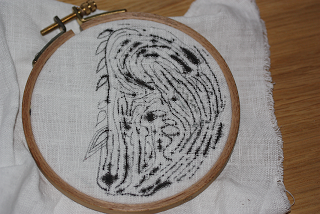
This was a nice and busy weekend - I finished my test-stitching, both in regard of the stitches and the ground fabrics that needed to be tried out.

And another thing is also done: 


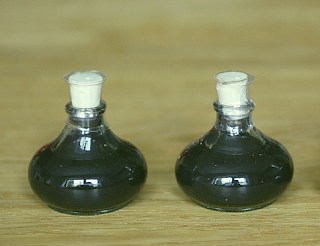
The ink has arrived, and I already bottled it off into nice little flasks that are quite close to some that can be seen on medieval illustrations of scribes.

And the ink... ah, the ink. It's wonderfully black, just the right viscosity to work really well for nice, thin lines on the linen test cloth, and it does what it's supposed to do: Dry up and then stay where it has been put, no bleeding, no creeping, no nothing. So after being annoyed for a bit more than a year by not having proper authentic medieval ink for proper authentic pattern transfers, I finally have ink to do it the medieval way - and ink to sell for all of you who want some, too. Hooray!
0
MäRZ
04
0

Stiches galore... and all the stuff for the prep work.

I'm still up to my ears in prep work for the embroidery course - I am using this as a wonderful opportunity to tackle all those embroidery-related side projects and side questions that had pestered me for quite a while, but that I never got around to occupy myself with.

And one of those eternal projects was getting the proper ink to do authentic medieval preparatory drawings. There's a nice instruction on how to do it in Cennino Cennini's handbook (the extended version; scroll down to CLXIV to read it), but getting the appropriate ink proved to be a bit harder than I had expected. And now I'm finally in the home straight for the ink project - only a few more days until I have that done and finished. Then I will be one step closer to having all the embroidery preparations covered!

(There's still plenty of steps left until that though, so no danger in my getting out of work to do in that area yet...)
0
FEB.
10
0

New threads!

My new linen threads have finally arrived, and now I have a slightly different assortment than before. Instead of offering sewing thread in two colours (creamy white or fully bleached), I have reduced the colour range to one thread inbetween the two and instead now have two thicknesses of linen sewing thread.


The picture shows both linens and between them a spool of fine silk thread. As you can see, I have also started winding the thread on new spool-like objects, so now your thread rolls can happily lie around in open sight on every historical event - these babies are historically correct material. Plus you can secure your thread in the open end if you carefully crack the roll in one or two spots!

And just so you can get an approximate picture of the thicknesses we are talking about here:


These are, from left to right in the picture: Silk Gütermann 100/3 thread (for thickness comparison), the thin linen thread and then the thicker linen thread. I'm sorry the picture is a little blurry, but you should be able to compare the three thicknesses if you look at the spot right under the cent-coin.

I am very happy with these new threads: Sturdy, very high quality, very smooth and thinner than you usually get. Oh, and I have decided to do one hundred metre spools for now and see if there are requests for smaller portions, too.
0
JAN.
28
3

I'm working on it.

January is a good time to stock up wares, resupply and order exciting new stuff - it's already this year, April is looming on the horizon already and with end of April comes the season's start for me.

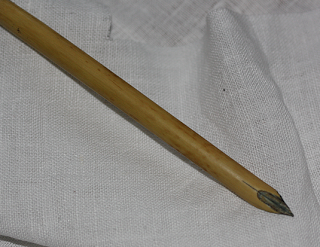
And that means I'm currently working on acquiring yet another craft-related skill: Cutting quills. Those are textile-craft-related because drawing with ink and quill is the traditional way of preparing an embroidery design, and the tools and materials for the full process of embroidery work are something that I wanted to offer for a good while.  After hunting for proper medieval ink for a good while, I have now found somebody that will make it for me and ordered some, so it's about time to hone down my quill-cutting skills.

There are several "scriptorium" suppliers on the market that offer writing implements. Quite often it's a biro tip set with a (brightly coloured) feather on top - which is about as un-medieval as you can get, since the first thing you are going to do is to cut the barbs from the rachis (I looked those terms up in Wikipedia, and so can you) - that is, you cut the interesting stuff that makes a feather look like a feather from the boring central stem. Why? Because the stuff gets into the way otherwise.
A very few suppliers also have proper quills (unprepared, hardened, or hardened and cut), but the cut ones are always intended for writing. What I need is however something else: I need a tip that will reliably (and without blotting) draw fine lines on linen cloth.

So I sat down yesterday and tried several different feathers from different birds, with varying preparation steps. And that's the result:


 I'm still figuring out what makes a cut a successful one, but at the moment, it looks as if I'm getting way better and more reliable results in cutting quills from reed than using feather quills. So what will be on sale next season will probably look like this:


I'm not yet sure whether I will test each quill or not - though I'm heavily leaning towards testing each one even if they will not look pristine and unstained on the table then.
Would you prefer unstained and untested or stained and tested?
0
JAN.
14
4

How do you like your sewing thread?

It's the time of year to work on the wares for next season, and I've been thinking about my linen sewing thread. Currently, I'm offering the thread in 20 metre packages, but seriously sewing with this thread means that 20 metres won't last for long - and that means needing to buy several rolls at once.

So I am wondering: What package units (length in metres) would you prefer when buying linen sewing thread? 20 metres? 50? Maybe even a hundred on one roll? Or should I offer different unit sizes? Please let me know what you would prefer!
0

By accepting you will be accessing a service provided by a third-party external to https://pallia.net/

Kontakt