Latest Comments

Guest - Aislinn Dyestuff Citizen Science.
09. Oktober 2026
This is a great project. I look forward to the results. Thanks for letting us know.
Guest - Aislinn Time for...
09. Oktober 2026
Looks delicious!
Guest - Katrin Sprang Discussion
18. September 2026
Hi Rachel, I have looked for more photos of you, but that was not very successful. I found a link on...
Guest - Beatrix Sprang Discussion
15. September 2026
That lozenge pattern element is not a photograph, but a scan. So it should be to scale. But I pinned...
Guest - Katrin Sprang Discussion
15. September 2026
I was not referring to Rachel's reconstruction (is the reconstruction you refer to the one photograp...
APR.
24
0

Hairnets, part V

TimeZM4 for a little sequel for the hairnet series - all because we did a little math yesterday...
I met up with the lady who did my netting needle, and I have ordered a really teeny slim one - suitable for making very fine mesh. Think Sint-Truiden: think this net:


It is listed as catalogue nr. 102, made of silk thread in rose and beige and almost fully embroidered with silk in grey, beige and white. Mesh size? The publication states 64 mesh per square centimeter, which translates to very little more than one millimeter mesh size! Now that is tiny.

The little math yesterday I hinted at? We tried to calculate how long making such a net would take. The following number crunchies are probably not accurate, but meant to give me (and now you) an idea about how much of a time-sink something like this piece can be.

The basis for our calculation was the net I have almost finished, with the mesh size of 4 mm. For this net, I can pretty safely state about 30 hours for the net until completion, including wetting and setting the finished net. When calculating the same overall size for the tiny-meshed net, I'd need about 16 times the amount of single meshes for the tiny net (since there would fit 16 meshes into one large mesh). Which means 16 times 30 hours, that is 480 hours just for the base of the hairnet! Add to that the embroidery, which I'd guess takes at least as long (maybe one of the embroidering people can pitch in here) - that would leave you at roughly one thousand hours of work just for a puny hairnet.

For sake of comparison, let's translate this into a modern working schedule, with a five day week, fourty hours work time each week. That means twentyfive weeks of work, full-time, provided you really work for eight hours a day on the net, with no distraction whatsoever. Let's add in a week for all the rub-your-eye breaks, breaking threads, bad hair (netting) days, and tea-and-cookie breaks. That means one skilled textile person will work half a year, full-time, nothing else done, just for the puny hairnet.

And people seeing such a net in medieval times will know what this means. How much work this means - and thus, how much money.

So wearing this puny hairnet is something like putting a Ferrari into your garage. Wearing this little beauty is like really thumping the table with your bag of gold, so to speak.

Source: DECONINCK, E., GEORGE, PH., DE JONGHE, D., Y., VAN STRYDONCK M. J., WOUTERS, J., VYNCKIER, J. und DE BOECK, J.: Stof uit de Kist: De Middeleeuwse Textielschat uit de Abdij van Sint-Truiden. Leuven 1991. Catalog nr. 102.
0
APR.
17
2

Herjolfsnæs Patterns

Via the MEDTC-List I wrote about in January, I learned yesterday that a new book about medieval garments will come out in December.

Many of you probably know "Woven Into the Earth: Textile Finds in Norse Greenland" by Else Østergaard. She has worked about the Herjolfsnæs garments and published results and photos of the garments in said volume. There are, however, no patterns in that book.

When I last met her, she told me that she was working on a book with all the patterns. And now it seems to be finished - or at least far enough progressed that there's a publisher and a publication date. The new book will come out in Danish and in English:

The Danish title is "Nordbomønstre - dragtsnit fra middelalderen". The English title is "Medieval Garments Reconstructed: Norse Clothing Patterns." The book deals with garments from about 1200 to 1500; the oldest Herjolfsnæs garment is radiocarbon dated to the 13th century.
Due out in December 2009, Aarhus University Press, Denmark.

The book can be pre-ordered both in Europe and in the US. In Europe, go to the contact form on the publisher's website and mail your pre-order request. For those living beyond the pond, you can pre-order via David Brown books. Don't get confused by the slightly different title there, no Viking patterns are in the book.

My preorder is already off. Hooray for a new book for the personal library! Now... where do I squeeze in another shelf?
0
APR.
03
0

Lovely Links Listings

I'll toss you some nice links today for a change, and I hope to get a proper textile post in during next week - it's been much too long since the last one. For now, enjoy the more or less textile related goodness here:

The National Museum of Denmark has a new webpage that's worth a good look. If you click your way through to the "exhibitions", you get wonderful pictures that can be zoomed for a real close-up view. Don't miss the Mammen textiles in the Viking section while you're browsing!

I know few people as active as Roeland Paardekooper. The man is a veritable epicentre of connections between folks in archaeology, experimental archaeology, and Living History - it seems to me as if everybody knows Roeland. He's running a rather large database with articles and information about archaeology and open air museums that can be found on http://publicarchaeology.eu/.

In a comment to one of my hairnet posts, Isis from Medieval Silkwork pointed me to another wonderful database: KIK-IRPA, the website of the Royal Institut for Cultural Heritage in Belgium. Click your way through to the photo library database and be awed: They have pre- and post-conservation shots of the hairnets I have shown and a lot more truly amazing things. Thanks, Isis!

And non-textile related, but nice nevertheless: A kitchen maid from around 1900 blogs about life in and around her kitchen, including recipes. Brought to you by the Danish National Museum, and available in Danish only.
0
MäRZ
11
2

Hairnets, part IV

Time for another hairnet, again from the treasure of Abbey Sint-Truiden in Belgium (Dutch Wikipedia Entry about it).

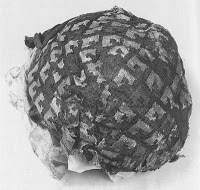
This net has large mesh for the St.-Truiden finds, with only 9 mesh per square cm, so about 3 mm mesh size. It is dated to the 13th or 14th century and preserved in three fragments, the largest of which is 12 x max. 30 cm. The material for the nets is red silk, and the net is embroidered with silk in white and green, the latter coloured with Reseda luteola (and probably something else, undetected). Atached to the net are a band of textile with motifs in different colours and two tablet-woven bands.

The net is knotted in the round, and beginning and end of the work can not be distinguished. The net is embroidered all over with "hooks", made in linen stitch.

Hairnet before conservation.
Picture clickable for larger view.


There is unfortunately no "after-conservation" picture of the net.

Source: DECONINCK, E., GEORGE, PH., DE JONGHE, D., Y., VAN STRYDONCK M. J., WOUTERS, J., VYNCKIER, J. und DE BOECK, J.: Stof uit de Kist: De Middeleeuwse Textielschat uit de Abdij van Sint-Truiden. Leuven 1991. Catalog nr. 103, pages 348-349.
0
FEB.
26
0

Hairnets, part II

Hairnets. Yes.
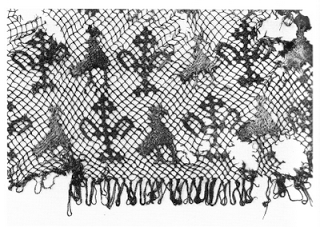
Should you feel that the actual netting of rather large mesh is just not enough, even when combined with a bit of embroidery on cloth to sew on later - you can always do some embroidery straight on the mesh. Lacis, or filet lace, or however you want to call it, has a rather long history. The even ground made by the meshes of the net is a good groundwork for embroidery and allows for a nice contrast between open mesh and filled-in mesh.

A nice example for this is this fragmented net from the 13th or 14th century, with origin in West-Europe. There are two larger fragments and some smaller fragments preserved, with the largest piece measuring 13.5 by 43.5 cm. It is made from red silk for the knotted ground and embroidered with yellow and white silk.
picture clickable for larger version


On the bottom right side the large fragment has larger loops of thread, measuring 1.1 cm. The regular mesh size is 4 mm. If I read correctly, the red silk is dyed with madder, yellow was done with weld (Reseda luteola). The embroidered motif consists of alternating white birds and flower motifs, maybe fleurs-de-lis. Embroidery was done in rows, and three rows are still preserved. The flowers are embroidered by stitches around the mesh threads, while the bird motifs fill in the open mesh squares, using linen stitch.

With rather sparse embroidery, on a mesh that is a whopping 4 mm size, this would be a nice starter for your medieval hairnet collection, don't you think?

By the way, medieval silk nets really have small mesh sizes in comparison to later ones. A pattern book for lacis by Therèse de Dillmont is available on the net (German version of "Filet Guipure": Part 1 and Part 2), and she offers thread weight advice for mesh sizes between 7 and 11 mm.

Source for text and pictures:
DECONINCK, E., GEORGE, PH., DE JONGHE, D., Y., VAN STRYDONCK M. J., WOUTERS, J., VYNCKIER, J. und DE BOECK, J.: Stof uit de Kist: De Middeleeuwse Textielschat uit de Abdij van Sint-Truiden. Leuven 1991. Catalog Nr. 107, page 354.
0
FEB.
17
2

Hairnets, part I

I like hairnets. I also like making them - it is a nice thing to do with the hands, without much thinking. My nets, however, are a far cry from some of those medieval ones that are still extant.
A lot of people know the nets found in London - with mesh sizes between 3 and 9 mm, depending on the net. But they are really simple.

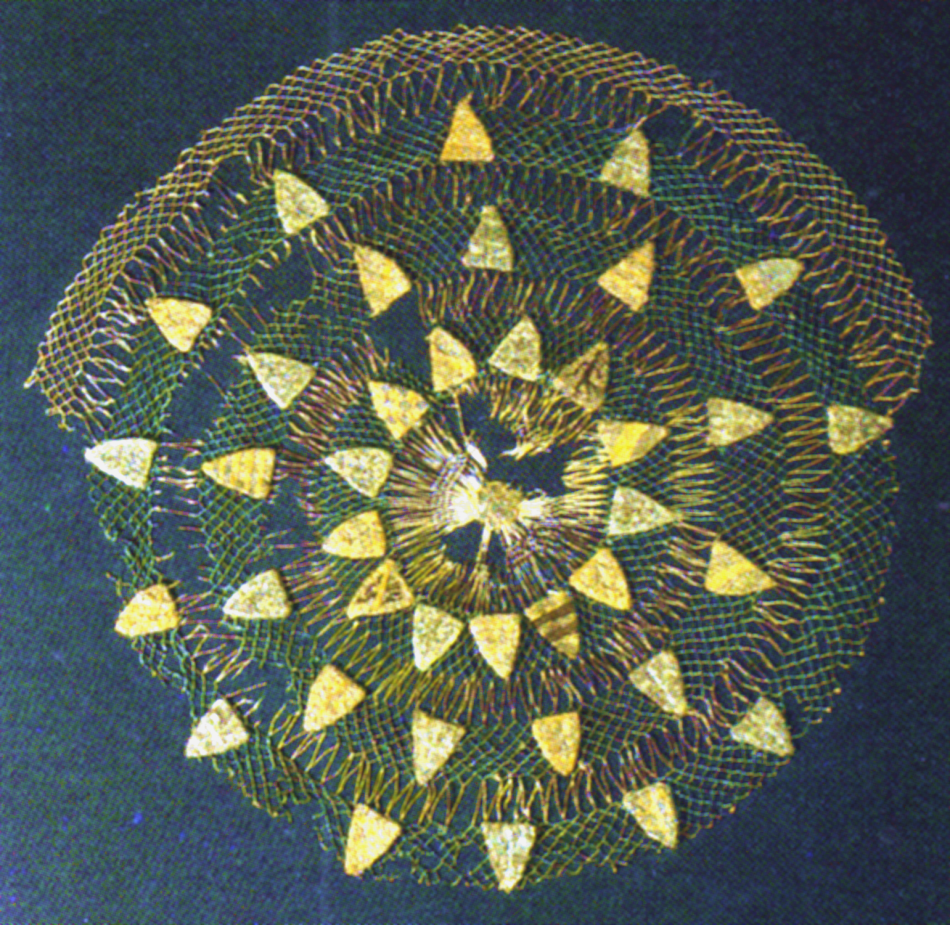
Now take this one, as one of the not-too-elaborate nets. We don't know where it comes from, unfortunately, since it was bought via art trade, but it has been dated to the last quarter of the 13th century. Nowadays, it is in the Art Museum in Düsseldorf.

(picture clickable for larger version)


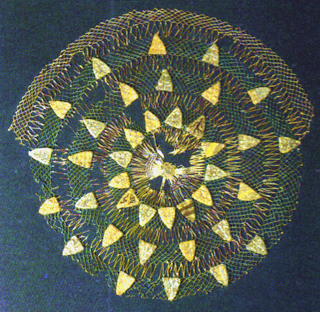
Diameter is 33 cm, and it has been worked in green and white silk. I had to tune up the colours on the scan, and now it should be easy to see where the green and where the white silk was used. I would have expected the small, embroidered shields-with-arms on a white background. Shame on my modern mind - green it is. The arms are embroidered in spun silk and gilded silver wrapped around a textile core. The ground for embroidering was coarsely woven linen. Some of the arms have been identified: there's six times Sayn and eight times Geldern, pointing to the Middle or Lower Rhine region. The net might have served for a wedding or proposal ceremony. In addition to the 38 arms, there's a little six-petaled rosette in the middle of the net.

The netting should not be too hard to do, using two different-size gauges for the long white and the small green meshes. My rough estimate is 3-4 mm for the small green mesh and about 1.5 cm length for the long white mesh - which is "not very small" for green and "exceptionally large" for white. It would be very interesting to see it close up, and in good detail, to see whether it was worked in spirals or in rounds, and whether the colour thread not in use was cut off or just led down for the next colour change. Any odd joints caused by this could be covered up easily with the embroidery bits sewn on later.

Source for the net picture and information: FANSA, MAMOUN (Hrsg.): der sassen speyghel. Sachsenspiegel - Recht - Alltag. Beiträge und Katalog zur Ausstellung "Aus dem Leben gegriffen - Ein Rechtsbuch spiegelt seine Zeit". Bd. Beiheft 10, Band 2, Archäologische Mitteilungen aus Nordwestdeutschland. Oldenburg 1995.
0
FEB.
04
2

I'm plugging now. Shamelessly.

I have fulfilled a dream by continuing research after my master's degree at Uni Bamberg. And, of course, I chose medieval garments as my topic. It took me a while, but I am very happy with the outcome (and eternally grateful to my parents, who were incredibly helpful when any obstacles turned up).

I have since successfully finished and defended my phd thesis "Konstruktion und Nähtechnik mittelalterlicher weltlicher Kleidung" (Construction and sewing techniques of secular medieval garments) in Summer 2008. The thesis is a comprehensive survey of extant medieval garments with analysis of cutting, construction development and sewing techniques.

It is written in German with an English summary; you can get more information (in German too) about the volume and the topics covered on my website. I have already found a wonderful publisher for the book, and publication is being prepared. However, two obstacles are left to overcome: Get funding for the costs of the print run, and determining the right number of copies to print.

Since it will take at least eight months until the book can be released - a long wait for you and me - and it is very hard to evaluate how many people will be interested - a problem for the publishing house and me - I am offering subscription to a newsletter that will hopefully help us all (and me even twice):
I will be sending a short newsflash whenever a step in the publishing process is finished, keeping you up to date.
You will know at once when the book can be pre-ordered, which means no delay for you in getting the book delivered.

In return, having a number of seriously interested people on the newsletter list will help me negotiating with the publishing house and my editor and me in determining the number of copies to print. We are aiming for the price range 60-80 Euro for the book (hardcover with b/w illustration and coloured plates).

If you are interested in getting this book, please subscribe to my newsletter by sending an e-mail with the subject "subscribe" to Diese E-Mail-Adresse ist vor Spambots geschützt! Zur Anzeige muss JavaScript eingeschaltet sein..

And if you are not interested in the book, but know somebody who might be, you can do me a huge favor by telling them!
0

By accepting you will be accessing a service provided by a third-party external to https://pallia.net/

Kontakt