Latest Comments

Guest - Aislinn Dyestuff Citizen Science.
09. Oktober 2026
This is a great project. I look forward to the results. Thanks for letting us know.
Guest - Aislinn Time for...
09. Oktober 2026
Looks delicious!
Guest - Katrin Sprang Discussion
18. September 2026
Hi Rachel, I have looked for more photos of you, but that was not very successful. I found a link on...
Guest - Beatrix Sprang Discussion
15. September 2026
That lozenge pattern element is not a photograph, but a scan. So it should be to scale. But I pinned...
Guest - Katrin Sprang Discussion
15. September 2026
I was not referring to Rachel's reconstruction (is the reconstruction you refer to the one photograp...
JAN.
12
0

New Year, New Adventures.

I'm back from the winter break - and ready for the next year to start off properly, and for new adventures. There's a stack of things already in planning, and to my great delight, I have managed to catch up on a few things in the meantime.

One reason why my breaks (both in winter and in summer) may seem rather long is that I'm not relaxing and taking time off all the time - there's also a good amount of behind-the-scenes things going on during these weeks. For the end of the old year and start of the new, these include a lot of paperwork. New numbers for the invoices, book-keeping for the end of the year, doing the tax paperwork. That, for me, always means quite a bit of checking, as VAT has to be paid for the last quarter, then I double-check if I have caught everything during the year (sometimes a receipt slips past and turns up after its accountancy period), then the car costs have to be figured in. Why the car costs? Well, it's the company's car, and due to German legislation that means if I use it for private purposes, it counts as income and I have to pay VAT on that. So that's another thing to book...

The good thing is: Once that's all finished, there is not a lot more left to do for filing the "proper" taxes, as in the income taxes, which have to be paid on top of the VAT. And this year I've managed to finish all the paperwork and tax prep work in the winter break, which is a very nice thing. It always gives me a good feeling to have sent off the last quarter's VAT, and have all the books in order.

The next step was taking stock of things in stock, and replenishing where necessary. That's mostly done, too, with a few items still on the waitlist because the suppliers are busy, or there's issues with raw materials, or other reasons out of my own control. But having sorted that means I can now take care of orders that came in during the break.

And then... planning. Plans for this year include a reprint of my Gold Embroidery book (that sold out during the last year), there's two articles about tablet weaving coming up in two different places, and I might be travelling to Lübeck again in spring for some more collaboration with the ever-lovely Hansemuseum.

The next European Textile Forum will be in Mayen once again, with a focus on dyeing - the date is not fixed yet, but hopefully will be rather soon. 

What has a fixed date, though, are the next in-person workshops I will be giving. 

First up, from February 3 to February 5: A selection of workshops at the "Historischer Nähtreff" at Burg Rothenfels, near Würzburg. I'll be offering a number of workshops: Hand sewing (medieval seams and stitches), historical spinning, sprang (which is braiding in a frame) and fingerloop braiding as well as weaving on a bow loom. If you're interested, here's more information, including how to register:


The second one is a big tablet-weaving workshop taking place in Tüchersfeld, in the stunningly beautiful Franconian Switzerland. That is going to take a full weekend, enabling us to cover tablet-weaving from the basics up to weaving patterns based on diagonals, freestyle, no pattern draft required. The course will be in German, and if you're interested and free on March 3-5, book your spot here.

Examples for diagonal-based patterns... they are just as fun to weave as they are beautiful to look at. Well, at least that's my opinion!

Apart from that, I have some tasks left on my list from last year - such as finishing off the website migration, and some writing tasks are to be done as well. Which means the new year has started off nicely, and promises to not be boring at all! 
0
DEZ.
20
0

Workshops Next Year!

I'm utterly delighted that there will be workshops next year - one set at the Nähtreffen Rothenfels, which is running for the 5th time now, and the tablet weaving workshop in Tüchersfeld.

Rothenfels will take place in February, from Friday 3 to Sunday 5. I have a number of workshops on the list, including the sewing introduction and sprang braiding - and there's other workshops as well, plus there will be music, and good company, and lots of fun hanging out with nice people. I'm very much looking forward to it already.

If everything works as it should, you can read more about it in the pdf on the right, which also contains information on how to register for the event.

The tablet weaving workshop is in March in the Fränkische Schweiz-Museum Tüchersfeld, on Friday 3 to Sunday 5. We'll cover tablet weaving from the basics to free pattern weaving with diagonals - and in some cases, participants in this course even proceeded on to the basics of 3:1 broken twill weaving, also without a pattern.  

The workshop can be booked via the museum website; the price includes materials and lunch on Saturday and Sunday.

0
DEZ.
19
2

How on earth did they do it?

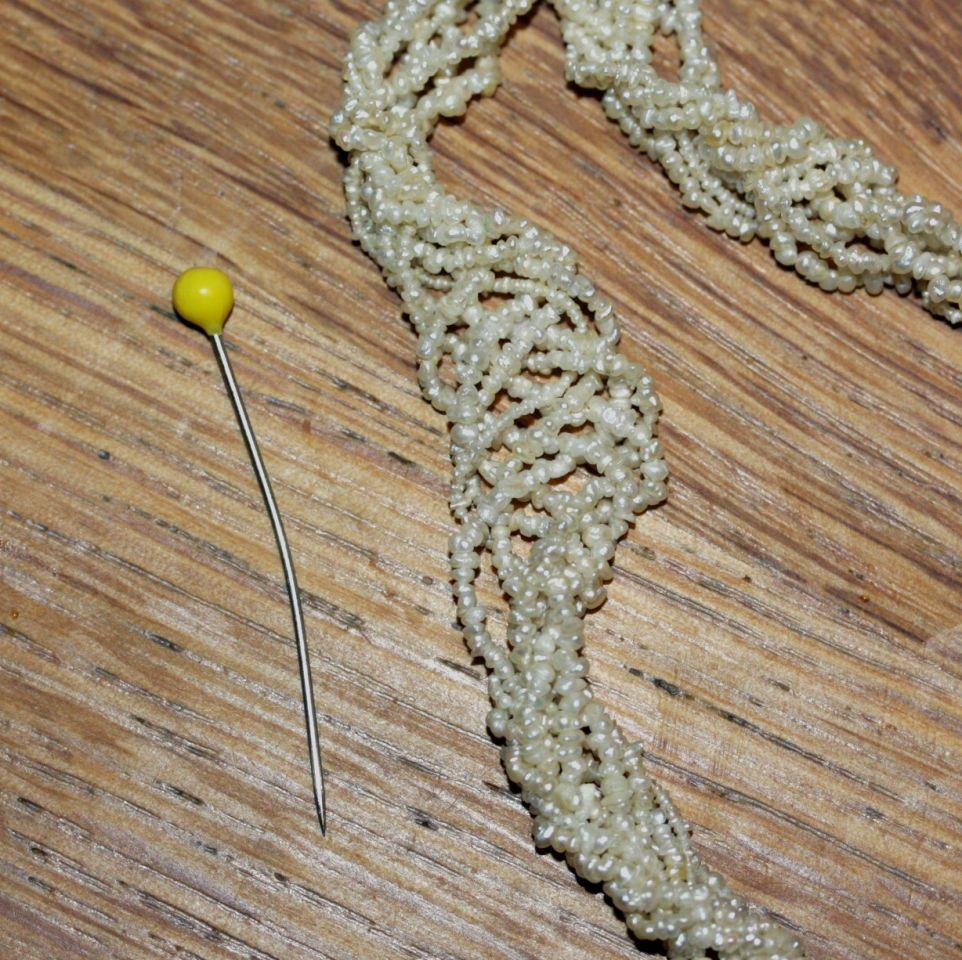
If you're looking at medieval embroideries, you will, sooner or later, stumble across one that has been embellished with pearls. Seed pearls. As in tiny, miniscule specimens of pearls, smaller than anything you will easily get today. (Or get at all, in some cases.)

A while ago, I was looking for a source for pearls to do embroidery medieval style, but to no avail. The company that I found which in theory offered small pearls (with a diameter of 1 to 1.5 mm, as that's the size we're talking about) told me, on my inquiry, that they don't have pearls that small at all, and if they had, nobody would be able to drill a hole into them.

That was done, however. I'm wondering, together with a lot of other people, how medieval and early modern and modern people managed to drill holes into pearls so small that it seems you can hardly see them. With techniques possible in the Middle Ages...

To give you an idea of the tinyness of these things, compare the size of these seed pearls to the size of the modern glass-headed pin:

They are utterly, utterly tiny, and if anyone has an idea of how the holes might have gotten into these pearls, or how they may have been strung up, or sewn to a textile (these haven't, of course, but others did) they would be more than welcome! 

0
DEZ.
16
0

Slowing Down.

The year is winding down, and while there's a list of things still to do before 2022 ends, there's only one larger and hard-deadlined item left on the list, with a "finish before winter break" tag on it. That is a really, really nice thing... and I very much enjoy the feeling of winding down and slowing down a bit too.

The one item? I have (not too foolishly, I hope) agreed to write a little article about tablet weaving. It's actually two, but one is finished, and there's only one left to do... so I've made some photos, and something vaguely resembling a plan, and there's an outline, and hopefully there's an article soon.

The really fascinating thing about this is that every time I look at the topic, there's another little aspect that I can see. Especially when I try to explain something, or describe something. This sharpens the eye in a way that nothing else does. There's a German idiom that more or less says "you learn when you teach", and that is really true. (Well, provided that when you teach, you try to explain things so that the audience understands them, and not just teach the motions and rules to be learned by heart and followed... because then, you will learn nothing.)

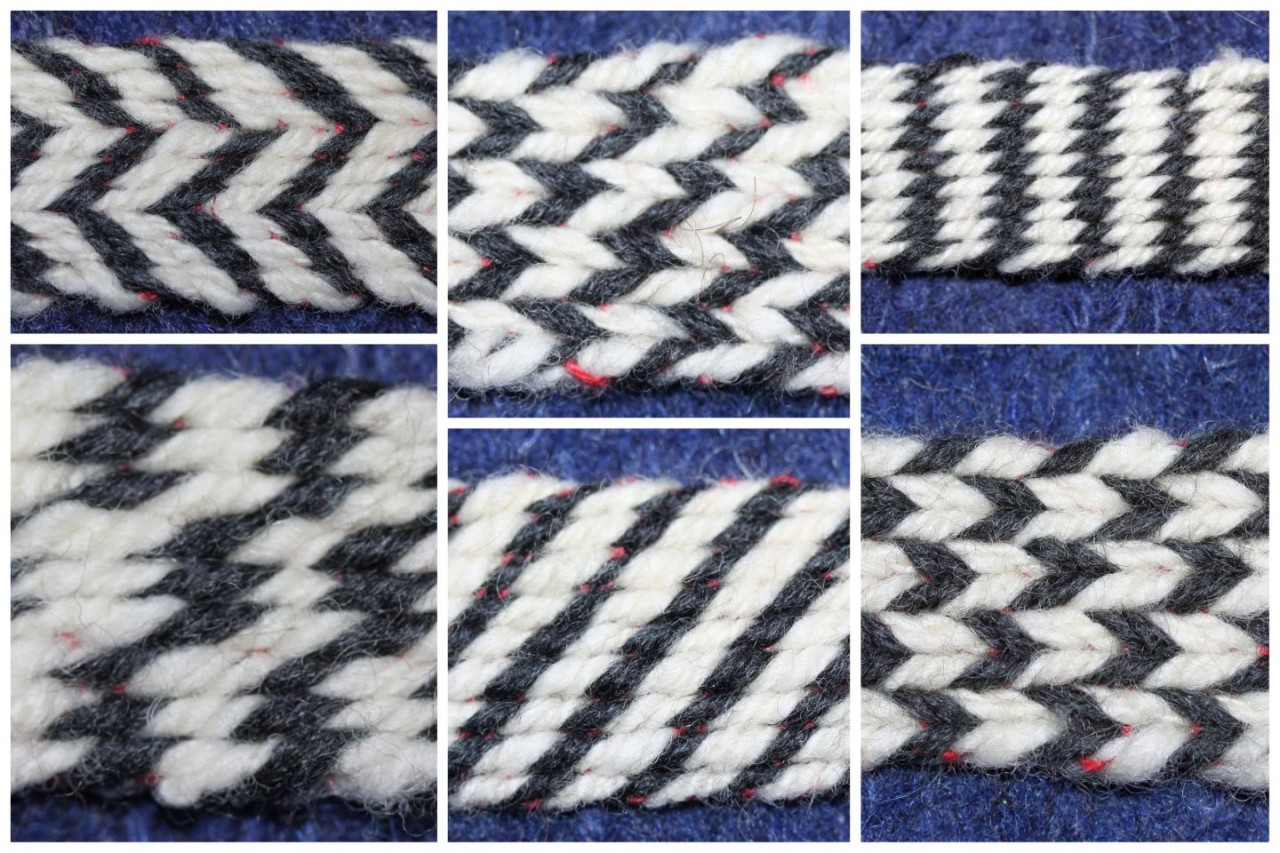
For the tablet weavers among you: The two middle images show the same setup and were woven the same way - only on top, the tablets are threaded alternatingly s and z, and on the bottom, all are threaded the same way. Like all of you, I know that the s and z are important and will change how the black and white line up. But I still find it amazing how much the alternate threading changes the line-up and the optical impression of the band. 

0
DEZ.
08
1

Blogiversary!

It's hard to believe, but it's blogiversary day again. And, even harder to believe, I am actually remembering to write about it on the very day itself!

Back when I started this, in 2008, I started out writing on the blogspot platform, and stayed there until 2015 - which was when I made a new website on Joomla, pulling everything together in one spot. 

There's been a lot of writing over the years, and there's been a lot of years since 2008. This blog is turning 14 today. FOURTEEN. Please excuse me while I am not believing this for a while. 

I've tried to find out how long the average lifespan of a blog is, and it seems to be somewhere around 3-4 years, but that's from an older blogpost... somewhere. Anyway, I think everything over ten years makes any blog some kind of dinosaur. In a similar line of thought, these days, I sometimes feel like I'm very old-fashioned, still doing a blog, while so many others have switched to (mostly) Instagram, or are on tictoc (I am so old I haven't even visited that yet), or somewhere that I haven't even heard of. While I'm also on Instagram, the blog is still my main thing. It's easier to search through the old entries than Instagram is, and for the instances that I feel like writing a lot, it's better suited to that.

Though admittedly, a lot of the entries are short, and sometimes it feels like I've written about everything at least once. From time to time, that means I sort of run out of steam, and wonder about whether I should stop or not - but then there's this link or that interesting article or something I feel like I need to rant about, and on it goes.

And then, from time to time, I get an utterly nice email telling me that someone stumbled across this blog, and found so many interesting things there... which always makes my day, and is the best reason for me to carry on a while longer. So there we go.


Blogiversary! Coffee and chocolate for celebration!  

1
DEZ.
06
0

Mixed Links!

You're overdue, I think, for a list of accumulated links... so I can close a few of the gazillion open tabs again. 

You can read something about the history and technique of spinning gold threads here. 

Late-medieval leather and textile finds, together with window glass fragments and toys, have been found in Berlin. The finds date to the 15th century, and the large amount of well-preserved organic materials promise very, very interesting results. You can read a German-language article about the find here.

The Internet Archive has so, so many different books and other written sources, it's quite overwhelming. They include a very large collections of cookbooks. The Modern Met has put together some recommendations for you here.

Here you can have a look at a very rare type of illuminated manuscript - the oldest income register of a secular manor, the Codex Falkensteinensis. It dates to the second half of the twelfth century, and its illustrations include people doing agricultural work - which is always nice if you are looking for sources for "normal" people.

You can find nice lace patterns for knitting here - the "Kelpies Hexagon Designs". 

If you're interested in loop braiding, the LMBRIC archives are now again available - via this website here.

0
NOV.
30
0

Big Savings on Medieval Gold.

No, this is not another Black Friday/Black Week/Cyber Something ad. (The concept of these "deep discount days", by the way, is something that I find weird and a little irritating, but that's an entirely different story. If you've been following the blog for a while, you'll probably know my stance on pricing and fair pay for work, and fair pricing like that means that there's no reason for special deals with deep discounts, and that they are also not possible.) 

No, this is the clickbait title for two articles on medieval Zwischgold, that metal leaf that is mostly silver with a very, very, VERY thin layer of gold on top, making it look like gold. At least for a while, until the silver corrodes and the black silver oxide finds its way through the layer of gold on top and makes everything look black.

There's been research on (mostly late-medieval) use of this material in artworks, with analyses of the metal and the changes in its structure over time. The original article has been published here and is freely available. If you read German, there's also a German article about this project, with fewer numbers and formulae and a bit more general information about the research and the material; you can find it here.

The German article also inspired the clickbaity title: Regular gold leaf was about 140 nanometres in thickness, but the Zwischgold made in the same region and the same timespan only had a gold layer of about 30 nanometres. And if this does not count as big savings, I don't know what will do!

0

By accepting you will be accessing a service provided by a third-party external to https://pallia.net/

Kontakt