Latest Comments

Guest - Aislinn Dyestuff Citizen Science.
09. Oktober 2026
This is a great project. I look forward to the results. Thanks for letting us know.
Guest - Aislinn Time for...
09. Oktober 2026
Looks delicious!
Guest - Katrin Sprang Discussion
18. September 2026
Hi Rachel, I have looked for more photos of you, but that was not very successful. I found a link on...
Guest - Beatrix Sprang Discussion
15. September 2026
That lozenge pattern element is not a photograph, but a scan. So it should be to scale. But I pinned...
Guest - Katrin Sprang Discussion
15. September 2026
I was not referring to Rachel's reconstruction (is the reconstruction you refer to the one photograp...
JUNI
16
2

The Return of the Evebø Dog.

The Evebø band... oh, source of joy and questions. For me, at least.

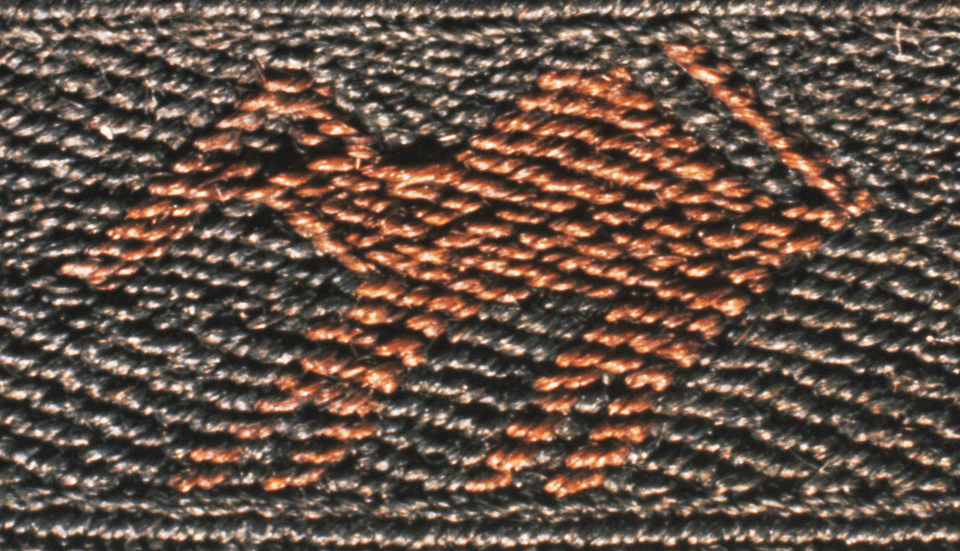
The Evebø band is a find from Norway and dated to the 6th century; it's a tablet-woven band with twill technique patterning, and very good, very detailed pictures of the band can be found at the Fotoportalen Unimus. Including, to my great joy and delight, photos of the back of the band... because, as simple as the band might look at first glance, there are some strange things happening with the animal that might be a dog (though the Most Patient Husband of Them All says it looks more like an ant-eater to him, and I sort of agree).

[caption id="attachment_5364" align="alignnone" width="368"] Photo from UNIMUS.no


The original band happens to have a 20 tablet pattern zone, which coincidentally is the width of one of my playbands... so of course, at some point, I had to weave the Evebø ant-eater doggie. And as we all know, dogs are pack animals.

So. Let me introduce you to my Evebø dog collection:
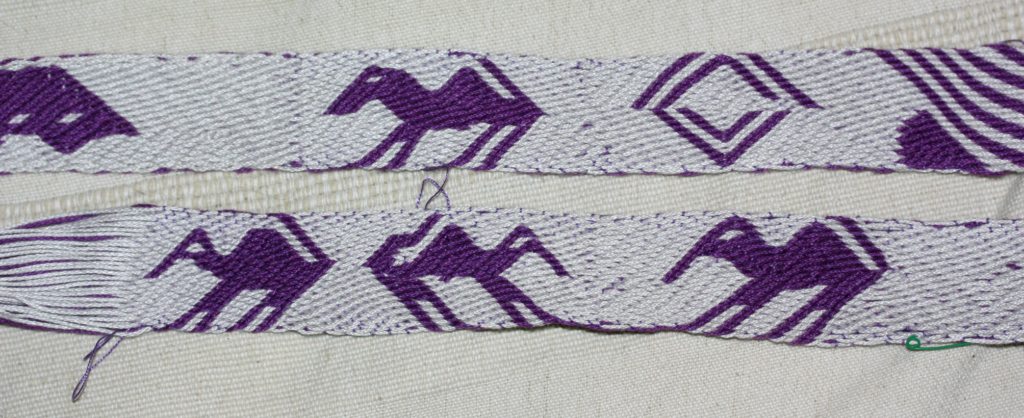


The first one, in the upper band part on the image, was woven starting from the nose, after just a sketch of the original animal. Though I was sort of aiming to reproduce it, I wasn't going for the "have to match it exactly" approach, but more for the general direction. As you can see, it has a wider nose than the original, a much thicker neck, and a baboon butt.

The rest followed a considerable amount of time later - they grow younger from right to left. First (rightmost) was woven from the tail onwards; then, because the first one had been so long ago and that made it hard to compare what the differences were, I did another one starting from the nose (you can easily tell that by the baboon butt). Finally, I did a third one, trying to a) weave less mistakes than in the first ass-starter, and b) matching it as closely as possible to the original. Which was... well... not completely successful in both cases. As you can see mostly in the chin and nose area. Sigh.

If you compare my versions with the original, you can find quite a few differences (even disregarding the baboon butt versions, and just looking at the ass-first doggies). A small thing is the forelegs not having the split further down than the hind legs in one case - though that is just a question of me not paying enough attention to where the split was supposed to come, and not a technical issue.

The really interesting differences, though, are in the neck, eye, and nose area... can you spot them?
0
MAI
27
1

Peer Reviews.

Once upon a time, I gave a presentation about spinning at a conference, and now that presentation is being turned into an article. A peer-reviewed one... and I'm currently working on the peer's comments and input.

If you're not familiar with this process of peer-reviewed publishing, let me give you the quick rundown. You hand in your paper, the editor reads it and comments on it (though that stage is optional), and sometimes you're then asked to change/expand/amend things. After that, the draft is handed on to one or more reviewers; they usually get a list of questions to help them evaluate the paper, and to help the editor(s) evaluate the peers' feedback. Those questions usually include things like "Is the paper well-structured?" and "Does the paper add to scientific discourse on the topic?". Once the reviewers have sent back their feedback forms and the paper itself with their comments and suggestions for changes in it, you'll get the whole load back from the editors, without any indication of who your peer reviewers are. Then it's up to you to go through the feedback forms and comments, and use them to make your paper better.

If you're lucky, you are getting solid, constructive feedback on your content, pointing out where things are still unclear, or where something is missing. A peer review can also show how different views on a single topic can be, depending on the individual and their area of specialisation, or their academic background. Archaeologists, for instance, will look at other things, or at the same things differently, than historians or art historians.

In any case, once you've tweaked and added and changed and wrote your replies to comments for the editor to read, you send your paper back again. Then you might hear back from the editor once more, if there are still some things to resolve; otherwise it will go into the process of typesetting. Then you will see it once more for the final proofread... and after that, it's finally all done.

The peer review process is not perfect, but it will definitely help make a paper better by pointing out things that you have missed as an author. Whenever I get the reviews back, though, it takes me a while to process them before I can really get to work on them... it's critique, after all, and that always tends to hurt a bit, no matter how well-deserved, well-meaning, and well-phrased it may be.

After that initial bit of deep breathing and letting it sit for a day or two (or three), though, I've always ended up with a paper I felt was better than before. And, hooray, I'm almost done with the current one!
0
MäRZ
30
0

Woot!

Today was a bit hectic, but in a good way - there was an urgent request for a little tablet-weaving something, which had to be finished as soon as possible so it could go into the post.

[caption id="attachment_5153" align="alignnone" width="576"] If you can't see the threads running through the tablets, that's because they are thin. Very thin. Not the thinnest I've worked with, but still. Trust me if I say that they are there, though, and they are quite colourful as well...


Even though I'd have liked to spend a little more time on this, and take a few breaks to let all the impressions from working with this very lovely stuff settle, and explore some more how best to handle the different details - I'm happy that I was able to get things done quickly, and hopefully the post will deliver in time, and all will be well, and I will be able to send you a link to a little video you can watch soon-ish.

Speaking of the post: The pandemic has its effect on postal services, too. German post is still running close to normal, with a few little things in effect to protect the posties (such as not needing a signature anymore, and putting the parcel down on the ground instead of handing it over). Outside of Germany, though, the picture is different - in some countries, there's issues with customs, or postal delivery is currently not done for quarantined areas. Sending things to the US is still possible for now, but larger parcels now cost a surcharge of 16 € due to the crisis... so I've put a note on my shop page (which will hopefully appear in all the right places), and I hope that things will not go worse. (Though I do suspect they will.)

Stay home, stay safe, and do some fun things!
0
MäRZ
25
0

Luck with Tiny Things.

Sometimes, sometimes you're lucky, and you manage to get your hands on something that almost does not exist anymore. Case in point: Tiny seed pearls.

There are a few surviving medieval embroideries that include seed pearls (which is the common term for small pearls). If you're trying to buy pearls today, the rule seems to be "the bigger the better", so most offers are for large pearls.

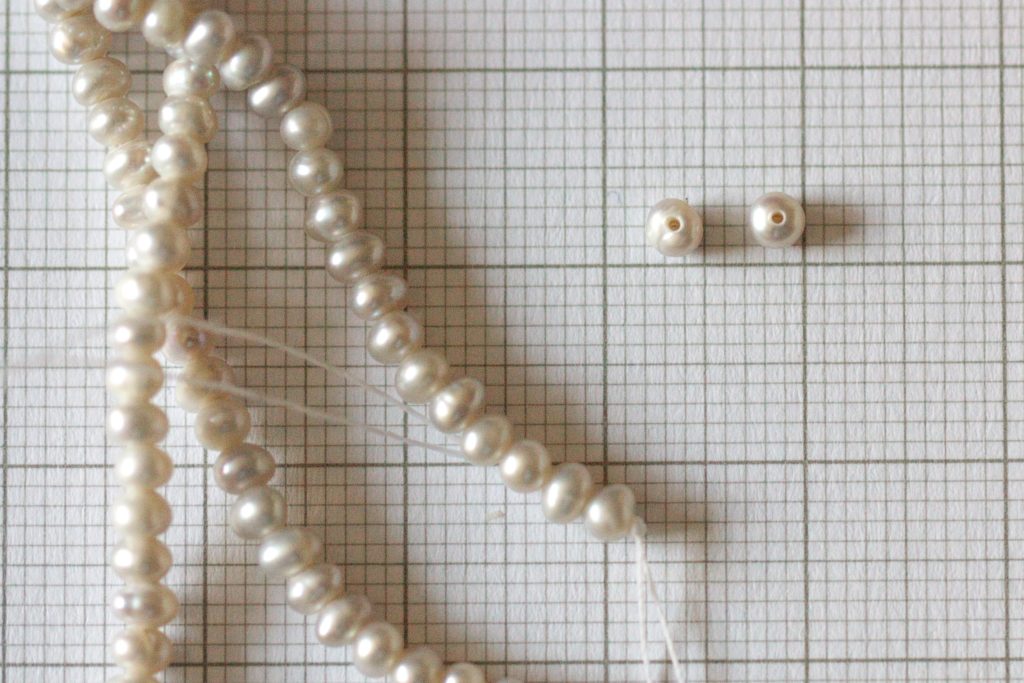
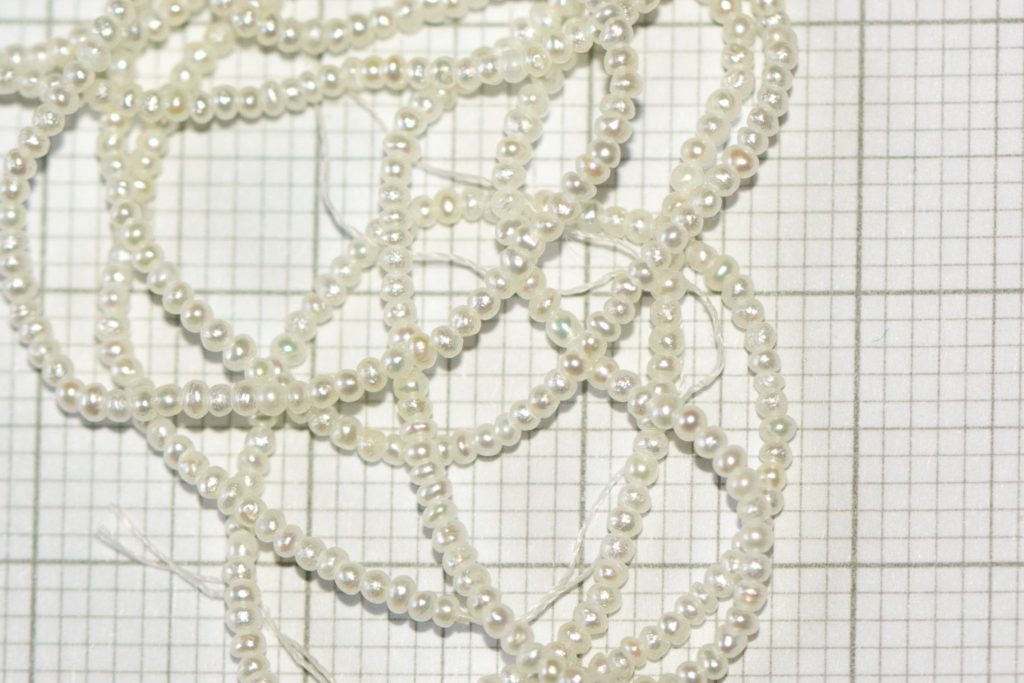
Seed pearls are still relatively large; the smallest you can usually find (especially if they're supposed to be drilled through) is c 2 mm in diameter... which looks, approximately, like this:

[caption id="attachment_5142" align="alignnone" width="501"] Seed pearls. The backdrop is paper with 1 mm squares.


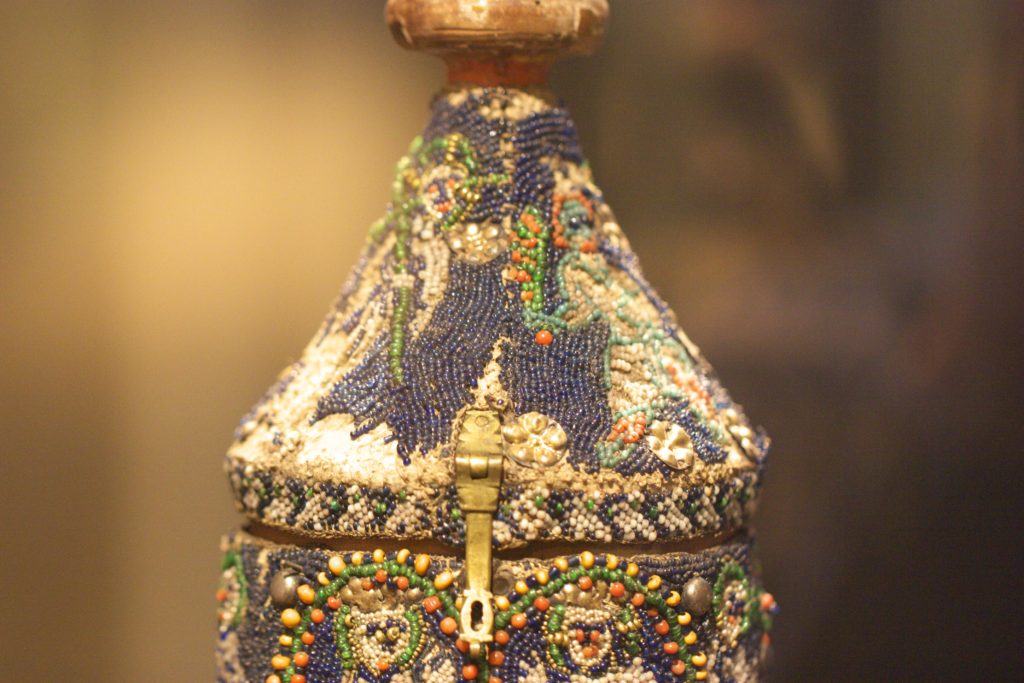
This is a string of seed pearls I bought years ago; the smallest pearls I could find. They are still way, way too big to properly simulate medieval embroideries, though. Here's a picture from a pyxis in the Schnütgen Museum Köln, with corals, pearls, and glass beads of about 1-1.5 mm in diameter:

[caption id="attachment_5145" align="alignnone" width="640"] Embroidered container for the Host. Hildesheim, second half 13th century. Wooden core, covered in embroidery with glass, sweetwater seed pearls, corals and metal appliqué on parchment. Schnütgen-Museum Köln, N 42
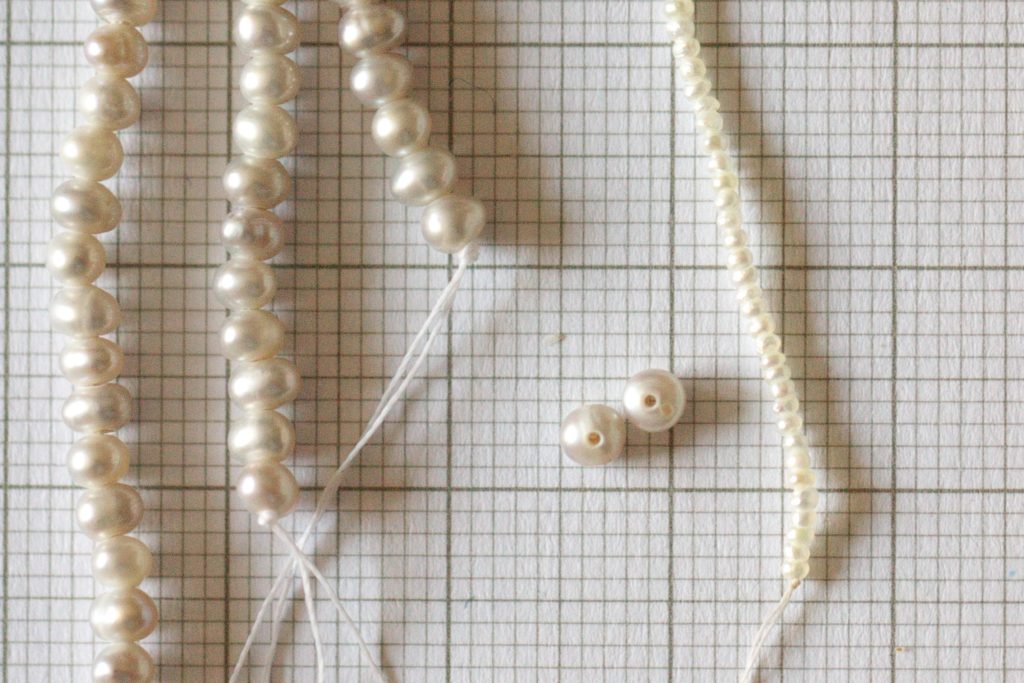

That is the pearl size that we're looking for. That, sadly, is the pearl size not available today, usually. So imagine my delight when, after the last conversation about this, I did another internet trawl, just to see if, maybe, maybe... and was successful.


Unfortunately, this string of pearls is not a new one, but an antique one (age unknown) which I got from an auction house. It does mean, however, that I now have a string of pearls in the proper size for demonstrations, or explanations...

Here's the two sizes side by side, so you can appreciate the difference even more:


...and I will take this as a sign that if you do not give up, things eventually might come. Even if they seemed impossible at some point.

I really do wonder, by the way, how the medieval pearl-drillers managed to drill such tiny, tiny holes into such miniscule pearls. You can hardly see these things, let alone hold them. Drilling a hole? I can't imagine how that's done. But there were lots of feats of similar size (or minisculity, rather): Gold threads. Miniscule miniatures. Tiny things in goldsmithing...
0
MäRZ
13
0

Sigh. Deep sigh.

Well, there I was, doing things and getting stuff ready well in time for the conference - and now I will have another year to prepare: NESAT has been postponed.

I'm obviously not very happy about this - I was so looking forward to travelling there together with friends, to meet friends and colleagues up in the north of Finland, to hear about their new research and results, to chat with them and hang out and try new exciting foods and all the rest of wonderful things you do at a conference.

It's a decision I can understand, though. It's not a very large conference, but it is very international... and nobody knows how things will develop during the next two months. We've already botched doing enough things early enough with our climate, maybe it is time to err on the side of caution for a change.

And maybe, once the epidemic is over, we might actually do some similarly drastic things to keep our planet habitable? Just saying. Because obviously, it is possible to do stuff to counter dire things happening...
0
MäRZ
11
2

Things Going On.

The Corona Scare has probably reached almost every corner of the world now, and things are definitely starting to get interesting in Germany. Bavaria has cancelled all events with more than 1000 people until April 19, and other federal states are following suit - among them Baden-Württemberg, though I couldn't find any dates on how long this ban will be in effect.

The cancellation of events in Ba-Wü will probably directly affect me, as there are two fairs there, one in mid-April (18th and 19th) and one at the beginning of May (8-10). At the moment, I'm not counting on either of the two actually taking place; the first because it's still just within the "ban time" that Bavaria has called out, and I'd guess that Baden-Württemberg will go for a similar time period, if not for a longer one; the second because though it is a good bit later, it's also a (substantial) bit larger, with more than 10 000 visitors during the three days of the fair, and it might well be that events in that size will still be banned then, depending on how things develop.

There's also a bike fair we were planning to go to, which is on the last weekend in April, in Rheinland-Pfalz. It's (unfortunately, in this case) also a very large one, with about 10 000 visitors, and a rather international one... so while the status for this is still unclear, I won't count on it taking place. Which would be rather sad, just like the wool fairs being called off. I do get that cutting out large gatherings of people, especially if the crowd comes from all kinds of places and will spread back out afterwards, will be helpful in slowing the virus spread.

NESAT is not before mid-May, and not very large - I'm keeping my fingers crossed that nothing dire will happen to put this in danger.

So. Things will develop as they will, and there's nothing to do right now than wait and see (and hope, of course, that the virus spread will peter out quickly). The virus has caused enough madness all around the world already - panic shopping included, which meant that hospitals and doctor's offices ran out of disinfectant and other necessary supplies, and could not get more because of people hoarding the stuff. That, obviously, is not a good thing at all. Especially since for most people, going a bit easy on the hugging and keeping up a good basic hygiene (washing hands, first and foremost) would be more than sufficient to keep risk down in normal life. We still know relatively little about the virus, including the real mortality rate, and panicking will definitely not help anybody.

Has the Corona Scare arrived in your area yet? Or are people still relatively relaxed?
0
MäRZ
10
0

Winding a Shuttle.

Shuttles are a handy thing... I've found, however, that a lot of people only use about a third of a shuttle's capacity. (And now I feel like one of those Scientology guys telling people they only use about 10 percent of their brain capacity...)

Anyways, I made a short and not-very-beautiful, but hopefully clear-and-helpful-enough video on how you can get more yarn onto your shuttle:


Basically you wind the yarn around the middle of the shuttle until there is a good bit on there; the yarn shouldn't be completely filling the incut bits, but usually there's a point where the yarn is piling up a lot in the middle, but there's still space in the openings. That is when you switch to winding your yarn figure-eight-wise around the side edges of the shuttle, first one, then the other. Stop when the shuttle openings are all full, or when you feel that you have enough yarn on there now.

I can't remember who showed this trick to me, and when, but I've done it ever since, and it is so useful! It's also the main reason why I strongly prefer shuttles in the simple,  symmetrical form like the one in the video; some shuttles these days have the opening at the side corners instead of in the middle of their short sides, and I always feel that winding them is a real chore, plus the figure-of-eight winding around the sides will not work.

What will also not work (or work very well) if you do this is pressing your weft in with the shuttle. I know that quite a few people use their shuttle (usually a wooden one, in that case, and sometimes with an edge especially made for this) to beat in; I've never done that, as it has always felt weird to me somehow. Also I beat in at a stage where I don't insert the weft right away afterwards in most cases, so using the shuttle or using some other implement makes no difference to me - and since I discovered how well the Dublin weaving knife works, I'm not using anything else anymore anyways. (The shuttle in the video, by the way, is one of my parchment shuttles - now with a larger opening so it can hold more yarn.)

 
0

By accepting you will be accessing a service provided by a third-party external to https://pallia.net/

Kontakt