Latest Comments

Guest - Aislinn Dyestuff Citizen Science.
09. Oktober 2026
This is a great project. I look forward to the results. Thanks for letting us know.
Guest - Aislinn Time for...
09. Oktober 2026
Looks delicious!
Guest - Katrin Sprang Discussion
18. September 2026
Hi Rachel, I have looked for more photos of you, but that was not very successful. I found a link on...
Guest - Beatrix Sprang Discussion
15. September 2026
That lozenge pattern element is not a photograph, but a scan. So it should be to scale. But I pinned...
Guest - Katrin Sprang Discussion
15. September 2026
I was not referring to Rachel's reconstruction (is the reconstruction you refer to the one photograp...
FEB.
01
2

Pictures!

Yesterday was a day for taking photos - because, well, the Newsletter for January was still to go out, and I actually had an exciting new thing for that one, which unfortunately had to be put into the shop before I was able to link to it...

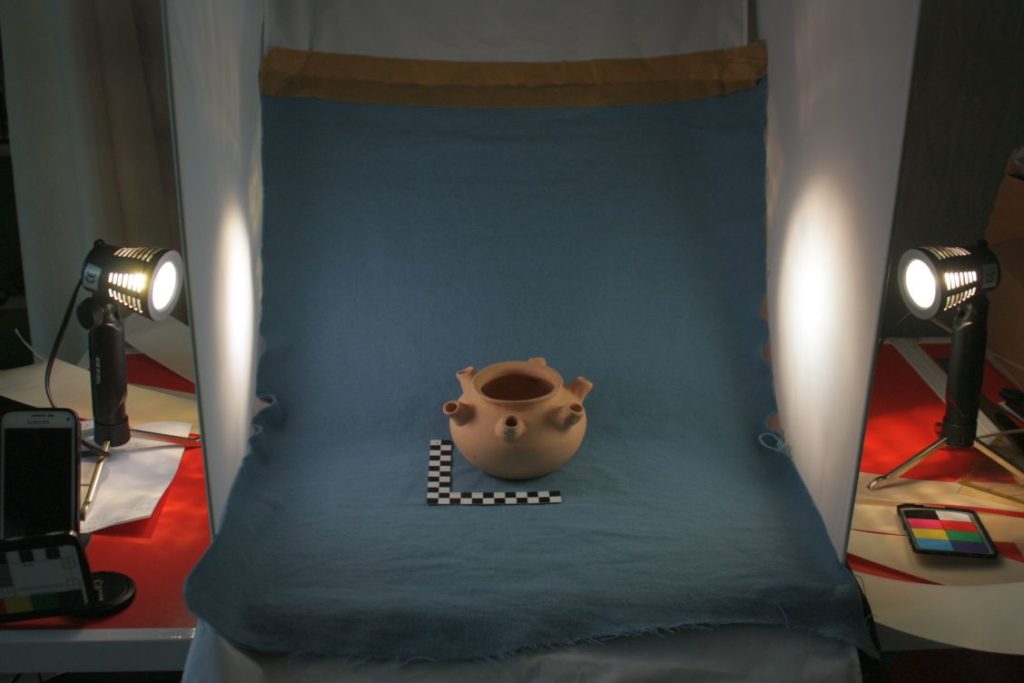
so there I was, having to take product photos. I'm sure I have complained in the past about how hard it is to take good product photos. Usually, I try to go for a nice, bright day and set up the photo equipment in the wintergarden, but yesterday, I missed the time of bright sunshine... so I was very, very glad that the photo tent thingie came with suitable lamps:


So... who knows what this is, and what it can be used for?
0
JAN.
30
0

Back from the Nähtreff Weekend!

I'm back, and now there's the usual things that need to be done after an event which included the shop going for a little travel: Putting everything back into place, for one thing, and re-filling stuff, plus re-ordering, in some cases.

I had a wonderful, wonderful weekend, with a group of lovely people. There was chocolate, and tea, and coffee; there was a large table full of books to browse; there was a nice, light, large room to sit in and chat and work on projects brought along; and then there was the workshop room, where I spent most of the time.

[caption id="" align="alignnone" width="960"] Our group - as you can see, it was a mixed bunch, doing Living History of a good number of different times! (I was one of the people opting for modern clothing - it's easier for me to put on and take off layers as I need to when I'm hopping around the room teaching.)


I had a lot of fun teaching a variety of courses - though, as sometimes happens, one of the courses went a little bit different than I had planned for. Apparently, my method of explaining how to sprang does work for some people - and for others, it does not work at all, and causes more confusion than clarity, which is not a good thing. (The workshop taking place on Saturday afternoon may have had something to do with it, too - with all the talking, book-reading, sewing and cutting, plus the other workshops taking place before, and the night probably not being too long for most people, learning something new is a tad more difficult than when you're all fresh and rested.)

There also were a few bouts of frustration about threads not going quite where they were supposed to be - and that is one of the category 2 problems, the ones involving motor skills and only being solved by practice.

In spite of all the pitfalls, we got it all figured out by the end, and all of the participating ladies had a nice bit of sprang to show for their efforts when we ended the workshop, with some of them even making holes where they wanted them to be. So the next time I'll give a sprang workshop, I will change things a bit, in hopes it will be clearer and easier for everybody.

"While we teach, we learn", said old Seneca the Younger - and he's still right about that...
0
JAN.
24
0

Teaching Thoughts (part 3)

So... I've covered the explanations, and the hunt for words - that is one of the challenges when teaching, and it relates to the mind part of the task, the understanding only.

The things I am teaching, though, are crafts. Which means that there is not only theory (understanding how things work, and how the process should look at every stage of the work and why, and how to check if it is correct) but also practice. Which, in turn, means fine motor skills - getting your hands to do exactly what they need to do to turn those tablets, spin that spindle, control these fibres, tighten the thread, hold and swap those loops.

Motor skills of that kind are not as easy to confer to someone else. Once you've found the right words and gotten that concept across, it's there (and hopefully there to stay), but you can show someone a movement, a motion, a way of holding the body or parts of it, and it might just be so uncomfortable or new or hard to do that it is not really happening for that student. Even worse, there might be issues that prevent someone from successfully doing something - a finger that once was broken, latent tendonitis in a hand, arthritic joints, limited range of motion in a shoulder. The human body is astonishingly strong and resilient in some ways, and astonishingly ill-designed and prone to failure in others.

Even when there are no illnesses or accidents or other things that have left their traces, some folks will get there quicker, and some will need more time to learn that motion. It has to do with what one is used to doing - having mastered other, similar movements for something else before will be helpful, and having never done anything of the sort of motion needed will make itself felt. So some students, naturally, will be faster and some will be slower.

And also naturally, the slower ones will tend to be frustrated, and look at the others who are quicker and start to doubt themselves and think they will never get it. This, for me, is the hardest thing to deal with when teaching crafts - because I would so love to help them be just as fast as the fastest student in the class, and spare them the frustration. I would love to transfer them my own muscle memory, my own experience of how to grip, how to loosen, how something feels when you have to let go just a little more, or hold on a tiny bit harder. Of how the fibre should feel when it is running through your distaff hand, how that stack of tablets resists a bit and then you loosen your grip in one way and turn a little more and there it is.

But this, alas, is not possible. Everyone has to find these little treasures of practical knowledge for themselves. Experience cannot be transferred directly. There is no quick fix for the muscles not getting it as fast as the brain did.

It's frustrating when you know exactly what you want to do, and your body just refuses to do it. It's also frustrating when other people do just the same task with an apparent effortlessness that makes you doubt yourself. Believe me - I know that feeling very well. Not from textile crafts (where I have been doing so many things over the years that I usually get the new motion very quickly). I know it all too well from bouldering, where I regularly have fits of frustration over not being able to do a problem that others just dance up - or so it seems to me. I am still not very strong, so some moves are right out (pull my body up with one arm? Oh forget it!), and I'm still not very tall, so sometimes my angles are different and it makes things very different indeed, and sometimes my hands are too small for a specific grip on a hold. But sometimes, all these things cannot serve as an excuse, or an explanation why something is harder for me. Sometimes I only lack the strength, or the muscle knowledge of how a motion is done, or both - and consequently, I  fall off. Again and again and again, while other people (including other women, and sometimes other women who are a similar height) just... you know... float up.

There's only one solution to this problem: Keep trying. Keep practicing. Even if it is hard, even if it is frustrating, every time of trying and failing means one more time exploring possibilities, making new connections between muscles and neurons, learning something. Eventually, it will click, and the motor part of the brain will realise that oh, this is how the movement should feel, and this is how the muscles here and there and there have to work together, and suddenly it works, not all the time at first, but the seed is laid and with some more practice, it will grow.

There's no shortcut here - but if you have a hard time getting your muscles to do just what they are supposed to do, you can at least have this consolation: The next time you try to learn motor skills similar to the one you are struggling with now, it will be easier, and even easier the next time, and at one point you will be floating along, effortlessly. Don't give up. Keep practising. Be gentle with yourself - you will get there.
0
JAN.
23
2

Teaching Thoughts (part 2)

Just to bring yesterday's thoughts to a close with a little story about how differently people think, here's what happened many years ago at my birthday party.

We were all sitting in the living room back in our old apartment, me and a number of friends and of course the most patient man of them all, and chatting away and having a good time, and then suddenly one of the many physicists in the room points at my little spinning wheel standing in one corner and says "How does this thing work?"

So of course I do what you do in such a situation - I pull out the wheel and I show how spinning is done, and I explain that this both twists the thread and winds it up at the same time, and it does this because the treadle drives the wheel and that in turn drives the bobbin, and the flyer is taken along for the ride by the yarn running through the hooks, but slowed down by this brake thing here, so they go at different speeds and this is why the yarn is wound onto the bobbin.

Blank stares. No comprehension whatsoever. "Yes, but how does this work?" So I try to explain again, showing all the different parts, explaining how the rotation of the whole thing twists up the fibre into yarn, and the flyer is just taken along for the ride by that yarn running over it, and I try to find different words, and different angles to look at it, but I have no clue how to explain it better, and I am met with blank stares still - I just can't get it across, and I'm getting frustrated, my goodness, there must be a way for me to make them understand?

Because, you see, I know my friends. I know very, very well that they are not stupid. At all. Or slow on the uptake. They are working at university, they are making science, they are writing their PhDs, and I've read some of the things they write, and I don't even get half of it, but I do get enough to know they are very intelligent people. And still... I just can't get that simple concept of how a flyer wheel works across to them.

So I'm sitting there, about to start over again with my explanation though I'm really feeling helpless by now - and then the Most Patient Man steps in, and he says just four words:
"It's a slip clutch."

Around me, six or seven men go "Aah." simultaneously. Now they know exactly how this works.

And me? When I think of this evening, I can still hear that "Aah", and I can also still remember the mix of feelings that I had about it - relief that at last there was clarity, and feeling slightly stupid because I had not been able to explain in a way to meet their needs, and at the same time realising that there can be differences in thinking so huge that the fitting explanation can be completely unavailable to me, and that it needed someone else who knows my way of thinking better, and who also knows the others' way of thinking, and knows the latter well enough to make the translation.

I have made very sure, though, to remember that term. These days, whenever someone stands before me, wanting me to explain the spinning wheel, and he (it's usually men) looks at me with a blank stare after the normal explanation, but it seems like he might be a technically inclined person, like an engineer, or a physicist, or something in that line of work, I take a breath and I say "It's a slip clutch."

You know what? They usually go "Aah." Finding the right words to explain is all it takes... and it also is what makes explaining, sometimes, really hard - because the right words do exist, only they might not exist in my personal dictionary. (Yet.)
0
JAN.
22
0

Teaching Thoughts (part 1)

I'm back home after a truly wonderful weekend - I think I had as much fun teaching my weavers as they had with the tablet weaving!

As always, what makes part of the fascination I have with teaching is how very differently people see (and thus learn) things. This gets especially obvious in techniques like tablet weaving where you have a combination of motoric skills (how to grasp and turn the tablets) and knowledge (when to do what) plus several directions where the tablets can move.

Sometimes, my explanations hit home straight away. Sometimes, though, my way of thinking and a students' way of thinking is so different that I need to find another way to explain, and that can be surprisingly difficult. In these cases, it often takes me a while to find out where I did not get across correctly what I was trying to, but once that has happened, there usually is a way to translate things and get the point right.

Mind you, this is by no means an indication of being "a bit stupid" or "slow on the uptake". Usually, it really just means that my way of thinking (and therefore explaining) is so different that it takes a translation, so to say, or a way of looking at things from a completely different angle. I've been having effects like this with the Most Patient Husband when I was trying to explain things to him, and he is certainly a very intelligent man who is quick to get things. We just see some stuff very, very differently. (Sometimes, by the way, someone else in the group thinks in some kind of inbetween way, and can help by phrasing things just differently enough to convey the message - and then I try to remember that for future teachings.)

So one of my goals when teaching is to find the words for everyone in the group to understand what I'm getting at - and the bonus, for me, is seeing all those large and small differences in how we all see our world.  And if you ever find yourself in one of my workshops and my explanations just make no sense to you, please don't think you are stupid, or slow, or unable to understand. Let me know that I have not gotten across, we will try to figure out where the problem is, and I will hunt for the words or the story or the way of explanation that will bring it home to you.

Because the way I see it is this: If I am telling you things, and you understand what I am telling you but choose to ignore it and do things differently, and you get into trouble - that is your problem (and I might or might not be able to help).
If, however, I am telling you things, and you do not understand what I want from you, that means I have not explained it well for you, and that is not your problem at all, that is my problem, because it means I am not doing my job right, and I will do everything I can to take care of it. So don't think you are slower than others - you just think differently, and we need to find the matching explanation.
0
JAN.
17
0

The Power of the Mantra.

Recently (as in "in the last few months"), while exploring new techniques and learning things and doing pattern weaving as well as teaching stuff, it occurred to me how much I mantra-mutter to myself when I am learning, or doing more complex things (or even not so complex things that are new).

When I have a new technique, even if it's an easy, repetetive motion, I find that it takes a good while for the thing to imprint itself in my brain deep enough so it runs on itself. Take sprang, for instance - I've been doing the basic interlinking often enough now that I don't have to pay much attention to it anymore. I know how it is supposed to look at each stage of the thread manipulation, so I just watch my fingers dancing their way across the threads, and in case something untoward happens, I can stop and fix it. Double-layer sprang, though, is still a different beast, so when I sit there doing it, I mutter (or at least thought-mutter) "front layer, back layer, front layer, back layer" all the time, all the way through.

The same with knitting. That brioche stuff is still so new to me that there is a little voice singing out to myself "yarnover and slip, brioche knit, yarnover and slip, brioche knit" all the time. I know, from experience, that at some time this voice will not be audible to my inner ear anymore, though it probably will go on somewhere in the back of my brain. Which means that should I mess up and drop out of the sequence, it will be noticed in a timely(-ish, hopefully) manner, so I can stop and fix it.

When I do tablet-weaving, there is a whole bunch of things to mutter to myself - the work sequence, where the main diagonal slants when I turn the tablets this way or that, whether this is a pattern block or background twill, where the edge of the tablets with two dark threads stands. (Top. Band. Bottom. Warp. Top. Band. Bottom. Warp.) If you could hear all the things I think to myself, over and over and over again, your ears would probably bleed. Hell, sometimes mine start to itch from hearing the same things over and over and over again.

I was wondering, at one point, why I do this. Surely it ought to be possible to work a simple thing without telling myself how to do it all the time, for hours and hours?

Turns out... this seems to not be the case. I have often joked (or, let's face it, half-joked) that I have trouble counting to two when working textile techniques. I don't know why I need the mantra-like mumbling to myself most - but I have found that it is keeping me concentrated on the simple, yet still not ingrained task at hand. It makes it easier for me to look and imprint on my mind, again and again, how my threads should look at each specific phase of the manipulation. Much later, this becomes a subconscious thing, but until then, the mumbling helps. A lot.

So I have decided that mantra-mumbling is a wonderful tool to use while learning. (Best, of course, not done loudly enough that your workspace neighbour can participate.) And I have come to terms with needing a while before the little voice goes quieter, and starts to recede, and only goes on unnoticed in some back corner of my head until my fingers make a mess by accident.

What about you? Are you a mumbler too? And has it ever felt weird to you?
0
JAN.
10
1

Sprang springing up.

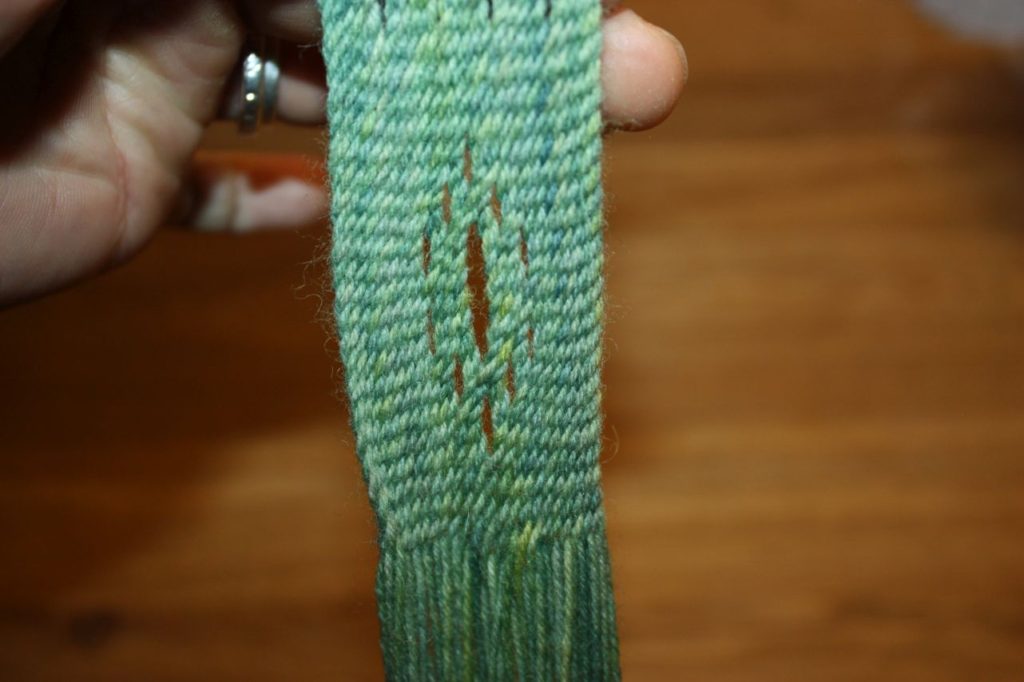
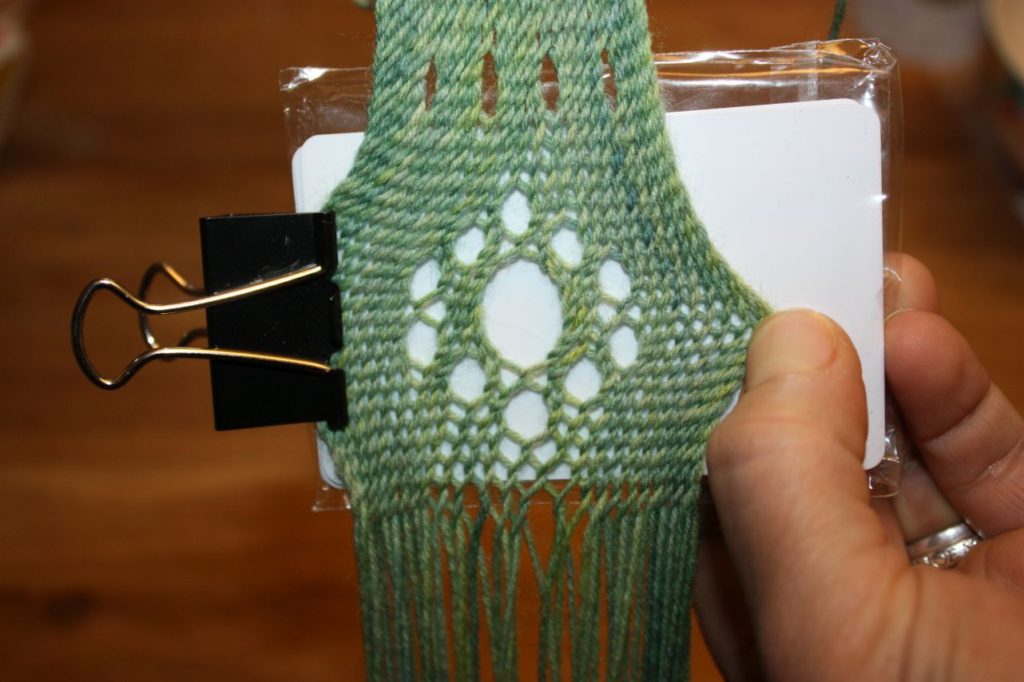
I also mentioned... sprang, right? There has been some spranging going on, both in preparation for the workshop I'll give (where there will be a little flower made as a pattern)...

[caption id="attachment_4223" align="alignnone" width="640"] The flower motif - almost invisible on the collapsed sprang...

[caption id="attachment_4222" align="alignnone" width="640"] ...but very much visible when it is stretched out a bit!

...and, as a sideline collateral, some spranging on a project of mine that has been in hibernation for several years. (I believe things like that happen to all of us.) It is basically a very simple thing - a circular (and thus "endless" warp), worked in simple, boring, basic interlinking... to the point where about as much is left over as would make a good bag handle.

The plan, you see, was to make this a bag, which would stretch to almost any form and size, within the (generous) limits that sprang fabric gives. I wanted a nice, long strap as a handle or carrier strap, though, and that is supposed to be a bit slimmer than the rest. The first thing I tried was just taking double threads as working elements, but that did not give enough of a slimming effect, and using 4 or 6 as single elements messes up the nice colour effect. So... double-layered sprang to the rescue!

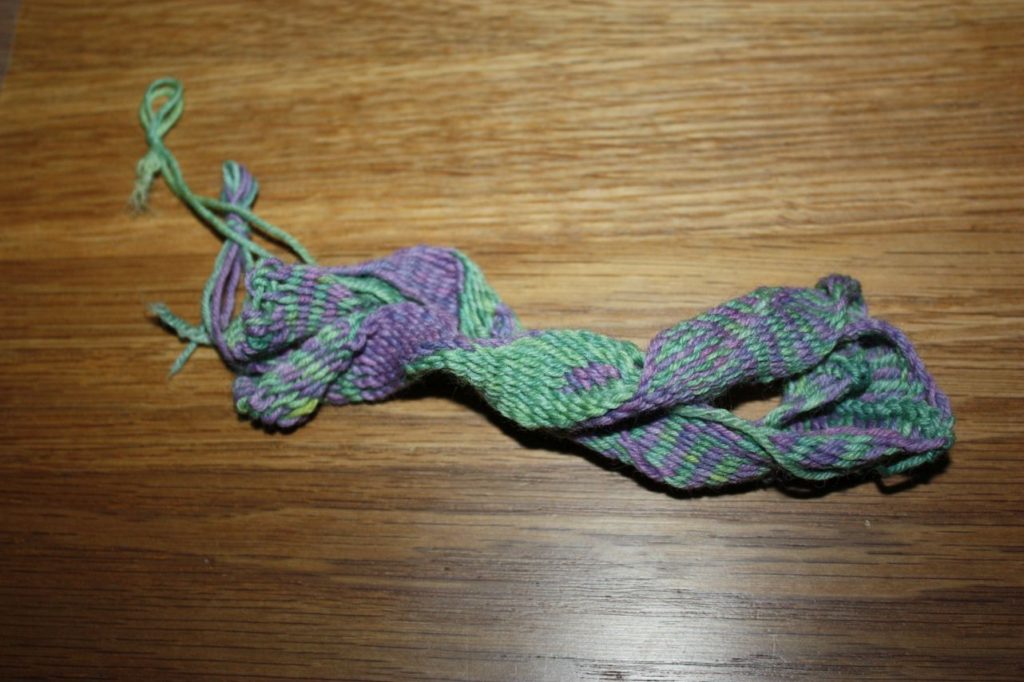
I did a little test piece in green and purple, to make it easier for me to figure out how things are done...

[caption id="attachment_4224" align="alignnone" width="640"] Thanks to this twisting up on itself, you can see the striped beginning (purple and green following each other) and then, in the middle, the double-layer sprang (where I even did a tiny bit of colour changing).

...and then I started double-layering my strap.
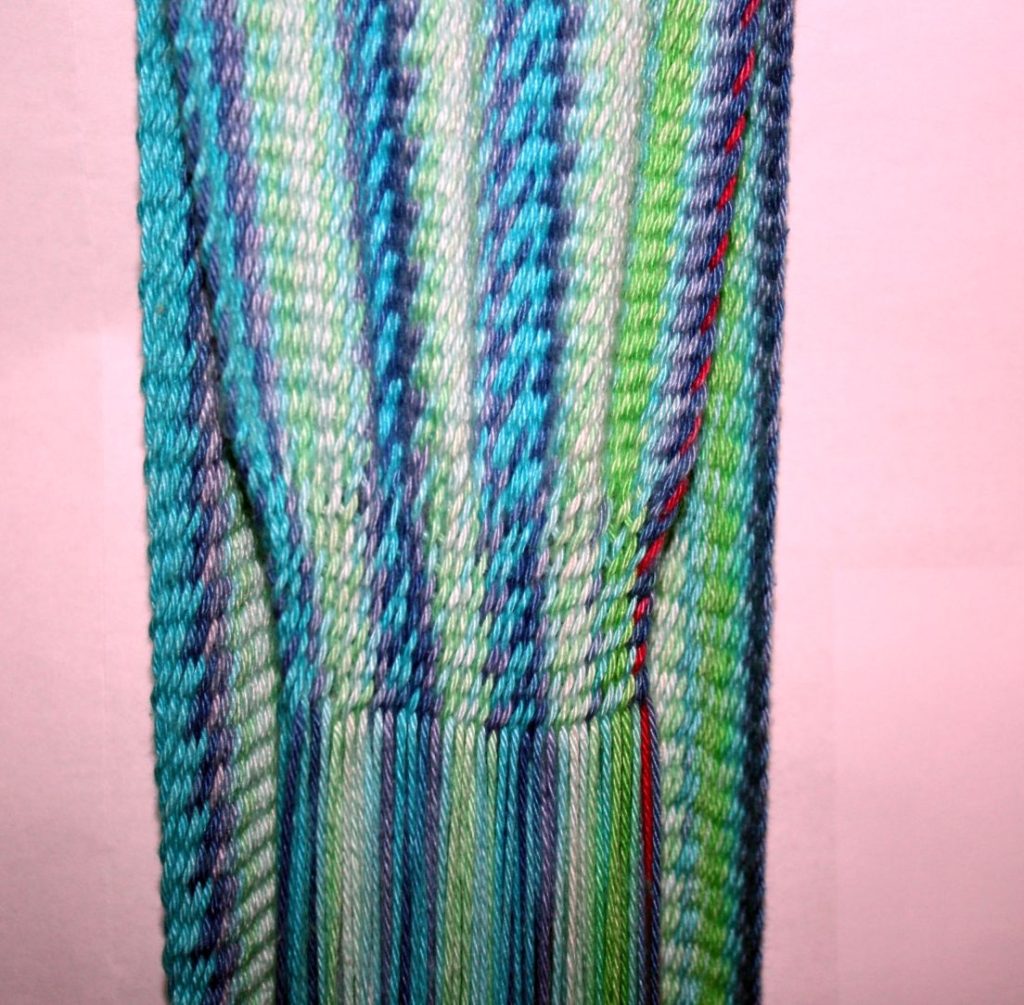


You can see how it narrows down, and changes a bit in structure, but the colours stay similar. It's a little fiddlier than regular sprang, and I am still in the stages where I brain-mumble the mantra of "front layer, back layer, front layer, back layer" all the time (plus I already made one small mistake near one edge), but it does work quite nicely.

Now all that's left to do is a generous amount of double-layer spranging, and then, in the very end, doing double-layer sprang with knitting needles instead of fingers (which will be... exciting!) and finishing it up by securing the final shed (which I will do by weaving in a few threads, to have a firm, stable ending).

And then, eventually, I might have a bag...
0

By accepting you will be accessing a service provided by a third-party external to https://pallia.net/

Kontakt