







Latest Comments

Guest - Aislinn Dyestuff Citizen Science.
09. Oktober 2026
This is a great project. I look forward to the results. Thanks for letting us know.
Guest - Aislinn Time for...
09. Oktober 2026
Looks delicious!
Guest - Katrin Sprang Discussion
18. September 2026
Hi Rachel, I have looked for more photos of you, but that was not very successful. I found a link on...
Guest - Beatrix Sprang Discussion
15. September 2026
That lozenge pattern element is not a photograph, but a scan. So it should be to scale. But I pinned...
Guest - Katrin Sprang Discussion
15. September 2026
I was not referring to Rachel's reconstruction (is the reconstruction you refer to the one photograp...
FEB.
12
0

Digitised manuscripts. And books.

There are more and more libraries that have digitised manuscripts, in a very decent quality, and they can be leafed through for free on the Internet. (I love the Internet.)

One example that I recently stumbled across: The Württembergische Landesbibliothek Stuttgart. (The link will take you directly to the list of manuscripts; there are other categories on the left-hand side. The page is only German, though.) When you click on one of the manuscript titles, it opens in a viewer and you can look your way through the entire book.

Speaking of books, there is new software out - it's called Booksorber and is supposed to turn your camera into a high-speed, high-quality scanning device. I have already downloaded the demo, but not tested it yet. If this works as well as the demonstration pictures on the homepage promise... I will definitely buy it and be a very happy woman.

Speaking even more of books, my library database sorting and ordering is coming along - there are much less unaccounted books in there now than were before, though it is still a sizable heap. Real-life ordering and sorting of books has also taken place and lead to me realising I have quite a few duplicate copies of journals (Experimentelle Archäologie and Zeitschrift für Waffen- und Kostümkunde, mostly). So a new item on my to-do list: make a list (ha!) and offer those for sale...
0
FEB.
04
0

So much to do, so little time.

I have not written a list of all the things I need to do because I do not want to see such a long list. Among the things that would be on it are: take care of the bookkeeping (especially the one considering the car costs, since that is necessary for one of the steps in finishing last year's tax work, and that should be done before March at the latest); scan in more of the spinning experiment visual survey cards in a high dpi setting (tedious, boring work that eats up time and nerves because of its pure, undiluted boringness); have a bit more of a spin-in with my Great Wheel (that is currently standing in the living room) since there was that project planned with lovely Vix that requires about 500 m of decent wheel-spun yarn; testspin with the other, new little wheel that lives here since the start of the year and see what has to be done to fix it; finish an article; work my way through many chapters of the project I have with Gillian; review and possibly change (or at least tweak) my website; make a new info leaflet; plan the next Textile Forum; and I will now stop noting things now or I could really have just written a list to shock me.

Also coming up? Each year's sudden February need to sort and put away any jumble standing around and clear tables and spaces. And have a thorough cleaning of the place. So... plenty of work around here, as you can see. But as they say: "Everything is better with a cup of tea." Which is exactly what I shall get myself now before starting into the day. I am determined to make at least a little dent in the stack of stuff to do with today's work!
0
JAN.
28
2

"Independent Researcher"

The last few years that I've been at conferences, I have seen quite a few different ways of handling conference name tags.

Name tags are a wonderful thing. Not only are they a wonderful help for those who have trouble remembering faces, names, or both (where both is obviously the worst possibility), they also can serve as an icebreaker help (such as "Oh, you are from ... - I always wanted to see Museum X (or whatever else) there). (Yes, I know, not the smartest opening of them all, but still) or they can help finding someone you have always wanted to meet.

What has irked me, sometimes, is the labeling for those who are not affiliated with a Uni or similar institution. I then went around as "Independent Researcher", and somehow I felt like a sore thumb. Or something else that sticks out.

Being independent does, obviously, have its plus sides - there is no uni politics or uni programme making you do things that you don't want to research, you can pick which conferences you go to, you are very free in how you schedule stuff and who you team up with. On the other hand, it means that you lack a lot of opportunities and a lot of support, because it really can make a difference having an institution or a Big Name behind you - or not. And in the worst case, if you do not have (good) access to a library, you have to pay for all the literature access yourself.

On that note, here is something that is nice for everyone, but especially for independent folks: Cambridge Journals is having Free Access weeks for everything published in 2012 if you register at their site. The free access is available until March 5, so there is quite a bit of time to make use of it. There's a promo code you have to enter during registration for the free access, so do not forget to do that if you take up the offer!


0
DEZ.
13
0

Gaah!

It seems that the season is not only bad for my speed (slowing me down), but also for my sense of time (I totally forgot that I had not yet blogged for today) and for my inventiveness (since I don't have a good idea what to blog about).

Today's earmarked for a visit at the library in Bamberg, and possibly also for a short stroll over the market there, followed by a cup of coffee or similar nice hot drink. It's cold but sunny outside, and everything still has a snow cover - it's almost picture-perfect!

"Picture", however, reminds me that I have a paper to outline and a presentation to prepare and a demonstration to plan. So with that and the other things to take care of, there's enough work for the rest of the week. Good thing that I have a sizeable part of the presentation already prepared from another occasion - I only need to adjust and update it for the next one.

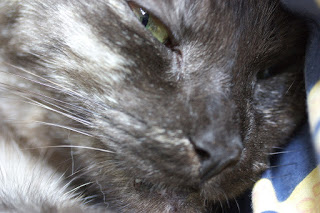
And now... gratuitous cat picture.


She's watching. Remember that.


0
NOV.
21
0

Databases (again), part II.

Endnote is, according to their makers, the bestest citation software ever. As is Zotero (according to their makers). And probably a bunch of others as well.

Back when I was still trying out stuff and relatively new to the world of people working in physics (who have an affinity to LaTeX-the-programme), I wrote one article in TeX. I had to re-do it in MS Word to get it published, but this little stint meant that I got to know the powers of BibTeX, which is the citation system thingie that comes with TeX. It is, more or less, a reference database that you cite from, and the programme does the formatting.

Sound familiar? That's just what EndNote does with Word. Back when I then found out that there was, indeed, such a programme, I bought it for the hefty sum they asked for the student edition back then and have been using it ever since. There's connection files to get data from online library catalogues (something I should have used more, I now think, it might have saved me lots of work), style files that can be altered to suit individual needs, and both a field for "notes" (which I use for making general, personal notes about a reference) and "research notes" (which I use for typing excerpts or snippets including the page number so they can actually be used for working without the physical copy of the book). Plus there are custom fields - those I have used to mark whether I own a book (physical or digital copy), where it stands in my library (well, that's a work in progress to be honest), if I have pictures in my picture database (by noting down the prefix of the image files, such as schweppe_ which is, in the actual files, followed by a page number so I have files like schweppe_10.png) and if I have already read it or just jotted it down for future reading.

According to the version history, my purchase of the programme must have been in 2004. Which means that my version is a little... older. Now, I have no problem with older software (I'm happily using Word2000, and not planning to change from that), but sometimes, it pays to look for alternatives. Especially since my EndNote is sort of iffy on the connection files, with quite a few of them not working (or not working anymore), and I cannot download the whole set of new ones from the site (there is no such button in my installation menu).

Due to the recent mention of Mendeley by Phiala in the comments of some other post, I did a little looking and found Qiqqa - a .pdf organising software with built-in OCR, a wizard to help with filling out the reference data for each imported .pdf, and the possibility to cite to Word. I quite like it on the first try and am currently using it to get some order into my .pdfs. I have even considered changing to this programme from EndNote for all my referencing, but it does not do a few things that I have grown accustomed to, and I have also read that it's not too easy to modify citation styles (something I regularly need to do).

Qiqqa is intended for use over the web, with web storage of .pdfs, something which I don't need (and don't want). It allows "vanilla references", that is those without a .pdf attached, but then I get a nasty popup if I want to associate a file with it now. It also does import from EndNote - but not the "Research Notes". There is the possibility to search for duplicates, but I found it rather hard to compare the actual duplicates with each other and decide which one should stay and which one should go. I have not tried the citation thingie yet, but from the overall feel, it's very much geared towards .pdf files only, and I don't want to use two programmes. So at the moment, my plan is to use Qiqqa to get some order into my .pdf files, then export the data via BibTeX and a converter to EndNote, and merge the two databases. (That's the plan only, though - and it might change if problems with the import should arise. Or if Qiqqa should evolve some more, and then I might reconsider using it as my new reference database thingie.)

I'd be happy to hear about your experiences with Qiqqa, EndNote, Zotero or whatever you use!
0
NOV.
20
0

Databases (again).

Update 2021: Unfortunately, Fototime has ceased operation, as the company has gone under during a huge server failure. So they are not online anymore, and if you have a pro edition, that includes their license server. I'm very sad about this, and if someone has suggestions for alternative software that is similar, I'd love to hear about it!
As the long-term readers among you might know, I am using Endnote for my references and bibliography, and a programme called Fototime FotoAlbum. Both have been on my system for years now, so I have gained a bit of experience with them.

FotoAlbum is making a good job of sorting and handling my image database, and their online support is one of the best I know. There was no instance where I didn't get a speedy reply, and things were taken care of whenever possible (I realise that not all my requests would fall in line with the needs of the normal customers, so it's understandable they are not adapting the programme just for me).
The programme allows notes and comments, ratings, copyright notes, keywords and captions; it has filters and an "album" system that makes it possible to store pictures in a given folder structure, yet have them as part of several albums. There's also the possibility to define smart albums, automatically putting pictures in there if they have the right keywords, date, or other defined thing.

Speaking of dates - I use the programme to sort my picture database which, logically if you are working about medieval stuff, consists mostly of old things. The photo timeline is quite generous, since it allows to go back until 1700 (there were no photos before that time, right? Right? Yes.). For stuff from the 9th or 12th century... that's a bit late, though. So I developed my own system that has been successful for years now: I use the 1700 as code for my centuries, as in 1708 - eighth century, 1715 - fifteenth century. And I even have a months key, for example January 1713 means from 1200 to the 1220s. The months key is not perfect (due to my less than perfect definition, that is) but it works fine and it allows me to sort all my pictures by date. And I have a lot of pictures.

So if you are in search of a picture database, I can fully recommend the programme. I use the paid-for edition, due to a few reasons of my own, but FotoAlbum is also available in a free edition that will already serve for most database-related needs, including handing out your pictures or a selection of them, with all the data attached and viewable, to someone else.

As for Endnote... that's something to write about tomorrow.
0
NOV.
15
0

Things are picking up.

Usually, for someone working with demonstrations and in connection with living history events, the late autumn and winter months are the slow season - the time to kick back and think about stuff for the next season to come. The time to pack away things, repair stuff, make new stuff (or plan to do it until it's time to frantically do at least a bit of all that work in the week before the new season, in time-honoured tradition and in tune with the old reenactor's joke "Winter is the week before the first event in the new season").

But this year around, I don't feel as if things were slowing down; on the other hand, there's plenty to do and some juicy projects and other things have reared their heads, promising interesting times and a chance of income.

So I am emailing and reading and writing and planning... while drinking coffee (always good) and eating highly motivating sweet substances (aka cookies and chocolate). After all, the brain needs sugars, right?

Link for today: Not a medieval dress, but a spectacular one - and it has been restored recently. It's the Victorian stage costume of actress Ellen Terry, and the article is brought to you by PastHorizons.
0

By accepting you will be accessing a service provided by a third-party external to https://pallia.net/

Kontakt