Latest Comments

Guest - Aislinn Dyestuff Citizen Science.
09. Oktober 2026
This is a great project. I look forward to the results. Thanks for letting us know.
Guest - Aislinn Time for...
09. Oktober 2026
Looks delicious!
Guest - Katrin Sprang Discussion
18. September 2026
Hi Rachel, I have looked for more photos of you, but that was not very successful. I found a link on...
Guest - Beatrix Sprang Discussion
15. September 2026
That lozenge pattern element is not a photograph, but a scan. So it should be to scale. But I pinned...
Guest - Katrin Sprang Discussion
15. September 2026
I was not referring to Rachel's reconstruction (is the reconstruction you refer to the one photograp...
JULI
30
4

Spooling... spooling... spooling...

No, I haven't become a printer. I am busy with the next additions to the market stall, and that means spooling. For example linen thread, that all-time favourite and staple for all handsewing purposes where firm seams in linen or wool are needed.

I have searched for nice, smooth, sturdy linen thread for quite some time, and I am happy to have found one finally with no or next to no slubs and imperfections in the thread. And now it's ready for sale, coming in white or off-white and on little brown paper spools with 20 metres of thread.


While brown paper is not an authentic medieval packaging, I have chosen it because it is easy to handle, quite eco-friendly, cheap to get and will at least not be blatantly modern-looking in a historical sewing kit. One day, I will find a wonderful solution to this problem - but for the moment, as I'm only establishing my stack of wares, this seems like the best way to me.
0
JULI
29
0

Deadlines and Life After

I more or less like deadlines. After all, this means that there is a set date at which it will all be over. I'm trying to meet all my deadlines, of course, but that means that I'm often wrestling with last problems and last-minute ideas in the week before, resulting in rather intense concentration on the one topic.

So the deadline, to me, is not only the set and slightly dreaded "time to be all finished", it's also the point of time after which I know I can turn again to other things. And this is rather nice, because while the projects are usually something I like to do, it can get a bit too much when immersed deeply for a longer stretch of time. And during the last days, other things are usually left to form heaps, literally and figuratively speaking, because I'm not able or willing to spend the extra effort on them.

When I've handed in something, I try to take a day or two off. That is needed anyway, because even when I try to put in a proper work day after T-0, there won't be much coming off it, resulting in frustration only. So the time is better spent for relaxing and recharging the batteries of the self.

After the deadline is before the deadline, though, so I usually need to get back on track pretty quick. And that is the thing I like least about the full immersion and the slack-off day after T-0: That it can be rather hard to take up all these other threads of thought and of work again and get back onto them. And this is exactly what I need to manage today, with new deadlines approaching (Cave Gladium one of them) and quite some things to take up again...
0
JULI
27
3

Busy Sunday, Lazy Monday

The opening of yesterday's exhibition went really fine, and people came in all during the day to see the exhibition and look at the different textile techniques - so I call yesterday a success.
The Altstadtfest was very nice as well, with gloriously sunny weather and a lot of people strolling through the streets, eating, drinking, listening to music, watching crafts presentations, and generally amusing themselves.

Here are some photos from the exhibition:


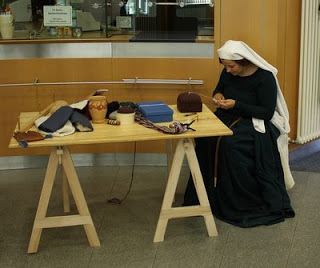
Preparing for the opening - I'm sorting out my hairnet for demonstration of the technique, and you can see the demo band for tablet weaving (twill demonstration), still secured with a clamp and unattached, in front on the table. The brand-new wonderful table, by the way, that will accompany me to markets, events and any occasions I need a medieval table. I'm so happy about it!


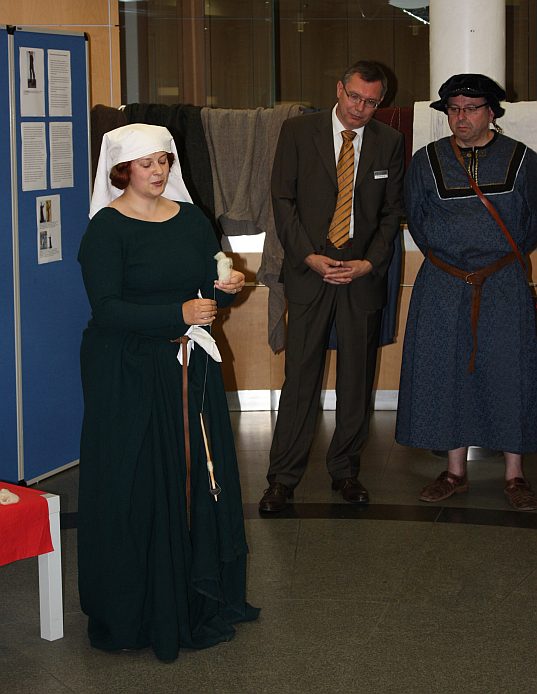
This is a picture taking during my introduction speech for the exhibition - I was showing a snippet of spinning with the drop spindle to make people realise how much time is needed for making just the threads for weaving. This usually works very well, and it did also in Bad Staffelstein.


This picture was taken right after the official part, with the honorary guests and the gentleman of the bank who opened the exhibition. On the photo, you see two "royalties" at once - the "Korbkönigin" (Queen of Basketwork) from Lichtenfels, the German "Capital of Basket Making", and the "Thermenkönigin" (Queen of thermal springs) from Bad Staffelstein. And my colleague Marion, dressed medievally as well, who helped to draw people in and explain all day long.

So because yesterday was nice but exhausting, and I'm really tired today, I'm taking a day off. No work requiring brains today, hooray!
0
JULI
24
4

Rollercoaster, anyone?

Back to earth is a nice thing, but silk ribbon is very nice as well. And who minds a little luxury, huh?


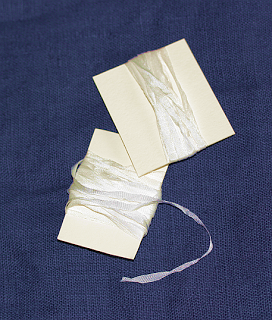
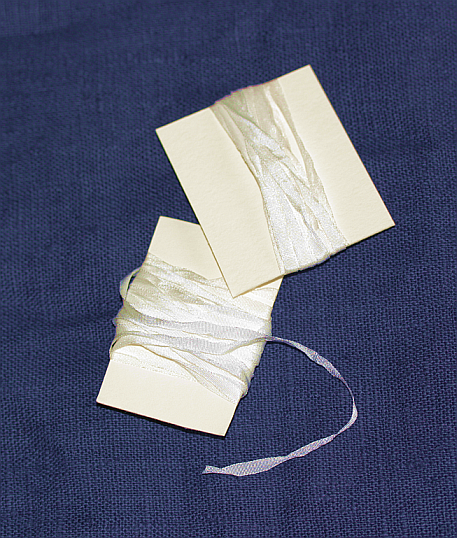
This is 3.5 mm wide pure silk ribbon, very light and airy. A nice thing if you need shoulder straps for a reconstruction of this garment:


Or a light, fine drawstring. Or a ribbon to bind and decorate your hair. Or whatever else you can think of. The ribbon comes in 5-metre pieces, but should you need more in one piece (or just more), I can wind off (almost) whatever length you desire.

Picture source: Bartz/Karnein/Lange: Liebesfreuden im Mittelalter. München 2001. P. 25.
0
JULI
23
3

Back to earth.

After yesterday's high aspirations to luxury thread, today it's back down to earth in the Market Stall. I proudly and happily present to you the most basic of tools for the textile trade:

The Abysmally Underestimated and Neglected Spindle Stick!

While spindle-whorls are common archaeological finds, and while there are hundreds of dozens of spindles in all kinds of homes, working or not, the spindles themselves - that is, the sticks - are not something commonly seen for sale on markets. And I asked myself: Why? While there are not so many conserved wooden spindle sticks (I could write just "spindle", but I want to prevent any misunderstandings) around, the situation is still much better than that on textiles. And there are textiles on any medieval event.

I found out soon why they are not commonly for sale. Medieval spindles are usually rather slender with a double-conical form. With as little as two or three millimetres diameter at the ends, and not much more than a centimetre at the thickest place, they are too slim to be turned on just any lathe - the thin stick starts to wobble, making an efficient production difficult or impossible. But spinning with a much thicker double-conical spindle stick, which would pose no problems when turning, will not work as well. And, even more important, that stick won't fit the whorls so smoothly. And you want your spindle to fit your whorls, all of them, so you can just change. For example, have three spindle sticks, spin on one until it's full, spin on the second until it's full, and then ply both singles together on the third stick before removing your ball of plied yarn from that spindle, freeing all three again. And that will work only if you can change your whorl from spindle stick to spindle stick - and preferably, if you have more than one whorl, this would work with any of your stash.

In contrast, most modern spindles are seen differently, with the whorl and the spindle stick firmly belonging together. And most spindle makers just have their own method that will cut out the need for double-conical spindle sticks - often they use a stick that is firmly fixed to the whorl and not conical in shape. So the market for spindle sticks seems to be not so large. And if you want just one single stick, you can always take a knife and whittle it down to fit your whorl(s). If you are like me, that is possible yet not pleasing, because I'm not so good a whittler, and most of my "make a spindle" efforts were not so successful. Whittling down some wood to get a rounded, conical and slender shape is not too easy, I found.

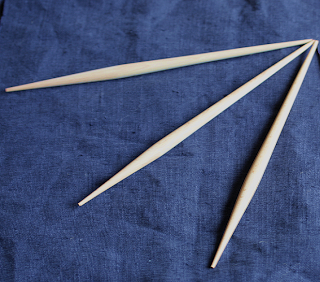
So after searching a while, I finally found a workshop that accepted the challenge. And now they are back: Double-conical spindle sticks, made from beech wood, modeled after a find from Bergen in Norway. They are 11 mm thick at the fattest part, 3 mm at the ends, and 27 cm long. Need I say they are a pleasure to spin with?
0
JULI
22
8

Guessing the Market

There's sort of good news: Finally, I might have found an artisan who is capable and willing to reproduce medieval gold thread for me. Real, no-compromise gold thread, as it was found in the excavations at Villach-Judendorf in Austria: Gilt silver wound around a natural-coloured silk "soul", 0,2 mm thick and used for weaving (brocade) as well as for embroidery. (You can use several threads at once when doing couch work - I have a nice photo somewhere showing just that. After all, medieval people had their lazy streak too!)

"Normal" gilt or gold threads are imitation gold, wound around a core of cellulose or other material, but not around silk. And getting gilt-silver threads (not the japanese version, where a strip of paper is gilded or silvered) is really hard already, even if it's "just" gilt, not pure gold. Those threads are usually much thicker, too.

The downside? There's a hefty minimum order, and gold thread is not cheap. Quite the opposite, actually: Real gold or gilt thread was exquisitely expensive in the Middle Ages and it's still exquisitely expensive today. I'm very, very tempted to order the thread, but it's an investment that should not go too wrong.

So now it's time for me to play my most beloved game of them all (well, not really): "Guess The Market". And this time, I'm shamelessly using this blog to get some input from you, because I've been told time and again that I'm no normal textile stuff customer (though you probably aren't).

Do you feel the strong desire to buy authentic-to-the-soul gold thread? Modeled after a find? Even if it is really thin and really pricey? Would you use it for weaving, for embroidery, or for both? How much need do you have? And how much would you be willing to pay for, say, 10 metres? Or do you prefer to buy the cheaper imitation gold thread?
0
JULI
21
11

More additions to the Stall

When some time ago I asked for suggestions for the market stall, Kruliczyca (she has a blog, too, in Polish with English summaries) mentioned bentwood boxes for storage of needlework goods.

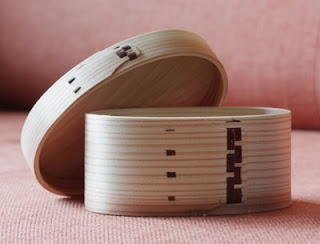
I have now come up with some of them - smallish, oval boxes made from fragrant wood. They are small enough to slip into a sewing cabinet or box that is already quite crowded, plain but pleasing the eye so they will look nicely on a table with work in progress, and a good possibility to store a needlebox, small shears, or your favourite sewing threads in them. Or hide some unauthentic thread rolls or other needlework trinkets that are not for everybody to see.


I quite like them and will probably use a few of these boxes for displaying wares. At the moment, they make an impressive stack in my warehousing cupboard!
0

By accepting you will be accessing a service provided by a third-party external to https://pallia.net/

Kontakt