



Search the Blog
Latest Comments
Lightfastness Tests - with pictures!
For those of you interested in the lightfastness tests, here are pictures!
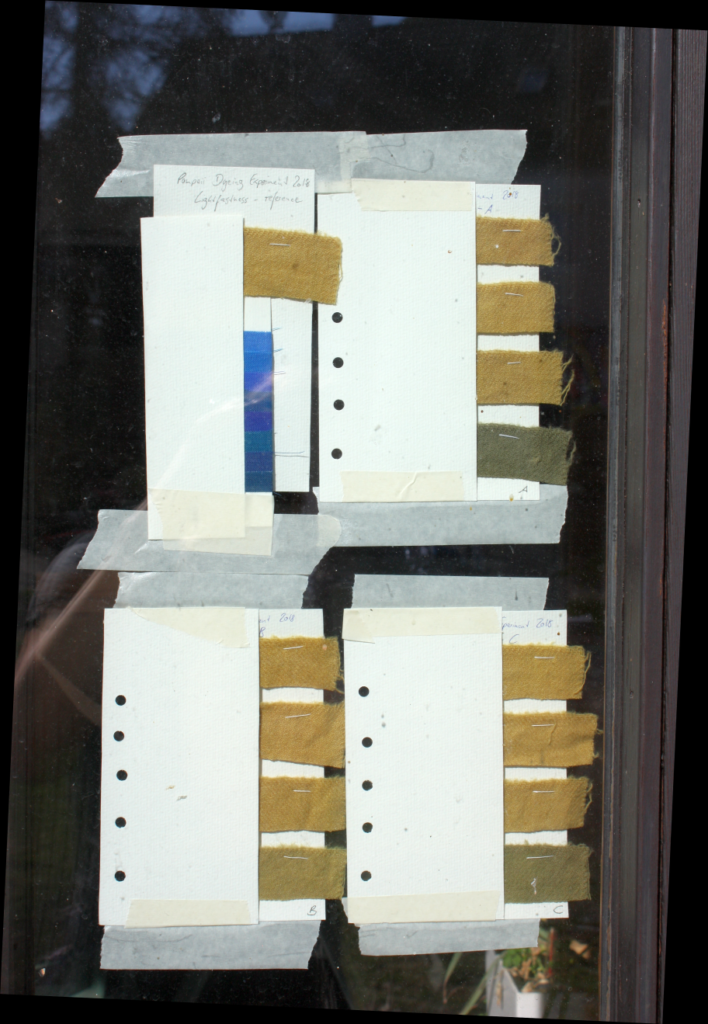
I covered the parts to be protected with cardboard and stuck the whole shebang into the window of our wintergarden, facing south. After 7 days, I took it all down and checked the fading.
On the blue wool scale, each reference strip takes about two to three times longer to begin fading as the next lower strip in the scale. As the Material Technologies Limited website states:
Under normal solar testing conditions, reference 1, the least permanent, will begin to fade in 3 hours to 3 days, depending on geographic location, season, cloud cover and humidity; reference 3 will fade in 5 days to 2 weeks; reference 6 in 6 to 16 weeks; and reference 8, the most permanent, in 6 to 15 months.) These scales are used for paint lightfastness testing under international standard ISO 105-B, and are also used by gallery curators to measure the accumulated amount of light received by museum displays of paintings, textiles or photographic prints.
This fits in fairly well with the speed of fading that I had, with reference strip 3 already noticeably faded after the 7 days that I took it down for the check. And this is how the birch looked:
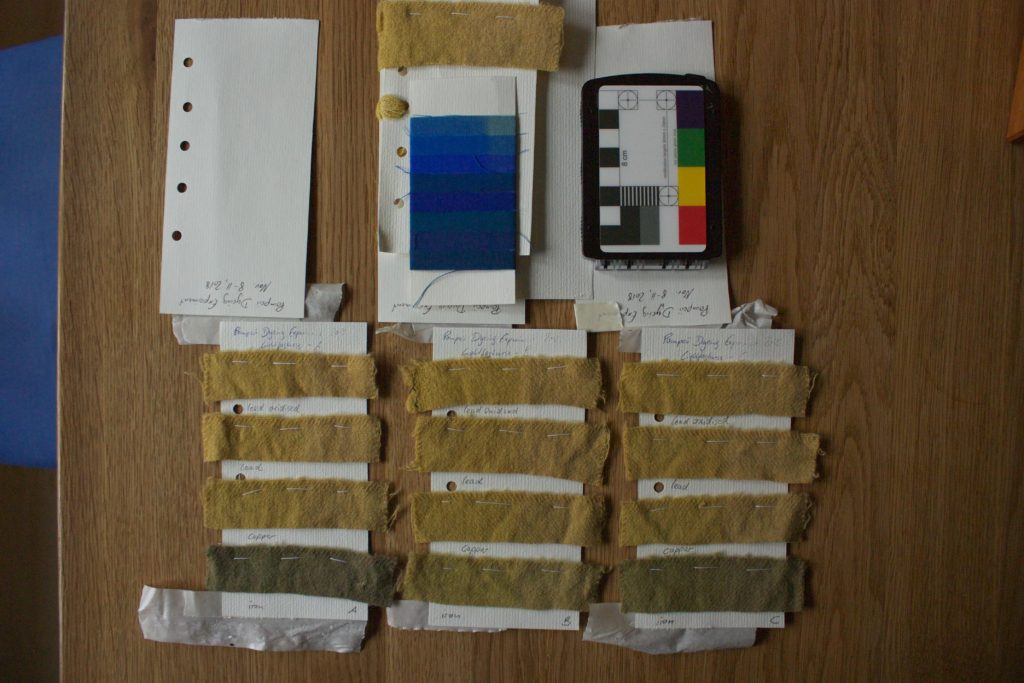
As you can hopefully see, there's distinct fading on the first blue strip, and there also is fading on the second and third one. It is not so easy to see on the photograph, but in actual natural daylight, there also is a little fading visible on the birch-dyed cloths. That would place the colour fastness regarding light of these strips somewhere between strip 3 or 4 - not too bad, seeing that modern recommendation for clothing dyes is to have 4 or better.
This, by the way, is another example of it being rather difficult to document nicely and clearly - not everything is easy, or even possible, to show on a photo.
After taking these pictures, the strips were covered again and went back into the window. I'll take them down once more soon, and see how things look then.
Comments
By accepting you will be accessing a service provided by a third-party external to https://pallia.net/