


Search the Blog

Latest Comments
More Sprang Cap Questions...
All the discussions about size, fit, and how to wear a sprang cap aside - one of the interesting side track things that I have realised is that there seems to be a rather narrow selection of who is shown wearing these caps, and in what context.
In their article "Enigmatic Beauty", the authors have a list of fourteen examples of headwear with sprang or net inserts. Some of these are shown as re-drawings in the article, some are only listed (for instance there are several occurrences in the Schatzbehalter from Heidelberg University). Interestingly, there seem to be almost only midwives, executioners, and to a smaller extent servants who are wearing these caps.
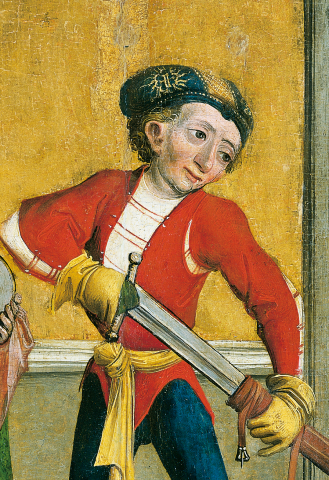
That is one of the additional instances I could find - and, again, we see an executioner.
So the logically following question is... why do we have the caps in these rather selected circumstances, and, at least as far as I can tell, rarely anywhere else?
Executioners are a sort of special person, as they are doing work that is considered dishonest. Yet they are still needed - and as a lot of saints get to be executed in some way, they are frequently depicted. Usually, they are wearing up-to-date fashionable garments, but they are also not the most positive characters. So are they wearing the caps in the images because they did so in real life? Or was it some kind of slander? Unfortunately, I regret sometimes these days that I didn't catch more background knowledge about art history, which would be helpful in things like that - but the executioners and sometimes some (male) servant wearing a cap like this does not point towards a high status, at least not as a piece of menswear.
If we look at the women, the scene where there's most of the depictions is the Birth of Mary. Here, we have a clearly domestic scene. Mary is on the bed, there's usually someone in the background doing something in the kitchen, and there are one or several other woman assisting with the birth and the newborn child. Notably someone usually identified as midwife - and that woman, sometimes wearing an apron, sometimes not, has this cap on her head - while Anna, the new mother, and the other assisting women usually wear a headcloth, or sometimes nothing (maybe signifying an unmarried status). Sometimes, the midwife has her sleeves drawn up, or wears a sleeveless dress (sleeves removed?) and her shirtsleeves are visible.
To me, this gives the impression of someone partly undressing to do the work necessary, which would have been including different kinds of fluids that you'd not want on clothes more than cannot be avoided. She's not wearing the complete "outside" dress usually including several layers, and she's not wearing the full headcloth that is also usually seen. That full headcloth that, coincidentally, might or might not have been fastened to something worn underneath - because some constellations of that headcloth would require glue, magic, or, well, something to pin them to in order to stay where they are.
I would be inclined to see the cap as an under-cap, thus, designed to sit on the head firmly enough (while hopefully still comfortable) to pin the rest of the headdress to, or if no pins were needed to provide some more friction between fabrics than between fabric on hair. That would also explain why we don't see it worn out and about by women, though they do sport many different kinds of headcloths otherwise.
(I will be keeping my eyes open for more examples of this kind of headwear - so if you happen to know more images apart from those already mentioned, these are very welcome!)
Comments
By accepting you will be accessing a service provided by a third-party external to https://pallia.net/