


Search the Blog
Latest Comments
Guest - Aislinn
Dyestuff Citizen Science.
09. Oktober 2026
This is a great project. I look forward to the results. Thanks for letting us know.
Guest - Aislinn
Time for...
09. Oktober 2026
Looks delicious!
Guest - Katrin
Sprang Discussion
18. September 2026
Hi Rachel, I have looked for more photos of you, but that was not very successful. I found a link on...
Guest - Beatrix
Sprang Discussion
15. September 2026
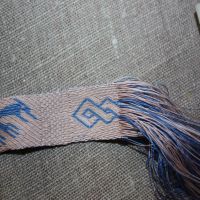
That lozenge pattern element is not a photograph, but a scan. So it should be to scale. But I pinned...
Guest - Katrin
Sprang Discussion
15. September 2026
I was not referring to Rachel's reconstruction (is the reconstruction you refer to the one photograp...
Sounds from the Middle Ages.
We are so far removed from the Middle Ages that there are very, very few sensory things left that we can still experience in the knowledge that people in the twelfth century would have had the same experience. We can try to recreate recipes, for instance, but we will never know if a medieval cook would have seasoned something to the same taste... and even deeper than that, many of the foods available today have changed a lot through breeding, so in some cases it has become impossible to use a similar basis for the cooking itself already.
There are some things that have remained much the same, and we can still experience them. Wood fires are an example of this - wood will burn just like it did in 1140, and if it's dry it burns better than if it's wet, and different kinds of wood burn with a different heat, and burning wood gives off light and warmth. And smoke.
However, for most of us today, a fire is something special, not an everyday tool - which is very different from medieval times. Fire was an omnipresent tool, the heat and light supplier, and wood smoke consequently permeating everything. All the time. Which means... when we experience a fire today, we tend to notice the smell of burning wood as something special, while it would have been just like a city smell in our times: so much part of everyday life that it is hardly ever noticed.
We might get a little closer with something that has not changed as much from everyday to special, though - something that would have been noted in the Middle Ages, due to its significance, as it would be noted still today. Such as a church bell.
This bell is called the Theophilus-Glocke (Theophilus Bell) and was cast around 1140 by "Meister Wolfger". It is one of the oldest surviving church bells we have. The fact that we can still hear it ring? Absolutely utterly awesome.
(h/t to Matthis from the Schauhuette blog.)
There are some things that have remained much the same, and we can still experience them. Wood fires are an example of this - wood will burn just like it did in 1140, and if it's dry it burns better than if it's wet, and different kinds of wood burn with a different heat, and burning wood gives off light and warmth. And smoke.
However, for most of us today, a fire is something special, not an everyday tool - which is very different from medieval times. Fire was an omnipresent tool, the heat and light supplier, and wood smoke consequently permeating everything. All the time. Which means... when we experience a fire today, we tend to notice the smell of burning wood as something special, while it would have been just like a city smell in our times: so much part of everyday life that it is hardly ever noticed.
We might get a little closer with something that has not changed as much from everyday to special, though - something that would have been noted in the Middle Ages, due to its significance, as it would be noted still today. Such as a church bell.
This bell is called the Theophilus-Glocke (Theophilus Bell) and was cast around 1140 by "Meister Wolfger". It is one of the oldest surviving church bells we have. The fact that we can still hear it ring? Absolutely utterly awesome.
(h/t to Matthis from the Schauhuette blog.)
Comments
No comments made yet. Be the first to submit a comment
By accepting you will be accessing a service provided by a third-party external to https://pallia.net/