



Search the Blog






Latest Comments
Very Old Knitting, Part 5.
After mulling this over and thinking a minute about it, he asked "Why don't you just align them differently?" Brilliant man. So once I had yarn and needles handy again (this might have involved buying a set of simple metal needles to live in my handbag, because you can always find a use for metal sticks, and there was yarn in the bag already) I tried both my ideas (which did utterly not work, both of them, but it was interesting to see how spectacularly they failed to work) and then the different alignment.
So here you go, courtesy of the Most Patient of All Husbands, a second method to do compound knitting, with no slipping at all as long as you work in the round.
All stitches are aligned with the right leg behind the needle. The older stitch is now always on the left side, the newer stitch on the right side of the pair.
[caption id="attachment_2062" align="alignnone" width="640"]
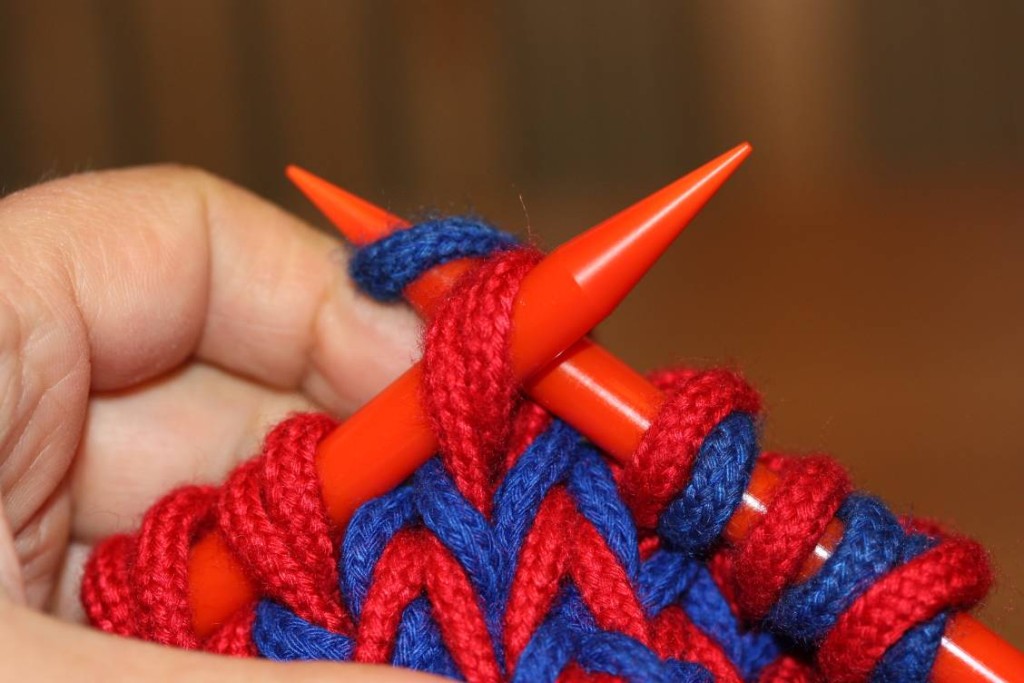 Insert right needle straight through both stitches on the left needle and wrap yarn from back to front (so the right leg of the new stitch will lie in the back)...
[caption id="attachment_2061" align="alignnone" width="640"]
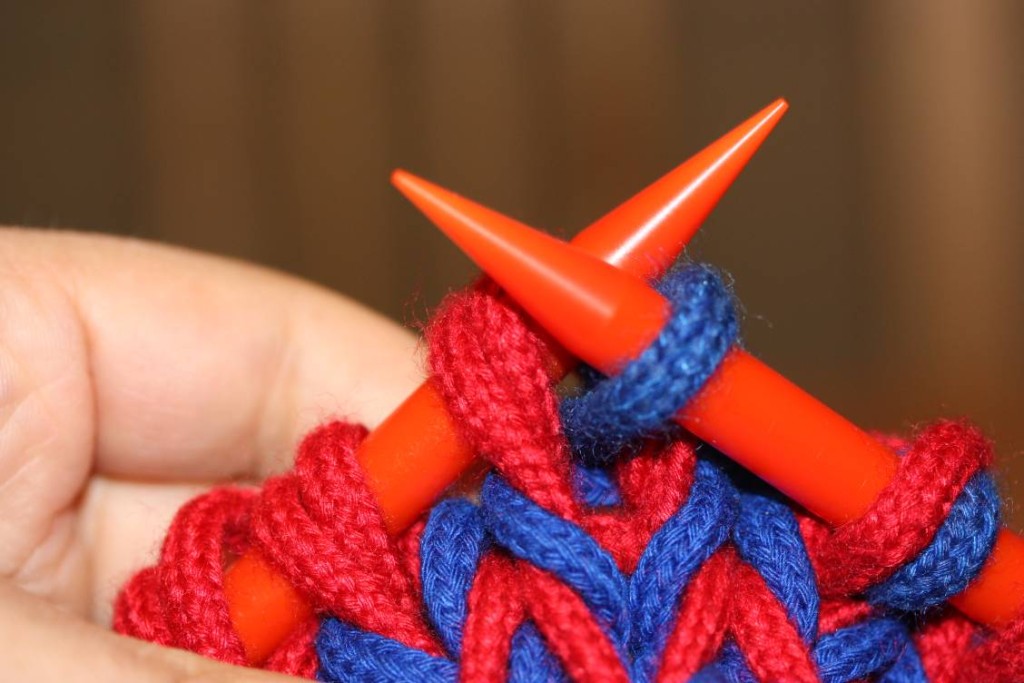 ...draw through both stitches on left needle...
[caption id="attachment_2060" align="alignnone" width="640"]
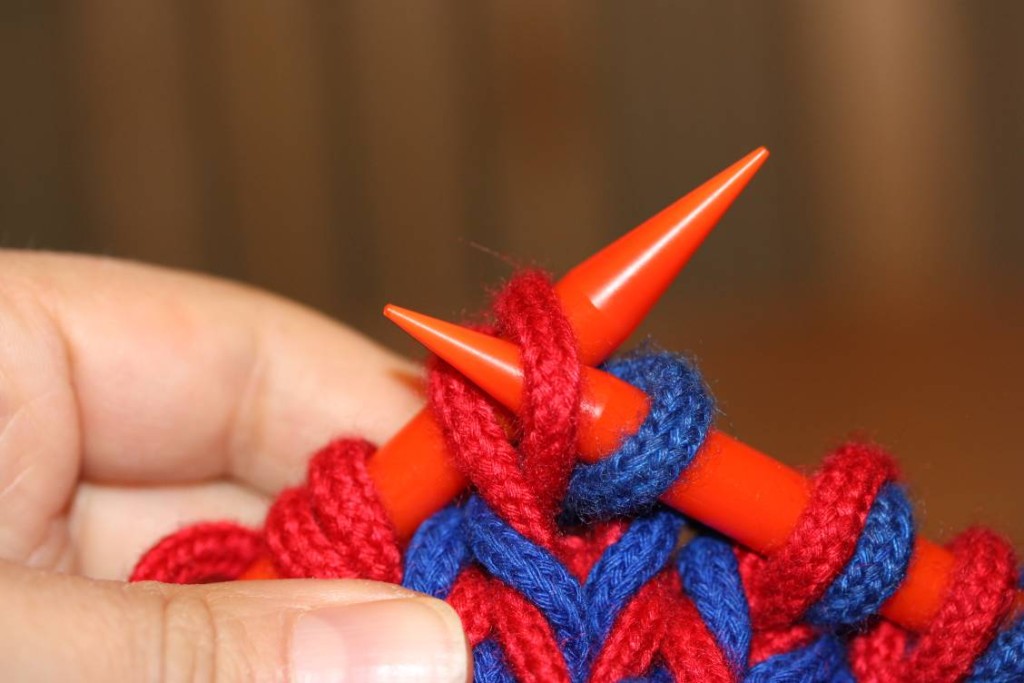 ...and move the first stitch on the left needle over to the right.
[caption id="attachment_2059" align="alignnone" width="640"]
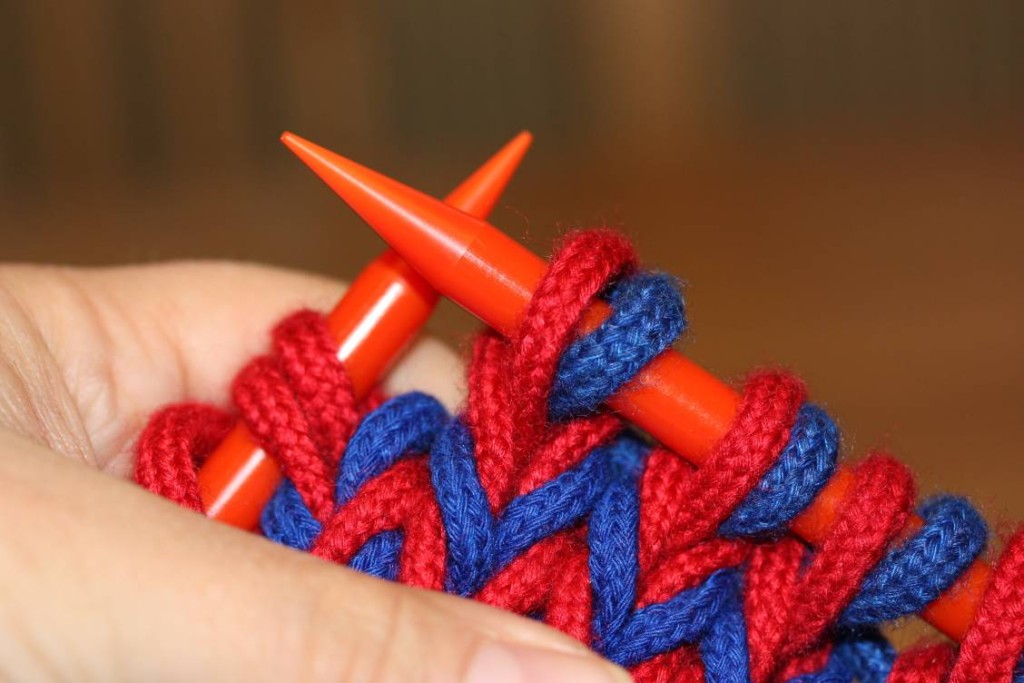 The new stitch lies on the right, the older stitch on the left.
[caption id="attachment_2058" align="alignnone" width="640"]
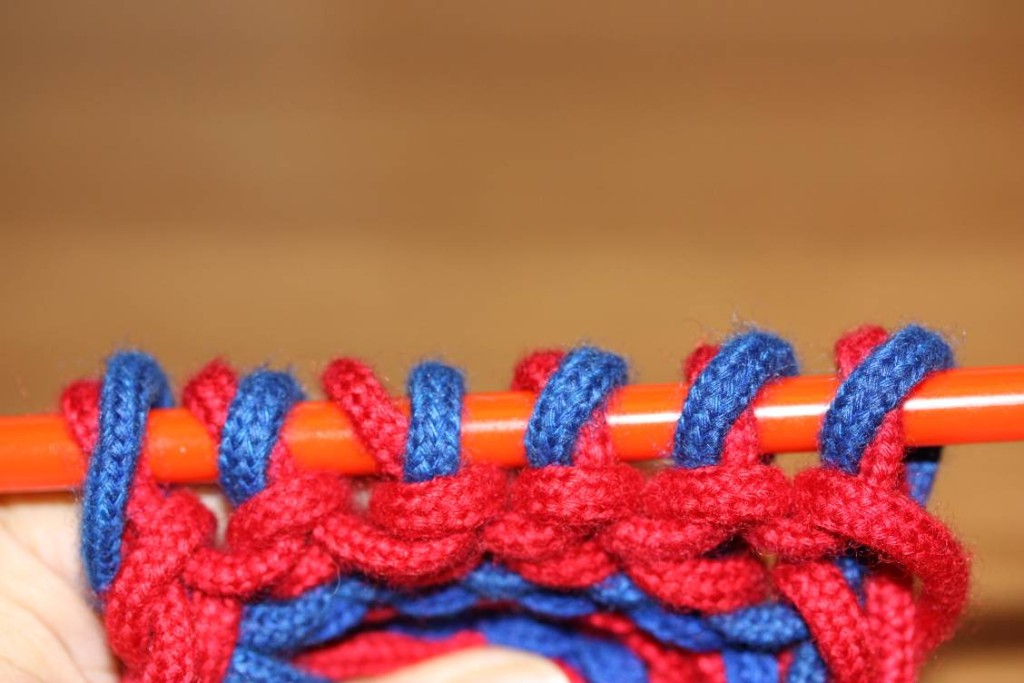 View from the back - you can see how the stitches sort of cross over each other on the needle.
This is nice and relatively fast to work, and involves no slipping. There is a little danger of stitches swapping positions, though, especially in the first and last stitch of the row, mostly due to them being much looser. Knitting in the round eliminates that problem, and it also lets you work without having to deal with a return row, because that... well. That's an entirely different beast.
To get the stitches that have to be discarded to move over their new counterparts in the correct direction, there needs to be some slipping of stitches again. I tried doing a return row, similar in method to the original instructions, and lo and behold - there were twisted stitches again:
[caption id="attachment_2057" align="alignnone" width="640"]
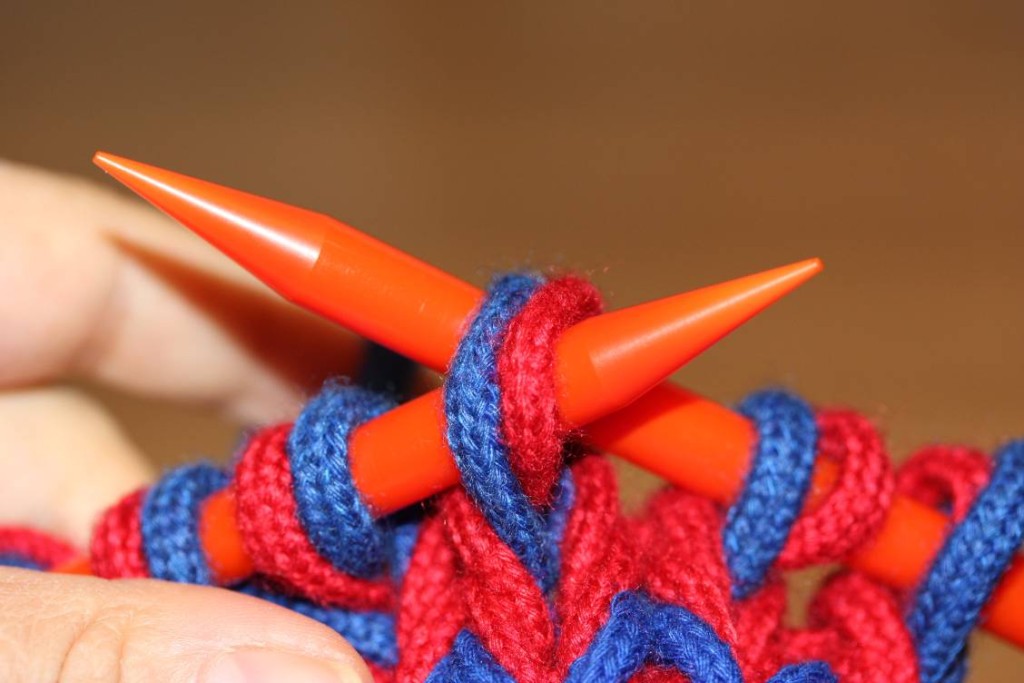 Insert left needle through both stitches on right needle.
[caption id="attachment_2056" align="alignnone" width="640"]
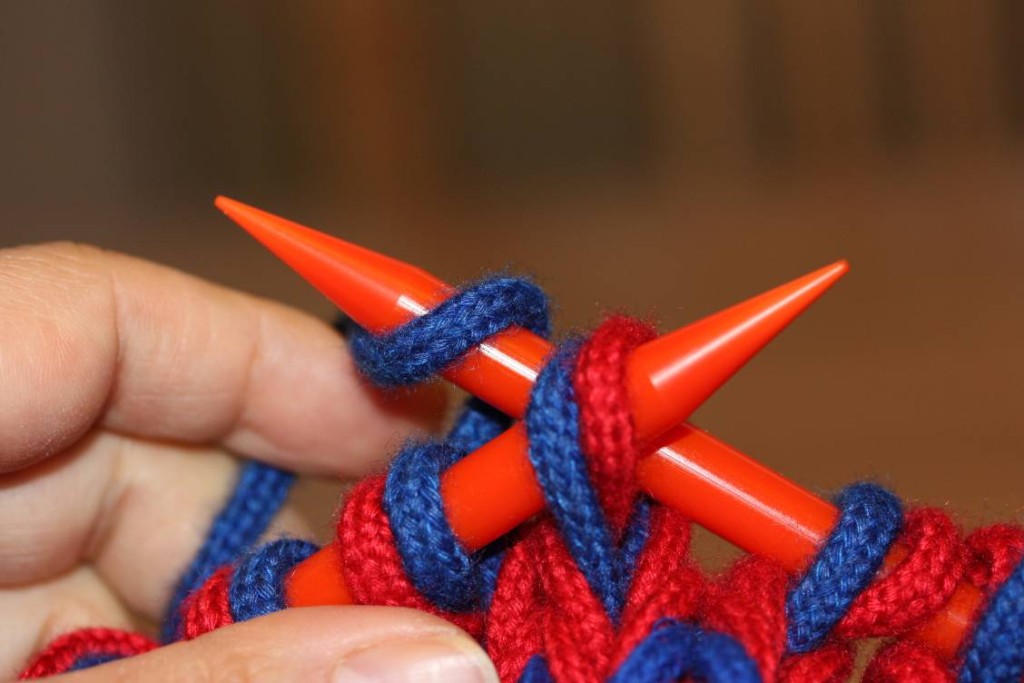 Wrap yarn from back to front around right needle, pull through both stitches...
[caption id="attachment_2055" align="alignnone" width="640"]
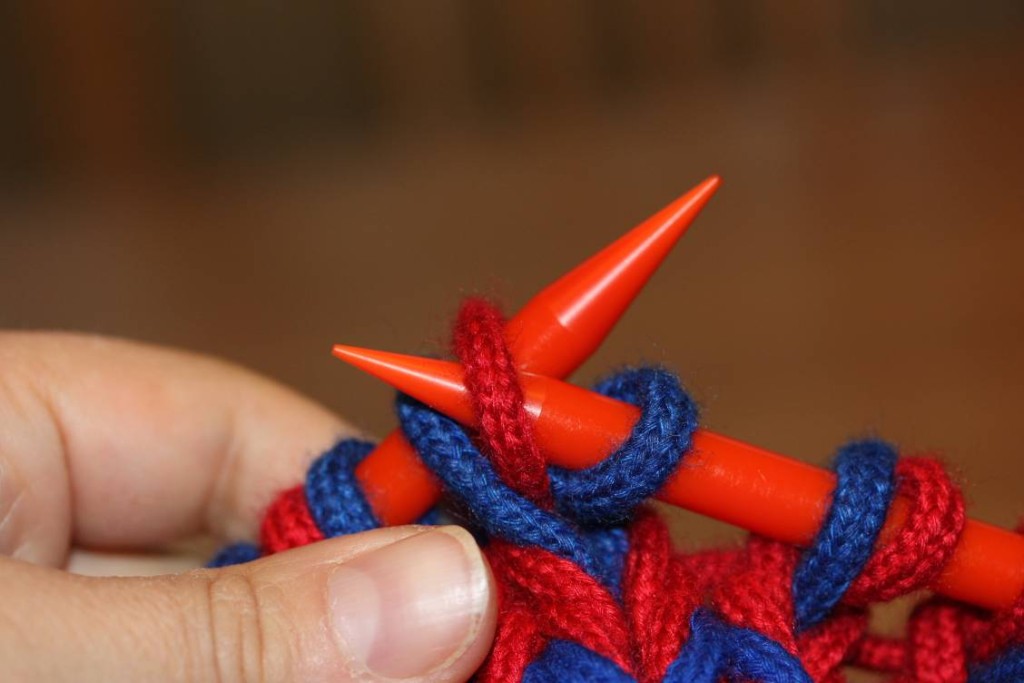 ... and transfer first stitch on left needle to right, dropping the second stitch off the needles.
[caption id="attachment_2054" align="alignnone" width="640"]
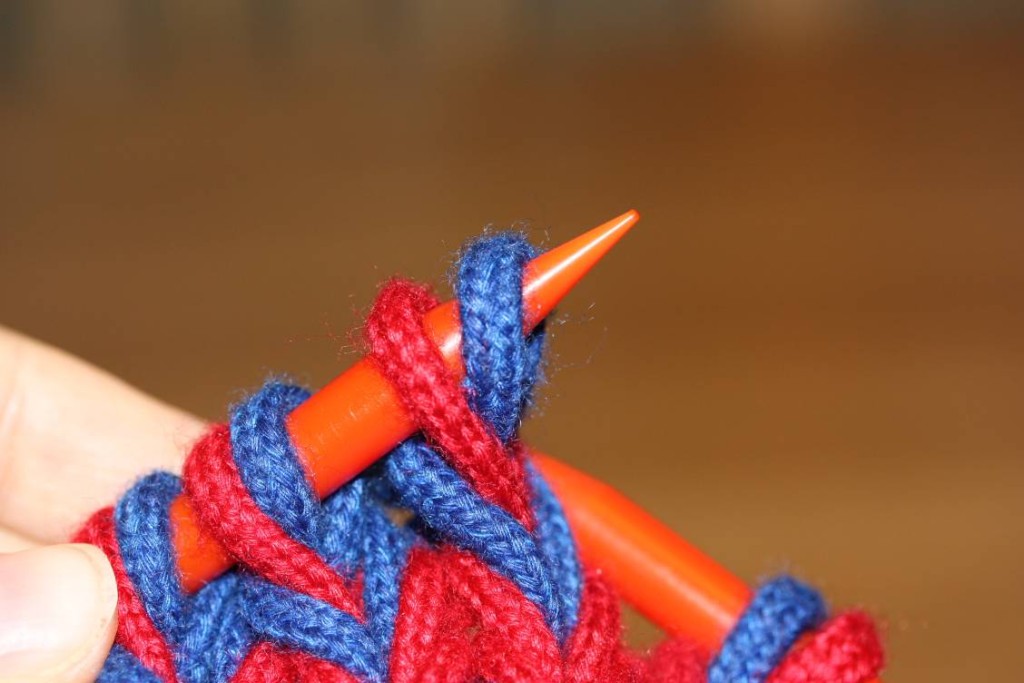 Then transfer both stitches to the left needle.
[caption id="attachment_2053" align="alignnone" width="640"]
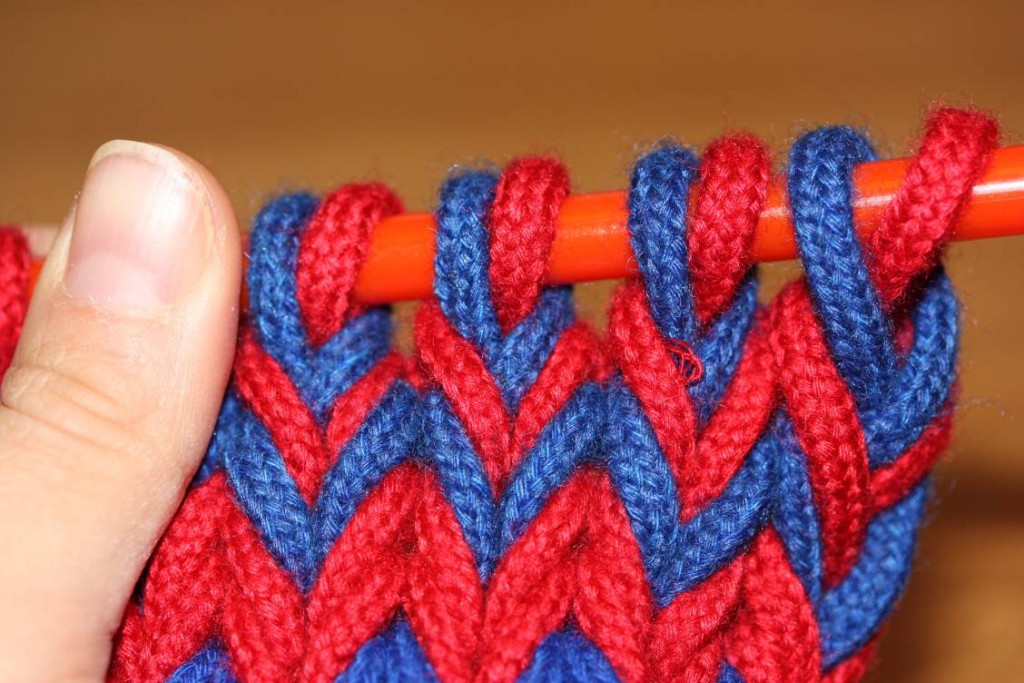 The result after one more regular row: after the return row, the stitches that were worked in the return row are twisted...
I'm quite sure that the twisted-stitch issue can be resolved by different alignment or some other shenanigans. There remains, however, an interesting fact: no matter which method, the original or this one, working in one direction only is much easier than turning around and working knitting in the flat. So knitting with stitches through two previous rows instead of just one seems to be much better suited to working in the round, not in the flat.
Which sort of fits into the picture of early knitting being done in the round only, as far as we can tell from our evidence. So maybe there was a point in time when flat knitting, going back and forth in rows, was developed and it didn't work so well with the stitches in double depth, leading to the development of the knitting through just one previous row? Who knows - but maybe, some day, we'll have a few more knitting finds to help with these questions.
I hope you enjoyed this series about knitting - and if you find a better method, or a good way of working the return row, please let the rest of us know in the comments!
Comments 1

I got to this page from Eukaryote Writes Blog and was surprised to see that this post was from 2015. I recently purchased out of deep curiosity (and was a little disappointed upon receipt) a book called Distitch, by Assia Brill. (You can see previews of it here: https://assiabrill.com/knitting-2/distitch/) It's basically a rediscovery of what I've now learned (from a review: https://www.youtube.com/watch?v=mqNkC0x26aQ (see description, specifically the Archeological Textiles Review links)) is called "compound knitting", specifically "two-course". Brill's book includes the two-course versions of many knitting techniques, not only purl but also brioche, starting and resolving a two-course section inside a field of plain knitting, and increases and decreases.
What's so interesting to me was that both Brill and I couldn't find any mentions of this technique anywhere -- though she may (or may not!) have been motivated to claim novelty, I was motivated to not feel the need to buy a $40 book. Part of this was likely because we didn't know what keywords to search, and another part is that it seems to legitimately not be very popular -- though as the archaeological textile community will attest, much of the time we don't even know what we're looking at, much less whether it's popular. Having used the Distitch selvedge technique, I will attest that it is fiddlier and more interesting than simple knitting.
By accepting you will be accessing a service provided by a third-party external to https://pallia.net/