Latest Comments

Guest - Max Mustermann The True Cost of Driving a Car.
06. November 2026
Great breakdown — the non-fuel costs are exactly the bit most people forget when they compare cars. ...
Guest - Harma Phew. Now it gets involved!
21. Oktober 2026
Have fun at these events.
Guest - Aislinn Dyestuff Citizen Science.
09. Oktober 2026
This is a great project. I look forward to the results. Thanks for letting us know.
Guest - Aislinn Time for...
09. Oktober 2026
Looks delicious!
Guest - Katrin Sprang Discussion
18. September 2026
Hi Rachel, I have looked for more photos of you, but that was not very successful. I found a link on...
NOV.
20
0

Dear Volunteers... Thank You.

I got to meet a lot of old friends at the Texel Stockings conference, and I also got to know (or know better) a bunch more people. Among them some of the absolutely and utterly amazing volunteer knitters who knitted an entire stocking reconstruction.

An entire one. It's not a sock, mind you. It is a stocking - more than knee-high. We're talking about a piece knit from fine silk, with about 200 stitches to cast on, and about 83 stitches per 10 cm. It took the volunteers between 170 and 350 hours to knit one stocking... no wonder these things were precious. My full and utter respect, and admiration, to the group of volunteers that, up to yesterday, handed in twentyseven complete stockings for the project.

You are heroes for science. Truly. Thank you so, so much for giving such an enormous amount of your time, your skill, and your love to a science project that could not have been done without you. People like you make the world of textile archaeology a better place, and I know from my own personal experience that all of the academics involved in the project will carry you forever in their hearts - like I do my volunteers from the Spinning Experiment that I did ten years ago.

Words are not enough to express how important your work is. Your contribution. Archaeology, especially experimental archaeology and textile archaeology both, are low-budget disciplines. Researchers often work all on their own, trying hard to make projects happen, and there's a constant struggle to source the correct and fitting information, workspace, tools, and materials. If you are very lucky, you can get financial support from an organisation, but a lot of archaeology projects are just fund-your-own research ventures.

Sometimes, this means you are working all on your own for a long while. It feels lonely, and it can be hard. Not only because you feel like there is so much to do, so much to find out, and so little time - but sometimes, as you muddle along crunching data and looking for pictures and written evidence and try to find solutions, it happens that you wonder if your work is interesting or important to anyone else.

Your volunteer support is not only helping us do science. It is also showing us that we are not writing for a dusty stack of paper, to be forgotten in some corner of a neglected library somewhere. It tells us, not only with words but with your actions, that what we are doing is interesting. It is relevant. It helps us find out things about the past, about textiles, about human work and human crafts and human lives - and you, too, are interested in this, and in the connection we today still have. In how our lives are similar, or different. Maybe also in how we can make the world a better place tomorrow, learning from yesterday's techniques, from yesterday's successes, from yesterday's mistakes.

Thank you so, so much. You are wonderful, and I am honoured to have seen, touched, and even tried on some of your hard, meticulous work. I hope you are proud of your work for the project, and that it will continue to warm your heart as it has warmed mine, and that of so many of my colleagues involved in the project.
0
NOV.
19
0

Knitting Symposium Leiden

So, as promised, stories from my past weeks - let's start with the first of my two conferences, the one I only attended (as opposed to organising it).

When I heard about the symposium held by the TRC together with the Knitting History Forum (which you should totally check out, and maybe join, if you are interested in knitting history), to bring the Texel Stocking Project to its culmination and end, I had this inkling that it would be a wonderful conference.

And it was. It was... glorious. Like all the best conferences, it was full of interesting papers looking at the stockings, knitting in general, silk stockings in particular, and Citizen Science. There were things to look at, including (but not limited to) the exhibition about Socks and Stockings at the TRC. We got to meet the TRC collection's curator Lies van de Wege, who came in especially for our group and even let us poke at things in the depot, which was amazing.

There was coffee in abundance (necessary, too, to keep the brain awake), and there were cookies (lovely, buttery, crunchy Dutch cookies), and in coffee breaks and after the conference there was time for socialising (though, of course, there is never enough time to talk to all the people you want to chat with about all the things you could chat about).

Chrystel Brandenburgh did a wonderful job in organising all this, and putting together an amazing programme, which included a look at dyes, at the knitting process, at written data about hand knitters, and at the possibilities and challenges of Citizen Science projects. We were also lucky in that Leiden had a big special market just on the Saturday of the conference, which meant there were even more things to pick from for our lunch, and ample opportunities to sample local delicacies. (The Dutch know how to do delicious food, and delicious cakes.)

I did learn a lot at the conference - amongst the most important bits, for me, was hearing that it had been much easier for most of the knitters to use gummy silk (with the sericin still in it) to knit; after the stocking had been finished, it was then de-gummed and in some cases dyed. There were a lot of interesting conversations with colleagues around that topic, and it made me itchy to find out more about partial de-gumming, and how silk like that might feel, and how easy it would be to work with, and how well it would take dye, and how well that would wear.

Leiden was beautiful, too, and after Friday, even the weather was nice enough to have a little stroll through the city. Saturday evening was spent with a group that had formed after the conference, having dinner together, and I got the opportunity to try on a pair of the stockings (one of the two pairs used for wear-testing). They were amazing. Unfortunately, I was not allowed to take them home, but I am now thinking about making myself some socks from similar silk, and based on the pattern of the original stockings (which, by the way, is available as a Ravelry download, for a little under 9 Euro, and buying it will support the TRC).

So I was going back from the conference having heard a lot, learned so much, with lots of new impressions of all kinds, lots of new connections formed; having drunk entirely too much coffee and having eaten way too much of the local delicacies, and with about a million new questions and a hundred ideas for things that would be good to look at. Or do. (Which includes, by the way, thinking about stocking some gummy silk in the shop, in case someone wants that to knit or weave with.) And with some stroopwafels and chocolate in my pack. Obviously.

To put it shortly: In exactly the state you are in after a perfect conference!
0
NOV.
18
0

I am back.

I'm back home, and I am trying to catch up - there's a long list of homework I have brought from the Textile Forum (as always), plus the usual things that are on the list, so it won't get boring here soon.

The Forum was amazing - we had weaving, and tablet weaving, and there were tours of both the monastery grounds and the Lauresham Open Air laboratory; there was a museum visit; there was incredibly delicious poppy seed cake, and of course there was chocolate and coffee, coffee, coffee. My gran kindly lent me her large coffee-machine, so I could make four to five litres of coffee in the morning - enough to tide the group over until about lunchtime.

It was actually the tenth European Textile Forum. The tenth - our first one was back in September 2009, when I ran the Spinning Experiment. I have a hard time believing that it's been that long, and that often. We only had one single gap year since 2009, and that was in 2011, the year before we found our longtime home at the LEA in Mayen. It does look like we did not completely misbehave in Lorsch, as we've been offered to come back - which might be a smart thing to do for topics where we need looms for our Forum explorations.

Speaking of looms - one of the things I found out during that week: I can do a decent starting border, but I am not very good at tying loom weights securely to their threads; while I am comfortable making the warp crossings needed to weave tapestry inserts, my actual weaving of the ground fabric was not looking good (and I quickly stopped, so I wouldn't ruin the beautiful work that Tracy and Florian had done). So I'm probably a good minion to have in the workshop for the related works, but I'd need some training to be an actual weaver. It was great fun to minion, though, and I did learn a lot about warp-weighted loom work.

I'll tell more stories from my adventures, both at the Knitting Symposium in Leiden and from the Forum, during the next days...
0
OKT.
28
0

Time for Time Off.

You've probably been half expecting this after Monday's post - it's time for me to take some time off the blog, because of... things. Exciting things. Conference-y things.

I'll be travelling to the Knitting Symposium at the TRC in Leiden, where I am utterly delighted to be part of the panel discussion. Once I am back here, I will go straight on to the European Textile Forum, and after that, experience tells me, I will be totally knackered and will need a few days to recuperate, and then there's my Gran's Birthday coming up (she is turning ninety-eight!) and I will be home for that.

So... expect blog silence here until Monday, November 18.
0
OKT.
25
2

More Stranded Knitting.

For those of you who are now intrigued by the stranded knitting thing and holding yarns thing, here's a youtube video demonstrating several ways of how you can handle your yarns when knitting with two colours:


It's rather long, but it also includes some information on how to do colour changes. The maker of this video, Suzanne Bryan, also has instructions on how to catch yarns over long floats:


Also very interesting because she looks at dominant colours and the difference between stitches made with the yarn in the left hand and stitches made with the yarn in the right hand.

(I have made a little documentary video of my learning how to do purl stitching with one yarn held in each hand, by the way. So if you want to see about five minutes' worth of awkward needle movements - let me know!)
0
OKT.
24
0

Stranded Knitting, or: Learning New Things.

I've mentioned that I my next knitting project involves stranded knitting - that's something that has intrigued me for a while now, but I hadn't had a project for it. Until now. There is something that, design-wise, looks like a lot of fun to me; there is suitable yarn for what the final product is intended for, and there's a good reason to knit it. So.

The thing about stranded knitting is that you have two colours in one row, and they are used more or less alternatingly, so to work efficiently (which, we all know, is something that I tend to be rather obsessed about) you have to hold both yarns at the same time. In a way that makes each one easily available for knitting... and the nicest and most efficient way to do that, it seems, is to hold one yarn in the left hand and one in the right. Which means that you are knitting both Continental style (which is my usual style), picking the yarn from the left hand with the right needle, and English style (which I had not done yet), throwing the yarn on the right hand around the right needle tip.

This was... awkward. It still is, though I am getting better at it. I had the knit stitches sort of mostly down when the first purl row started, though, and it was awkward times eleven again. Which I found vastly, vastly enjoyable in some weird sort of way - the joy of learning something new, and with this, looking at the old things you are doing in a new way. It's a whole new finger dance to get into muscle memory (preferably in a way that is ergonomical and, yes there we are again, efficient right from the start). Since knitting is one of my non-work-related textile techniques (and for me counts as hobby only, even though there are a few slight digressions into work-related spaces), I have all the time in the world to learn this, and I can stumble and fumble as much as I want to, which is somehow delightfully fun for me.

Also - colours! Motifs! Great fun!
0
OKT.
23
2

It's finished!

I love knitting. It's a wonderful pastime, it makes beautiful things, and since most of my knitting is modern and just for my own pleasure, it is a nice way for me to play around with yarns without feeling it to be work-related in some way.

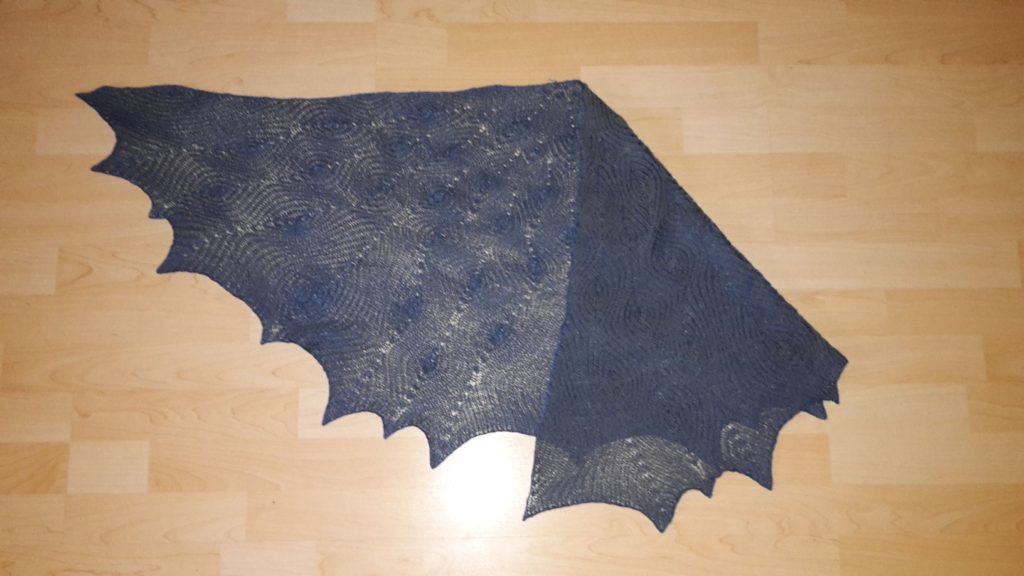
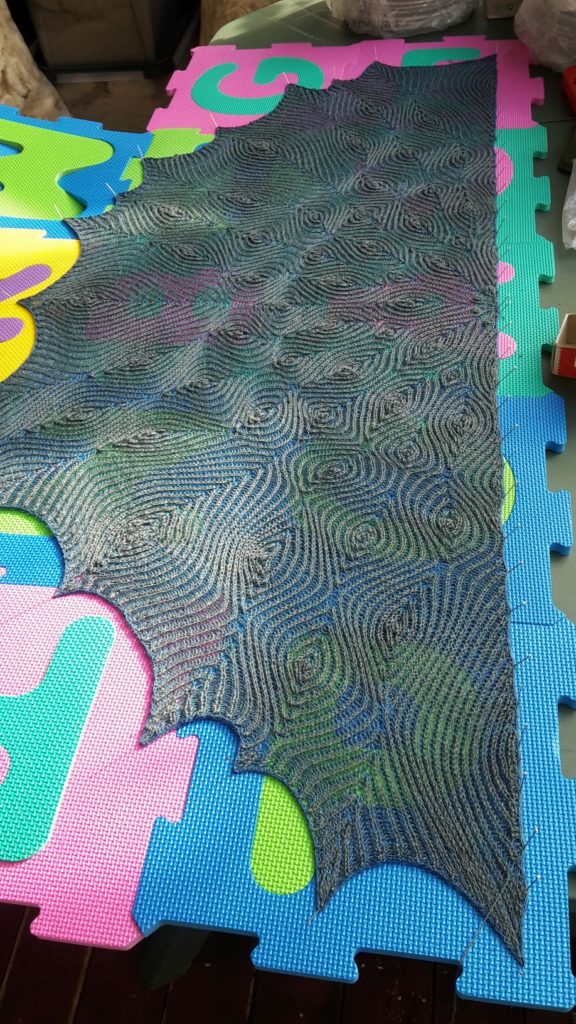
I am not a very fast knitter, though - in the sense that it often takes me a long while to finish a project. Not because my actual needling action is so slow, but mostly because things tend to lie around for a while between stints of knitting frenzy. So I'm always quite happy to have a project finished, and it feels like a Big Thing. The latest one was finally bound off on Saturday morning, and it has now been blocked, and I am utterly delighted to have this done just in time for the cold season:


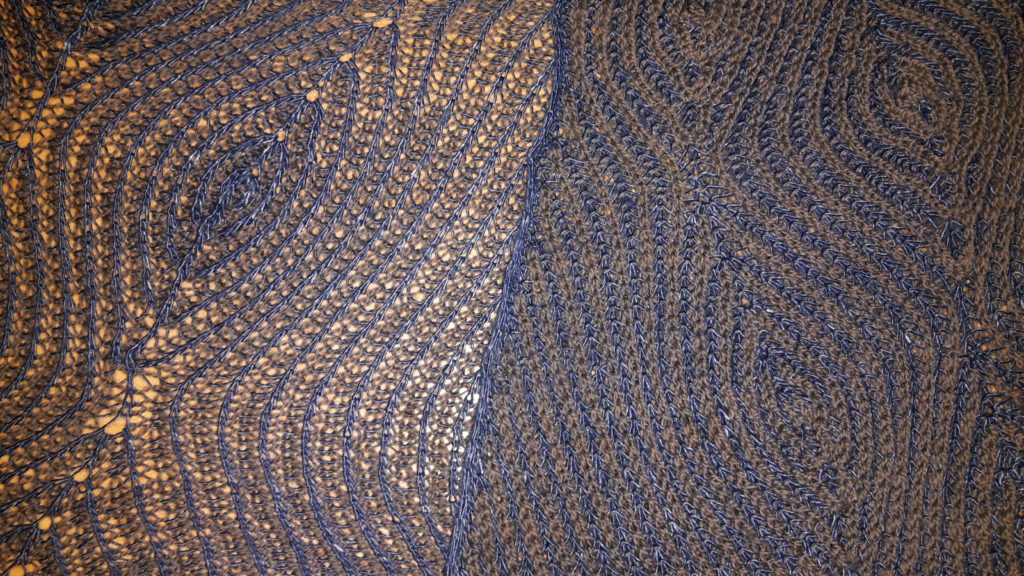
My Arabian Nights shawl is finished. I didn't knit it all to the end, as I want to have it more like a scarf than as a shawl, and since I used lace yarns, not sock yarns, it is a good bit smaller than the pattern states for the original - but I'm happy with the current size, and it definitely is very fluffy and very nice and warm.


Yarns were a two-ply fine wool yarn, dyed by Micky in a wonderful shade of grey, and a silk yarn, dyed with indigo by Margit.


It was my first venture into brioche knitting, and I did like it. The knitting itself was rather mindless, apart from doing decreases, which were a bit tedious, just the thing that I was looking for, though now I'm happy to have this finished and do something a little more exciting next. (Stranded knitting, just in case you are wondering. Time for some colour shenanigans.)

 
0

By accepting you will be accessing a service provided by a third-party external to https://pallia.net/

Kontakt