Latest Comments

Guest - Max Mustermann The True Cost of Driving a Car.
06. November 2026
Great breakdown — the non-fuel costs are exactly the bit most people forget when they compare cars. ...
Guest - Harma Phew. Now it gets involved!
21. Oktober 2026
Have fun at these events.
Guest - Aislinn Dyestuff Citizen Science.
09. Oktober 2026
This is a great project. I look forward to the results. Thanks for letting us know.
Guest - Aislinn Time for...
09. Oktober 2026
Looks delicious!
Guest - Katrin Sprang Discussion
18. September 2026
Hi Rachel, I have looked for more photos of you, but that was not very successful. I found a link on...
AUG.
30
0

Newsy Things.

Now that you've heard the gist of my adventures in Dublin, it's time for some other news: I've been doing a newsletter in German for a good while now, and I've finally decided to offer one in English as well. So if you're interested in hearing about news from the pallia online shop once a month, with a spattering of other information thrown in (such as most popular blog posts of the past month, or information about exhibitions or other possibly interesting things), you can subscribe to the English newsletter by clicking here. (You can also subscribe to the German one via this link, should you be interested.)

The newsletter, like the German one, will come out monthly, so September will be the first time - and I'm very much looking forward to this, as there will be a few new things in the shop for it!


 
0
AUG.
29
1

Even more Dublin Stories.

So what else is there to tell about my Dublin adventures? There was a talk about medieval textiles and textile crafts, which was very well received according to what I heard afterwards. I had the pleasure of sharing that panel with Jeannette Ng, who later during the convention accepted her award for Best New Writer (congratulations again!).

I also enjoyed my two other panels (proper panels, not talks, this time) about archaeology in SFF, and about costume research and documentation.

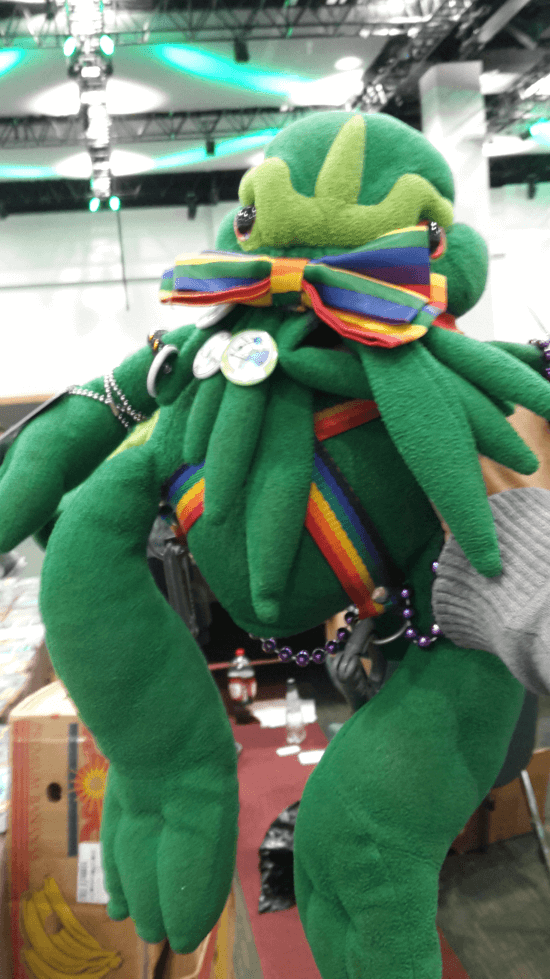
I also got to meet (and hold, for a short time) this guy:


and I got to meet a real Lady Astronaut, as Dr. Jeannette Epps was at the convention. Which was a "wow" moment as well.

There also was cake (because life is better with cake, even if it is only store-bought chocolate cake from Tesco's), and weird chocolate both from Ireland (Cadbury's Mint Oreo. Delicious, if you ask me.) and from Germany (I brought some Knusperflocken for people to try) and from New Zealand (which will host next year's convention) and, if you are generous in what you count as chocolate, choc-covered malty caramel Timtams from Australia.

Finally, one of the really nice things about WorldCon is how easy it is to meet people, and chat with them, making new acquaintances and learning things about their bits of the world. I was delighted to see again quite a number of people I'd last met in London, back in 2014 (one of whom saved my voice by bringing me a pack of Fisherman's Friends). Even though there's never a load of time to catch up, it was wonderful to see them again and chat. It was also totally delightful to see so many authors, whose work I love to read, and it felt like so many of them stopped at my table in the hall and enjoyed seeing (and, in some cases, buying) something completely different. (Which were the moments when I silently went "squeee!" in the back of my head. As you do. Right?).

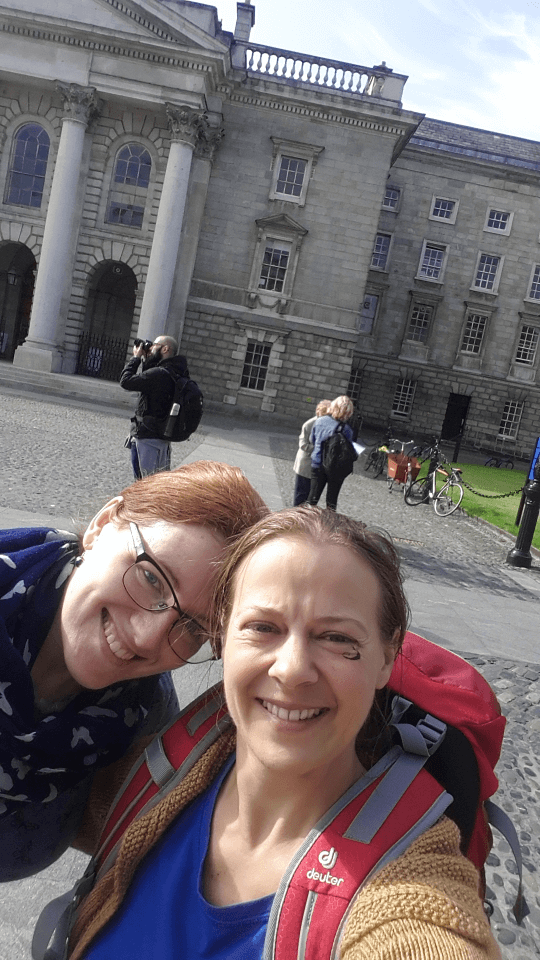
All this would never have happened if not for Gillian prodding me to come to London in 2014 (because apparently, London is right around the corner from Erlangen, if you ask an Aussie) and for my wonderful Irish friend helping me out at the table, making it possible for me to sneak away to my programme items, the Escape Artists Live panel, and, occasionally, even to the toilet:


Thank you! (Also, I'm still bad at taking phone selfies. Obviously.)

 
0
AUG.
28
0

More Dublin Stories.

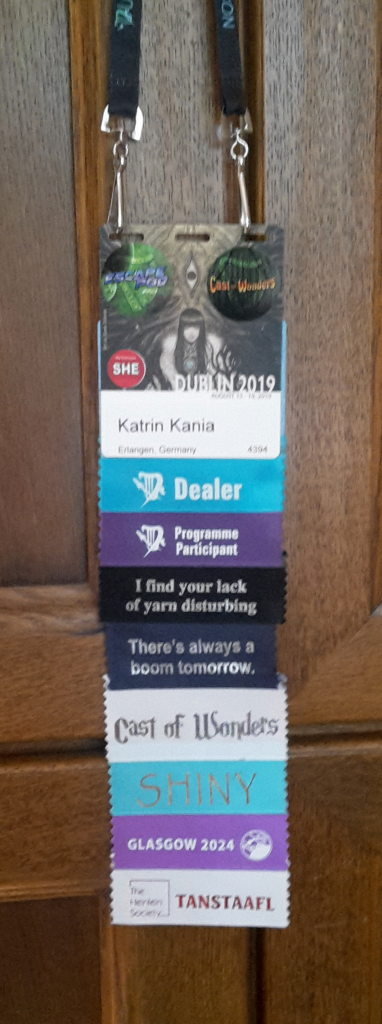
I mentioned badge ribbons in yesterday's post, and some of you may have wondered what that is. This is one of the things I was introduced to back in London, at my first WorldCon, and I had so much fun with them back then already, which was repeated this year in Dublin. But I should explain first...

When you have an attending membership and turn up at the con registration, you are getting a badge with your name on it (or a badge name/alias/nick, whatever you put in the form when you got your membership), where you come from, and your membership number. This is your pass to enter the convention and all its panels and so on.

Underneath that plastic badge, you can stick ribbons - which are printed textile ribbons with a sticky stripe, (hopefully) in the width of the lower edge of the badge. You get "official" ribbons if you are a programme participant, dealer, or otherwise involved with the con; or if you are a Hugo finalist. You can also get ribbons from various other places - from authors, groups or societies, and from individuals who had an idea for a ribbon, had some made and now hand them out to those who ask.


There are some people (especially children) who make it a game to get as many ribbons as they can, and I've seen some kids walk around with a trail of ribbons that was about three times as long as they were tall. My haul was not huge - tiny in comparison, in fact - but each of them made me ridiculously happy. I got the "lack of yarn" handed out of the blue by someone passing my table, and thus could not even tell others who had given it to me, having no clear memory of the person in question. That was different for the "shiny" ribbon, whose maker walked around with a Kaylee parasol, and thus was relatively easy to spot. The TANSTAAFL came, of course, from the Heinlein Society table - it's one of my favourite bits of Heinlein's writing, and I was looking forward to getting one of these even before the con started... and the Cast of Wonders ribbon, obviously, also makes me happy, being one of their narrators.

So. Ribbons. Some don't care for them, some collect them, and it's definitely a thing at WorldCon. Plus they are a good conversation starter should you need one!
0
AUG.
27
0

Dublin Stories.

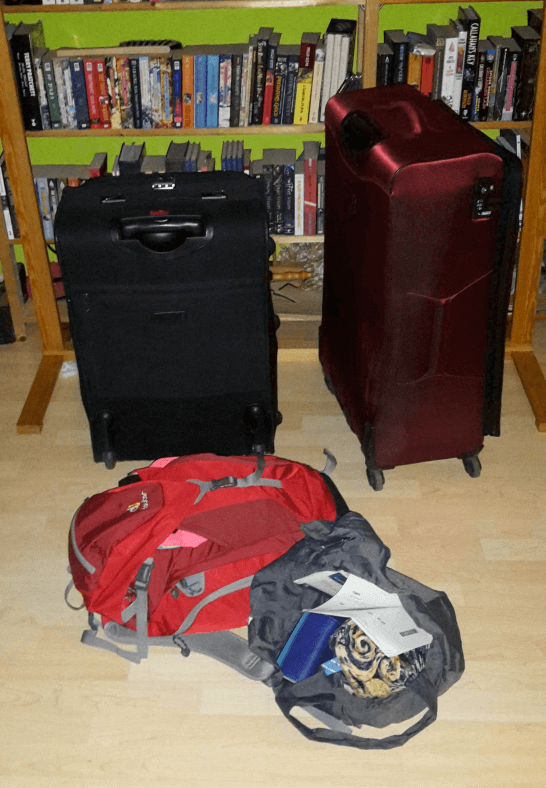
Dublin was... exciting, and wonderful, even though getting there was a tiny bit scary - I knew I'd be travelling alone, and taking two large suitcases. Plus a backpack. Plus a handbag... maxing out my luggage allowance on all counts.

[caption id="attachment_4776" align="alignnone" width="412"] Tell me again who is going to be lugging all this to Dublin?

Because I was rather nervous about not making the airport in time, I took a really early train, which meant, of course, that everything went smoothly and I arrived with plenty of time to spend knitting at the airport. Changing trains was also going well - I did have a helping hand for all exits and entrances that involved stairs, and a very friendly couple helped me (and a group of fellow travellers from Taiwan) to pick the right S-Bahn to get to Munich airport, as there were currently construction works going on, mangling the usual schedules. (Things like that are wonderfully reinforcing my belief that most of the human beings on this our planet are lovely people who are willing to help, and happy to make the world a little bit better by their actions. Thank you.)

So... everything went smoothly, we landed in Dublin wonderfully on time, I collected my things and went straight to this place:


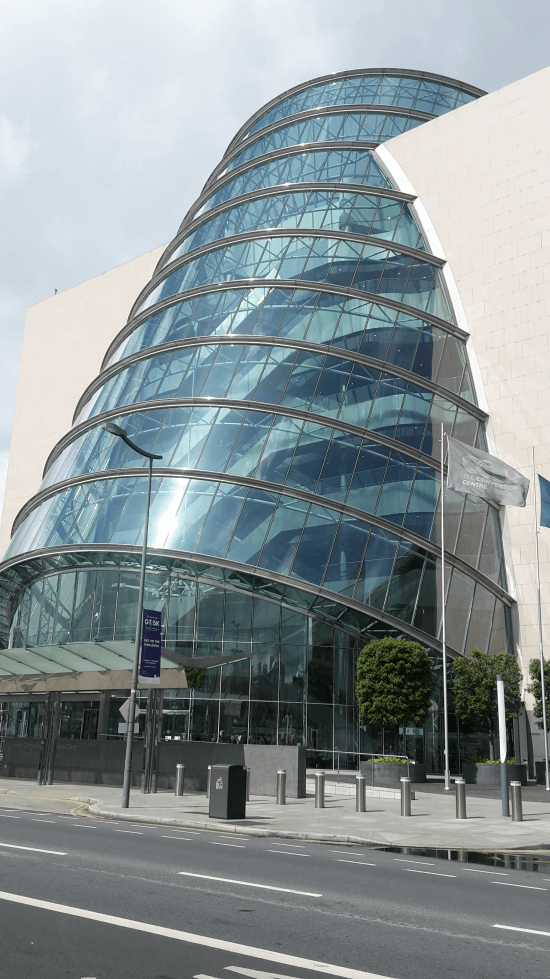
which is the Convention Centre Dublin. And then I started getting to work, as in getting my stall set up. I had some help from Gillian Polack, who was one of the volunteers in the Dealer's Hall, helping everybody to find their way around and to get set up. (Of course, as always, I had to hand-write a few of the labels. And also of course, as always, I finished set-up the next morning.)

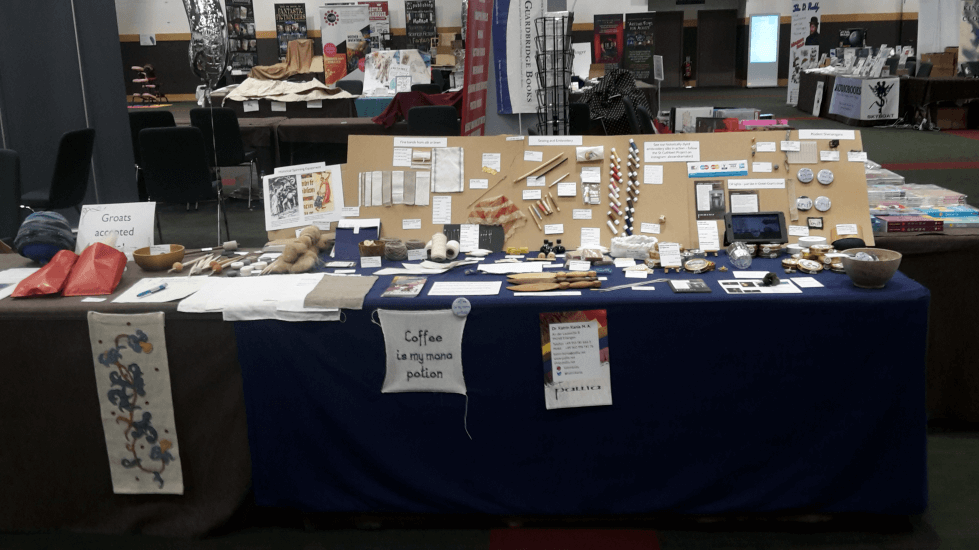
In the end, the table looked like this - at least it did so at one point, things changed slightly in their layout as some stuff was sold out:


Being at a WorldCon is something lovely, and special, and exciting - and for me, being part of it by having a stall in the Dealer's Hall is something extra-special on top of all the "normal" WorldCon excitement and enjoyment. Every show and every fair has their own distinct flavour, so to say, but I think that the WorldCon flavour is far, far different from any of the other fairs that I have done until now. And personally, I find it very, very tasty.

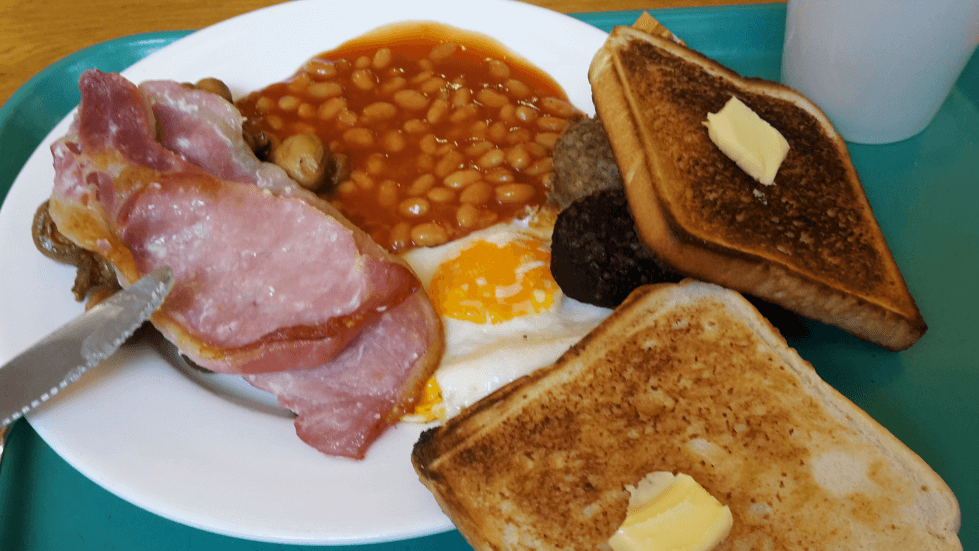
Speaking of tasty - I was totally delighted when I found out my accommodation came with breakfast included, and actually treated me to the possibility of having a Full Irish Breakfast each day, complete with white and black pudding:


That set me up nicely for the day to come - which was good, because between the programme items I was on, the programme items I got to see, and standing at my table meeting so, so many wonderful people (plus looking at their t-shirts and badge ribbons) did not leave much time for eating!

 
0
AUG.
26
0

I am back!

I am back home, the summer break is over, and it was wonderful. So wonderful, indeed, that all the happenings should be good for several blog posts.

There was a bit of holiday things (we paddled down the Elbe river), there was also the WorldCon at Dublin, which was wonderful and exciting and utterly, utterly glorious, and now I'm sitting here doing this quick get-back-into-things blogpost before hauling a huge stack of parcels off to the post office, which takes care of the orders that came in during the break, and of those I got at Dublin when I ran out of some of the things to sell. (Such as gold embroidery books. And spinning fibres. I also almost ran out of "I knit so I don't kill people" badges... but only almost.)

A Worldcon is a special thing - it's full of people getting to meet and chat with other people, and enjoying common interests. There's panels, where several people discuss a topic (usually with help of a moderator, who asks questions and makes sure things stay more or less on track); there's also talks, shows, singalongs, films, dances, theatre plays, concerts, readings, and opportunities to meet authors or have them sign your book(s). Plus there is the Hugo Award ceremony. And, of course, the dealer's hall...

This time, I ended up as a participant on three panels, in addition to having a table in the dealer's hall - made possible by an Irish friend who volunteered to come along and mind the shop while I was off having fun. And fun I had! One of my programme items was a talk to give an intro to medieval textiles and textile crafts, supported by the wonderful (and Campbell-Award-winning) Jeannette Ng. There were a few technical problems, but in the end, everything turned out allright. My second programme item was a "proper" panel, together with Alyc Helms and Marie Brennan, wonderfully moderated by Ehud Maimon, where we got to talk about archaeology and its use for worldbuilding in SFF literature. In the third one, I again got to sit at a table together with Jeannette Ng, as she was moderating the panel about costume research and documentation; my co-panelists this time were Kerri-Ellen Kelly and Kevin Hewett. I had a blast on all three of my items, and as far as I've been told, the audience generally also enjoyed them, so that was definitely a success. (I really need to work on my shameless self-promotion skills, though...)

And now it's time already to prepare for the next events coming up: the weaving workshop this weekend, first of all; the MEDATS conference in September, where I will be giving a paper; the Nadelkunst fair at Weikersheim. Certainly I'm not getting bored here!
0
JULI
18
0

Summer Break!

Just like every year, it's time for a nice summer break. I'll be taking care of the things that always drop behind when it's business like usual, and of course I'll also be taking time off to knit, cuddle the cat, go on holidays for a bit, eat ice cream and generally relax.


As usual during my breaks, I'll try to cut down on internet usage as much as possible - so you probably won't see much of me on facebook, instagram, or anywhere else for the next few weeks.

I'll be back in action for the WorldCon in Dublin, which is August 15-August 19, and you might see things from me on instagram and facebook for this. Because of the WorldCon, this year's blog break and shop break will be a bit longer than my actual time off work - I will be back on the blog on August 26.

Until then, have a good summer - see you at the end of August!
0
JULI
17
0

CfP: Leeds 2020.

Leeds. If you're a medievalist, you automatically think of the International Medieval Congress (which is the European equivalent to Kalamazoo). It's a fantastic congress - I'm tempted to write "event" instead. I've only been there once, but eventually, I'll make it back again. There's always a huge programme, split into sessions with specific topics, and the sessions are organised by conference participants, who then look for papers fitting the topic.

One of my colleagues from the textile fraction is co-organising a session in Leeds next year, which will run on July 6-9. It's called

The Art of Borders: Examining the meaning and function of borders, edges and thresholds in early medieval art.

This session explores how medieval art incorporated, established or broke down borders in both real and metaphorical forms as understood through material objects. Drawing on physical, visual and conceptual engagement with borders and edges, the material forms of painting, manuscript illumination, stained glass, metalwork, sculpture, textiles and embroidery are all understood to use physical and imaginary borders to provide meaning and impart messages for those who came into contact with them. These encounters ranged from the moment of their creation, through their continued use and reuse, to their deposition or preservation and use today in the settings of contemporary scholarship and public display. We are seeking papers which explore the use of visual, metaphorical and conceptual borders in medieval art, exploring how these were understood and used both by early medieval society, and from a current scholarly perspective. Paper proposals are encouraged that focus on practical and sensory engagement with art, as well as those speaking from theoretical standpoints.

Paper topics might include but are not limited to:
  • How physical borders and edges create and craft meaning.
  • How the development of Visual Physiology has been used to help us explore the use and meaning of art in earlier societies.
  • What it means to draw attention to the edges of things in early medieval art.
  • The transformative and/or transgressional nature of borders and edges
  • The symbolic or material significance of borders on visual objects
Original proposals are sought for twenty-minute papers. Please submit a working title and a 250-word abstract by 1st September 2019 to Dr Alexandra Makin at Diese E-Mail-Adresse ist vor Spambots geschützt! Zur Anzeige muss JavaScript eingeschaltet sein. and Dr Meg Boulton at Diese E-Mail-Adresse ist vor Spambots geschützt! Zur Anzeige muss JavaScript eingeschaltet sein.
For information relating to the Congress, including information about fees and bursaries, please see https://www.imc.leeds.ac.uk/imc2020/.

0

By accepting you will be accessing a service provided by a third-party external to https://pallia.net/

Kontakt