







Latest Comments

Guest - Max Mustermann The True Cost of Driving a Car.
06. November 2026
Great breakdown — the non-fuel costs are exactly the bit most people forget when they compare cars. ...
Guest - Harma Phew. Now it gets involved!
21. Oktober 2026
Have fun at these events.
Guest - Aislinn Dyestuff Citizen Science.
09. Oktober 2026
This is a great project. I look forward to the results. Thanks for letting us know.
Guest - Aislinn Time for...
09. Oktober 2026
Looks delicious!
Guest - Katrin Sprang Discussion
18. September 2026
Hi Rachel, I have looked for more photos of you, but that was not very successful. I found a link on...
JULI
06
3

Oh the joys of construction work.

We're having construction work being done (the heating system in our house needs to be replaced), and I find that I'm all out of practice ignoring construction work sounds. That used to be much, much better in the days I was digging more, with all the construction site noise right beside you day in, day out, so you'd get used to tuning it out.

Though admittedly it's something else again when it is in the same building, as it's not only the noise, but also the vibrations and the workers going in and out the door. Which is visible from my workspace and adds to the distractions. Usually there's not much traffic down our garden path, or much noise here in the quarter, so it really helps me to appreciate even more the circumstances I can normally enjoy!

Speaking of enjoyable things - I finally got on top of my email pile again, and things feel more or less caught up, though the next deadlines, I'm sure, are already conspiring to creep up on me. While I have more of an opportunity to take care of long-overdue things, I'm quite happy to do so. And in the course of this I finally found a programme that will do the angle measurements I need for my spinning documentation in the way that I want them: several of them permanently shown in the picture, with a label with the angle beside it. And it's even possible to lock in the angle tool so I don't have to select it again for every single measurement, plus there's a list of measurements and the automatic calculation of the average. Yay!

The programme is called Digimizer, and like so many good and helpful research tools, it is completely free. (ImageJ will also measure angles and label them, but I haven't been able to trick it into keeping the first angle when doing the second one. Just now, while doing this post, I find that there's a new version of the programme, ImageJ2, as well as an offspin called Fiji - and I might check them out for other analysis purposes.)
0
JULI
05
0

Links Lumped Together.

Here's, for a change, a selection of semi-random links:

Ask the Past tells us about coffee and how to substitute the real stuff with... other stuff.

There's a kickstarter running for bras for asymmetrical breasts; for the start, there'll just be a one-cup difference between left and right breast, but their plan is to offer more variety and bras with larger cup differences in the future. This is a brilliant idea!

2017 is the bicetennary of Jane Austen's death, and the Literary Hub has a long article about the woman herself and the many ways we are wrong about Jane Austen - who is surprisingly hard to get hold of.

And finally, the reason why there are no more unicorns:

 
0
JULI
04
2

Crocheted snails, knitting spies.

Textile craft stuff just is so versatile, and here's two examples of it. First of all, a really nice article about knitting spies and knitted secret messages - though I'm rather convinced it's not a dropped stitch that actually happened, but something like a yarnover.

Knitting codes is definitely fun - the most patient husband of them all knit yoga socks that morse code spell out "Yoga socks", and he had a lot of fun with that. I've yet to do something similarly geeky, but it is on my list. (Though not very far up the list, I'll admit.)

The second link is not knitting, but crocheting: the clinic in Hannover is giving hand-crafted cuddly snails to children getting cochlea implants (German site). These children are born deaf, and they are getting the implant operation at a very young age - usually still a little less than a year old - which is of course quite exciting and frightening for them and their parents. So the staff of the clinic in Hannover has started a project back in 2015 where each of the about 100 children getting the implant each year gets a hand-crocheted snail to cuddle. It's intended not only as an emotional uplifter for the children, but also as a token of appreciation for this very big step in their lives.

In case you have itchy fingers now, the (German) pdf instructions on how to crochet the snails are linked from their site. And if you love the idea of the snails getting handed to children - all snails are crocheted by volunteers, and the clinic is always looking for snail donations, which are much appreciated.
0
JULI
03
0

The Textile Orchard

I've been pointed to a map/collection thing called The Textile Orchard, where you can find artisans, textile researchers, museums, dye and fabric producers, and historical sites related to textiles.

It's always a nice thing to have collections of resources, and I'm happy to now be part of the growing Orchard, as you can see from the small blue star in the south of Germany:


The red star across to the left is my friend and colleague Margit from Alte Künste, by the way.

If you are a textile person yourself, or have a place or museum to add, you can quickly and easily do so with this questionnaire. You can also follow the Textile Orchard on twitter via @textileorchard.
0
JUNI
30
2

Course Prepping.

I had a lot of fun yesterday preparing for a tablet weaving workshop testrun - which, unsurprisingly, proves to be a lot of work. I last posted about this almost one and a half years ago, so it's been stewing for a really, really long time now. That is mostly due to logistics problems. One of the large stumbling blocks for me were the questions "How do you enable up to eight people to warp simultaneously?" and "How do you get the warps tensioned?"

The answer to both, in my case: F-clamps. I love those things, especially those single-hand F-clamps, and I've used two tiny ones for years now. I should probably say "abused", though, because, well, they are not intended to be clamped down onto something upside down and then get stuff attached to the stem sticking upwards. There's high-quality ones that will withstand this kind of abuse, though, and cheap ones that will eventually give up and come loose with rather little tension on their stem. Which means the sensible thing is to go for the higher quality tool... with the higher price.

Unfortunately, regarding my two questions, "F-clamps" is not the full answer. The full answer is "a shitload of F-clamps", and it has taken me a while to get to terms with that, bite the bullet, and invest. But I have found a good clamp, they have arrived, and I'm now working on finalising my teaching script, getting the handout (which will be a how-to-make-your-pattern cheat sheet) all done and lined up, and then there will be three nice guinea pig ladies coming over next week to try their hand and my teaching ideas.

It's all quite, quite exciting - and if it all works as planned, the course will cover warping in the "endless" method, the basic system and mechanics underlying all tablet weaving, how to read and write patterns, and how to do 3/1 twill on tablets, including how to work (and design) patterns in this method.

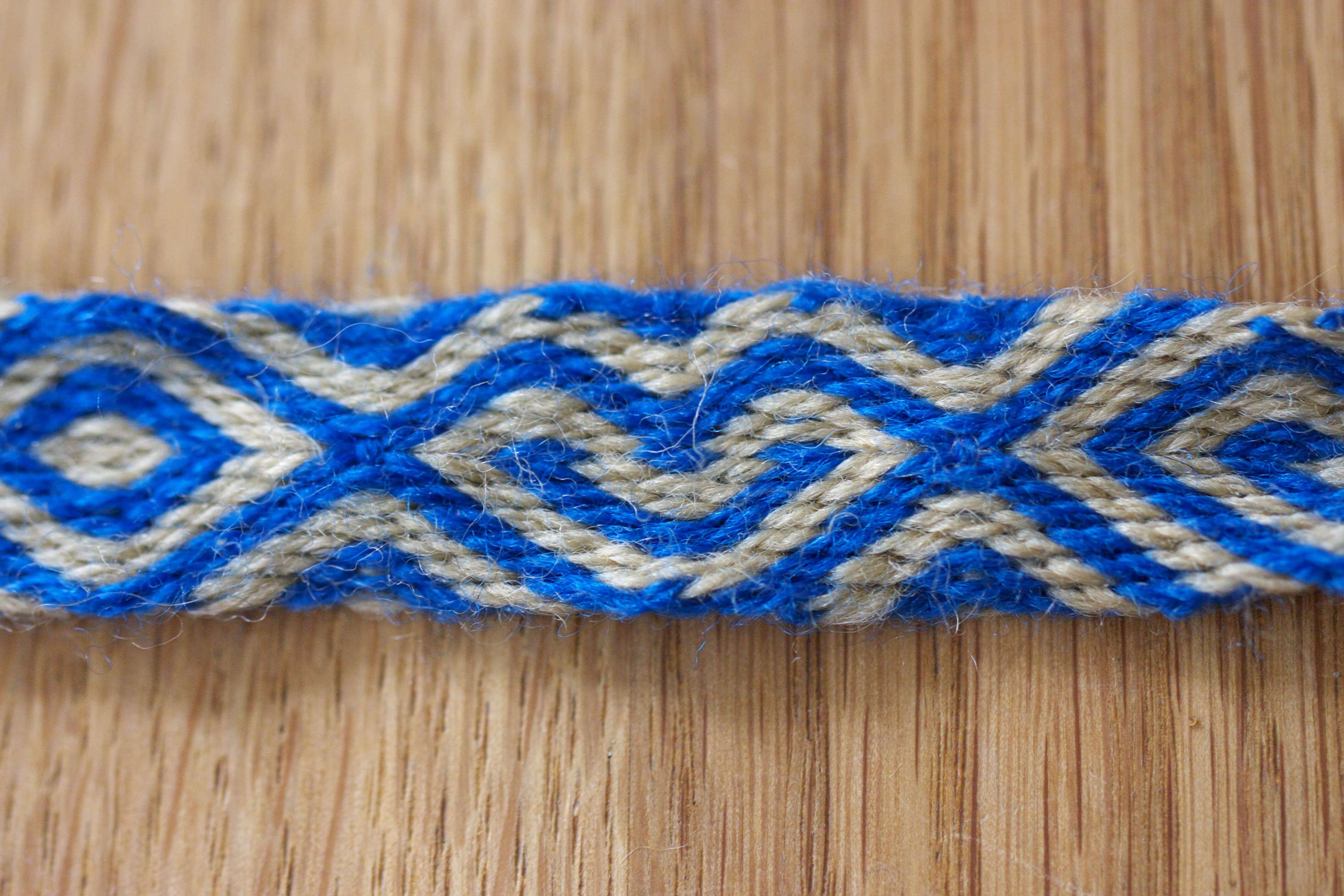
[caption id="attachment_3213" align="alignnone" width="4272"]One of the possible pattern bits that will be part of the workshop - and part of learning how to design swirls and stuff. One of the possible pattern bits that will be part of the workshop - and part of learning how to design swirls and stuff.


The course will then have its first proper appearance at the Nähtreff in October - which right now seems rather far in the future, but with the way time is flying, it will probably be happening before I know it!
0
JUNI
29
0

... and more NESAT presentations.

Speaking of things from NESAT, and continuing the blog from yesterday - Beatrix Nutz, Rachel Case and Marion McNealy, who did a presentation about the Lengberg finds at NESAT, have also put their presentation online for you to watch (in fact, they were a lot faster than me!), and they even re-made the audio part as the audio quality from their recording was not brilliant.

So here's a little bit more of NESAT for you to enjoy:
0
JUNI
28
3

Papers and presentations...

The NESAT is still lingering on for me, not only because I got new ideas and new contacts that I have not yet followed up on completely - it also is still lingering as I need to finish my paper writeup.

I like to give my presentations freestyle, with no written script, and I very much enjoy doing that. It means preparing the presentation so I get all my prompts from the Powerpoint, and doing multiple test runs (but then I guess everybody has to do these). For those test runs, I really like to use the "rehearse timings" function ("Neue Einblendezeiten testen", for the Germans among you). This gives me a running count of how long I've already babbled to myself, and in the overview pane in the program, I can see how long each slide took me to narrate everything I wanted to say. This makes it easy to see if a slide has too much babbling done, and I should probably split it, or lets me see at one quick glance where I might be able to cut something. (Just be aware, if you are planning to try this out, that PP will automatically adjust the settings for the presentation to automatically advance the slides according to the rehearsed timing; make sure you set your presentation to advance manually before you save the final version, or you will be irritated no end as your slides advance without your doing, and probably just a little out of sync with your talk.)

The upside of this? I only have to concentrate on the presentation, and I can speak freely, and if necessary speed up some part or go more into detail in another one. (This, obviously, is mostly the case when it's a longer presentation in a lecture setting and not at a conference, where the usual 20 minute time slot does not allow for much deviation from the rehearsed durations.) The downside of this, however, is that when it is time to write the presentation up in form of a paper, all the writing still needs to be done - there's no presentation script to build up from.

So this is what I am currently doing - writing up my paper for the NESAT conference publication. There are clear author guidelines for it, with a very clear hard deadline, and also hard limits on the number of pictures and words - and I'm sort of half-happy and half-sad that both are rather low. It means less writing, but also less space for thoughts and considerations and explanations, and some of my points are rather easier to show with pictures - so I'm wrangling with that.

And while I'm doing that... maybe you would like to see my presentation? I have kind friends who filmed my paper, and with kind permission from the NESAT organisers, I have put this recording on Youtube - so here's a little bit of the conference for you to enjoy, even if you couldn't be there in person:

 
0

By accepting you will be accessing a service provided by a third-party external to https://pallia.net/

Kontakt