Latest Comments

Guest - Max Mustermann The True Cost of Driving a Car.
06. November 2026
Great breakdown — the non-fuel costs are exactly the bit most people forget when they compare cars. ...
Guest - Harma Phew. Now it gets involved!
21. Oktober 2026
Have fun at these events.
Guest - Aislinn Dyestuff Citizen Science.
09. Oktober 2026
This is a great project. I look forward to the results. Thanks for letting us know.
Guest - Aislinn Time for...
09. Oktober 2026
Looks delicious!
Guest - Katrin Sprang Discussion
18. September 2026
Hi Rachel, I have looked for more photos of you, but that was not very successful. I found a link on...
FEB.
19
0

World's Oldest Dress

A dress find from Egypt, called the Tarkhan Dress and housed in the Petrie Museum of Egyptian Archaeology in London, has been radiocarbon-dated - and the result: it's the oldest garment we know of, about 5000 years old. This makes the piece the oldest piece of evidence for something that was tailored from woven fabric - and with a V-neck, decorative pleats in the yoke area and long sleeves, this is definitely and beautifully tailored.

The National Geographic has a short article about this garment, and there's also a more in-depth article about the dating in Antiquity.

This is a really exciting garment, and it does show again how old clothing is - and how important it was for mankind...
0
FEB.
18
0

Lots of Links.

I have a stack of diverse links for you again - hope you'll enjoy them!

First of all, for those of you who understand German, here's a nice video about archaeological excavations of a Villa Rustica (a Roman villa):


Shit Academics Say has a really interesting article about quitting one's PhD study over at the blog - if you're struggling with your PhD and are not feeling happy with the thought of spending x more months doing this work, I'd definitely recommend it.

Historian Sasha Handley is just starting out with a blog about the history of sleep - go check out the very first post on the blog, if human sleep in Early Modern Age is of interest to you.

On an unrelated note: Edible Spoons! (Looks like the spoon-baking thingummy is just a prototype yet, though, and thus not really available.)

And finally, if you're non-white and an SFF fan, you can request assistance to be able to attend a con via Con or Bust. Including WorldCon 75 - application is possible until February 25. Helsinki! I'll be there too!
0
FEB.
17
0

Here's what I did yesterday evening...

... apart from some knitting, that is:

I went for a little walk with the most patient of all husbands, entered a building, handed a card over to an elderly lady, and received a sheet of paper with lots of boxes to tick in return.

Boxes were ticked. Then I brought the sheet into another room and handed it over to a guy in a white coat, who stuck something into my ear, asked me a few questions, scribbled some notes on the paper and signed it.

I carried it into yet another room, where yet another guy pricked my ear and did some stamping on the paper and the card, and a third one handed me an aluminum box with a few plastic items in it. And the sheet of paper, joined by a second and third one.

In yet another room (I carried the box there), I lay down on a comfy recliner, told some lady my name and date of birth (while she was looking at the papers), got handed one of the three sheets, and then she stuck a needle into my arm.

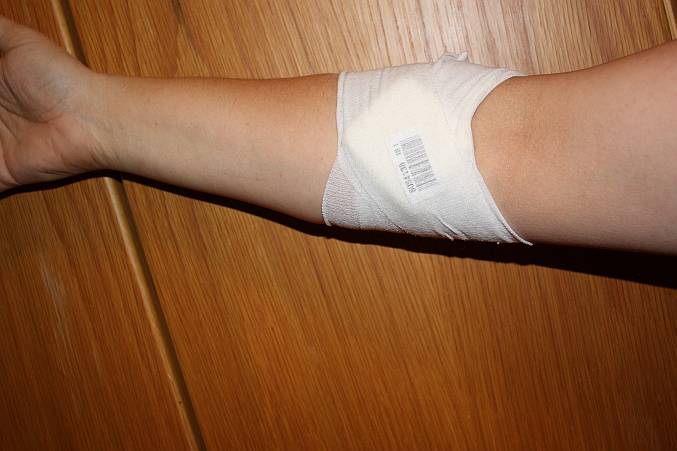
About ten minutes later, my right arm looked like this:

[caption id="attachment_2213" align="alignnone" width="677"]blutspendeverband The barcode in the wrap matches the barcode on my paperwork and the bag plus the test tubes that my blood went in. It's more or less just decorative on the arm, though!


And you've probably figured it out by now - we went to donate blood. I've been doing this since I turned eighteen, with a few years of hiatus inbetween, and it's a really nice thing to do. We usually team up with a friend or two, which makes this a nice and social evening for us. It's a good feeling to be able to help somebody else (plus you get your blood checked, and will be informed in case there's anything really amiss with you), there's lots of nice and friendly people there, and after the donation you get coffee and a bite to eat. Donating blood also has some health benefits for the donor, so it's an allround win-win situation. Yay!
0
FEB.
16
0

Tell Them Of Us.

I posted a while ago about the exhibition on knitwear used during WWI, but I didn't mention in that short blogpost how the exhibition idea originated. The reason for this knitting project was a film about two young men going off to war. The film is based on a true story of one family.

The film has been all finished now, and it's available through vimeo, where you can either rent or buy it. There's also a trailer (free to watch, of course) that is already featuring quite a few bits and pieces of beautiful knitting.

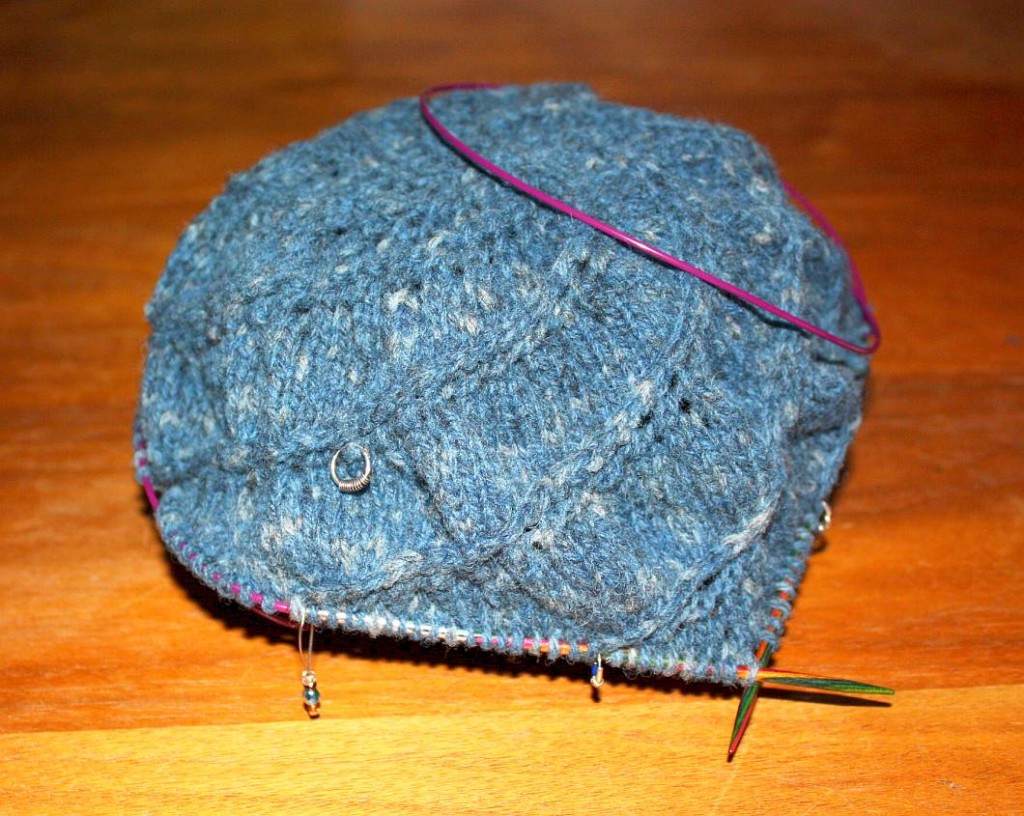
Speaking of knitting - my own hat knitting has only progressed very little over the weekend. I'm working on the sides of the hat now, and there's still a good bit (about 12 cm or so) to go before I can get started on the brim (which is the most fun part of the whole pattern).

[caption id="attachment_2210" align="alignnone" width="640"]The hat in progress. Sloow progress... as it's often the case for me. The hat in progress. Sloow progress... as it's often the case for me.


The one single earring in the knitting marks the edge of the flat crown and start of the cylindrical part, the other ones are my usual stitch markers. I really like to use earrings (the small hoop type) as stitch markers - they are small, they are pretty, they are available in different designs so you can mark different spots, they can be opened and all that gives me a perfect excuse to buy some from time to time. (I like the look of them. I even had my ears pierced ages ago, but I'm not a wear-earrings-daily type of person, and wearing them occasionally only always led to pain and infection... so I stopped wearing them altogether, and now I'm getting the earring-fix through knitting.)
0
FEB.
15
0

Videos and Stitches.

Let me start this week by giving you two links to spend lots of time looking at stuff!

Firstly, Doug has posted a number of videos from Scotland's Community Heritage Conference in 2015. Topics range from community projects and landscape projects to surveying, and there's even a "minute of madness" short video.

Non-moving pictures, but lots of them, and lovely ones of sewing work are in Sarah A Bendall's post about her reconstruction of the Elizabeth I effigy bodies - cutting and sewing. If you like to look at hand-sewing, or are interested in early modern stays, or both, you should not miss that post!
0
FEB.
12
0

Friday Linkapalooza.

Thank goodness it's Friday - somehow, this week seemed both too long and too short at the same time. So here's links to celebrate that it is Friday, and the weekend is coming!

A self-filling water bottle for cyclists - it catches humidity from the air and collects it in a bottle. I'm not so sure I would really want to drink that water, or how well it would work (especially in dry weather, when you'd need the water the most), but the idea is just cool.

Copenhagen Uni is offering a POD book called "Refashioning Viking Garments"; their sales page also has a pdf with the table of contents to download.

If you're looking for some nice stories to enjoy this weekend, here's a bunch of Escape Artist ones (they are podcasts, so you can even do stuff while enjoying the stories). They're all eligible for the Hugo Awards 2016, in case you have voting rights.

Or you could check out the Recording Archaeology Youtube Channel, where you can find videos from archaeological conferences.

Enjoy!
0
FEB.
11
0

Textile Economics.

One of the things that come up frequently when I do presentations or demonstrations of textile techniques is the value of textiles. We're so used today to going into a clothes shop that sells things for ridiculously low prices that our estimation of textiles and their worth tends to be very low.

The ridiculously low prices are not without their own price, though - only it's usually not us here who are paying it, but cotton farmers, clothing factory workers in Bangladesh, or everyone in the area where cotton is grown when water supplies are used up and the groundwater level plummets (no wonder if up to 20 000 litres of water are used to produce one kilo of cotton), or is poisoned by herbicides and pesticides.

It's not fair, it's not sustainable, and a lot of people have been talking about this "fast fashion" and its problems in the last years. (Just plug "fast fashion problems" into your favourite search engine. You'll be surprised.) There's things we all can do, though - one of them is becoming more aware of what we buy, and how often. Another thing is to try and avoid conventionally grown cotton (organic is much kinder to both producers and the environment) and look for clothes that were not produced in Bangladesh, but more locally. Buy used clothing, mend things that can be mended, and give things you do not wear anymore away instead of tossing them into the bin.

The fact that textiles are such a cheap commodity today has coloured our perception of textile crafts, and our internal valuing of fabrics. This makes it hard for many people to understand why fabrics were so precious in the Middle Ages (and also way past that time, until rather recently). Clothes used to be a very valuable thing, in our past, and I do wonder if they will, one day, be again.
0

By accepting you will be accessing a service provided by a third-party external to https://pallia.net/

Kontakt