








And while I am finishing up the last bits before heading into lovely laziness and sunshine and trying to match the cat in being utterly relaxed, here's a song for you:


And while I am finishing up the last bits before heading into lovely laziness and sunshine and trying to match the cat in being utterly relaxed, here's a song for you:
Well, not much to tell about here today - there was stuff to be done on the computer, so there wasn't even sneaking away for a good bit to do some more sprang. (Which is still growing too quickly, by the way, so I'll only need about half the original row count for the original length. Grrr.) The Little Cat had a vet checkup today to get blood drawn, and she was understandably not very amused. The vet was, though, when I told him that the Little Cat's newest medication seems to be the tastiest thing ever available to a cat, and goes absolutely bonkers for it. (Apparently that's not normal.)
Otherwise, texts, reading, phone, writing, emails, stuff. And because you deserve something not as unexciting as hearing about this, here's a link for you to a new kind of sock heel that can be knit in top-down or toe-up, and a link to a paper about cats doing the "fetch" thing. Enjoy.
So in case I have gotten you curious about sprang, but you have never really heard about it... let me introduce you to Carol James, who has done an insane amount of sprang in all imaginable shapes, sizes, and colours, and who does a very nice job of explaining holes, patterns, and her notation system (which is also how the Lengberg tree of life pattern is published):
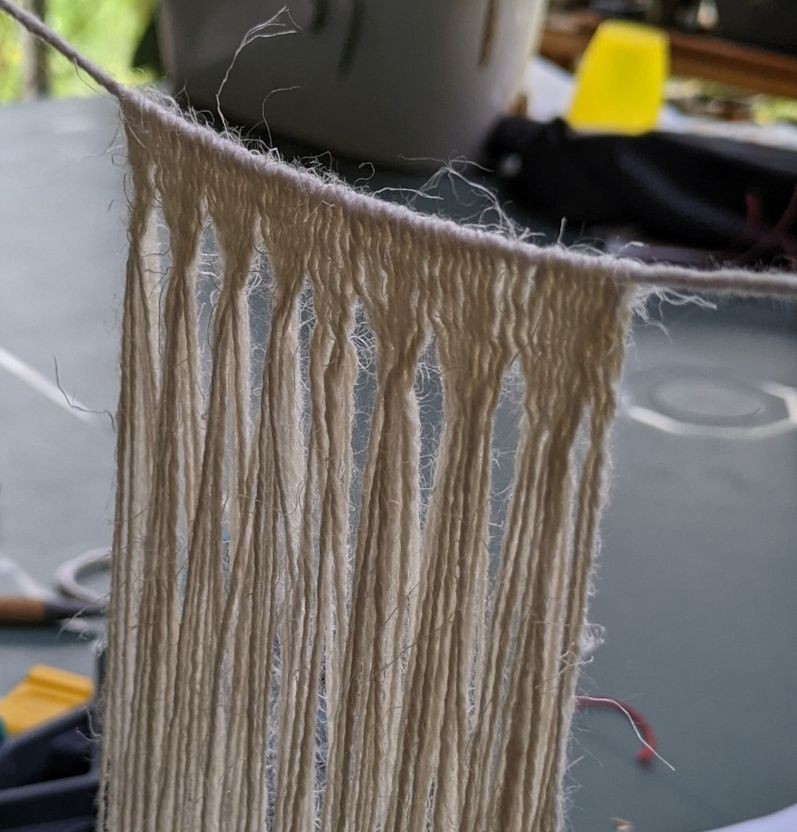
I spent a part of the long weekend (thanks to Pentecost) taking extra naps (thanks to a cold I managed to catch). As Murphy wills it, now that the weekend is over, I'm back to health again, and of course also back to work.
(Not really complaining here, though. Even though I could have done very well without the cold, at least the timing was only mildly annoying, slowing down the weekend, as opposed to horrendous, as in "could have hit me while abroad and needing all my brain and energy".)
Plus side of having some extra time to just sit and do stuff: I managed to do a little bit of sprang. The story behind it is that I might need to make a piece of sprang for a museum project, and that means I have to do at least a rough calculation on how much it will be, and that is, obviously, hard to do without a basis.
For things that I've done before, I have all the data written down and collected, so I know how long something takes when it goes smoothly (or, as it usually does in best case, mostly smoothly) and how long it will take if something explodes. (Figuratively, not literally.) Yes, I always take time measurements when working for work purposes. Yes, I still do it even once it's clear I am way beyond my initial estimate. Even if it hurts to see how much it's going off estimate - it will be really, really helpful for planning the next similar project.
(In case you are planning to track your work times now, too: My recommendation is a simple stopwatch to place at where you work. That way, you can pause whenever you get up for tea, or a phone call, or whatever - just in case it takes longer than planned and then you forget when you stopped.)
So now I'm spranging again. Last time was a good while ago, and this time I am supposed to follow a pattern to get, well, a pattern, so it was a little different. It took me a bit to get back into the flow and figure out how to get a fabric density similar to the original, but now I'm getting there.

The threads are not optimal, but they have about the right thickness, and were what I had on hand quickly.
As always with textile techniques, it pays to have a good, even set-up - differences in tension when doing the setup will mess with your work later on. And then...
There's a pattern to sprang, to the normal, very basic crossing pattern. It involves two threads from the front getting closer together as you pull one thread from the back, and then you split the pair and pull one more from the back and have a new pair to split. It's rhythmic and beautiful and mesmerising, and it only gets tricky if you have a tension issue, or if you get to the edge (where tension is normally a little bit off, too). This pattern will be persistent throughout work, only broken at edges (which includes edges of holes, making everything a bit more interesting).
So basically, this means you have a running feedback on whether you are still correct, or if you have messed up. That requires adequate eyesight (very thankful for that!) and adequate light (thank you, Joseph Wilson Swan, Thomas Edison, and successors) and adequate concentration.
And then it's just... beautiful. It helps if you have a firm fabric, and if you take care to keep all threads nice and orderly, so I like to work close underneath the top fell. One of the hardest things, really, is now to stop in time before concentration wanes and I mess up, or to stop and do other things that need to be done. (I'm looking at you, bills I need to pay and orders I need to send out.)
By the way, my hack for getting an even warp when warping, or an evenly tensioned sprang setup: Don't tension your threads more than necessary to just keep them from sagging. You are measuring them off on a horizontal thingummy, so start with the thread completely slack and only tension it so it just goes straight. Continue with this technique throughout.
Gravity helps you get it right here, because you always need the same amount of tension to just get it straight, no more. If you always adjust to that exact tension from slack, there's no danger of you building up more tension gradually as you are working - which is a rather common, if unwelcome, effect. In case you have accidentally tensioned more than desired (because your yarn stuck, for instance, and the ball/cone/reel/spool un-helpfully tensioned it for you), just let it go all slack, then re-tension to just straight. You do not need to make the set-up at the exact amount of tension that you want to have later! You can add all the tension you want or need for working with your bits of string measured off this slacky way later on, and they will be deliciously even. Works with every technique where you do a set-up step measuring off threads that have to be the same length.
I'm back from the workshop with colleagues, where - for the first time ever - I got the pleasure of having a moderated discussion with some teambuilding elements thrown in. It was a fantastic experience, and I did learn a lot about the meta elements of how a group forms and what happens. We were, for instance, introduced to the stages of teambuilding after Tuckman's Theory.
I had never heard of this at any point before, but it does sound familiar, and I found it immensely helpful to know that there will inevitably be some discordancies before everyone has found their place and the group can start to really perform.
Wikipedia has, of course, an article about the four stages of the original model, and also some additions and further developments, so if you are curious now, you can read up on this here.
As for me, I have some stuff to catch up on now, so I'll be off performing in my workgroup of one...
It's the time of year again where public holidays mean nice and very welcome gaps in the work week... that's the case with Thursday this week, and since that is ideal to make it into a super-long weekend, I will be taking Friday off as well.
On the Monday afterwards, I'll take off to a workshop and networking meeting, with the goal of making textile research and conservation easier for everybody involved. I'm already looking forward a lot to this, the programme sounds really interesting!
Accordingly, I will be off the blog until Friday next week.
In the meantime, maybe you'd like to read this article about fetching and retrieval by cats when they are playing!
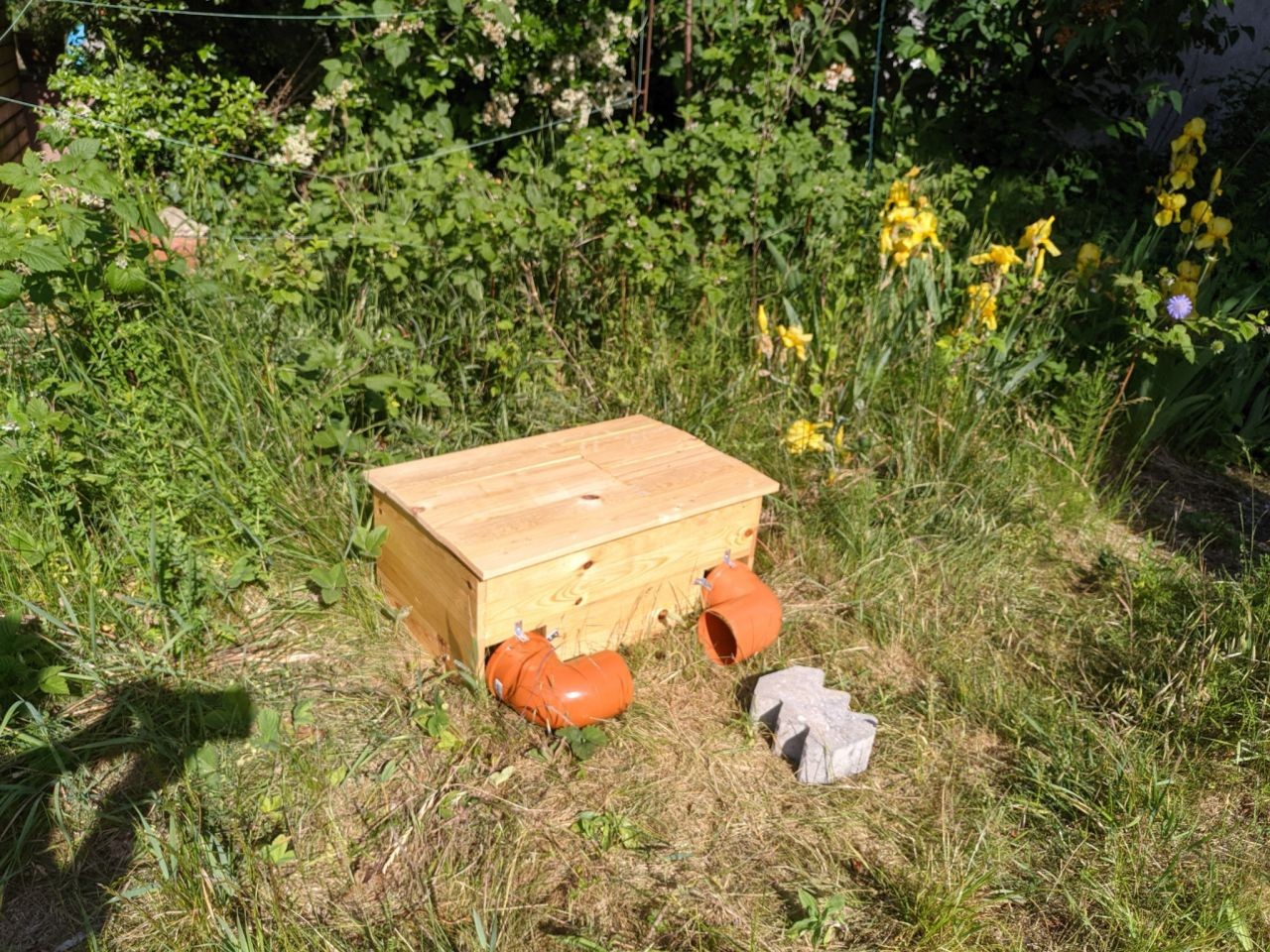
Yesterday was too hectic to get a picture in here - but now you are getting a view of the catproofed hedgehog restaurant:

The stone goes on top of the roof/lid for the night, otherwise at least one of the cats will lift it off. (We saw him trying on one of the videos. Before he gave up on that method and contorted himself in through the door opening.)
And this is how the inside looks:
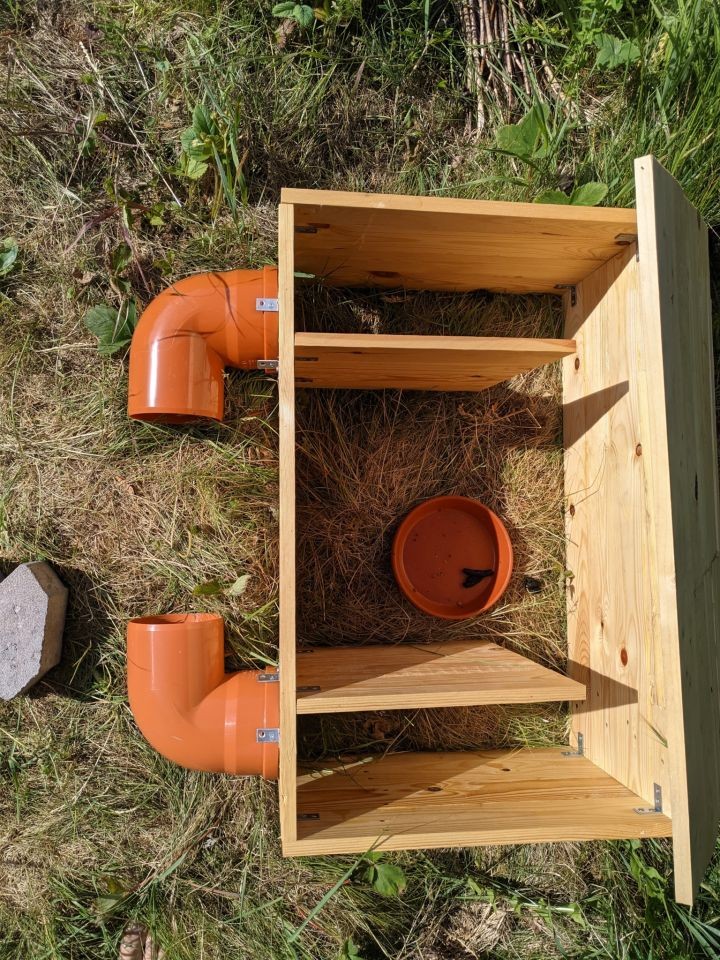
I'm still impressed that the cats managed to squeeze around that corner. It's only about 11 or so cm wide, after all.
The center space should be large enough for two hedgehogs to turn around each other (which should be possible here), and the food houses need two separate entrances so there's always a way to flee, in case there are disagreements about who is supposed to be in there, and who is not. That makes those food houses surprisingly large. Instead of adding the two sewage tube knees, some plans recommend closing off the entrance labyrinth paths on top, making them only about 12 cm in height, so it's more like a tunnel. We considered that option, but went for the knees - as we did not trust the cat burglars to get stopped by a little bit of a height inconvenience.
And yes, what you see in that dish is no more food, and some hedgehog droppings instead. They have a weird way of saying "thank you for the food", those guys!
By accepting you will be accessing a service provided by a third-party external to https://pallia.net/