Latest Comments

Guest - Max Mustermann The True Cost of Driving a Car.
06. November 2026
Great breakdown — the non-fuel costs are exactly the bit most people forget when they compare cars. ...
Guest - Harma Phew. Now it gets involved!
21. Oktober 2026
Have fun at these events.
Guest - Aislinn Dyestuff Citizen Science.
09. Oktober 2026
This is a great project. I look forward to the results. Thanks for letting us know.
Guest - Aislinn Time for...
09. Oktober 2026
Looks delicious!
Guest - Katrin Sprang Discussion
18. September 2026
Hi Rachel, I have looked for more photos of you, but that was not very successful. I found a link on...
MAI
26
0

Summer colds are nasty.

I seem to have caught a summer cold - which is always nasty, and sometimes I wonder whether summer or winter colds are worse. At least in winter, everybody expects to get some sniffles sometime, and it doesn't come by surprise.

So now I'm trying to decide if this is a good excuse for going easy today or if I really cannot afford to go easy... there's this blackboard in the study, you know? It's a board to write down all the things that are on my to-do-list (with green chalk, currently), plus there's a section for the upcoming dates and deadlines. And a section for the long-term projects, just so I don't forget. And a list for the things that are to be taken care of, but not really urgent yet. And sometimes I make an additional small things paper to-do list, if the items are to be taken care of on the same day and it's not worth it chalking them up on the board.

The board which, incidentally, always seems to be more green than black. At least there's two deadline chalkings that I could wipe out today if I do the rest of the work necessary for that... sounds like I won't be slacking after all.
0
MAI
25
0

It's that time of the year again.

ItZM2 is almost the end of May, which means that the deadline for German taxes is approaching - and that, in turn, means I am doing what all good Germans are doing now... which would be re-checking the bookkeeping, making final calculations, and filling out tax forms with all the maths that is involved with that.

And while I am here and happy that there are programmes to help me doing all the maths and calculations and listing and whatnot that needs to be done, in case you want something else to look at, here's a list of stuff that I wanted to pass on to you, accumulated during the last few days when things were busy here:


Textile History, Journal of the Pasold Research Fund Ltd' has digitized all back issues. You can find the contents of each issue at http://www.ingentaconnect.com/content/maney/tex. There's also a free issue to look through (one from 2009) as well as a cumulative index. (h/t to MEDTC-list)

There's a conference "Developments in Dress History" planned for December 8-10 2011 in the University of Brighton, UK; the Call for Papers is open until August 1. You find more info about the conference and the full CfP here.

The Euregio Maas-Rhine has a project about the historical wool fabrication up and running - it's called the Wollroute (wool route). They have made videos to show the historic production places and tell some background info - in German, Dutch or French. If you don't understand any of these three, you will at least have nice pictures of wool and looms, so do check out their website www.wollroute.net.


Yale has made their digital collection available online, and it's free! They announced an Open Access policy this May, and now you can browse what they have via Discover Yale Digital Commons. (They have spindle whorls. And lots more.)


And finally... Crowd Funding has found its entrance into archaeology. A group of German students wants to try and make a T-shaped stone pillar, as it was used at Göbekli Tepe more than 11000 years ago. The pillar will be about 5 m high, 35 t heavy, and will be worked with only the materials and tools available back then. They have already done their preliminary experiments, and now they are looking to raise money for the real project this summer. The fundraising is done via mySherpa, a German-language site (and the project description is all German) - if you are interested in the project (or better still wish to support it), you can find their mySherpa site here. (In contrast to kickstarter.com, mySherpa requires you to pay upfront as soon as you declare your sponsorship; in case of underfunding of the project, they wire your money back.)


Go have fun with these links!
0
MAI
24
0

Call for Papers ending soon!

Here's just a short reminder that the Call for Papers of the European Textile Forum is ending on the 27th of May - so if you were planning to register, please do not forget to do so!

We are looking forward to a very interesting week - and we hope that you will join us! (Just in case you haven't been here before when I was plugging the Forum, you can learn more about it on www.textileforum.org.)
0
MAI
23
0

Tidings from Conferences.

ZM1First of all, I had a wonderful time at the conference on Friday - my paper went over very well, and all the other papers were uniformly interesting and well-presented. Plus I got to see a lot of old friends and colleagues again - and meet some new people.

And now, as promised last week, a bit of a report from NESAT...

The conference started off with an evening event, a lecture about - no, not textiles, but pile dwellings and their archaeology. Since pile dwellings are situated in watery areas, these settlements are often graced with textile and other organic remnants - so it was a topic close to textiles, yet not totally textile. The rest of the first evening was spent mingling and enjoying some wonderful food (a recurring topic during the following days), chatting with old acquaintances and meeting new faces.


The next day was the start of the conference proper, which took place in a building called "Salemer Pfleghof". That was a fantastic place to hold a conference - a nice, large room for the papers (and the book table), and right outside it a light, open space that could be opened up into a little courtyard to have the coffee breaks. And the papers... there were only fascinating papers.

The conference started out with some papers about methods and methodology - pictorial and written sources, of course strongly focused on textile topics, and documentation methods for in-situ-blocks (X-ray computer tomography) as well as techniques to identify fibres and dyes. Something that was utterly new to me was the possibility to get information about local or non-local provenance of fibres by doing Strontium-Isotope analysis, though this technique is still limited by contamination problems, low Sr content in fibres and of course the fact that similar Sr rations can occur in different places - so it is not possible to get true origins from this alone.

The next part of NESAT was focusing a little more on crafts, with a paper about crafts and creativity followed by a report about Gunnister Man and the reproduction of his clothes - 14 different garments made from 22 different fibres, painstakingly reproduced by Lena Hammarlund and Martin Ciszuk. (Oh, and if you need a well-dressed friend... Gunnister Man is on Facebook.) Another paper about a Migration Period textile find and one about basic research inside the framework of Dress ID rounded off the papers. And then the first day was already over, and almost magically, a lot of the NESAT gang met up again at the little café and restaurant next to the inofficial conference hotel - turned out that about half the participants were staying at the same spot. The weather was warm and nice enough to sit outside until everybody went to get some sleep, too.

The second day of the conference started with identification issues again - from XCT to analyse mineralised and carbonised neolithic textiles, fibre identification as an important part of analysis and quality evaluation to the use of proteins to identify animal species and even breeds. We heard something more about the use of Sr isotope analysis for provenance studies as well as about the use of light stable isotope analysis - carbon, nitrogen and hydrogen - to do a different kind of provenance analysis. Then some papers told us about finds - the utterly spectacular find of the Hammerum Woman from Denmark, where a complete 2nd/start of 3rd c AD garment was excavated out of an in-situ block; a paper about the re-examination of the Prachtmantel finds and their technique of production; and the puzzle of the garments of the "Lady of Cloonshannagh Bog" that were shredded by a modern peat-cutting machine. The afternoon was reserved for the poster presentation, and the early evening was garnished with wonderful food again, including delicious non-alcoholic cocktails (that was a surprise for all of us), and of course more talk. This evening also saw the ATN meeting.

Thursday was a shortened day, since this was also the excursion day; we heard about the use of pollen analysis to study the very well preserved organic remains of cave burials in Minorca with the aim of finding out about burial practices and rituals; pollen analysis on late medieval burials in Spain to discern practices from the first burial and the translocation and second burial from each other; and the rest of the papers this day were about finds and find analyis and partly also their interpretation.
Afternoon was reserved for the excursion; I went to Ludwigsburg to be fed with cake and be shown around the Fashion Exhibition, the conservation lab and the baroque gardens. It was a wonderful excursion, only much, much too short - we had some traffic problems on the way there which further shortened the time for the rather ambitious programme prepared for us by the conference organisers. The other conference participants went to Hochdorf and had a good look around the Keltenfürst museum there.

Then it was already the last day, starting off with a bang - the Lengberg finds of 15th century underwear, including bras. Other papers told us about high-quality wools and silks from Elbing, the discovery of a sheep washing installation in Wurt Hessens, hemp and linen in Talmud interpretations, the dyeing industry in Pompeii and finally tools and tool interpretation in two papers - one centering in Etruria, the other in Pannonia.
That ended the 11th NESAT - and there was an unofficial "concluding meeting" with more chatting and some scheming for the future that took place in the ice cream parlour, some more hanging out in the evening and the gradual departure of all the participants.

It was a glorious NESAT, and I'm already looking forward to the next one...
0
MAI
20
3

Chaser Conference.

I'm at a (very) small conference today, my paper is the second one in the morning, and yes, I did finish its preparation in time.

And I finally figured out what made it so weird in preparation... it's mostly NESAT's fault. Because, when you come back from a place where you have been for a week and where somebody says "2/2 twill", everybody nods and goes "ok", or where you say "that sock from Coppergate", and the room goes "ah, that sock" - it is kind of hard to not feel weird when you prepare to explain in a paper how a hand-spindle works.
Plus I've only gone to international conferences during the last few years, and of course I did my papers in English - and today's little thing will be in German, and that also feels kind of weird.

I'm packing up now to head for the conference, and I'm trying to not feel weird.
0
MAI
19
0

It's still crazy round here.

The past days have been really, utterly crazy, with deadlines coming up so close to each other they might as well play leapfrog to amuse themselves. It has been so crazy that the most patient of all husbands invented a new name for a weekday: Drölftag.

Drölftag happens when you skip at least one weekend because you have to work and thus lose all track of what weekday it is today - since your inner long-term clock has taken the week off in protest. Drölf is, by the way, the first part of "drölfernolzig", and that is an expression meaning something like "umpteen". Monday was a true Drölftag, and now it's almost Friday, and I'm really, utterly looking forward to the breather that the weekend will be, since I will then actually have two full days off. But today, I'm hunting one last deadline (a small paper due tomorrow morning at a small birthday-for-a-prof conference).

Now... where's that net? The bear trap? The infrared motion sensor? I have a deadline to hunt - and these buggers can be fast...
0
MAI
18
0

More knitting.

(This was supposed to go live during last week - on the 12th, to be exact. Why on earth it never did - beats me. I'm serving it to you now instead. And I'm retroactively sorry for the blog silence.)

I had an unplanned-for splurging moment in Freienfels, when I went to Sabine's stall on Sunday afternoon and decided that yes, that was my cardigan hanging there in the back of her stall (some assembly required).


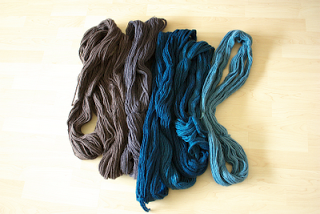
I have been ogling the pinwheel sweater (ravelry link) for a good while now, but I absolutely wanted a very nice, gradual colour change. With blues and greys, and maybe some teal. I had been thinking about using Kauni wool, but after knitting my legwarmers last autumn, I decided not to use Kauni ever again - my hand spinning on a bad day is less irregular than that skein I had.

Then I was pondering getting some top, dyed in a gradual colour change, and spin the yarn for the pinwheel. But I don't get to spin much, and the yarn would be very thin, or quite irregular and ugly, or plied from 4 to 5 singles, and I can't see myself finishing anything like that before I'm about 120 years old. Plus I am sort of unwilling to spin dyed top in large amounts. (I much prefer to spin historically prepared wool, nowadays.)

So... I splurged on an array of blues and greys, in really thick and deliciously soft yarn. And I wound the first two balls, on my day off after Freienfels. And started knitting.


Of course, it wouldn't be me knitting if there wouldn't be some modifications. Basic pattern is the pinwheel sweater, but with left-leaning increases instead of yarn-overs, and starting with four stitches from an I-cord "belly button" for a better and easier start.

And I am knitting with two yarns at one time, making "barberpole stripes" for that more or less gradual colour change; each of the two colours has four increases, so I don't have the alternating increase round and plain round, but always the same round (except for where the increases are). One of the yarns increases right before the green markers, the other right before the white markers; each double-round starts with the white-marked yarn. And I've made a bit of progress since taking these pictures - though it will take some time still until I can put in the armholes.

Hooray knitting!

(Update: Since my day off yesterday was partly spent knitting on this, I am by now just a little past the armhole line - so there's garishly red thread knitted in there, to take out later and knit the sleeves on.)
0

By accepting you will be accessing a service provided by a third-party external to https://pallia.net/

Kontakt