Latest Comments

Guest - Max Mustermann The True Cost of Driving a Car.
06. November 2026
Great breakdown — the non-fuel costs are exactly the bit most people forget when they compare cars. ...
Guest - Harma Phew. Now it gets involved!
21. Oktober 2026
Have fun at these events.
Guest - Aislinn Dyestuff Citizen Science.
09. Oktober 2026
This is a great project. I look forward to the results. Thanks for letting us know.
Guest - Aislinn Time for...
09. Oktober 2026
Looks delicious!
Guest - Katrin Sprang Discussion
18. September 2026
Hi Rachel, I have looked for more photos of you, but that was not very successful. I found a link on...
NOV.
19
1

Like a little medieval splendour?

After a long time of nothing happening for the market stall or range of goods(I blame it all on the upcoming move), I have some medieval splendour to spice up the modern life:
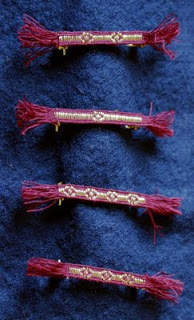
Brocaded tabletwoven brooches!


Made from silk and real gilt thread and mounted securely onto a gilt brooch base, these are a wonderful way to add the splendour of medieval luxury bands to your modern life. The picture really does not do these little beauties justice - photographing goldwork is not easy. The gold brocade really sparkles out from the deep ruby red of the silk. The gilt brooch base has a little locking wheel to keep the brooch from falling out of the fabric.
The little bits of band are made individually and can't unravel. The pattern is adapted from a medieval brocaded band, threads are pure silk (dyed chemically) and gilt fine silver around a silk core. The brooches are available now from the Market Stall.

The brooch is a beautiful way to subtly show your love for things medieval - and to find out whether your conversation partner knows about brocaded tablet weaving! This will also make a wonderful Christmas gift for somebody into historical textiles or textile crafts.
0
NOV.
18
7

How to Untangle a Skein of Yarn

InZM5 a perfect world, every skein of yarn is a perfectly arranged series of loops, ready to be unwound with no trouble whatsoever.

Unfortunately, this is not a perfect world, and after going through the rigors of a dyebath or after being mangled by children, cats or other calamities, you might end up with a tangled skein. Maybe even a severely tangled skein.

You have three options now. Option One: Throw that lump of loops into the rubbish bin. Yes, that is a valid option - if you don't really need that yarn, if you can buy it again, if you don't have a lot of patience, if you are not really willing to untangle it, if it's wool and has felted itself together in the tangling process, so that pulling apart the loops will damage the yarn. If it's one-of-a-kind or it was horrendously expensive, though, you might not want to throw it away. Luckily, there is Option Two: Figure out some way to use the yarn that does not require it to be all in one piece. Draw out as much yarn as possible at one time (or your pre-defined lengths), cut, untangle the knob that forms, repeat until skein is gone and you are left with a number of one-length cutoffs. Take care to wind each cutoff after measuring it and cutting it, or you might face more tangles!

That is not the thing you need? You really want one long length of yarn? Then take a deep breath, go buy some chocolate, put on a kettle for some tea and sit down for some lengthy yarn skein de-tangling. To get an estimation of how long it will take you, make a wild guess. Then multiply the time of your wild guess by two - that's the pessimistic wild guess. Now multiply that by ten, and you have an estimate. (Seriously, if you are pressed for time, this is not an option. Go buy another bit of yarn. And if you are not patient in the face of tangles, find somebody who likes to untangle yarn and bribe that person.)

You will wind the skein into a ball of yarn by hand, or, if it is very fine yarn, you might opt to wind it onto something like the core of a paper roll. You will not be able to use a ball winder or similar contraption. There is nothing speaking against making a center-pull ball, if you can wind one by hand, though (and there are instructions galore on how to do that on the internet).

Try to find the original middle of your skein. If it is still bound off, that should be no problem - just locate one of the bind-off yarns, hold that and insert your hands between the bottom of the skein part with the bind-off and the mass of tangles. If your skein is not bound anymore, hope for the best. Open up your skein gently but completely and gently stretch it between your hands. Stretch it all the way around, rotating it bit by bit and stretching after each little rotation - this is to straighten out the loops as much as possible.

Now you place it on a good swift - one that is turning lightly, that does not have much weight on its own, and that has as many arms as possible. If you don't have a swift yet, it's the reason to get or make one (if you sit down to untangle a skein, you are probably a yarny person and you want a swift anyway). If you have a four-armed swift and face tangles often when unwinding, consider getting one with more arms, and if possible with arms that have a wide surface for the yarn to rest on (like the Goko). The higher the number of arms, the more your skein on the swift resembles a circle - and it's much easier to wind off a circle than a rectangle, because the corners are where yarn likes to catch itself.

Once your yarn is on the swift, spread it out as much as possible. Locate the end of the yarn - if possible, the end lying on the outside. Your skein is technically a huge spiral, and it's easier to unwind that from the outside than from the inside. In a skein that is tangled, the loops of the spiral have gotten into disorder, locking each other into place and hindering you from unwinding. Your task now is to straighten out those loops.

Now you are going to face two different kinds of tangles. (If you are working with wool yarn, the yarn might stick to each other as an additional, third kind - a pseudo-tangle.) You are winding your working end, and suddenly it won't detach itself from the surface of the skein - instead, many short bits of yarn seem to tie it down to the swift, forming a sort of small triangles. Those are loops locking each other and the working yarn - insert your finger and gently pull upwards, or try sliding your finger in the opposite direction of your winding direction. That should release the small triangles. Each of these triangles is a loop of the spiral, where one bit has been caught by other loops, locking it in place. The bit a little more "upstream", so to say, overtakes the bit that is caught (using up the slack in the yarn at the same time) and forms the apex of the triangle. To remove the triangles, you need to free the spot that is caught - if you move your finger "upstream" (against the winding direction) underneath the triangle, you will find that point. Gently tug on the leg that is caught in downstream direction to release it.
Typical "catch-points" are the arms of the swift, because this is where the skein turns a corner. The larger the angle of that corner, the easier it is to turn it for the yarn (that's why more arms make a difference). If something is caught at a corner, insert your fingers beneath the skein and flatten out that corner while gently pulling on the yarn end(s) caught - this should release them.

Once in a while, however, a single loop or a number of loops will form around your working end. If you slide your finger under that loop, back where it comes from, that loop will turn out to be one really big version of the small triangles of yarn. If you can go back to the point where one leg of the loop is caught in the skein and gently tug it free, do so and gently travel underneath that free leg with your finger to where your working end was caught - that will remove the loop completely. If your loop is really big and goes around and around the swift, you can in theory follow the loop until you find the end that is caught and release that in the same way. In practice, however, it is much easier to just cheat and move your ball or spool through the loop. This means you have now changed the run of yarn - it is not an unbroken spiral path anymore, but might contain one half-hitch knot. Never mind that, just be aware of it - because it means that you will eventually find yourself caught in a loop again and have to move your ball through it.

If you run across any bad tangles, always try to tease them apart with your fingers, leaving them more loose than you found them. If you can't get your yarn free from a badly tangled place, just move the ball through and move on. It will all get sorted out eventually. Spread your skein from time to time (if your swift has wide arm-ends) to help with unwinding. Take breaks when you need to - and don't make yourself finish in one day. Instead, I'd recommend placing your swift somewhere easily accessible (and with very good lighting) and just untangle a bit at a time. Don't try to untangle when you are angry, stressed or impatient, and most importantly, don't think that you need to do it fast - and the whole business can even be a soothing, meditative thing.
0
NOV.
17
8

The Hartenstein Knights

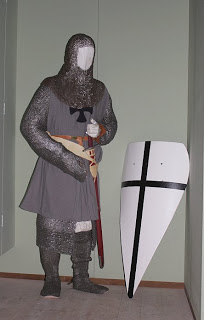
For those of you who can't go there (or for those who would like a little preview), here are photos of the two "guys" standing in the Hartenstein exhibition. I took my camera to the opening ceremony, but had unfortunately not checked the batteries before, so I can only show you pics from the setup procedure - which means that the pictures show only the almost-finished state, with little details missing.

First, there's the miles from around 1200. It's a knight from the Teutonic order, and there were two possibilities for him for the exhibition, the warlike outfit and the courtly one. When we set up the exhibition, the warlike presentation was chosen, so he currently looks like this:


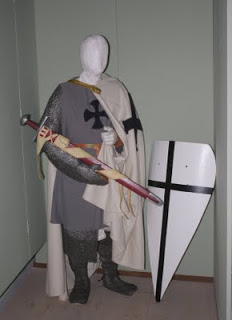
And this would be his courtly self:


He's wearing braies, a pair of cloth hose beneath the mail, a wadded gambeson, the mail shirt with mittens attached, a tabard and then either a half-circle cloak or helmet and mail coif.
Isn't it amazing how much of a difference this makes?

And as the second "guy", we have the master of Hartenstein himself, caught in the act of donning his Great Helmet:

He's wearing braies, cloth and mail hose, a gambeson, a mail shirt, armour covered with silk cloth, knee protectors and vambraces. And gauntlets. And two helmets, of course - the bascinet with mail attached to protect the neck, the great helmet with a fish as the crest. (I hope I got all the English terms right - I'm not so used to translating weapons-and-armour terminology.) He isn't equipped yet with his shield and his sword - he only got those after the photo.

(He's cut off at the knees because there are tools and paraphernalia at his feet. He does have feet. Really.)
0
NOV.
16
5

Am I an official Dark Side padawan now?

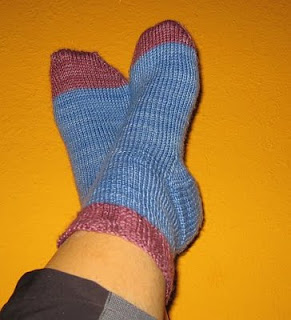
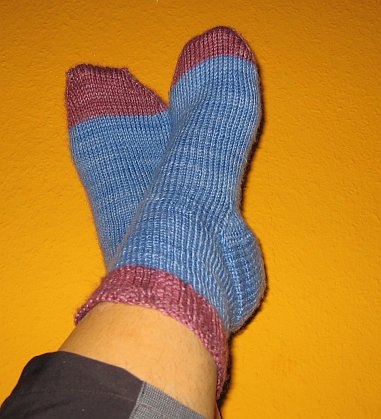
Here's proof (visual) that I'm doing my best to join the Dark Side (and thank you, Darth Harma, for your friendly welcome!)


I am really amazed at how much stuff about knitting is there on the Internet (and I haven't even been to Ravelry in my forays). This all makes it easy to find out about stuff - it truly is standing on the shoulders of giants. Like, to name just one of the many, Darth Techknitter, who happily shares her knitting knowledge with incredible drawings - and everybody who ever made a drawing of any textile technique that entails yarn looping through and around other loops of yarn will know what that means. So a huge thank you from me to all of you out there who make it possible for others to learn about knitting - and not only the canonised version of one's own country and the tricks from one's vicinity, but all the twists, turns, variations and tricks from all over the knitting world. You rock!

And they are not normal giants. No, there are giants who are doing seriously mad stuff, like knitting two socks at once. Simultaneously. On double-pointed needles.
That, now, is seriously awesome, and I don't know whether to be happy or mad at Darth Harmless Drudge, because this is so awesome that I absolutely have to try it.

I like the dark side. There are socks. There is chocolate as accredited motivational tool. And there is madness... it seems to be just the place for me.
0
NOV.
13
1

Today is the exhibition opening!

Today is the opening ceremony for the exhibition on Burg Hartenstein, and from tomorrow, the exhibition is open to the public.

If you are around here, why not give the two knightly guys I made and clothed a visit? The exhibition is open on Thursday and Friday afternoons (from 15.00) and on Saturdays and Sundays (from 10.00).

And if you are not in the Nuremberg area, you can see one of the guys greeting you on the official homepage of the Freundeskreis Hartenstein e.V., the association that initialised making the exhibition.
0
NOV.
12
0

"Jogless Jogs" and true spirals

Now that I'm slightly over the half-way mark with my "learn how to knit" project, I've already fallen in love with something to make after that.

It is a pair of socks, with free pattern on the Internet. But no ordinary socks - no, they are Alice-in-Wonderland-Illusion-Socks (pattern and pics in pdf). And of course there are questions... like "can I use the wool from my stash* for socks, even if it's a bit thick, if I use really thin knitting needles?" and "how can I eliminate that jog?"

Now I already hate jogging as in "run to get somewhere faster" - my knees and me, we're just not made for that. And jogging in knits? Not so grand as well. So I was looking around a bit the Internet on how to eliminate the jog, and there's a method called "jogless jog" - which helps. Basically, jogless jogging means gently mangling or mushing the stitches around the jog to conceal it. But there's still a jog, and there's still fiddling with the colour change and carrying up of threads. (Nice explanations of jogless jogging can be found at TechKnitter's blog.) And the structure of circular knitting does allow for truly jogless stripes - with only a slight colour-coming-in-jog at the start and the end.

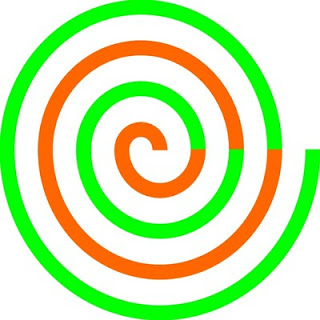
Now, technically, knitting in-the-round is knitting a spiral. For normal colour changes as for stripes, you are breaking the spiral to change from colour A to colour B. Imagine knitting in the round with a lot of increases so your round turns out flat, and it will look like this:


In sock knitting, this would be one round orange, jog, one round green, jog, ... and so on. You are trying to knit rounds of colour in a true spiral, breaking the spiral. Rounds of colour can be done easily, and jog-lessly, on a rounds-based technique like netting, but not on a spirals-based technique like knitting or nalbinding (and not in netting if you mush your meshes at the beginning so you can net spirals).
Breaking the spiral will always result in a jog. For thick, solid stripes, that isn't too bad. But for one-line or two-line stripes, that means the jog is all or half the stripe thickness if it's not eliminated.

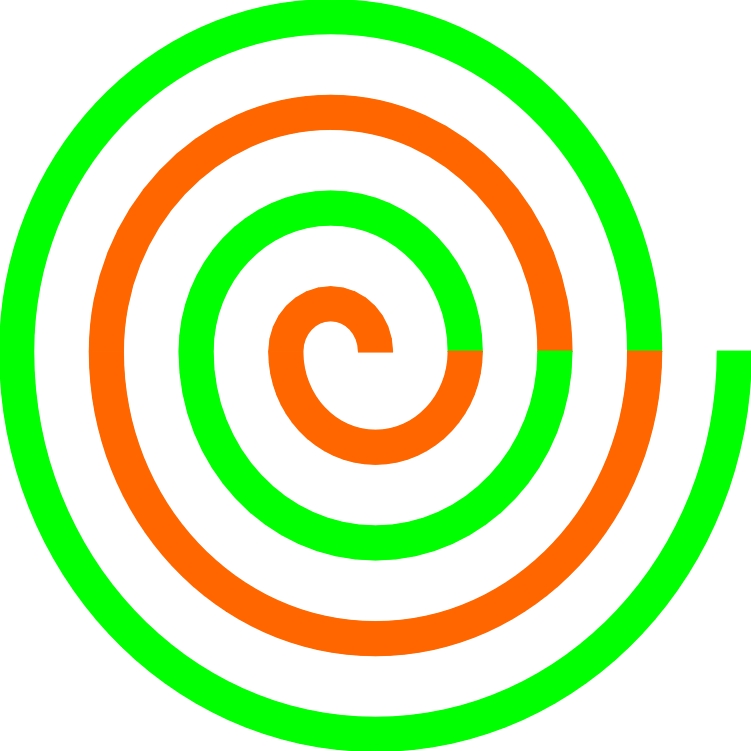
But why break the spiral at all? Why not just insert another spiral? That would look like this:

In sock knitting, this would look like one round orange-one round green-one round orange and so on. No jogs - because you are not breaking the spiral.
You just add another spiral for each coloured row - so for illusion knitting, that would mean four spirals (two of colour A, two of colour B) each coming from one ball of yarn. Which is more or less the limiting factor of this technique: one ball for each spiral, making it a ballsy technique, so to say.

Of course I had to try it out (and that's why this blog post is so late today):


You can see the very sloppy join of the cast-on (the bump), and you should be able to see where the additional three spirals come in at different places at the bottom of the tiny tube. You cast on, knit to the end of your solid part, and then you just knit in the other colours/spirals.

Let's say you are knitting in the round with five needles (four in the knitting, one working needle) and want to have two-row spirals. This means you stop at where you want the colours to come in, with your current working thread (colour A) at the end of one needle (and the fifth needle free). Now usually, you would turn your work clockwise and continue on the next needle. Instead, turn counter-clockwise and knit in the second thread of colour A, right across the needle, turn clockwise and knit across the next needle. You now have both colour A threads stacked on top of each other. Now turn your work 180° counter-clockwise and knit in the first ball of colour B - across that needle, across the needle where you brought in the second colour A, across the third needle where you already stacked up both colour A threads, making your stack even higher. Now you can turn clockwise again, and on this needle you knit in your second colour B thread. You can knit this all around until you reach the huge stack - and from now on, whenever you find yourself on top of that stack, just take the bottommost working thread and work one round, switch thread, and so on and so on. That's it. The last stitch you are knitting into (on top of that stack) will be quite loose, but the tension adjusts itself when you take up each of the threads to work with them. And the little stack of current spiral ends also makes for a wonderful rounds marker.

To end spiraling, just stop knitting the spirals one by one, preferably at the place where you started it, to make the complete thing approximately the same length all over. Putting in a short-row heel when starting the sock at the toe shouldn't pose too large a problem as well (I'll figure that out after I've found out whether I can use my stash yarn or not). And then - Illusion Socks in Ballsy Spirals method!


* Yes, I already have a significant yarn stash. Yes, that shouldn't happen if you are not a knitter. However, I started buying those wonderful, naturally-dyed yarns ages ago when I would still think of using them for tablet weaving, and I sort of got hooked on the colours and just needed my regular yarn fix afterwards.
0
NOV.
11
5

Knitting history

Ah, I should have known that a single post about knitting will draw more people out of the woodwork and get comments than all the other techniques. And actually, I wonder why - is it because more people can relate to knitting stuff, doing the technique themselves?

Comments yesterday made clear that there is huge interest in the history of knitting. When I was writing my thesis, of course knitting was one of the textile techniques to be mentioned, so I did some reading on that topic. And found (again) that knitting is a very, very hard technique to trace - about as nigh impossible as felting, if for different reasons.

Felting has no regular internal structure and thus is prone to fall apart into single hairs in adverse conditions - and adverse conditions for felt even include those that are generally good for organic material. With knitting, the problem lies elsewhere. Knitting can be unraveled so easily - and partly or completely "frogging" the work, if modern knitting blogs are any indication, is quite usual for things not living up to expectance. (Please tell me, do you frog knitted things that you don't wear anymore as well? Or only new stuff that doesn't fit or please well enough?)

If we assume that yarn was a valuable thing, and especially fine, colourful silk yarns, I can very well imagine that the yarns were unraveled and stored for another use - which would greatly reduce the number of knitted finds. Recycling and re-using (or remaking) of standard, sewn-from-fabric garments can be frequently seen in the archaeological evidence: Small, cut-off bits with seams in them, obviously the bits that could not be salvaged and used in a re-make because they were too crooked, too small or too oddly formed, or bits that were too worn. Now imagine somebody frogging a piece of knitting to re-knit. All that will be left might be a snippet of yarn - which, unfortunately, doesn't carry a sign telling the textile researcher "hey, I was part of knitting once!". And this makes knitting research a huge problem.

From what I could find in sources that were recent enough to already factor in the discussion of nalbinding against sprang, there was no evidence for true knitting before the start of the 12th century. There's a little more in the 13th, and more and more in the late middle ages and early modern age, but nothing earlier. The early datings usually come from the "coptic socks", and those I will consider as all nalbinding until somebody can prove the opposite by re-evaluation of the actual finds.

To round this off, for those of you hungry for references: Here's my list of things about knitting, taken from my bib database. I have not read all of those, so I can't guarantee that they will be good or insightful - if you know any of them, comments are very welcome!

CARDON, DOMINIQUE: Fils renoués. Trésors textiles du Moyen Âge en Languedoc-Rousillon. Carcassonne 1993.

GREINER, SYLVIA: Kulturphänomen Stricken. Grunbach 2002.

KJELLBERG, ANNE: "Knitting and the use of knitted goods in Norway before 1700. From archaeological finds to documentary evidence." In NOCKERT, MARGARETA und ESTHAM, INGER (Hrsg.), Opera Textilia Variorum Temporum. To honour Agnes Geijer on her ninetieth birthday 26th October 1988. Stockholm 1988. 145-152.

TURNAU, IRENA: "The Diffusion of Knitting in Mediaeval Europe." In HARTE, N.B. und PONTING, K.G (Hrsg.), Cloth and Clothing in Mediaeval Europe. Essays in Memory of Professor E. M. Carus-Wilson. London 1983. 368-389.

WYSS, ROBERT L.: "Die Handarbeiten der Maria. Eine ikonographische Studie unter Berücksichtigung der textilen Technik." In STETTLER, MICHAEL und LEMBERG, MECHTHILD (Hrsg.), Artes Minores. Dank an Werner Abegg. Bern 1973. 113-188.
0

By accepting you will be accessing a service provided by a third-party external to https://pallia.net/

Kontakt