



Search the Blog
Latest Comments
Aargh. And Sprang Musings.
Aaargh. Sometimes I still manage to click that button necessary to do the blog publishing and not do the confirmation thingie. With the wonderful result of the post, you may have guessed it, not going out.
Which is, you may also have guessed it, what happened yesterday. You didn't miss much, though - I finally got around to doing a little maintenance stuff, such as sorting the new stamps, tidying up things in the main stock shelves, and checking if the amounts I have listed for this and that are still more or less correct, and if and what I have to re-order and re-stock.
The little cat, meanwhile, was making the most of the summer heat and has been napping in the wintergarden all day. The wintergarden, of all places, where even with as much shadow as the curtain-like roof thingies will provide and the doors open, it gets very warm. I jokingly refer to it as the cat oven in the summer. But, well, she insists (and could go somewhere cooler any time).
When I took a break and joined her, it was definitely no place where you'd want to do work of any kind. Napping, though... yes, that might work. Unfortunately there's still a few bits to take care of here on the desk! (Where it's also nice and cool compared to outside, so I have no real excuse to slack.)
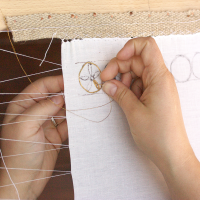
This morning, though, it was still cool enough that I could keep the cat company and do a little bit of sprang. I'm getting closer to the required length for the Lengberg cap, and it's really nice to work in that technique again.
One of the things I find fascinating is that sprang also shares that rhythm of "stuff can happen - nothing happens" that you also can get in tablet weaving, and that you sometimes have in knitting (when there's no pattern on the wrong side row and you only purl back).
In sprang, you do your patterning in one row and then just confirm and get things nice and orderly in the following one. I have done sprang stuff before, but it was mostly solid things, partly with interlinking in the opposite direction and partly with double layers - but I have not worked with a larger hole pattern before.
My guess before starting out on this would thus have been that with a heavily patterned sprang I will have one slower row (to read and follow the pattern) and one faster row (just go over everything to set up for the next slow one). I've found, however, that it's not as pronounced for me here as I would have guessed.
The main reason for that is... edges. Sprang, when done with the basic interlinking as the main structure, acquires a curl or twist after a while. That's just normal, and with a solid piece, it means you will have some curling, and thus potentially crossing threads, at the start and at the end. Which, coincidentally, is also where the usual selvedge effect happens and your threads are a little looser than the others. (That happens because they only have one neighbour, and thus don't get as nicely fixed down in the fabric, and there's also a little less take-up, so they can get longer compared to the others after a while. It's annoying, but can be found as an edge effect in many techniques.)
So with a plain thing in sprang, done with only interlinking, I get slowed down a little at the start, where I have to take care the threads are in the correct order, and at the end, where there's the same issue. The rest is breezing through, more or less. With patterns in the sprang, though... Patterns in this case are made by working holes. And holes are, in fact, a right edge and a left edge happening in the middle of the fabric.
These edges behave, for all practical purposes, like edges. That means they will also try to curl up a little. So instead of having two places where you have to pay a little extra attention, you now have as many extra places that will try to mess with your flow as you have holes. Actually... double the amount, as each hole has a left edge and a right edge.
I've measured time, and it does look like I am almost consistenly as quick doing the pattern row as the unpatterned one. I'm working with fairly little tension on the threads, which might make things a little more difficult sometimes, but definitely helps with getting a nice, tight interlinking. Quite often in sprang, there's rather big holes even in the (technically solid) base fabric; one reason for that is the use of sticks to save the previous sheds, just in case you made a mistake and have to go back. I haven't worked with sticks in a long time, but for the Lengberg sprang, it needs not only no sticks, but also enthusiastic pressing in of the new crossings. Which is made easier by having low tension on the threads, as they will be happier to stay crossed over and not stretch out again.
Very long story short: I am having fun. In both rows. Even though I don't appreciate the edges trying to be difficult.
Comments
By accepting you will be accessing a service provided by a third-party external to https://pallia.net/