Latest Comments

Guest - Aislinn Dyestuff Citizen Science.
09. Oktober 2026
This is a great project. I look forward to the results. Thanks for letting us know.
Guest - Aislinn Time for...
09. Oktober 2026
Looks delicious!
Guest - Katrin Sprang Discussion
18. September 2026
Hi Rachel, I have looked for more photos of you, but that was not very successful. I found a link on...
Guest - Beatrix Sprang Discussion
15. September 2026
That lozenge pattern element is not a photograph, but a scan. So it should be to scale. But I pinned...
Guest - Katrin Sprang Discussion
15. September 2026
I was not referring to Rachel's reconstruction (is the reconstruction you refer to the one photograp...
SEP.
21
0

Tales from the Summer Break (3)

Let me talk a bit more about food (as we all know that I like to do that).

The food planning efforts were very well worth it - the things that we brought onto our trip worked very well, and they were just the right amount. We had a walk into the village of Gorisch on our last Forststeig overnight stay, and had something for dinner there; accordingly there was a little bit of food left over in the end. If we hadn't had the dinner out, we'd have ended up eating odds and ends in a slightly curious combination, but it would have been about the amount necessary to bring us to the end of the trail.

For our evening meals, which were the main meal of the day, we had pre-packed things that would cook quickly and easily, with an appropriate amount of calories, and a variety of tastes. That included potato soup with lots of bacon and some salami; rice with a rich peanut-coconut-sauce spiced with ginger (my favourite of the meals); red lentil curry, again with coconut; and pasta bolognese with sunflower seed "minced meat" (which also worked fairly well). The vegan sausages we took along to try out, eaten with mashed potatoes, were not convincing, though.
I'd packaged the individual meal parts in ziplock bags, and each bag collection was held together with a rubber band; then there was "food roulette" in the evening, when The Most Patient Husband of Them All stuck his hand into his pack and pulled out one of the packages. For breakfast, we had a kind of porridge with added dry fruits, and for food during the day, there were nuts, bread, sausage, and home-made bars. Theoretically, you'd call these "Müsliriegel" in German, or "granola bars" in English, but as we were going for more caloric value per weight unit, they were more like... nut bars. I had made some in several different flavours, and the least favourite for both of us was the most müsli-like one, with rolled oats as basis. For the others, I combined figs, walnuts and cardamom; cashews, pistachio nuts and marzipan; and our favourite variation was made from cashews, poppy seed, marzipan, almonds, and dried apricots. The last one did remind me more of a poppy seed cake than a granola bar, which is a very nice thing on such a trip!

And just in case you want to try it yourself, here's the recipe:

100 g shaved almonds
40 g poppy seed, ground
42 g maple syrup
65 g honey (I used honeydew honey, which to me always seems less sweet than other honeys)
35 g marzipan
30 g almond flour (ground almonds should also work)
55 g dried apricots
100 g cashew nuts, finely chopped or ground

Grate marzipan into small bits and mix these into the ground poppy seed. Mix in the other dry ingredients. Mix honey and maple syrup, maybe adding a little hot water, pour over the dry ingredients and mix well. The mass should be firm and sticky. Bake, either shaped into individual bars/pieces or as one flat piece, in a fan oven at c 150-160°C for about 35 mins. It's more drying the mass than baking. If baked in one piece, cut into pieces of the desired size. I had about 12 bars. They tended to stick together a bit in their little bag, but could be pried apart more or less easily. Wrapping them in rice paper would probably work well to keep them more separatistic, or placing a wafer on top and below each bar.

The apricots were not really taste-able in this mix, and could probably have been left out without a change in taste. You should be able to change the amount of the ingredients according to your preferences; as long as things stick firmly enough together, you should be fine - the individual ingredients are all stuff that keeps well, and their combination, accordingly, should do so too.
0
SEP.
18
0

Tales from the Summer Break (2)

For trekking beginners like us, the Forststeig was the perfect setup: Taking everything you need, and getting the experience of having to rely on what you brought, but with the option of finding a bus stop and getting out with only a few kilometres to walk at about any place during the trip. I'm not sure whether I would have dared to do a trip with a similar description (only for experienced hikers, it said) without that option. We had done a few trips before, especially to try how well we both could handle walking several days in a row with a pack, and how we'd cope with a rather heavy pack, but we still were not sure about the combination, and doing a multi-day hike with all the food, and sleeping in a tent, and so on.

Accordingly, there was a lot of planning beforehand, and more thinking about what to bring and what to leave at home than usually. Lots of weighing of stuff was happening. (Interestingly, women's underpants are much more lightweight than men's, but that advantage is completely eaten up again if you plan to bring bras, which are surprisingly heavy.) We did weigh about everything, partly because it was interesting, partly because it helped to decide which shirt or sweater to pack, and also because we tried to keep track of the ever-growing load we'd have to carry. It was a very good thing that most of our equipment was already chosen to be lightweight and relatively small to pack; it's not as crucial on bike trips, but it does of course help. There was more food-planning, of course, too. Usually, when on a bike or canoe trip, we have a "kitchen pack" which includes spices, a few kitchen tools such as a can opener and a peeler as well as sharp knives, and then we pack some essentials such as rice, pasta, couscous, oil, vinegar, coffee, tea, butter, jam, and so on. Then we rely on being able to buy fresh ingredients along the way, or eat out if we fancy it and get the opportunity. There's always at least a full meal's worth of ingredients in the pack though. The powdered tomato sauce packets sold for pasta are a staple fallback for this; in case there's nothing to be had anywhere, we can always have rice or noodles with tomato sauce. (We've had situations where that fallback was necessary, and much appreciated.)

This time, fresh stuff was mostly out, because of its weight and bulk. We took some snack veggies onto the train trip with us, and had them along for the very first day of walking, when they got consumed according to plan. Afterwards, it was dried stuff, and no fresh things at all - which was weird and very unusual. I did get my fix of freshness at least partly by picking blackberries whenever they presented themselves and looked more or less ripe, and there were a few late raspberries as well, but it was certainly far below the usual rate of greenery and fruit consumption.
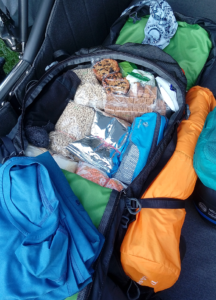
Also much different to my usual meal planning, where I prefer things that are lower in caloric value, we tried to pack densely for the trip - and that did include nutritional value in regard to weight and bulk. Nuts were our friends, and I've probably never eaten so many nuts in a week before this. There was some wild guesstimating as to the number of calories required for a day, and some maths, and then there was writing of green numbers with the kcal values on each package, which did help a lot for the planning. It all added up in the end to about the amount we were guesstimating, and made for an astonishingly large pile of food. So large that we doubted it would all fit into the backpacks - but with careful squishing, and packing everything in as tightly as possible, and relegating tent and sleeping mats to the outsides of the backpacks, we did manage to pack everything.

We ended up with about 14 and 18 kg of pack weight, without drinking water (which added another one and 1.5 to 2.5 kg to the packs, respectively). That was quite heavy, but still manageable. It felt like about 80% of it was food (not quite true)... and the nice thing about having such a lot of food in the pack is that it will get lighter every day.

[caption id="attachment_5563" align="alignnone" width="216"] This pack contains... mostly food. Or so it felt!


So we went on the trip, and walked, and it was taxing, at times, but it was utterly wonderful, and we even had a lot of luck regarding the weather. There was one day when it was raining all day long, and that was by chance the one day that we spent evening and night in a hut. When we arrived there, someone was already there, the wood stove was on, it was nice and warm inside, and we could dry our wet things - heavenly!
0
SEP.
17
0

Tales from the Summer Break (1)

Now that I've posted the date-y things, it's time for some rambling about the summer break. First of all, and most importantly: It was wonderful. It was also full of things, both holiday-ish things and some work-related stuff that I finally got around to doing, and some household things, and a bit of cooking things, and some green living stuff. All of this is, in some ways, mashing nicely together. Which also means that I want to write about all of this, which will probably result in a long and rambling post that will be split at semi-random places to make a series of blog posts, because it's definitely way, way too much to go into a single one.

So. Let me set the scene...

First of all was our vacation, with a trip. Like about almost everyone, we spent our holidays this year in Germany (though we quite often do that, actually, since we both appreciate not having to travel for ages before or after). We had originally thought about going on a cycling tour in Denmark, but several different things, such as not being keen on spending 8+ hours on the train wearing masks, and some issues with the bike that are a bit more complicated and need to be fixed before a trip with heavy luggage, along with the usual C-19 issues of going abroad, made us change our plan. At least the bike issues meant that the decision what to do was easier: canoeing or hiking. We definitely wanted to use campsites as much as possible, which ruled out quite a few possibilities. That was especially the case with the hiking areas and hiking routes; a lot of them only have very few campsites along the route, and you need to spend nights in pensions, hotels or B&Bs. This would not be a real deterrent for us in a normal year, but this summer, we had indications that it might be rather full in German accommodations.

In the end, after researching quite a bit, we had almost given up on the hiking plan - and then I clicked one last link, and stumbled across something called the "Forststeig", and there we had it. The perfect hiking route for us: located in Saxonia, in the Elbsandstein area. This place is known for its spectacular sandstone formations - we had seen them when paddling on the Elbe last year, but it's very different again to explore them on foot.


The route is leading you through the forest with almost no contact with civilisation, with small campsites just for the Forststeig hikers. We were a bit unsure at first, as you have to carry all your food and take care about your drinking water underway, but we did decide to do it. Definitely a very, very good decision - it was glorious!

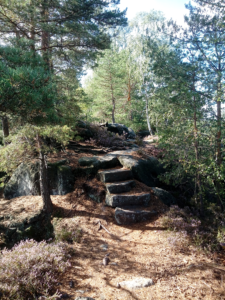
[caption id="attachment_5556" align="alignnone" width="225"] Stone steps in the middle of nowhere - a rather frequent occurrence.
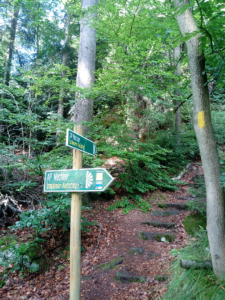

The Forststeig leads you from Schöna to Bad Schandau, almost exclusively on small paths and trails. The route goes through Germany and the Czech republic, and on some parts, you walk right on the border between these two states. Because it's meandering to make sure you climb every hill (the steeper the better) and see every spectacular sight, the route manages to squeeze more than a hundred kilometres of trail into the area.

[caption id="attachment_5557" align="alignnone" width="225"] You can be sure that if there's a "comfy ascent" and a "steep ascent", the Forststeig will send you up the former.
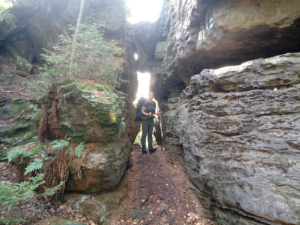

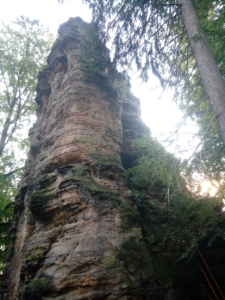
It's very well marked (yellow lines on the trees), and there are campsites and a few huts for spending the night along the way. There's also one partner campsite near Bad Schandau, and one regular camping site in Ostrov. There's a scant handful of restaurants in the first half of the route, but there are no shops along the way. In fact, you're always as far away from civilisation as is possible. You're sometimes very close to the stones, though:

[caption id="attachment_5558" align="alignnone" width="300"] In some spaces, the stones are close enough together that my backpack touched both sides of the gap...
We walked about 12 to 18 km each day, with the packs slowly getting lighter. That was exhausting, but in a very good way - and it felt so good to be breathing fresh forest air all day long, and to have (mostly) silence, and then casual good company in the evenings when we'd see other hikers again at the bivouac sites. And because we all were outdoors all the time, there was no wearing a mask for days. You could almost forget there's a pandemic going on...
0
AUG.
11
1

Grow-your-own, Distaff Edition.


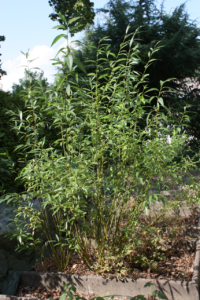
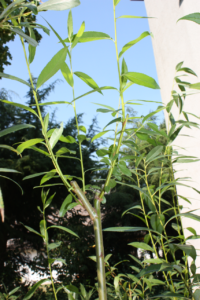
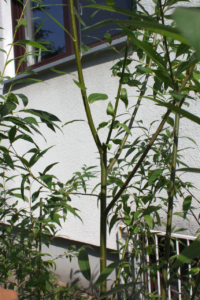
What you see on this picture is my current little bit of fun. Actually, it's not really very current - this has been going on for a while: I'm trying to grow caged distaffs.

This is a willow bush, and since willow grows fairly fast and makes new branches from where it's cut, I thought that maybe it might be possible to grow shoots with enough smaller branches at the top to form a cage.


Jury's still out on whether it will work or not, and on how long it will take to grow a distaff once I know how best to do the pruning and forming, but there is some progress on some of the shoots.


Forming the top part will be the next interesting step...
0
AUG.
10
2

Slowly, slowly...

I've already told you about my chili plants, at least a few things - and now, finally, they are starting to bloom. Slowly. And with some hiccups.

There's a variety of chili breeds in my pots (moved, again, outside, but out of hare's reach, or so I thought), and some of them are unknown (as the seeds came out of my spice rack, so it's either Ecuador Purple or some unstabilised mixed breed). All of them were started rather late, with the seeds sprouting mid-April, and there have been some losses due to snails and hare bite.

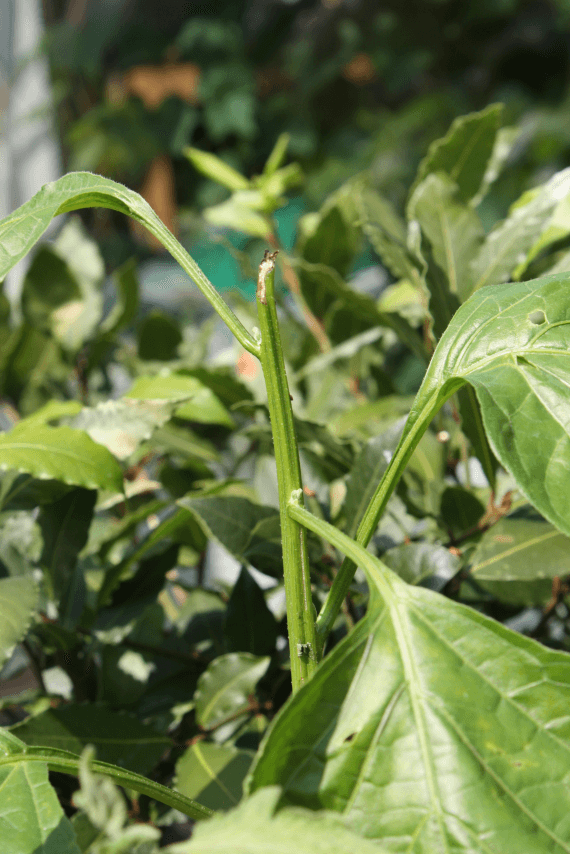
Now one of the larger plants has sadly lost its head.


I don't really know how that happened; it was not eaten, the lost crown lay beside the plant in the pot. With all the nice little buds it had. I'm quite sad about that, especially as I have only that one so far along of the kind, but I hope it will rally itself and make a bunch of side branches with flowers.

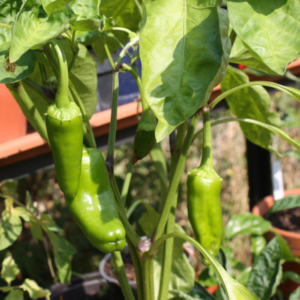
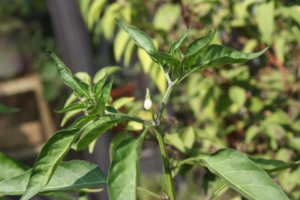
That was one of the more vegetable-y peppers, which tend to be quicker than the chilis in my lineup here. One of them actually has produced fruits already:


They will take a bit longer to ripen, though I'm very tempted to try how they taste still green. I like green peppers best anyways...

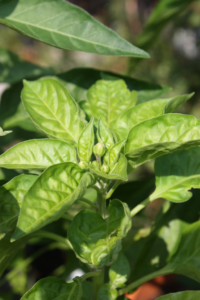
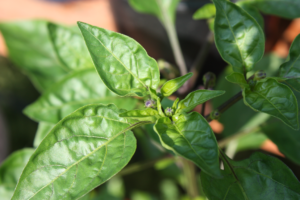
But yes, slowly, the chilis are getting ready as well. There's no open flower yet, but that is a question of days, as the buds are growing larger and larger on some:


And here's a view of Ecuador Purple buds - pleasingly purple, too:


I'm quite happy about all that, I just hope there won't be more losing of heads to whatever made that one plant shorter!
0
AUG.
04
0

Grow your own...

There's, obviously, a lot of stuff you can grow yourself. Weld. Madder. Tomatoes. Your own hair. Kombucha leather, which a designer couple from the US has used to make transparent face masks... you can read more about that here, and the article includes a link to instructions on how you can do it yourself.

It would be a very good thing to have biodegradable, sustainable masks. It would be a very good thing, actually, to have a lot more things biodegradable and sustainable, and maybe that bacteria-grown cellulose is a good solution for it? I can imagine having sheets of that for wrapping stuff as well.

At the moment, all the Covid19-precautions are leading to much more single-use stuff, and much more trash and landfill. Our favourite bakery doesn't accept any customer-brought bags or containers at the moment, so if we buy something there, it's always a paper bag or two. We see thrown-away masks everywhere outside these days. To protect from the virus, single-use cups are much more frequent again... and while the spread of corona is very much at the front of our attention these days (though if you look at some images from holiday places, or at other images, probably not as much anymore as it should be), if we're not acting quickly and decisively enough to stop our climate change, we'll be screwed even more by our planet heating up.

So here we are. Rock. Hard place. I do hope we'll be able to find a way that will let humankind have a future on this planet, because we quite obviously won't be able to find a new one (and a way to get there) quickly enough to save our asses. Seeing how much the common effort to keep everyone safe from the virus is going down, though, after only six months, and even though numbers everywhere are going up again? I somehow doubt it will be done.
0
JULI
31
1

Need some wool?

There's not many traditional sheep flocks left in Germany, wandering around to graze here and there. Rules, regulations (sometimes really stupid ones, especially concerning herd protection dogs), the intensive agriculture in Germany, the many streets and roadways, and last but not at all least the very low price for wool are all making it hard for this way of keeping sheep to be economically viable. Yet sheep grazing is the thing that keeps some of the iconic landscapes of Germany what they are, and wandering flocks like that are the only way to preserve them.

One of the last flocks that remain is now trying to change the "no money for the wool" dilemma, to make things better. The shepherd (who is also active on twitter) started a Startnext campaign to sell their wool directly. It has been funded already, then met its second funding goal, but there are a few more days left to support it, and there's also (most importantly) some knitting yarn, carded wool, and other wooly product stuff left to get.

I think it's a wonderful project. Supporting the project means a reasonable price for wool, making sure traditionally-kept wandering flocks like Sven's flock can keep going, and helps to protect the very special environment in German regions that have been grazed on, and formed by this, for many years. Plus you get knitting or spinning fodder!

You can check out the project under "Paulas Wolle" at startnext, and support it there. Text is German only, but they do send their wool outside of Germany within the EU (sorry Great-Britain, you're out).
0

By accepting you will be accessing a service provided by a third-party external to https://pallia.net/

Kontakt