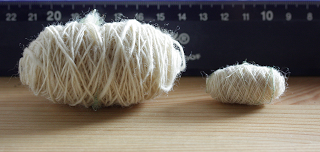
I'm still weighing and packaging wool, preparing spindles and preparing "starter yarn" for the spinning experiment, so the living room is quite taken over by the huge box of unpacked wool and the boxes with wool in plastic bags. Thankfully, once the air is out of the bags and they are sealed, they are pretty slim and thus quite manageable. I think I've never weighed and portioned off so much wool in my entire life!
While thinking about experiment details yesterday, I have also found a solution to keep all the spinning procedures as much the same as possible - which means to slide off the spun yarn after the first hour and start a new batch with the second wool type, again with an empty spindle and using a starter thread. And fortunately, I have also found something to slide the spun wool on.
There's still things left to decide, though. Should the spinning be done with the two wools in the same order every day? Say, first the fine and then the coarser wool, or vice versa? Is it better to do spinning of one spindle on one day, or is it better to change spindles and spin with two different ones, a new one after the first hour? Maybe this changing would diminish a big "getting-used-to" effect (but then, I'd guess that getting used to a new spindle won't take longer than five to ten minutes). Still, changing spindles would give at least a bit of the need to get used to it back, especially since changing spindles in the experiment means a vastly different tool to work with. And it would give me enough time to slide each bunch of spun yarn off the spindle stick and onto its storage tube, weigh it and label it as necessary.
Details like these are what I find so very fascinating about archaeological experiments. Even if you take a very simple thing to find out about as the basis of the experiment, it will get down to details that might not seem much at first glance, but that might be making or breaking the whole thing.
Our experiment basic idea is quite, quite simple: Find out about the influences of the different factors in spinning with a hand spindle. There are only three main factors, the spinner, the fibre, and the spindle itself; but the latter already offers two influencing elements, its moment of inertia and its weight. The spinner's influence can only be estimated if all the other influences are well known, so we only need to find out about these. The approach to that is like in any laboratory work: If you want to find out what a specific value does, just change that value and nothing else. And that is exactly what we did in designing and calculating four whorls, starting with a "reference whorl" corresponding to an actual archaeological piece in both weight and moment of inertia. (This, by the way, was not easy - the calculating was, but trying to guesstimate the shrinkage of clay from wet to fired and developing a method to get whorls all alike each other did prove difficult.)
So now we have five whorls and two sorts of wool, fine and coarse - the only thing we need to do now is run the actual experiment, with up to twenty spinners each spinning ten hours altogether, one hour per fibre and spindle. And, of course, deciding which spindle goes into action when, and with which fibre, and in what order. And what to document, and when, and how (you can never document too much, but you can't write down something that you haven't thought about...). And how to label each test batch. And, and, and...
Which gets me back to the title of today's post: Experiments are Awesome! But they always seem to multiply their demands on time and brain cells. And they never end up as harmless as they seem at the beginning.
While thinking about experiment details yesterday, I have also found a solution to keep all the spinning procedures as much the same as possible - which means to slide off the spun yarn after the first hour and start a new batch with the second wool type, again with an empty spindle and using a starter thread. And fortunately, I have also found something to slide the spun wool on.
There's still things left to decide, though. Should the spinning be done with the two wools in the same order every day? Say, first the fine and then the coarser wool, or vice versa? Is it better to do spinning of one spindle on one day, or is it better to change spindles and spin with two different ones, a new one after the first hour? Maybe this changing would diminish a big "getting-used-to" effect (but then, I'd guess that getting used to a new spindle won't take longer than five to ten minutes). Still, changing spindles would give at least a bit of the need to get used to it back, especially since changing spindles in the experiment means a vastly different tool to work with. And it would give me enough time to slide each bunch of spun yarn off the spindle stick and onto its storage tube, weigh it and label it as necessary.
Details like these are what I find so very fascinating about archaeological experiments. Even if you take a very simple thing to find out about as the basis of the experiment, it will get down to details that might not seem much at first glance, but that might be making or breaking the whole thing.
Our experiment basic idea is quite, quite simple: Find out about the influences of the different factors in spinning with a hand spindle. There are only three main factors, the spinner, the fibre, and the spindle itself; but the latter already offers two influencing elements, its moment of inertia and its weight. The spinner's influence can only be estimated if all the other influences are well known, so we only need to find out about these. The approach to that is like in any laboratory work: If you want to find out what a specific value does, just change that value and nothing else. And that is exactly what we did in designing and calculating four whorls, starting with a "reference whorl" corresponding to an actual archaeological piece in both weight and moment of inertia. (This, by the way, was not easy - the calculating was, but trying to guesstimate the shrinkage of clay from wet to fired and developing a method to get whorls all alike each other did prove difficult.)
So now we have five whorls and two sorts of wool, fine and coarse - the only thing we need to do now is run the actual experiment, with up to twenty spinners each spinning ten hours altogether, one hour per fibre and spindle. And, of course, deciding which spindle goes into action when, and with which fibre, and in what order. And what to document, and when, and how (you can never document too much, but you can't write down something that you haven't thought about...). And how to label each test batch. And, and, and...
Which gets me back to the title of today's post: Experiments are Awesome! But they always seem to multiply their demands on time and brain cells. And they never end up as harmless as they seem at the beginning.