Latest Comments

Guest - Aislinn Dyestuff Citizen Science.
09. Oktober 2026
This is a great project. I look forward to the results. Thanks for letting us know.
Guest - Aislinn Time for...
09. Oktober 2026
Looks delicious!
Guest - Katrin Sprang Discussion
18. September 2026
Hi Rachel, I have looked for more photos of you, but that was not very successful. I found a link on...
Guest - Beatrix Sprang Discussion
15. September 2026
That lozenge pattern element is not a photograph, but a scan. So it should be to scale. But I pinned...
Guest - Katrin Sprang Discussion
15. September 2026
I was not referring to Rachel's reconstruction (is the reconstruction you refer to the one photograp...
SEP.
30
0

Things That Happened During Summer Break (part 4)

(continued from part 3)

The pieces to practise on? I have a narrow band that I already set up before the Forum; a wider band (or a very narrow strip of cloth, if you'd prefer); and another band (or two, actually) that I call "The Pharaoh".

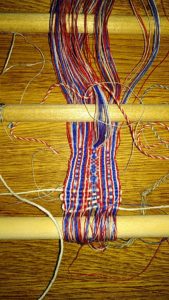
These are all three quite different from each other, and I'm feeling a bit challenged with each of them, though The Pharaoh really wears the crown. It's a much simplified version of Tutankhamun's collar that Marie Ekstedt Bjersing researched and taught to us, done in a thicker yarn. Thicker, in this case, means a linen yarn in 60/2, which is still freaking thin.

Here's a picture of it:


You might notice that this lacks its heddles - that's because I had a heddling mistake in my setup, and decided that re-heddling would be a very smart thing to do. Then Marie told me that I might as well do a second warp, because it's quick and easy to do, and, well, so I did. That is why I now have two pharaohs.

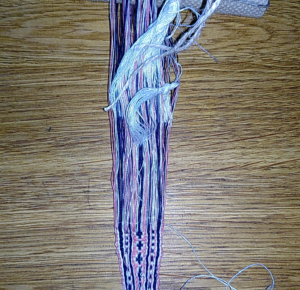
This is the second one:

 
That does have all the heddles - I had to re-do the small bunch (for the special shed), but now it works quite fine. Apart from the two white warp threads that I still have no clue where they rightfully belong. They got missed, somehow, during heddling, in addition to two red-coloured warps. I figured out  where the latter really belong, though, and got that fixed by now.


The second pharaoh, by the way, even got to accompany me on our holidays as my crafty thing to do. Usually I take some knitting along, but the current project (dubbed the Neverending Ink) is way too heavy and voluminous at its current stage, and the bike will only accommodate something nice and small...
0
SEP.
22
0

I'm Back, and Things Will Happen!

I'm back! And, can you believe it, it feels like I'm almost back on track? I'm sort of half-expecting and half-fearing, though, that I will find out any minute now that I am way more behind than I thought I am...

This year has been sort of crazy in regard to our summer holiday, and the summer break, with a lot of things lining up more or less seamlessly. That meant very little breathing space inbetween... so we ended up going off on holidays directly on our first free day, instead of taking one or two days off at home for preparing the trip and doing all the home things that should be done before.

And just like the holidays began - as in "very suddenly" - I'm back and there's things on the agenda for the next days already, starting with a talk (in German) about two experiments that took place during past European Textile Forums. At 19:00 CET tomorrow, I will be chatting with Franz Pieler, director of the MAMUZ in Austria, about the spinning experiment and the Pompeii dyeing experiment.

Here's the link to the MAMUZ site, where you'll be able to follow the livestream (which will also be available later).

Next thing to come up in line is the next German Online Spinning course, Tuesday next week - so on the 28th of September, starting at 18:00. There's still some spaces left, so if you book your spot now, you can join in with the fun.

For English speakers, the next online spinning course is on November 5, 10:30 CET (it's the Down Under Edition, hence the morning start). Again, there's spaces still free, and you can learn more about it here (and book as well).

And now I'll get back to catching up some more...
0
JULI
23
0

At least this happened.

There's been some more behind-the-scenes website wrangling, though that was not quite successful. (If you've run across broken image links in the blog - I'm working on it, they will be fixed soon. This is a side effect of me getting rid of the many, many extra images that Wordpress generates when media is uploaded... which cluttered up my webspace.)

I hope the other issue, which regards the new site and especially its template (sigh...) will get better with some support... and now I'm really looking forward to the weekend.

Which promises to be quite sunny, and nice, and warm.

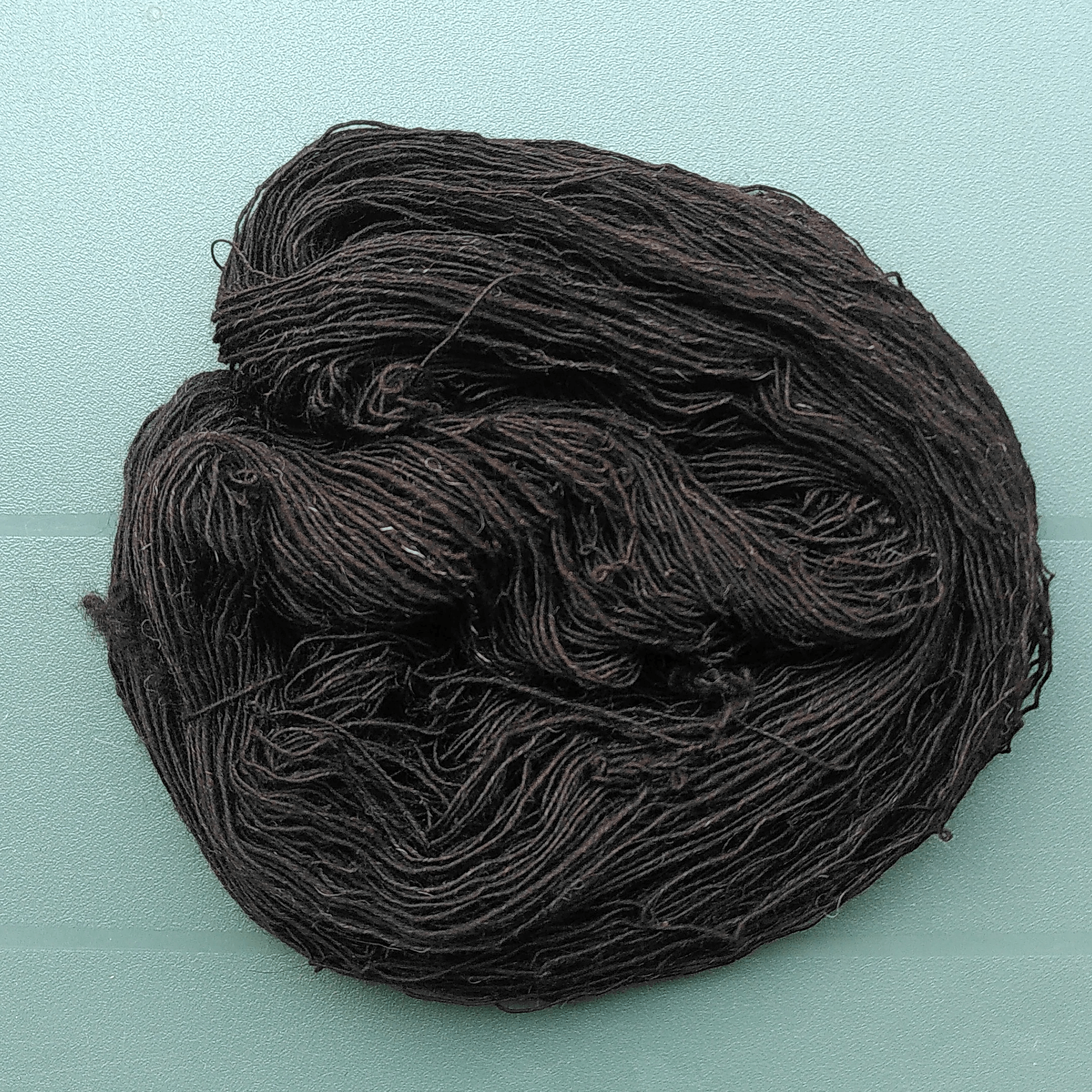
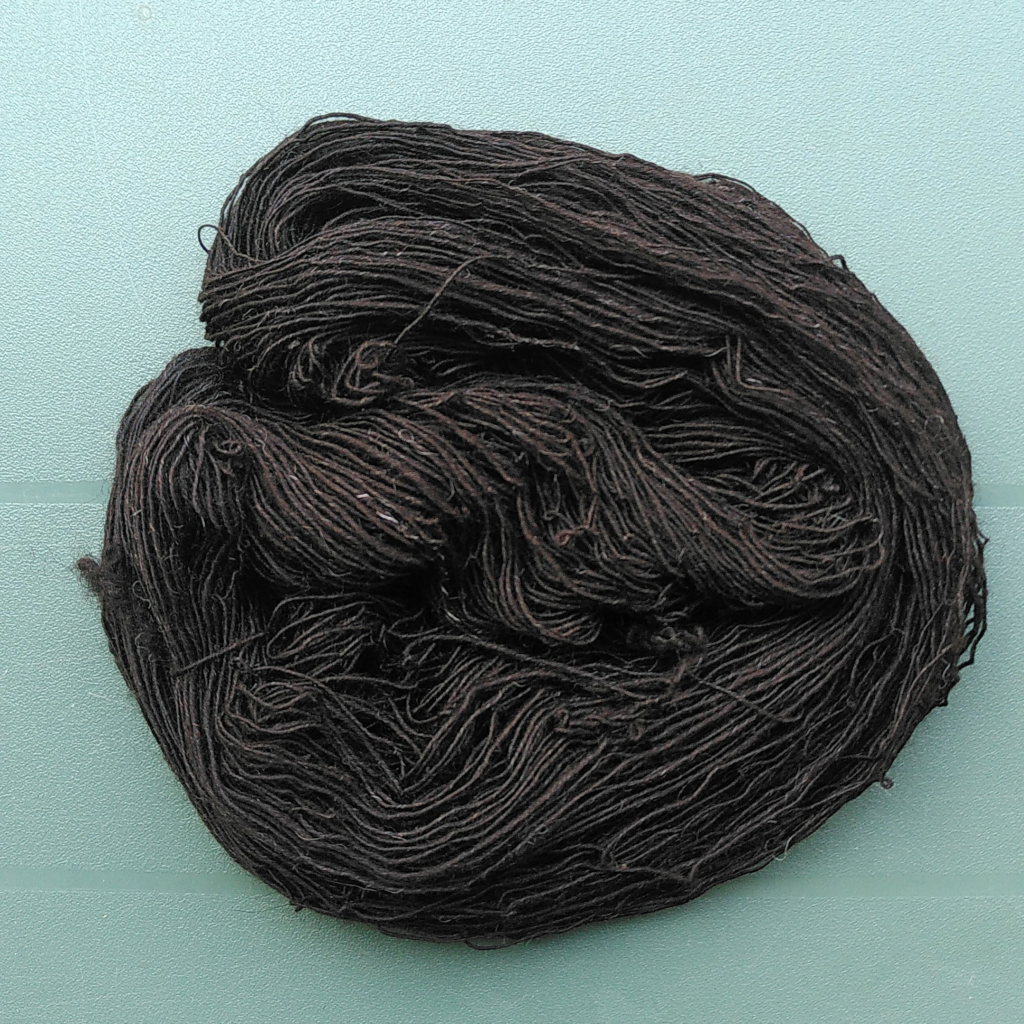
There also was some spinning! Here's the results:


One very nice skein of dark, rather shiny yarn, which was a joy to spin up. As opposed to the "fun" spinning I'm currently doing with some mystery fibre (well, I know it's wool, but I forgot exactly which kind) which has a lot of crimp, and somehow does not please me at all to work with. I'll stick with it some more, though, so that we can have some yarn for the Textile Forum to play with.
0
JULI
08
0

Handspun Stuff in Action.

I'm getting asked time and again about what I do with my handspun. Well... that depends.

Sometimes I spin for a museum reconstruction project, so it's spinning for a certain end result, and the threads then get passed on to the weaver, or I do something with them.

Most of the other spinning I do is for no specific purpose, and a lot of it is yarns I do for demonstration. Thus they can be a little inconsistent... because of explanations like "see, this is how you make thicker yarn, and this is how you make thinner yarn, and this has more twist and this less..."

With that kind of yarn, not much is happening. It mostly sits around on spindles somewhere until I take it off, or until I need some bit of string, or have to demonstrate plying (yarn with little twist also plies up shittily, but ah, one copes).

Sometimes, though, I also haul it out (the better, not so inconsistent yarns) to do some experimentation, or fooling around. Like now, when I've set up a warp to test our Blindis band technique reconstruction once more, and (most importantly) take some decent photos of the process.


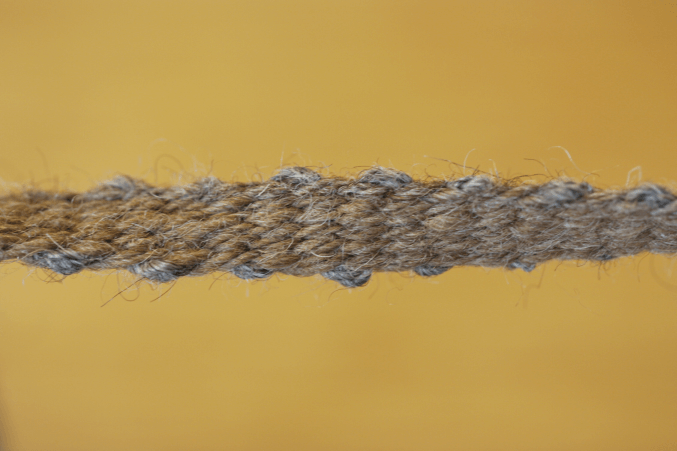
So... that's a bit of the brown handspun used...
0
JULI
07
0

Maaseik Embroideries

If you've done research about early medieval embroidery, you've probably come across the Maaseik embroideries - silk and goldwork, preserved in Maaseik, and there's pictures of them online at kikirpa.be.

Brand new, though, is this: Alexandra Makin has made a presentation about these pieces, and the results of an examination that she did. Watch it right here:

0
JUNI
29
0

A Closer Look at Fibres.

I'm back with my Bronze Age Fibre problem. Well, it's not just my problem... it's a pretty common one if you look at reproducing fabrics from that time. Let's take a look...

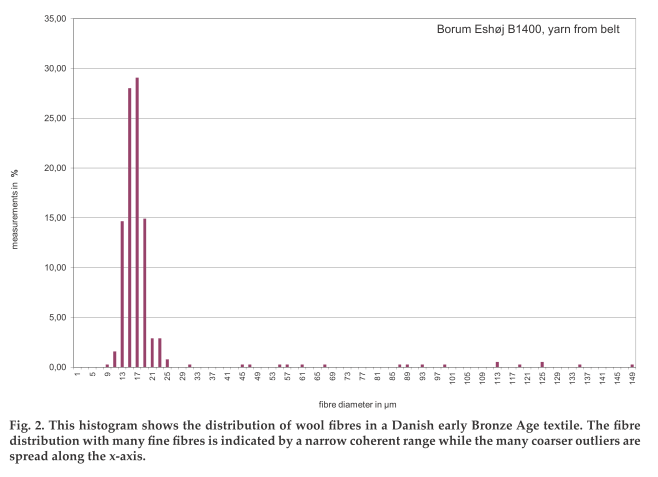
Modern Merino wool, which is seen as rather fine stuff, has - if of the fine kind - fibre thicknesses of around 20 micron. Sometimes you get extrafine, which is at about 17 micron.

Bronze age fibres were, mostly, around 17 micron. There's fluctuations, of course, but that's the main component of the textiles - really, really fine fibres. Then there's some few extra coarse ones thrown in, with 45-150 micron thickness. A diagram of fibre thicknesses counted was published in Skals, I., & Mannering, U. (2014). Investigating Wool Fibres from Danish Prehistoric Textiles. Archaeological Textiles Review, 56, 24-34, and thanks to the generousness of ATR, you can download the whole issue with the article included here. To save you the search, the histogram is on p 26, and it looks like this:


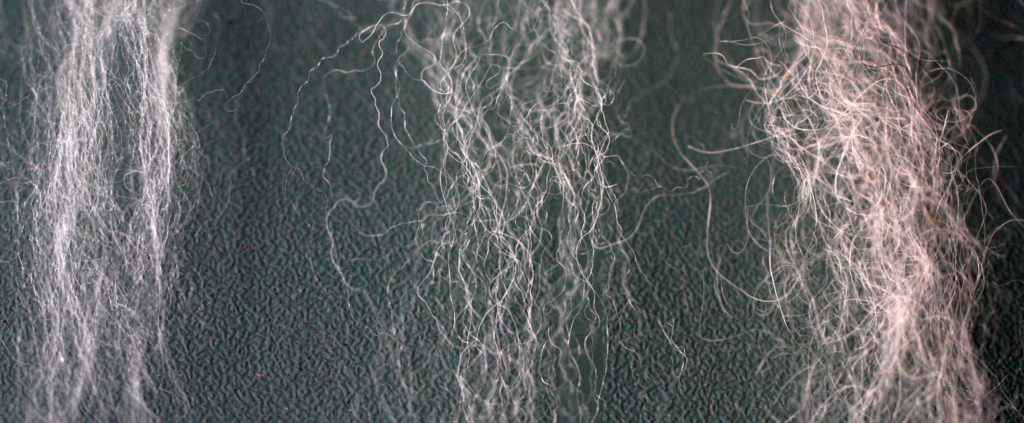
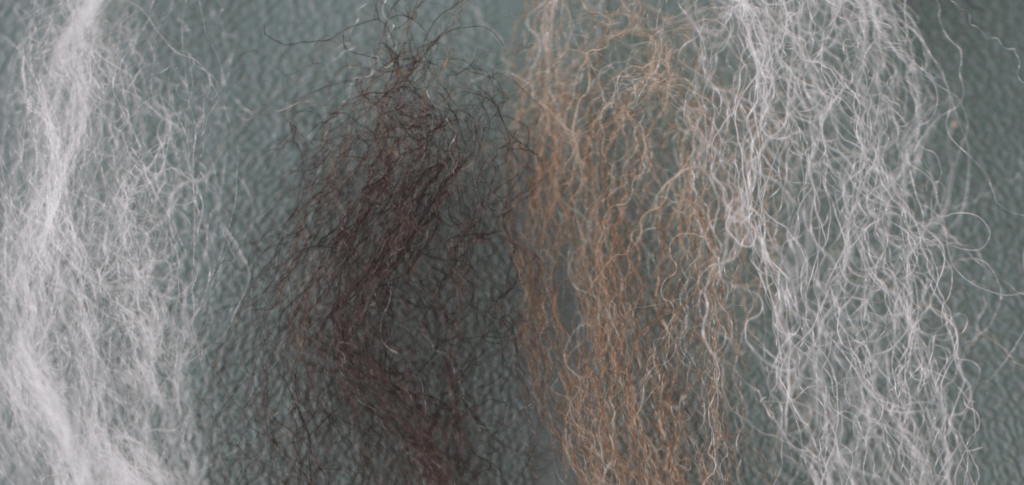
Getting this mix of fibres is difficult these days. I have gotten some superduperfine special wool now, with (according to my supplier) around 15 micron of fibre thickness. You can see it to the very left in this picture; next to it is a sample of my beloved Eider wool, and on the right Valais Blacknose wool.


Even though it's just a macro photograph, I think the difference is quite clear. The difference when you touch it is very clear as well - the superduperfine wool feels like silk, and it's supershiny (which is partly due to some post-shearing treatment), while the Eider and Valais are just normal shiny.

I've also compared it to the Manx Louaghtan, which is an old breed, and to another wool sample that I got for these comparison reasons:


Again the superfine is on the left, followed by my South American test candidate, then the Manx (which appears more saturated brown than in real life) and, for comparison, the Eider wool again. Both candidates are definitely finer than the Eider wool (which should have around 30-33 micron), but considerably coarser than the superduper benchmark.

And here you are. The Bronze Age Fibre Problem, in pictures. The superduperfine wool lacks the coarse fibres strewn in, and has been seriously processed to make it silky, smooth, and shiny. It also is very, very white, and BA fibres are mostly quite heavily pigmented. The two coloured wools have a mix of coarse and fine, but way too many coarse fibres strewn in to match the BA originals. They are, however, nicely pigmented.

So, like with many reconstruction projects, there's the choice between compromises. Use the very fine fibre although it has been heavily processed, dye it, and accept the fact that it lacks the coarse hairs? Try to blend some extra coarse fibres in (it would still need to be dyed)? Or use a wool that is naturally pigmented and not supertreated, but has too coarse fibres, or too many coarse fibres for the amount of fine ones?

Or... would someone please invent a time machine and fetch a handful of Bronze Age sheep? Pretty please?
0
JUNI
28
0

More Bronze Age Textile Stuff.

Bronze Age! Yes, that's a bit before my usual time span, but I'm getting more and more fascinated by these very early textiles. First of all, I wonder how much of a difference the fibre makes - would you be able to tell, from the touch of the finished cloth, whether the fibre has 15 micron 0r 22, or 30?

I'm also fascinated by an oddness in the weaving technique. The surviving blankets were huge - the one from Egtved was 190 by 258 cm. That is a width that would be hard to handle for a single weaver. Add to that the fact that there are weft crossings in the fabric - there's just one weft per shed, but it's not the same one all the way through. Weft A comes from the left, weft B from the right, and at some point roughly in the middle, both go to the surface of the fabric and cross each other. Then weft A continues its journey to the right in the next shed, while weft b goes to the left, and they turn normally at the selvedge. This sometimes occurs with three weft threads instead of two.

Thanks to the wonderful image database of the Danish National Museum, you can have a look at this weft crossing thing in the Trindhoj blanket here. There's some crossings in the area left of the hole - you can download the image and then go hunting for these oddities with your image viewer of choice.

My suspicion is that two (or even three) weavers worked together on these superwide fabrics, and the crossings are where the spools or sticks or whatever they used changed hands from one weaver to the other.

This is really fascinating, and I'd love to try this out. The only tiny issue is that this requires a superwide loom (with the corresponding large number of weights, and large amounts of yarn), and some other people willing to have a go at weaving... Though a bit of testing might be possible with a loom and fabric with less width, to get an idea of the method, at least.

 
0

By accepting you will be accessing a service provided by a third-party external to https://pallia.net/

Kontakt