Latest Comments

Guest - Aislinn Dyestuff Citizen Science.
09. Oktober 2026
This is a great project. I look forward to the results. Thanks for letting us know.
Guest - Aislinn Time for...
09. Oktober 2026
Looks delicious!
Guest - Katrin Sprang Discussion
18. September 2026
Hi Rachel, I have looked for more photos of you, but that was not very successful. I found a link on...
Guest - Beatrix Sprang Discussion
15. September 2026
That lozenge pattern element is not a photograph, but a scan. So it should be to scale. But I pinned...
Guest - Katrin Sprang Discussion
15. September 2026
I was not referring to Rachel's reconstruction (is the reconstruction you refer to the one photograp...
NOV.
24
0

Happening here.

Things currently happening here:

I'm writing a bit for a short little article about the Albecunde belt - it's more of just a better snippet, but it's still nice to revisit the thing again. It's a lovely piece of tablet weaving, and every time I look at the pictures I have of it, my fingers itch to sit down and make trials with different kinds of silk to find the perfect thread.

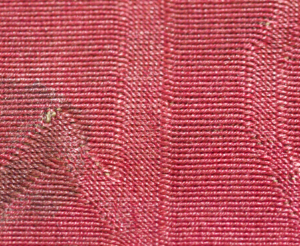
[caption id="attachment_5674" align="alignnone" width="300"] Detail from the "A(i)lbecunde" Belt from the Diözesanmuseum St. Ulrich & Afra, Augsburg. Tablet-woven from silk.


You can see in the picture that the angle of the individual cords in the weaving is very, very steep. There's also rather little difference iin apparent "looseness" in the looks of the cords twisted in S and twisted in Z direction - which points to very little, almost non-existant S-twist in the original threads.

The silk embroidery threads that I have already have too much of a twist in them, unfortunately. So I'd love to get my fingers on some gummy silk with almost indiscernable S-twist to give that a try, and that's certainly something that will be needed for the next stage of the project. (If you have a hint on where it's possible to get such silk, please do let me know!)

There's no time for that just now, though. The little piece needs to be written, and then there's some more prep to be done for a travelling exhibition organised under the wings of EXARC. That requires me to do two little snippets of a video, and this time I need a proper script, so I won't babble too much into the wrong directions.

Finally, more writing of some other kind - it's nearing the end of the month, which means, as usually, some newsletter writing. Before, you know, the month is over and I can't title it "November Newsletter" anymore...
0
OKT.
21
0

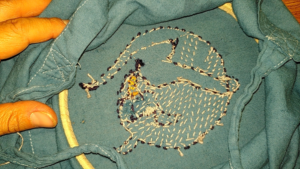
Cat Embroidery, Done.

I just realised that I haven't posted a picture of the finished "visible mending" cat embroidery yet - so high time to remedy that lapse!

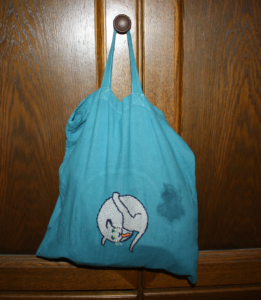
Here's the cat, in all its butt-licking glory, on the bag:


You can see that the bag has had better days, and the stain is still quite visible. There's also another small hole close to one of the side seams, and I'll eventually close that up with a few stitches. (Or, who knows, maybe with a tiny mouse?)

I'm quite happy with the bag and the cat overall, and it certainly was a lot of fun to do!
0
OKT.
20
0

The things you get used to.

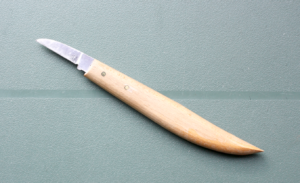
I've managed, for a little bit, to mislay one of my knives. To be more precise: The knife I use for cutting notches into spindle sticks.

This cutting is something I do periodically, whenever one of the shapes runs out. Then I stock up on all the combinations: horizontal and spiralling notches cut into beech, pearwood and maplewood sticks. There's a simple, small knife that I always use for this, and as mentioned, it was mislaid.

So I was searching for it, at the places I suspected it might have gotten to. Now, there's no dearth of knives in this household, and for the two most urgent notches, I used another knife... which worked, but felt weird, and not as nice and comfortable as I was used to.


Because with the knife I usually cut the notches with, the process is familiar, and the knife fits my hand just so, and the blade has just the right shape, and I know exactly how much pressure is needed, and what angle to hold it, and how to scrape and cut and work. I am actually not sure whether this little knife is, objectively, the perfect tool for that kind of cutting. I am sure that it is very good, but there might be a shape even better suited, so using a different tool for the two "I need these right now" notches might theoretically have brought a revelation. (It didn't. I think I'm good with the old knife.)

Things like this are what absolutely fascinates me in regards to crafting. We use tools, and we use them often, and we get so familiar with them that they start to feel, at some point, not like tools but like extensions of our hands. In some cases, they are not perfect - or not perfect anymore - but the crafter has grown so accustomed to the specific tool and its vagaries that it's not getting changed out for something else. Maybe it is not getting changed out even past the point where a new tool might make more sense than going on with the old one... but because things develop (or deteriorate) slowly, and over time, and with the crafter adapting, that point does not get noticed.

Getting a new tool for something also always means a process of familiarising oneself with the thing, getting used to it. Breaking it in, so to say. I remember being told about how construction workers go about getting a new shovel: You fit the shovel to the wooden shaft, and then you work with it a while. Once it has all settled, and you feel comfortable with your tool, then - and only then - you take a hammer, and a nail, and you fix the shovel head to the shaft. Because if you do it straight away, it might feel crooked, and then you always have this weird feeling about your tool.

The little knife has turned up again, by the way. So now, soon, I'll sit down and do some notch-cutting - and I already know that I will enjoy the process more than usual, because it will feel so nice to have the knife in my hand that fits it just so!
0
OKT.
08
0

Cat Embroidery Progress.

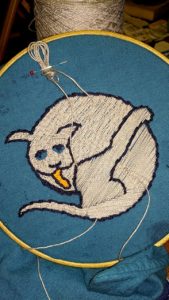
Progress has been made! There was some embroidering in the evening, and during weekend free time, so here's some more proof:


As you can see, I've opted for the Bayeux kind of couched work - long stitches covering the ground, then long stitches across those, and the latter stitched down to hold everything in place. It was nice and quick to work, and I really enjoyed it.

It's far from perfect, but then, it's just some fancy mending after all!

And for those of you interested in that kind of thing, here's the back of the cat:


You can still see where the original hole was if you look closely!
0
AUG.
13
5

Supported Spinning.

I'm not a huge fan of supported spinning, but I'm quite enjoying the technique when I get to do it. One of the things I remember wondering about when I first saw it was the use of a temporary cop - winding on the spun yarn near the tip of the spindle. It seemed weird to me to do that, as it means you have to wind off the temporary cop again and then wind on properly to the permanent cop.

This was one of the things that started to make sense a few years later, when I tried it with significantly more practice in spinning, and with more appreciation for spinning efficiency. Yes, you do wind your yarn twice with that technique - but it doesn't matter if the temporary cop is rather sloppy, so you can wind on very quickly (by twirling the spindle) and go on spinning. It also means that if you tend to add uneven amounts of twist in your makes, winding off and on again gives the twist a chance to partly redistribute and even out. One of the main pros for me, though, is the fact that winding to the temporary cop is less of a disruption in the process than winding to the permanent cop. I can wind much easier and better to the permanent cop if I take the spindle out of its bowl and place it on my leg or hold it in my hand, depending on the position of the rest of me and the spindle. Doing that is a major movement as compared to the small movements done during the spinning process. Add to that the fact that a typical make in supported spinning is much shorter than one in distaff spinning or long suspended spinning, where the winding process is already the main disruptor of the process, and it becomes quite clear that going from "spin position" to "winding position" is better done less often.

Not all variations of supported spinning use the temporary cop, though, and that is another thing I find fascinating with this type of spinning: There's a plethora of subvariations and possibilities. Like you can do a short draft as for worsted spinning, while the spindle twirls much like when you spin long suspended. This brings with it with the same necessity of having a feeling for when the spindle will stop, and twirling it again before it has come to rest completely. You can also do a kind of longdraft technique, either in the park-and-draft variation (which is easier) or in continuous spinning, and with the latter either drafting against the spindle weight, if your fibre is slippery enough to allow it, or helping with the hand close to the spindle by gripping the thread above the spindle.

If we're looking at evidence in medieval sources, supported spinning seems to be the exception, not the rule. Just like spinning with top-whorl spindles, there is a little bit of evidence for it, but not much. I know of one single picture showing a woman spinning with a spinning bowl; unfortunately, I've not made a proper note of where it is, and a quick internet search turned up the picture (yay!) but also no reference to where it's from (gnah).

I've done better with remembering the source of the image with a top-whorl spindle: it's in an English manuscript in the British Library, and it shows the Bearded Woman of Limerick spinning with distaff and top-whorl spindle. That's very nicely matching the fact that there are a few hooked metal spindles in the National Museum in Dublin that are very suitable for use as top-whorl spindles, possibly without an extra whorl in some cases.
0
JULI
30
3

Link Post.

Status of things here: The cat is lounging on my arms (and half on the keyboard) again, and if I have not cuddled her for too long, I get admonished that her ear needs kneading, or her belly needs rubbing, or that she generally needs some more attention. There's a package waiting to be packed and brought to the post office together with the already-packed one (which will happen very soon), the usual stack of emails to be answered and taken care of, and there are way too many tabs open in my browser. Which, as you well know, means:

Time for a link post!

If you like to look at weird design choices for... stuff, check out the Instagram account "uglydesign". It's curated by two designers who are trying to find the ugliest thing there is (just like the name hints) - but obviously, beauty and ugliness are in the eye of the beholder, and I find some of the things not predominantly ugly, but more "cool in a weird way". (Some are utterly horrible to my personal aesthetic sense, though.)

EXARC has a new section about textiles, with a collection of interesting articles that will be extended with new ones as they come up. I especially appreciate that someone else also writes about the "it depends" thing, something that has come up again and again in my personal research and crafting, and that I think is very important when discussing time needed to do something (which, in turn, is a frequent topic both in Experimental Archaeology and in explaining aspects of medieval or historical craft to the wider public).

Now some bits in German:
Here's an interesting article about how much food gets thrown away in Germany, and how much of that would be avoidable. Especially bread, one of the staples, and considered a Very German Thing Indeed, gets binned in a horribly high percentage. Altogether, a third of the food produced ends up in the trash. A THIRD!!!
We've recently had some more trouble than usual with bread getting mouldy, reasons as yet unknown (different types of bread, or the weather, or contamination of our bread box, or a mix of things, or something else, possibly), and it always makes me really sad to have to throw it away. I have a general tendency of seeing food going bad as a personal failure, and I consider throwing away still-edible things as a kind of disrespect towards all the people who have worked on making this food.
This is a combination that you might call... interesting. On the down side, it leads to much chagrin for every bit I have to bin because it's really not edible anymore, which includes those where there was no way of avoiding the outcome (such as fruit that was damaged during transport and instantly changes from "unripe" to "covered with greenish fur"). It also includes me eating dodgy stuff, or things I don't really enjoy anymore because they have to be used, on occasion. On the up side, it means that relatively few food gets thrown away here, and that I have a good amount of creative approaches to leftover foods and their use.

On to something more positive: A medieval shipwreck was found in a German river, the Lippe. The wreck was found by chance by a hobby diver, and now gets checked out by archaeologists. It's about ten metres long and probably about 1000 years old; whether and how it will be excavated is still being evaluated.

And a last German link - there's an Interessengemeinschaft Zugpferde! I didn't know that until a while ago, when I stumbled across it via an article about sustainability in field- and forestwork. For small fields and in some circumstances, it makes more sense to invest in draft animals instead of trying to go "all western, all modern" and get a tractor, or other machinery. The IG Zugpferde tries to keep the draught horse and draught cattle use alive and offers all kinds of stuff around this - from competitions to workshops and courses to learn how to care for and use draught animals. I'm utterly delighted - and I hope there will be more draught animals in use in the future!
0
JULI
23
4

Wool Combs.

So... let's return to the wool prep proper, and in particular: Wool combs!

Here's the basis on wool comb using: You have a pair of them, used together. Wool is placed on the tines of one of the combs, then gets transferred onto the second one, straightening and aligning the fibre in the process. Dust, debris and short cuts either fall out during the process as well or can be removed relatively easily. Once everything is aligned nicely, the wool can be drawn off, ready to be used.

There are several different ways that can be used to transfer the fibre from one comb to the other; most of them involve holding the combs so the tines are perpendicular. While it is possible to work with one comb held in each hand, most images also show one comb as fixed somewhere, and only one held in the hands to work with.

Modern wool combs are used in a similar way; usually, there's some combing station or pad included with them (unless it's very small ones) or available to go with them. One comb is held in that station, and the other is used to work, held in the hand(s). If you look on youtube, there's (of course!) a number of combing videos and tutorials. (Note, also, that modern wool combs may have several rows of tines, and very frequently have two; the medieval ones I know of have only one row of tines.)

This medieval-style version can be seen on a number of images, showing the process in more or less detail, and a more or less, hm, trustworthy way. For instance, the British Library manuscript pic here has a woman combing in a setup that has one comb looking like it's held by, as we in Germany would say, "Siemens Lufthaken" - an invisible device holding anything at any place. (Hard to get, unfortunately. Let me know if you have a source.)

Much more detailed, and looking a good bit closer to actual life, are two images from the Hausbuch der Mendelschen Zwölfbrüderstiftung - one here, and the second one here. The images date from the 15th century.

In both cases, one of the combs is held in the hands of the worker, while the other is fixed in some contraption: A stool-like support for the t-bar holding the tines, and an upright pole coming out of the floor or fixed to the floor, a bit further away, forming a brace for the end of the handle. This far, we're still in sort of a similar vein as modern combing. Both modern and medieval images show the worker in front of the fixed comb's tines, the handle pointing away from the worker.
However... modern combs are fixed in a way that allows the worker to stand or sit in front of the tines of the fixed comb, yet work towards oneself. The wool is pulled through the tines on the far side of the handle (close to the worker), towards the worker. This only works when the comb is fixed very firmly, though, and in a way that will bear the force of combing (which is not to be underestimated!).

Logically, and very obviously with the medieval setup, that work direction will not work - the comb could slide away from its brace and support towards the worker. Maybe there is some additional way to help the comb sit properly on its support - but it might not be necessary as the work direction is quite clearly adapted to the bracing construction: Both workers in the Hausbuch images use the hand-held comb on the far side of the tines, the handle side. Which obviously means they work away from themselves, not towards themselves.

This... is intriguing. I haven't gotten around to try this setup properly yet, but I can definitely tell you it feels very different from the "modern" wool combing, where you have full freedom downwards with your working comb, as the fixed one is clamped to the front of its support. This might mean some other technique for medieval-style combing is necessary. It will definitely be very quick and easy to switch the fixed and the handheld comb with such a construction, though.

If you know of more combing pictures, I'd love to hear about them. And of course if you have wool combs and try this out, please do let me know about your results!

 
0

By accepting you will be accessing a service provided by a third-party external to https://pallia.net/

Kontakt