Latest Comments

Guest - Aislinn Dyestuff Citizen Science.
09. Oktober 2026
This is a great project. I look forward to the results. Thanks for letting us know.
Guest - Aislinn Time for...
09. Oktober 2026
Looks delicious!
Guest - Katrin Sprang Discussion
18. September 2026
Hi Rachel, I have looked for more photos of you, but that was not very successful. I found a link on...
Guest - Beatrix Sprang Discussion
15. September 2026
That lozenge pattern element is not a photograph, but a scan. So it should be to scale. But I pinned...
Guest - Katrin Sprang Discussion
15. September 2026
I was not referring to Rachel's reconstruction (is the reconstruction you refer to the one photograp...
MAI
06
0

Twist matters.

Things I learned in the past days:
  1. Filming a video presentation of something makes me extra-super-duper nervous. Part of this is the thought in the back of my mind that every "erm..." and every silly facial expression and every little imperfection in speech will be recorded and thus preserved FOREVER, and thus I should be absolutely perfect, and that is hard to do.
  2. Writing subtitles in English underneath a German spoken text is hard, not only because I can (duh) talk much faster than I can type. There's also the temptation to deviate (too) much from the things I actually say, to make it more clearer to the reader, or to cram more info into the text... which I as a viewer would find confusing, and not ideal.
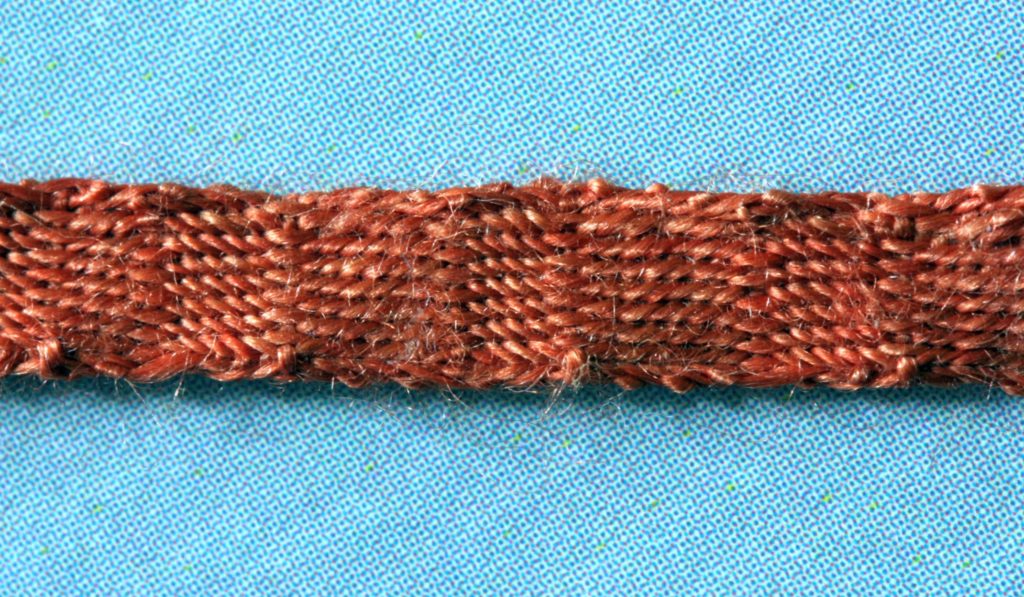
  3. There was very, very, very little twist in the threads used to weave the Albecunde belt. My tests done with my (only very slightly twisted) embroidery silk look like this:


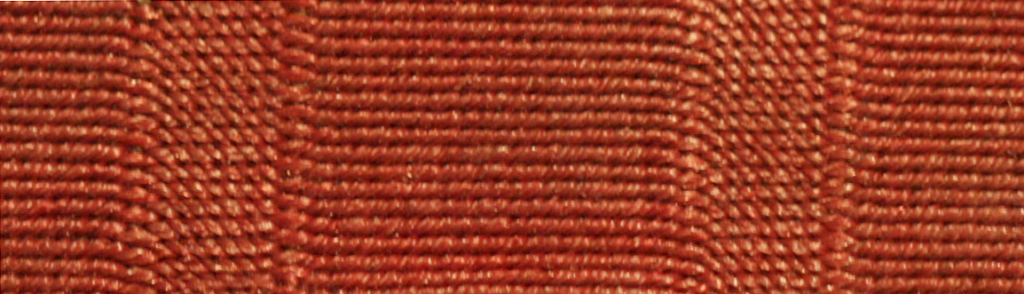
While the original belt looks like this:


You cannot see the pattern as clearly on my test piece as you can on the original - it looks very pronouncedly diagonally structured in one twist direction, but more like a mushy solid surface in the other. On the original, there's a diagonal structure visible in both directions, and it's only a very little more pronounced in one compared to the other.

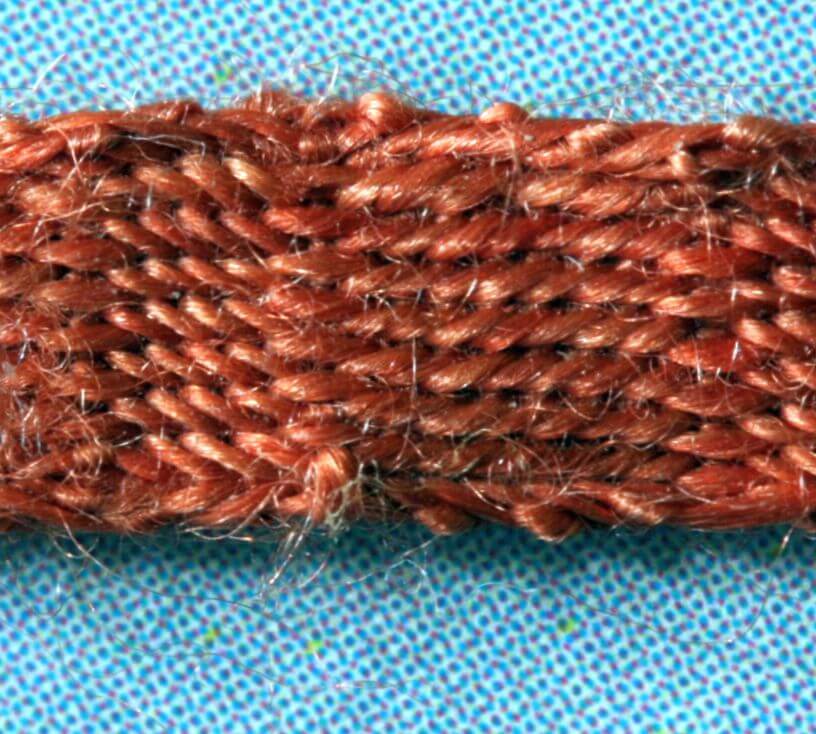
Here's closeups to make things even more clear:


You can see that the diagonals with an S-slant are much more defined than those with a Z-slant. That's because my thread is slightly s-twisted. It's not much, but enough to make quite a visible difference in the outcome; enough of the z-twist the tablets introduce is levelled out by the yarn twist to show. The twist is visible, if you look closely, in the areas where I changed tablet twist direction.


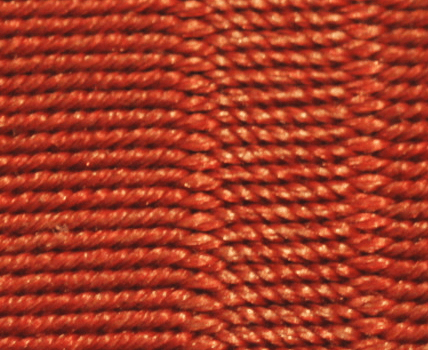
This is a detail, closeup, of the original. Here, too, you can observe the individual thread twist in the places where tablet turn direction changes - but it is so slight that it's almost impossible to detect. The best indication of it being a hint of an s-twist is that the S-cords in the tablet weave are a little bit more defined than the Z-cords.

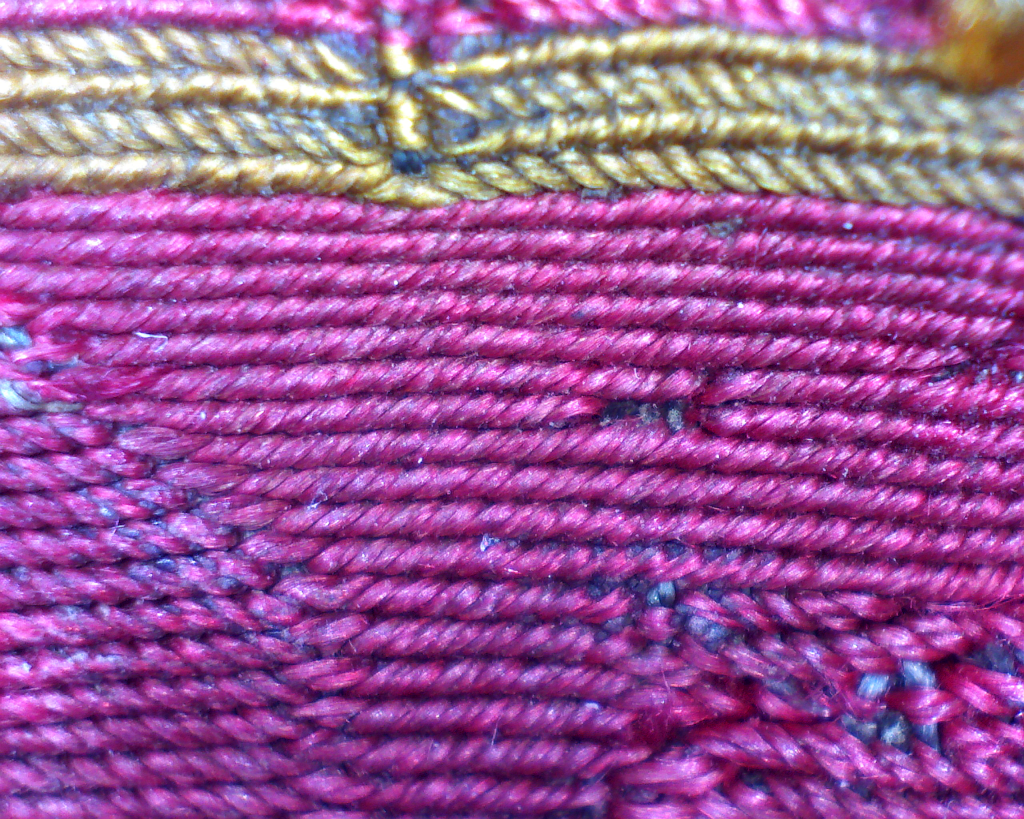
Here's a microscope picture, going even closer to the threads:


This shows how important even a little bit more or less of twist can be when you are weaving a pattern that relies, for its effect, exclusively on the shine and the light refraction of the silk used - and how much knowledge and skill went into this band.

You can hear more about the Albecunde band on Sunday in the presentation at Virtual Lauresham (and see my video thingie...)!

Thank you to the Diözesanmuseum Augsburg for letting us study the belt in detail for our reconstruction project!
0
APR.
24
0

Knitting!

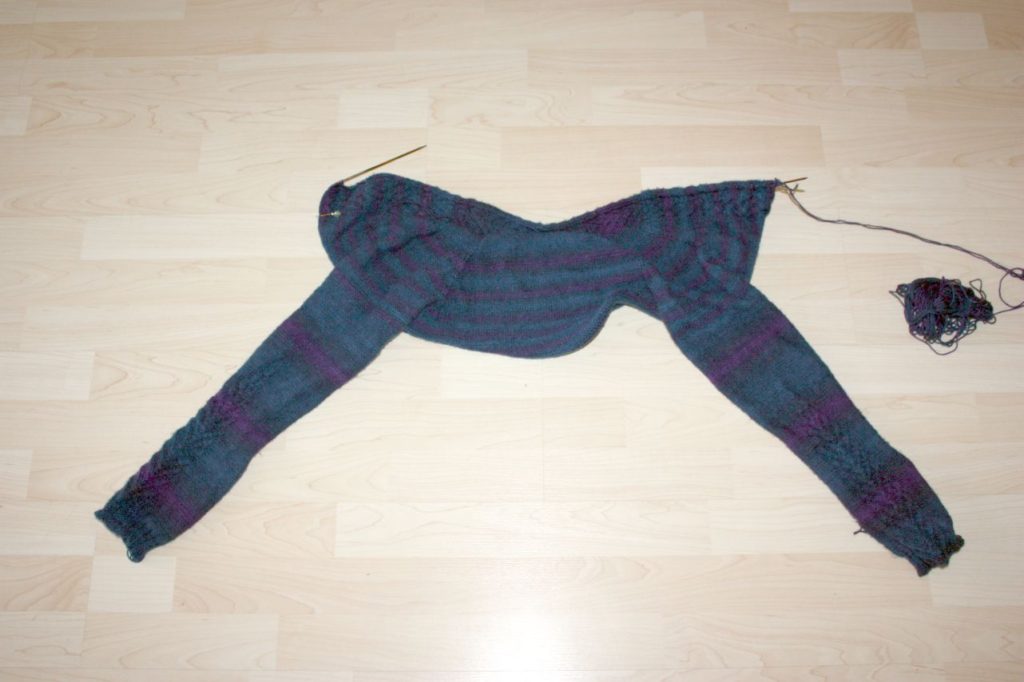
There's been surprisingly little knitting time happening here - too many other things have been done instead, predominantly gardening stuff. There's also been some mask sewing this week, as it will be compulsory to cover mouth and nose in shops and public transport from Monday on. I can report a bit of progress, though: The sleeves on my Ink cardi are finally finished, and I'm back to working on the body.


The yarn is very soft and very nice, and I also like the cable pattern, which is surprisingly hard to photograph. I still have a good long way to knit, though, before it will be finished...

Speaking of knitting, if you are looking for some inspiration, there's a nice and varied bundle of knitting patterns, called Spring Knits, available for 9.95 USD upwards from PatternChest. That's a new website, a spinoff from the Bundle of Holding, which sells bundles of roleplaying games.

You can pay the base price and get the basic bundle, or pay more than the threshold price (which gets adjusted on the basis of what people pay on average), and receive the basic bundle plus the bonus pack. Five percent of the price paid will get donated to a charity supporting healthcare workers, the rest of the payment is split up between the organisers and the designers.
0
APR.
23
3

Sashiko, Boro, and Medieval Mending.


In Tuesday's Ask me Anything post, I got this question from Michaela:
I'm getting started on mending and darning all the little things that are usually done by my mom (as she's currently obviously not visiting). Coincidentally I came across the japanese tradition of sashiko and boro (visible mending on garments sometimes used over several generations) and wonder if there ever was a similar tradition in Europe?

I had to look up both sashiko and boro first - and I hope that I've gained enough of an understanding of my quick look at the wikipedia articles to properly answer the question. For those of you also not familiar with these Japanese textile traditions, sashiko is using running stitches to make embroidery motifs; this can be used as a kind of quilting to reinforce worn textiles, or to firmly attach a patch to a worn or damaged textile. Boro is a technique where patches of fabrics were sewn together to provide more warmth in a very poor and very cold area of Japan - here is a Japanese museum site with explanations and images.


Both these techniques, as far as I can gather, were born out of necessity and poverty. Mending clothes was something done everywhere and in every time period when the cost of the textile, or the garment, was high enough to make mending feel worthwhile. In some cases, mending was done to be as inconspicuous as possible, while in other cases, the higher priority was to fix it in some way so that it would be okay to use again, with optics playing a secondary or no part. Which kind of mending was done probably depended on many different factors, including the personality of the mender and the owner of the garment.

Mending things usually is associated with poverty - if you are rich, you can afford to have new, unworn and undamaged things, and thus no mending. While having mended stuff would probably have been the norm for most people during most of human history, this association did its part to lead to our modern culture of throw-away clothing, bought very cheaply and in poor quality, worn a few times and then ending up in a landfill, or getting burned in some wast combustion plant.

Today, mending is becoming more fashionable again, in a turn against wasteful consumer culture. This also means that visible mending is turning into a kind of fashion statement - including the aforementioned techniques of sashiko and boro.

So did we have these, or similar techniques, in the Middle Ages in Europe? Whether that is answered with a "yes" or a "no" partly depends on how you see the different aspects.

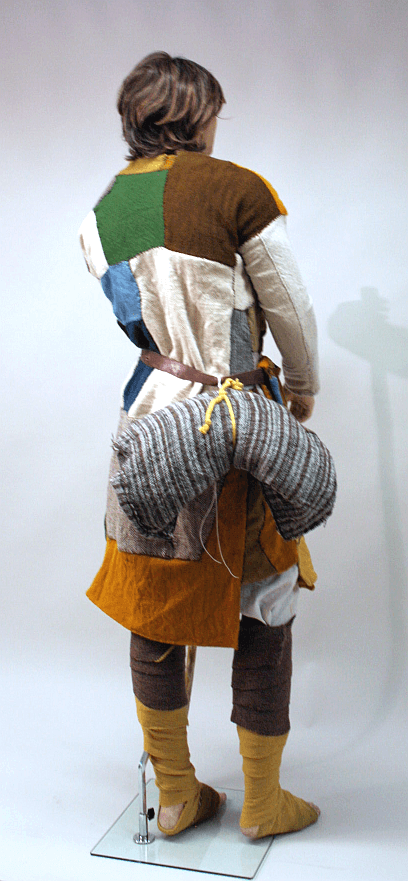
Firstly and most importantly, we did have a similar tradition in the widest sense - that garments and textiles were mended, re-used, and re-purposed; especially in poorer areas or by poorer people, who could not afford to buy shiny new things all the time. For the boro tradition, what comes to my mind first is the textile equipment of the Man from Bernuthsfeld, whose tunic was put together from many different patches of many different fabrics:

[caption id="attachment_3692" align="alignnone" width="273"] Reconstruction of the Bernuthsfeld tunic, made for the museum in Emden by Jens Klocke and myself.


However, this tunic is a special case - there's nothing else made in a similar fashion from the Middle Ages, as far as we know, and there is a lot of different speculations on why the man wore something like this.

There is a tradition in the European Middle Ages, though, that could be seen as a parallel to Japanese boro: Re-using the fabric of a garment to make something new out of it. This was done with garments that had a high value, either a tangible one (a very costly fabric) or an intangible one (something worn by a saint). Examples of these re-purposings are two Swedish altar frontals made from expensive garments that were donated to the church, or the Sixtus chasuble in Germany which was pieced together from another fabric, or St Birgitta's mantle in Sweden, which was made from what was a tunic or dress before.

There's also plenty of evidence for patches being sewn onto garments, sometimes in several layers, like in the underpants from Lengberg. Mending was not restricted to lower-class garments or less expensive fabrics either; for instance, the golden gown of Queen Margareta also has mends and patches. Off the top of my head, though, I don't know of patches reinforced with running stitches, or these stitchings being used as decoration.

So - I'd say that we had some aspects to mending traditions in Europe that could be considered similar to boro in Japan, but nothing that exactly or closely parallels the two Japanese techniques.


Read more about:

The Sixtus chasuble:
Worch, Maria Theresia. "Dokumentation zur Konservierung der Sixtuskasel." In Die Sixtuskasel in Vreden. Untersuchung und Restaurierung einer mittelalterlichen Gewandreliquie. Denkmalpflege und Forschung in Westfalen Bd. 35., edited by Elisabeth et al Jägers, S. 20-40. Bonn: Dr. Rudolf Habelt Verlag, 1997.

The altar frontals:
Nockert, Margareta. "Precious coats from the fifteenth century." In Opera Textilia Variorum Temporum. To honour Agnes Geijer on her ninetieth birthday 26th October 1988, edited by Margareta Nockert and Inger Estham, 111-20. Stockholm: Statens Historiska Museum, 1988.

The Bernuthsfeld man:
Farke, Heidemarie. "Der Männerkittel aus Bernuthsfeld. Beobachtungen während einer Restaurierung." In Textiles in European Archaeology. Report from the 6th NESAT Symposium, 7-11th May 1996 in Borås, edited by Lise Bender Jørgensen and Christina Rinaldo, 99-106. Göteborg, 1998.

St Birgitta's mantle:
Andersson, Aron, and Anne Marie Franzén. Birgittareliker inlånade till Historiska museets utställning "Birgitta och det Heliga landet" 30 november 1973-17 februari 1974. Vol. 59, Antikvariskt arkiv. Stockholm: Almqvist & Wiksell, 1975.

Margareta's Golden Gown:
Geijer, Agnes, Anne Marie Franzén, and Margareta Nockert. Drottning Margaretas gyllene kjortel i Uppsala domkyrka. Stockholm: Kungl. Vitterhets Historie och Antikvitets Akademien, 1994.
0
MäRZ
30
0

Woot!

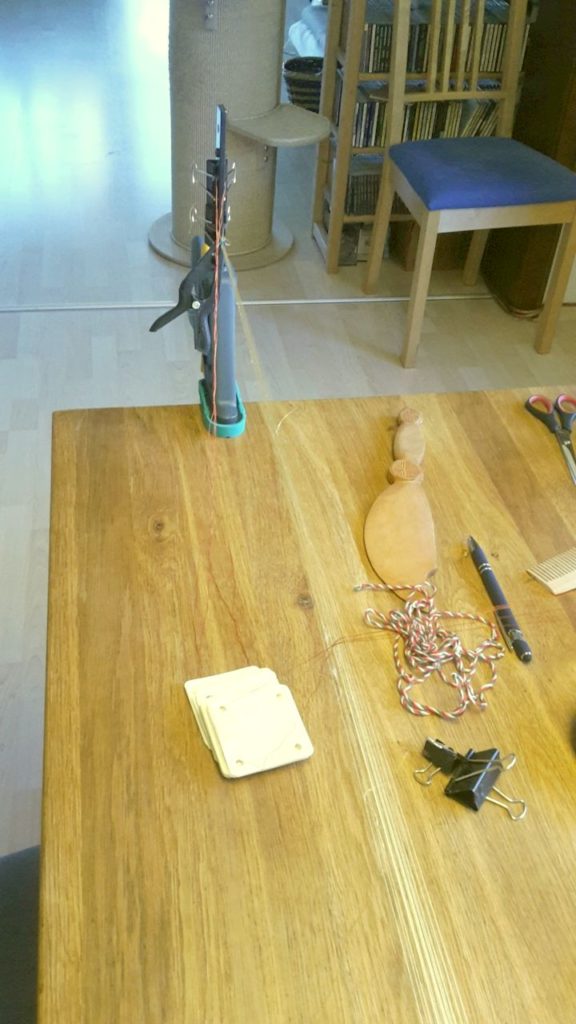
Today was a bit hectic, but in a good way - there was an urgent request for a little tablet-weaving something, which had to be finished as soon as possible so it could go into the post.

[caption id="attachment_5153" align="alignnone" width="576"] If you can't see the threads running through the tablets, that's because they are thin. Very thin. Not the thinnest I've worked with, but still. Trust me if I say that they are there, though, and they are quite colourful as well...


Even though I'd have liked to spend a little more time on this, and take a few breaks to let all the impressions from working with this very lovely stuff settle, and explore some more how best to handle the different details - I'm happy that I was able to get things done quickly, and hopefully the post will deliver in time, and all will be well, and I will be able to send you a link to a little video you can watch soon-ish.

Speaking of the post: The pandemic has its effect on postal services, too. German post is still running close to normal, with a few little things in effect to protect the posties (such as not needing a signature anymore, and putting the parcel down on the ground instead of handing it over). Outside of Germany, though, the picture is different - in some countries, there's issues with customs, or postal delivery is currently not done for quarantined areas. Sending things to the US is still possible for now, but larger parcels now cost a surcharge of 16 € due to the crisis... so I've put a note on my shop page (which will hopefully appear in all the right places), and I hope that things will not go worse. (Though I do suspect they will.)

Stay home, stay safe, and do some fun things!
0
MäRZ
20
0

Ink Progress.

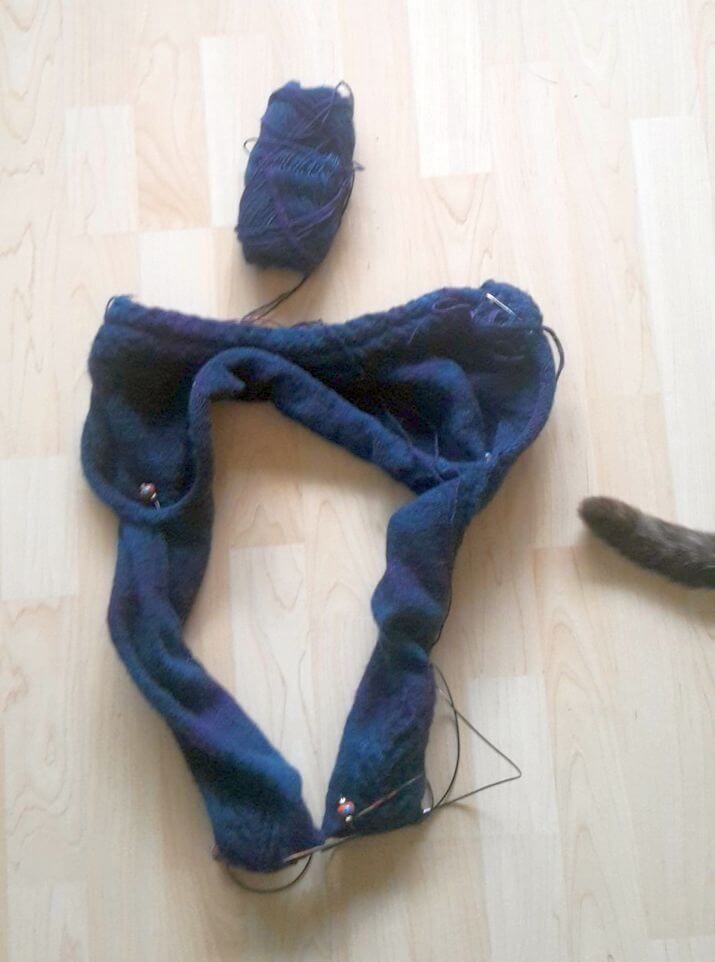
There hasn't been that much knitting in the past days and weeks as I'd have liked, but somehow other things happened or were done or taken care of. (Including some mending of socks and t-shirts...)

There is, however, some progress now. I'm getting closer and closer to the point where the sleeves will be finished, and I'm very much looking forward to that - and the fact that I will then be able to continue with the body of the cardigan. Hooray!


(Yes, that is Madam the Cat's tail in the picture.)

Working both sleeves at the same time using magic loop does work nicely in reducing my personal "Aaargh!" factor. It's a little awkward at times, as the two strands of yarn tend to do things they should not be able to do (as in they wrap around one of the sleeves, or suddenly are not both on the same side of the cardi anymore), but that is a relatively minor nuisance.

And soon, it will be over, and I'll go back to nice and brainless back-and-forth for a little bit, until the increases and the pattern shifts start. Already looking forward to that!
0
MäRZ
19
1

It Is Finished!

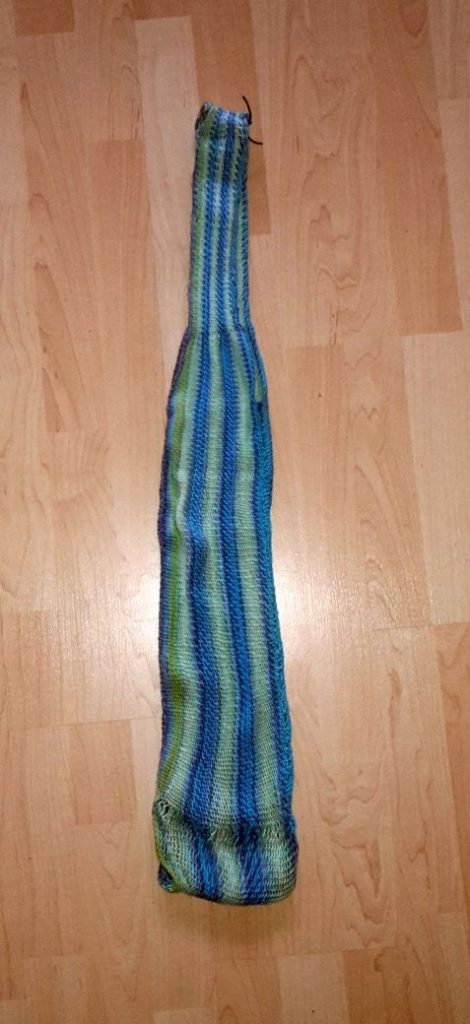
You remember the UFO sprang thing that I blogged about a while ago? Well, believe it or not (I certainly have a hard time believing it) - it is finished!

I started making this because I wanted to practise basic sprang, and wanted to try the "endless" circular setup, where you basically work one closed loop. As you can see on the photo, I totally botched the start, where the structure is much more loose than it should have been. The start is not right at the bottom of the thing because I also managed not to push both sides in completely evenly; it thus slipped to one side of the thing.


The project was successful insofar as I really got in a lot of practise with the basic move... and successful again as at the end, I got to learn how to do double-layered sprang (yay!) and try out methods for doing the last few rows.

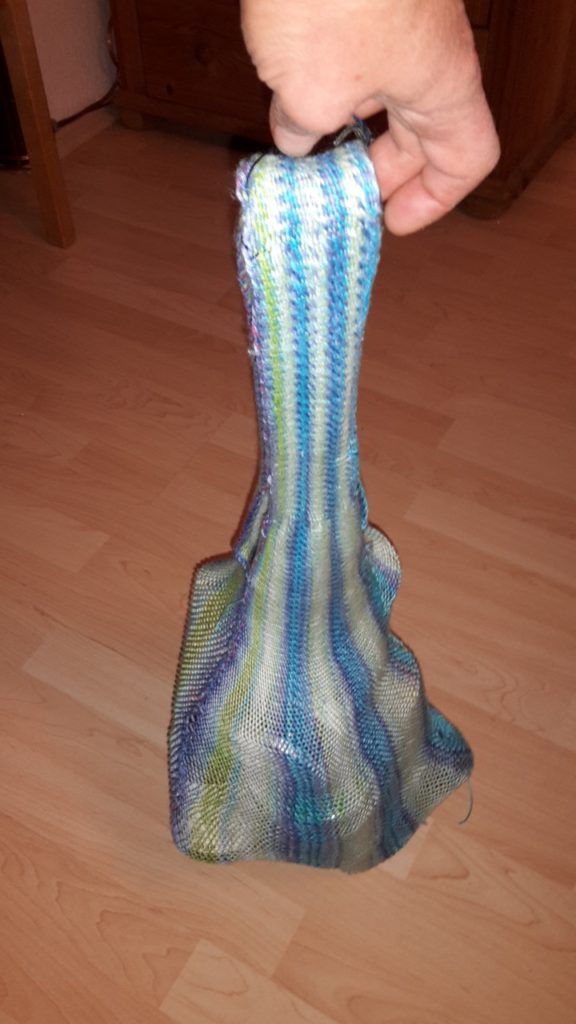
And now it's finished. It is quite stretchy, so it will eat up a lot of things - though they can be awkward to get out of it, because it's so long. It has been used successfully already to carry glass to the glass container:


Quite a few more would have fitted, but that was all we had to carry to recycling.

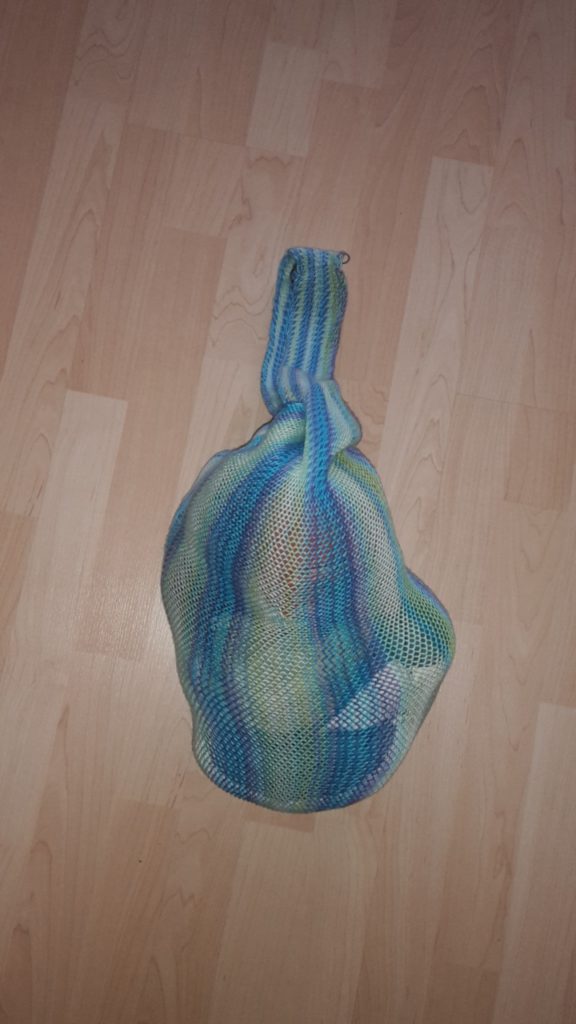
This is how it looks stuffed full of cushions:


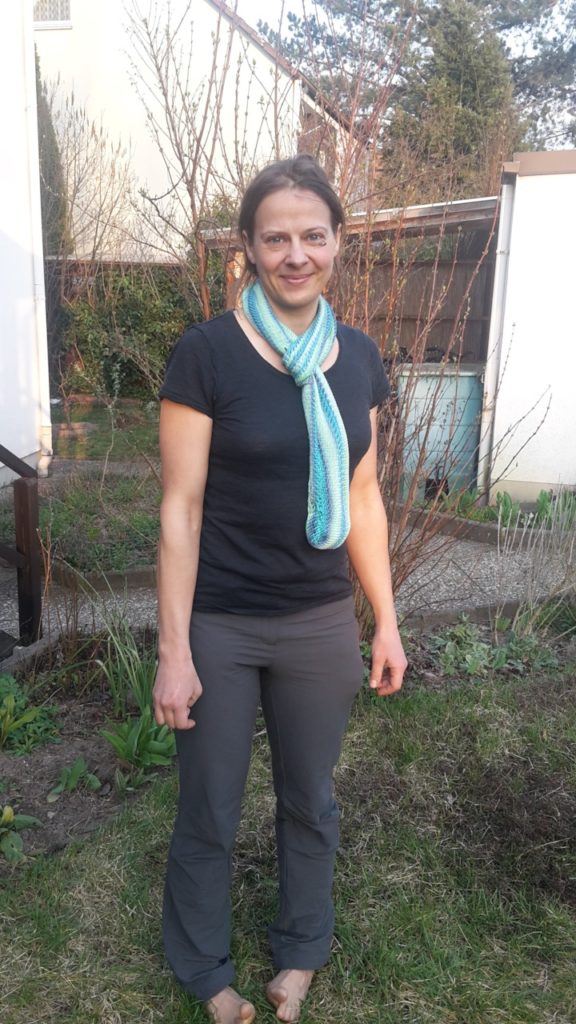
So... learning-wise, it was a good thing. Bag-usability-wise, jury's still out; because the relaxed state is such a narrow tube, large things won't fit through the opening easily. It still does seem useful, however, and on the plus side, when you're done carrying things, or when you want to bring it along clandestinely, it can be worn as a summer scarf:


...and that makes it definitely the weirdest bag I have!
0
MäRZ
12
0

Choose Wisely!

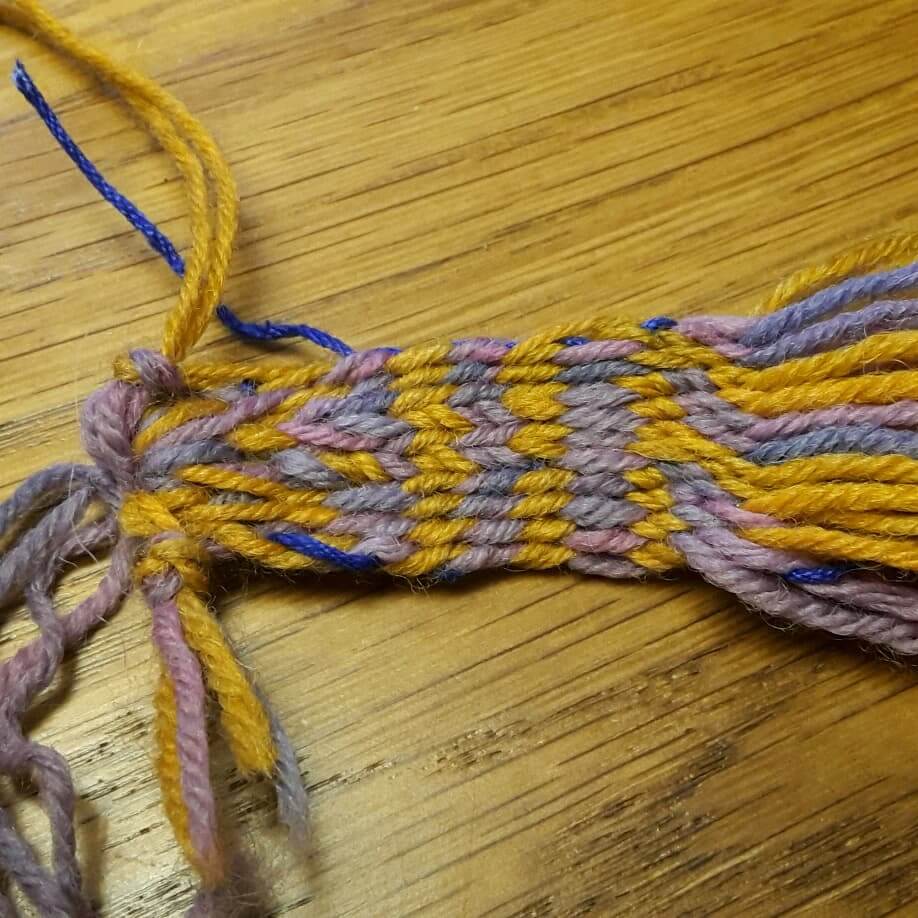
After being happy about figuring out the setup and sequence for my twill tablet weaving demo for NESAT, using up the last of my playband, I set out to warp a new band. Logically, that band also needs two colours, ones that play well together as in "give good contrast".

Well. Let's say my brain was probably not fully online when I was making the new warp... I looked at the colours, thought "they look nice together", found that the two colours were rather different from each other, then thought for a split second "but they are both rather light..." and then proceeded to warp anyways.

Which was, in retrospective, not a good choice. That quickly became clear when weaving the first few picks.


Yes, the two colours do look nice together. Yes, you can see the lines. However, contrast is not very high after all, and high contrast in every imaginable lighting (including not-so-good lighting) would be a very smart thing to have for a demo band.

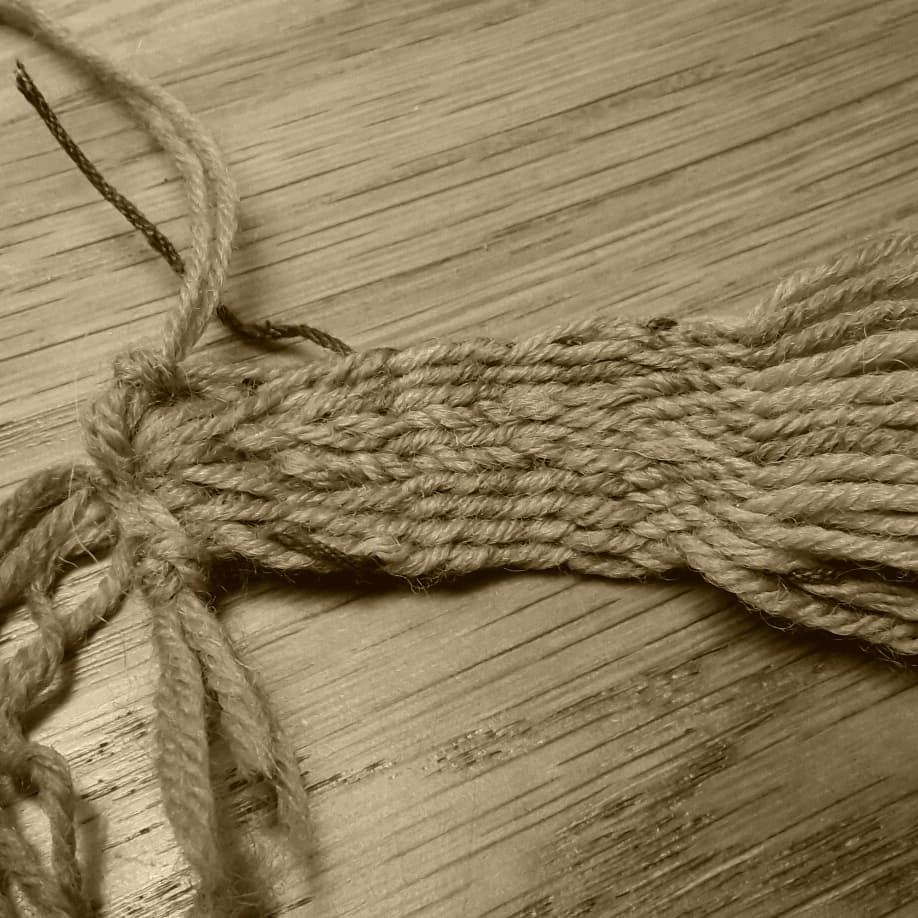
The reason for the not-so-good contrast is the difference, or better the lack of difference, in the grey value of the colours... which becomes very obvious if you use one of the convenient quick filters that will turn your image into grey-scale or, in this case, because I like it, sepia:


Nice, isn't it? You can see the structure of the band, and you might be able to guess where one or the other colours are, because of teeny tiny differences in darkness - but then that might just be an effect of the slight irregularity of the colours.

So this warp is not what I need for my demo. But. The effect of "everything the same colour" is just what you get in so, so many cases of archaeological textile finds - which, of course, includes tablet weaves. In these bands, there's sometimes a hint of pattern weaving because of changes in twist direction in the band.

I've had this idea of trying out how a band with a few different pattern types would look if everything turned the same colour for a while now, and this oopsie warp now means I have something to do exactly that. It's just 10 tablets, and not very long, so it will not result in spectacular stuff, but I'm planning to do some "threaded-in patterns" using tablet threading direction and alignment, a bit of "4 forward, 4 back" patterning, and then some Egyptian Diagonals and twilly stuff to round things off. Make photos of the band in colour, turn them into sepia, and see.

I think this sounds like fun - it just remains to see when I'll find the time for said fun, as there is still the "real" NESAT demo prep work to do. (Also there's a queue of fun stuff waiting for their turn... which, yes, is a luxury problem.)
0

By accepting you will be accessing a service provided by a third-party external to https://pallia.net/

Kontakt