Latest Comments

Guest - Aislinn Dyestuff Citizen Science.
09. Oktober 2026
This is a great project. I look forward to the results. Thanks for letting us know.
Guest - Aislinn Time for...
09. Oktober 2026
Looks delicious!
Guest - Katrin Sprang Discussion
18. September 2026
Hi Rachel, I have looked for more photos of you, but that was not very successful. I found a link on...
Guest - Beatrix Sprang Discussion
15. September 2026
That lozenge pattern element is not a photograph, but a scan. So it should be to scale. But I pinned...
Guest - Katrin Sprang Discussion
15. September 2026
I was not referring to Rachel's reconstruction (is the reconstruction you refer to the one photograp...
FEB.
19
7

Warp Weighted Loom Thoughts.

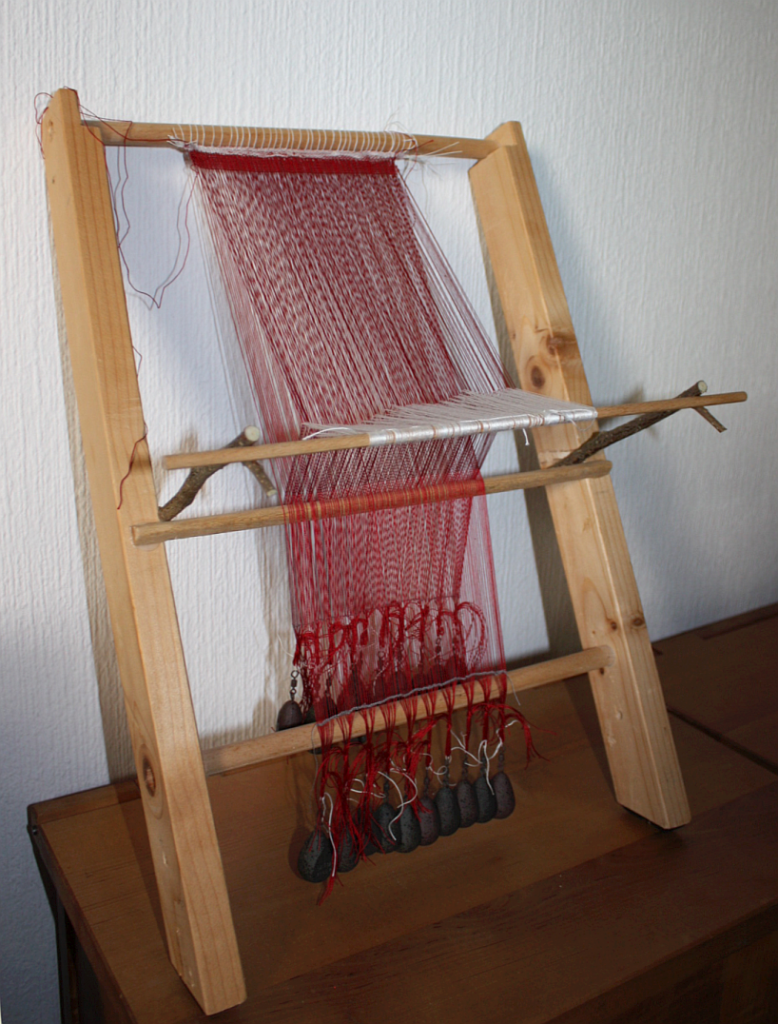
A long, long time ago, I made this little model of a warp-weighted loom, and after a few more years, I set it up again properly, trying to scale things down as well as possible.


The model has come in handy for a lot of occasions now - it's the perfect way to very quickly explain how a warp-weighted loom works, and much easier to transport than a full-size one. For weaving purposes, though... it is obviously not the most suitable thing.

For actual weaving on a warp-weighted loom, you need a full sized version. And due to some people putting a flea into my ear, I've been pondering the question of how to organise a loom-weaving workshop, in logistical terms. Because you'd obviously need a loom for every weaver...

Now, in my personal opinion, the weaving itself is not the crux in learning how to work with a warp-weighted loom. Yes, you can of course muck up things wielding the shuttle and beater - but according to my experience, the stage where the main decision happens on whether you will end up with thread salad or a proper fabric is the setting up of the loom. Which also happens to have a lot more steps, and a lot more varied tasks, than the actual weaving itself (which is, basically, change shed, beat, insert weft, repeat). So to learn the how-to, I would actually aim to teach setting up... followed by a bit of weaving.

Whether the one or the other, though, you still need a loom for every weaver. Preferably one that is a good, efficient tool which would be suitable for production weaving. Also relatively cheap and easy to make (even without a woodworking workshop and lots of tools), suitable for normal-sized women (a plus would be easy adaptability for body size), and with the option of making it free-standing (in case the workshop area does not have enough wall space). It should be possible to take it completely apart for storage or transport, preferably with no single piece longer than 2.2 m.

The most important measurement for me, at the moment, is a suitable and sensible depth of the natural and artificial shed. How deep does the shed have to be, in order to weave comfortably? At one point, it will be too shallow to pass the shuttle (or weft ball, or whatever) through. (Obviously, the wider the fabric, the more fiddly this might get.) Making the shed deeper than necessary, though, means that you have to pull your heddle stick out further than necessary each time, and that is not very efficient.

Mathematics say that the depth of shed and height of loom will dictate the angle of the loom, and thus how far its bottom will stick out from the wall, and thus how far forward you will have to lean to pull the heddle stick, and how long the rests will have to be for the artificial shed - so, basically, everything.

Which means that construction-wise, deciding on a smart depth of shed is the most important thing... which also means that if any weavers with experience on a warp-weighted loom are among you, please let me know about your thoughts - and your experiences with shed depths!
0
FEB.
18
0

Why I love warp spreaders.

When it comes to tablet weaving, I am a little... um... peculiar. If you've taken a workshop with me, you will know exactly what I mean - I will insist on certain things being done just so.
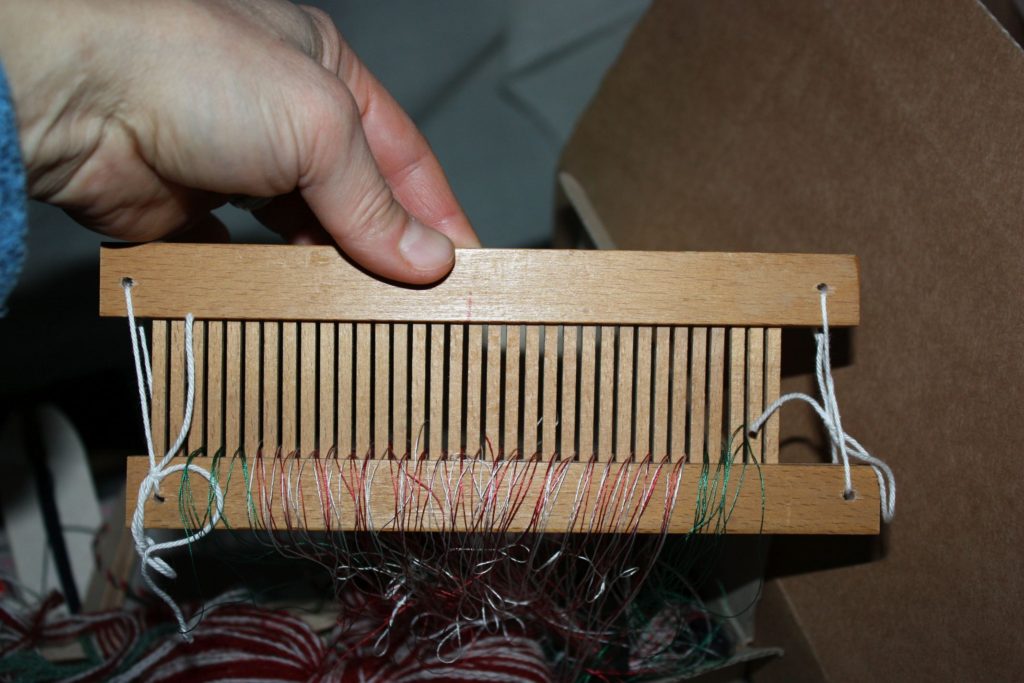
There's also a stack of things I will not insist on, but will strongly recommend - such as weaving with as little tension as possible, or leaving a loop when you are inserting the current weft, or warping with a cross and inserting either a cross (two sticks tied together, like the cross in loom weaving) or a warp spreader. In its simplest version, this is a stick with holes in it, through which you pull the individual tablet threads (all from one tablet through one hole). There's also the comb-style version, which can be filled easier, and without cutting up a continuous warp:

[caption id="attachment_5051" align="alignnone" width="640"] Warp spreader made from a broken piece of weaving reed - the top can come off to fill it with threads.


The warp spreader will, as its name implies, spread out your warp - so by adjusting its distance from the tablets, you can make turning the tablets easier, and fine-tune how easy it will be to keep your weaving the perfect width. That is its main function, and for that alone, it is very much worth installing one.

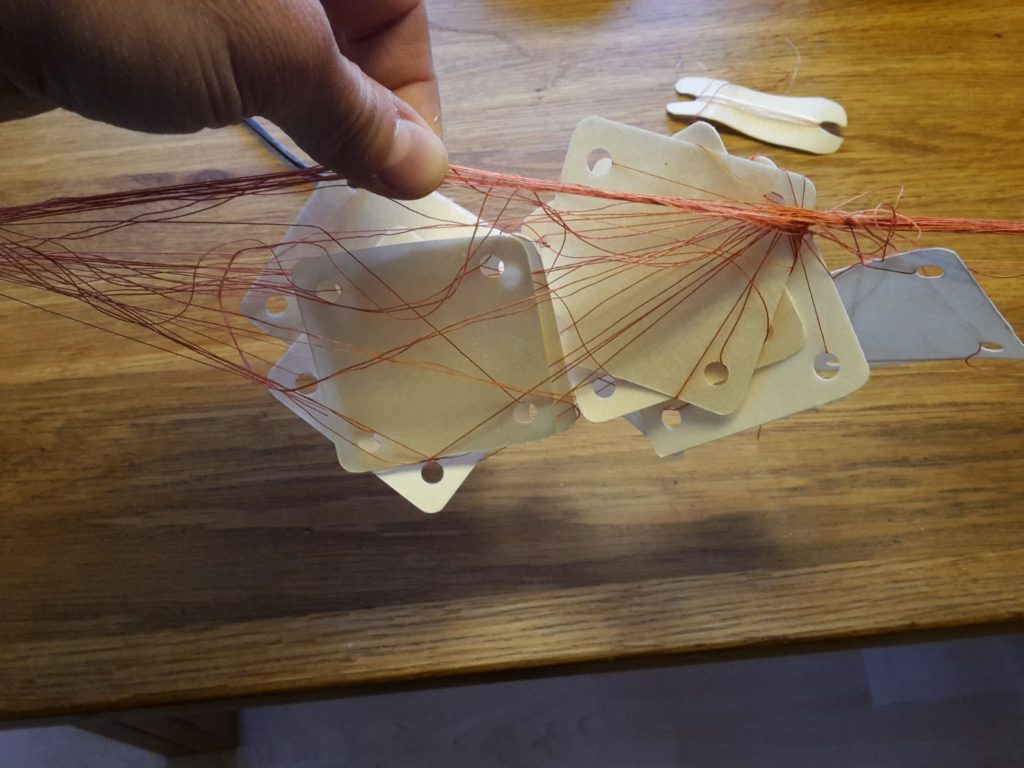
However... there's this secondary thing where it comes in really, really handy. Imagine, for a moment, that you are like me and occasionally have your five minutes of utter and complete loss of all motor skills, resulting in things dropping in the most spectacular way. (That, by the way, is the reason why I am using lightweight parchment shuttles for my weaving.) Or, in that case, you have a warp that was dragged around inadequately secured and in an inadequate packaging once too often (I am, generally, not kind to my warps). It might just result in something like this:


That was adequately termed "tablet salad" by someone. It's only nine tablets, but detangling something like this could be a real hassle... if not for the warp spreader. With that in place, all you need to do is go through the cords going through the spreader, one after the other, gently extract the corresponding tablet from the salad, and place it to the side to form the stack of tablets that is supposed to be there.

And then, a little while later, you can go back to weaving.


In this case, it was only nine tablets, so it was done very quickly. I once dropped my playband with 42 tablets - that took a bit longer, but still was not too bad, thanks to the cross that was in place there, too.

So... do you use warp spreaders? If not, do give it a try - it is worth it!
0
JAN.
31
2

Shenanigans! And sad truths.

I'm off for the weekend - it's time for the Historical Sewing Meet-Up in Rothenfels, where I'll be having fun and coffee and the happy occasion of giving a few workshops... about brocading in tablet-weaving, fingerloop braiding, and tailoring.

There's also the presentation about medieval fabrics that will be having its first outing this weekend, and I confess I'm very, very curious about how it will be received. I've tried to pack in both the specific information requested by some of the Meet-Up participants and to provide some background to properly understand medieval fabrics. I've also found myself in the awkward position to include all the Bad News (TM) regarding the sources available, and the differences between historical and modern fabrics... so I'm fully expecting to see some sad faces following the presentation.

However, I do believe that it's better to know the facts and know where the compromises start (and how big they are) than to bumble on in happy oblivion. After all, many of us who wear medieval clothing at events are also passing on knowledge to the public - and, whether we talk to the event visitors or not, we're helping form their view of the Middle Ages.

Which means that every bit of knowledge counts double - and every little step towards a better representation of the current state of research regarding history does as well, even if that means facing sad truths, or letting go of much-beloved things from one's (re)presentation and kit.
0
JAN.
14
0

Things happening here.

There's a stack of things happening here, though almost all of them are boring-type background things. There are some minor issues with the website, including some updates and some other small nuisances that I'd like to fix, but still haven't. In some cases, I'm not good enough at programming or understanding how the website innards work, and I just can't find where to tweak stuff so it works as intended. Most of these things are also not crucial, so I tend to have a go at them when they catch my eye, which they do once in a while, and after an hour or two of fuddling around, I put them to rest again. Sometimes I change a small thing only to find out (days or weeks later, if things go badly) that my things-look-better-now tweak actually was a things-look-better-here-now-but-shittier-everywhere-else thing. Sigh.

The most current problem was a deluge of spam coming via my contact form. It seems to have been solved now, at least mostly - I'll see if what I did was enough in the next few days. There's a plugin installed now that should keep bots from posting while doing nothing (and adding no extra steps) for regular, living and breathing human beings. If that will not stop the spamming, I'll have to add one of those wonderful "please answer this simple maths question" thingies - something I did want very much to avoid. But if the alternative is to get about 200 spam emails each day, plus the same amount in "Undelivered Mail Returned To  Sender" messages, that decision does get a lot easier.

There's also some more maintenance and ordering of things going on with the computer. Most of the transferred programmes seem to work fine on the newly setup machine, but there's a new backup procedure to be implemented, and it's a good opportunity to do some additional housekeeping, so that's also going on, and - as usual - it takes a long time and is a little annoying.

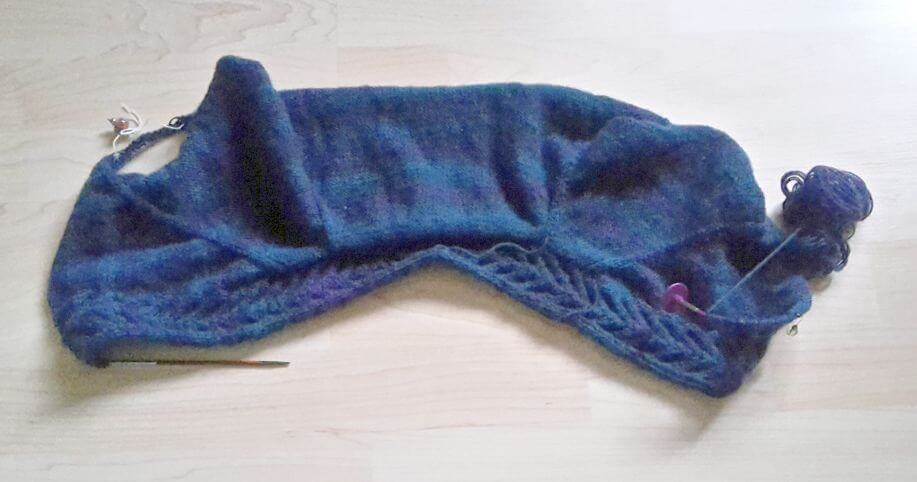
In other, more happy news: There's been some progress on the Ink cardigan, as can be proved by this very bad, very blurry photo:


I've progressed past the raglan increases and into the main body. Next step will be knitting the sleeves. I've found out with my first knit-it-all-in-one-piece piece that I absolutely hate knitting the sleeves as the last bit. There's just too much finished object to turn around with each round of the sleeve to make it comfortable... which means I'll do the sleeve-knitting right now, at the earliest possible part. That way I can also see if things fit, or if I have to go back a bit and adjust stuff.

 
0
DEZ.
04
1

On The Needles Now.

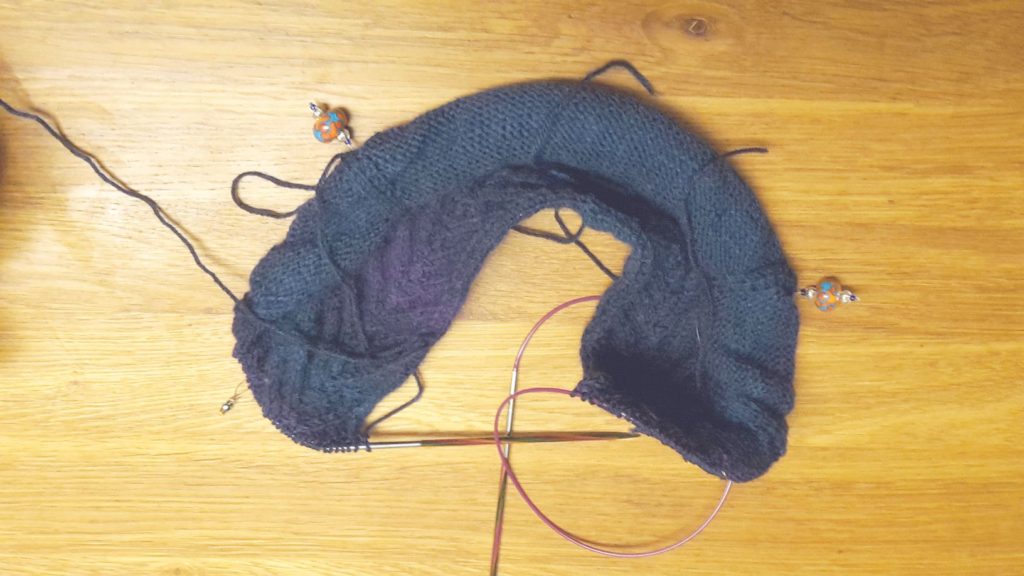
You have probably guessed correctly that I have, of course, started a new knitting project since finishing the Cat Hat - it's "Ink", by Hanna Maciejewska. I have a beautiful, soft, dark-blue-to-purple wool for this, in sock wool thickness, and it does knit up nicely.


I'm not very far along yet - the pattern starts in the middle of the neck with the collar, then progresses on to increases for the raglan-style sleeves, and that is where I am now. There is not so much knitting going on at the moment, too, as it's the time of year for the baking spree...
0
DEZ.
03
2

The Stranded Knitting Results.

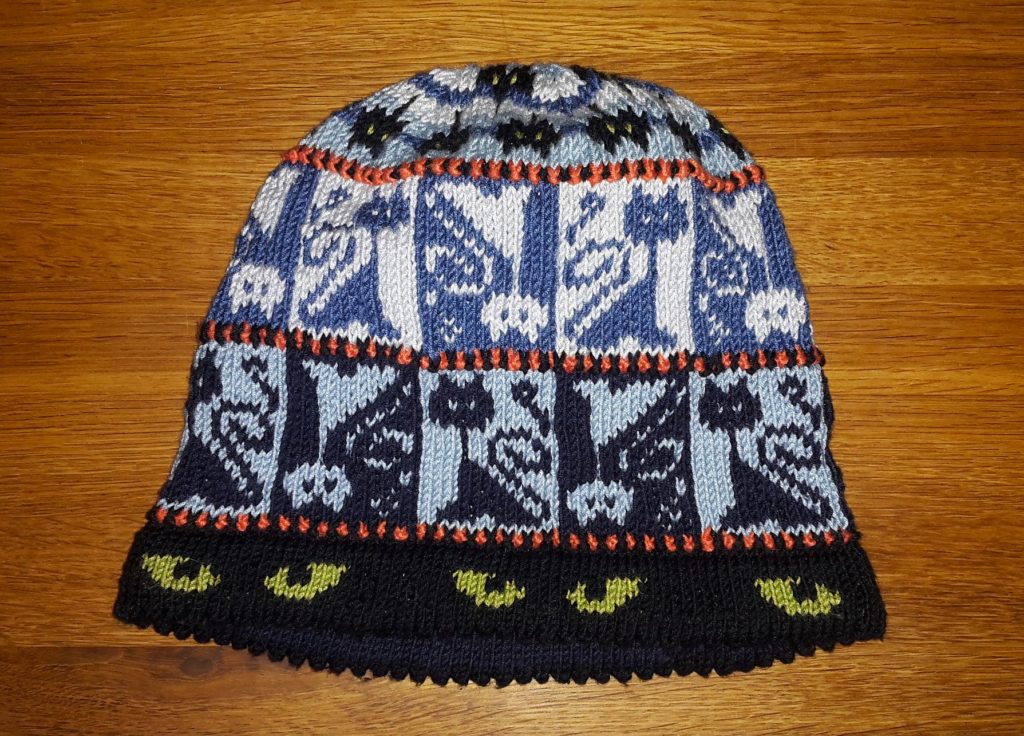
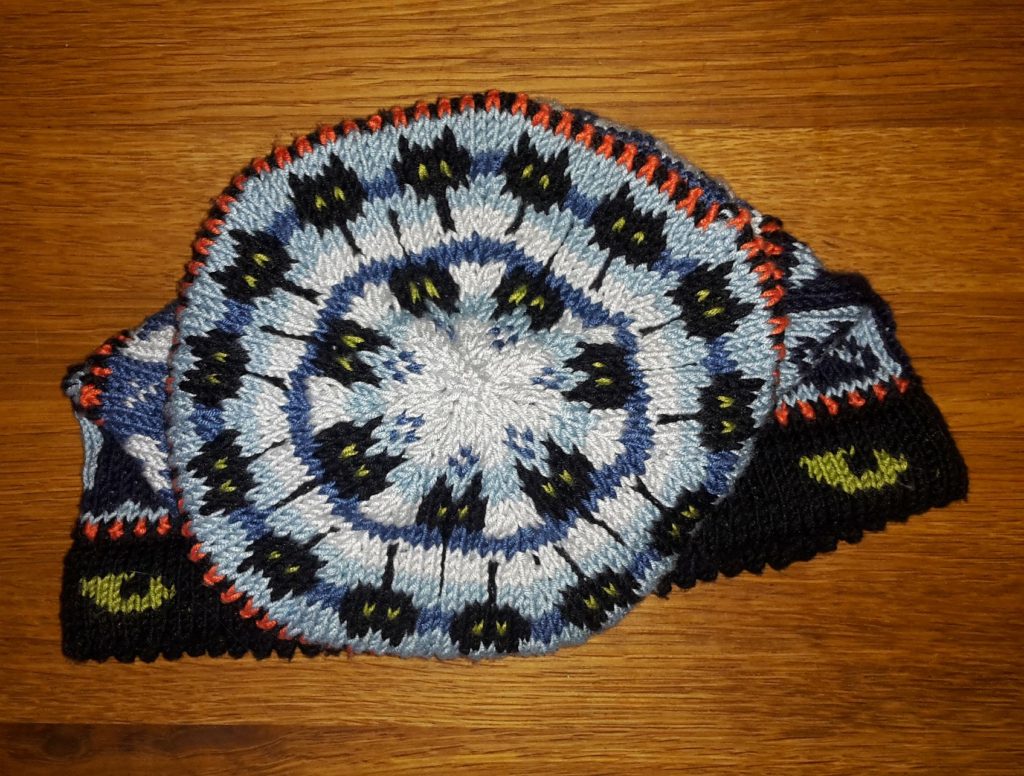
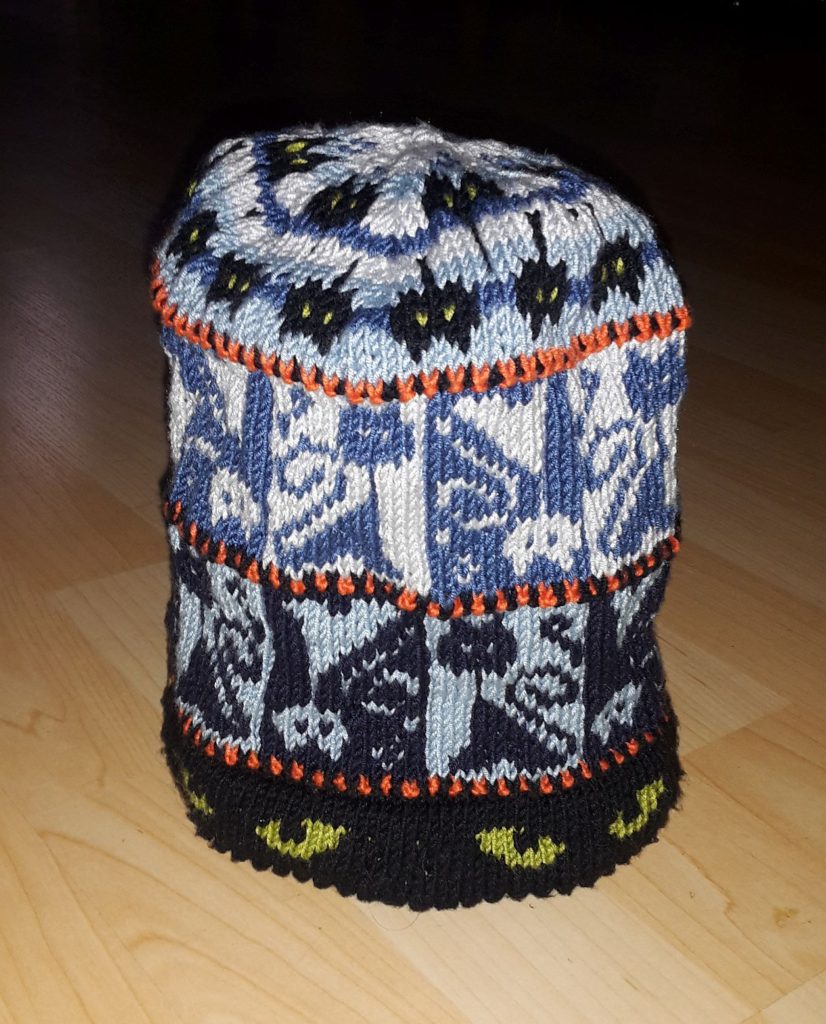
While I did write about learning how to do stranded knitting, I've never posted pictures - so here, finally, proof that it happened:


The pattern is "Cat-oween", and it's mostly stranded knitting with two colours in a row. There's some purl action, and in the crown part, you have to juggle three colours in a few rounds.


That was... awkward, but I did manage.

The pattern was nice to work, the yarn was pleasant (it's smooth and not very elastic, but feels really nice against the skin), and I had a blast knitting this. Bonus: The recipient really liked it, too, and it did fit. Yay!


I even managed to finish it before Halloween... and now I'm tempted to make another one of these with the leftover yarn (which might be juuuust enough for one more). Eventually.
0
NOV.
26
0

Unexpected Difficulties.

Sometimes, things turn out to be more difficult than anyone would have guessed. One of these things, as I've learned, is... getting a room.

Not a room at a hotel, or youth hostel, or such things; I'm perfectly capable of that, and it is generally not a problem at all (unless you wait until the last minute and then try to get something cheap in a town where there's a fair going on...). I was looking for a room to give workshops. To be even more precise, to give a tablet weaving workshop.

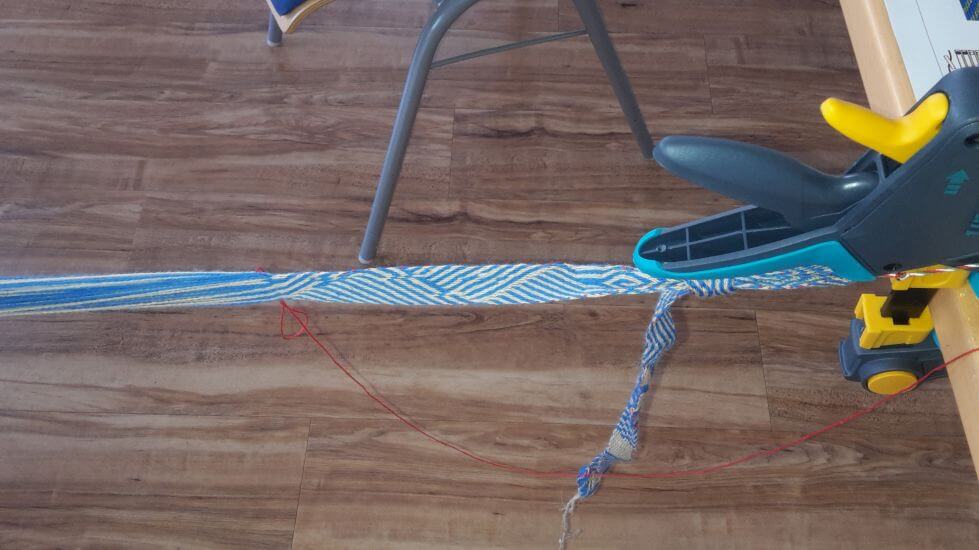
A while ago, when I was preparing for the weaving weekend in Belgium, I had figured out a good plan on how to place tables, chairs, and weaving warps so that the room available could fit the participants we'd planned for. I have since tweaked this a tiny bit, and I can comfortably fit twelve weavers using six tables. (And clamps, of course. I think there's no workshop where I don't turn up with my clamps.)

[caption id="attachment_4902" align="alignnone" width="979"] Table, clamp, band. I love this setup - it's quick, easy, versatile, and allows to have a wide choice on how to sit at the band.


For this constellation, I need a room size of no less than 6 by 9 metres, though - and it turned out that such a room for renting is very, very hard to find. Lots of people that I have talked to have expressed their wonder at this, and frankly, I would have thought it should be no problem either - before I started searching in earnest. Either there is such a room, but it is booked already, or the owners (especially churches) need it for themselves on Sunday, or it is not rented out over weekends, or it is completely unaffordable for me. I've managed to rent one room once, for my last workshop, but alas - this place is one of the "usually booked already" places.

Which means that, after searching for more than a month now, I was quite frustrated. So much that yesterday evening, I looked at our living room again... with a sharp eye, and a measuring tape, and the help of the Most Patient Husband of Them All (who really, absolutely, and utterly deserves this title - as my giving a full weekend workshop at home also means that our main living space is taken up).

There was then some drawing of available space, and some cutting of folding table mockups, and more measuring and thinking - and finally we came up with a method to fit up to eight weavers. Which is very good - and which means that I can finally, finally set the date for my next tablet weaving course, which will be a beginner's workshop. (It will be on March 7 and 8, by the way... description for the shop and booking possibility will come up tomorrow at the latest.)
0

By accepting you will be accessing a service provided by a third-party external to https://pallia.net/

Kontakt