Latest Comments

Guest - Aislinn Dyestuff Citizen Science.
09. Oktober 2026
This is a great project. I look forward to the results. Thanks for letting us know.
Guest - Aislinn Time for...
09. Oktober 2026
Looks delicious!
Guest - Katrin Sprang Discussion
18. September 2026
Hi Rachel, I have looked for more photos of you, but that was not very successful. I found a link on...
Guest - Beatrix Sprang Discussion
15. September 2026
That lozenge pattern element is not a photograph, but a scan. So it should be to scale. But I pinned...
Guest - Katrin Sprang Discussion
15. September 2026
I was not referring to Rachel's reconstruction (is the reconstruction you refer to the one photograp...
NOV.
20
0

Dear Volunteers... Thank You.

I got to meet a lot of old friends at the Texel Stockings conference, and I also got to know (or know better) a bunch more people. Among them some of the absolutely and utterly amazing volunteer knitters who knitted an entire stocking reconstruction.

An entire one. It's not a sock, mind you. It is a stocking - more than knee-high. We're talking about a piece knit from fine silk, with about 200 stitches to cast on, and about 83 stitches per 10 cm. It took the volunteers between 170 and 350 hours to knit one stocking... no wonder these things were precious. My full and utter respect, and admiration, to the group of volunteers that, up to yesterday, handed in twentyseven complete stockings for the project.

You are heroes for science. Truly. Thank you so, so much for giving such an enormous amount of your time, your skill, and your love to a science project that could not have been done without you. People like you make the world of textile archaeology a better place, and I know from my own personal experience that all of the academics involved in the project will carry you forever in their hearts - like I do my volunteers from the Spinning Experiment that I did ten years ago.

Words are not enough to express how important your work is. Your contribution. Archaeology, especially experimental archaeology and textile archaeology both, are low-budget disciplines. Researchers often work all on their own, trying hard to make projects happen, and there's a constant struggle to source the correct and fitting information, workspace, tools, and materials. If you are very lucky, you can get financial support from an organisation, but a lot of archaeology projects are just fund-your-own research ventures.

Sometimes, this means you are working all on your own for a long while. It feels lonely, and it can be hard. Not only because you feel like there is so much to do, so much to find out, and so little time - but sometimes, as you muddle along crunching data and looking for pictures and written evidence and try to find solutions, it happens that you wonder if your work is interesting or important to anyone else.

Your volunteer support is not only helping us do science. It is also showing us that we are not writing for a dusty stack of paper, to be forgotten in some corner of a neglected library somewhere. It tells us, not only with words but with your actions, that what we are doing is interesting. It is relevant. It helps us find out things about the past, about textiles, about human work and human crafts and human lives - and you, too, are interested in this, and in the connection we today still have. In how our lives are similar, or different. Maybe also in how we can make the world a better place tomorrow, learning from yesterday's techniques, from yesterday's successes, from yesterday's mistakes.

Thank you so, so much. You are wonderful, and I am honoured to have seen, touched, and even tried on some of your hard, meticulous work. I hope you are proud of your work for the project, and that it will continue to warm your heart as it has warmed mine, and that of so many of my colleagues involved in the project.
0
NOV.
19
0

Knitting Symposium Leiden

So, as promised, stories from my past weeks - let's start with the first of my two conferences, the one I only attended (as opposed to organising it).

When I heard about the symposium held by the TRC together with the Knitting History Forum (which you should totally check out, and maybe join, if you are interested in knitting history), to bring the Texel Stocking Project to its culmination and end, I had this inkling that it would be a wonderful conference.

And it was. It was... glorious. Like all the best conferences, it was full of interesting papers looking at the stockings, knitting in general, silk stockings in particular, and Citizen Science. There were things to look at, including (but not limited to) the exhibition about Socks and Stockings at the TRC. We got to meet the TRC collection's curator Lies van de Wege, who came in especially for our group and even let us poke at things in the depot, which was amazing.

There was coffee in abundance (necessary, too, to keep the brain awake), and there were cookies (lovely, buttery, crunchy Dutch cookies), and in coffee breaks and after the conference there was time for socialising (though, of course, there is never enough time to talk to all the people you want to chat with about all the things you could chat about).

Chrystel Brandenburgh did a wonderful job in organising all this, and putting together an amazing programme, which included a look at dyes, at the knitting process, at written data about hand knitters, and at the possibilities and challenges of Citizen Science projects. We were also lucky in that Leiden had a big special market just on the Saturday of the conference, which meant there were even more things to pick from for our lunch, and ample opportunities to sample local delicacies. (The Dutch know how to do delicious food, and delicious cakes.)

I did learn a lot at the conference - amongst the most important bits, for me, was hearing that it had been much easier for most of the knitters to use gummy silk (with the sericin still in it) to knit; after the stocking had been finished, it was then de-gummed and in some cases dyed. There were a lot of interesting conversations with colleagues around that topic, and it made me itchy to find out more about partial de-gumming, and how silk like that might feel, and how easy it would be to work with, and how well it would take dye, and how well that would wear.

Leiden was beautiful, too, and after Friday, even the weather was nice enough to have a little stroll through the city. Saturday evening was spent with a group that had formed after the conference, having dinner together, and I got the opportunity to try on a pair of the stockings (one of the two pairs used for wear-testing). They were amazing. Unfortunately, I was not allowed to take them home, but I am now thinking about making myself some socks from similar silk, and based on the pattern of the original stockings (which, by the way, is available as a Ravelry download, for a little under 9 Euro, and buying it will support the TRC).

So I was going back from the conference having heard a lot, learned so much, with lots of new impressions of all kinds, lots of new connections formed; having drunk entirely too much coffee and having eaten way too much of the local delicacies, and with about a million new questions and a hundred ideas for things that would be good to look at. Or do. (Which includes, by the way, thinking about stocking some gummy silk in the shop, in case someone wants that to knit or weave with.) And with some stroopwafels and chocolate in my pack. Obviously.

To put it shortly: In exactly the state you are in after a perfect conference!
0
OKT.
25
2

More Stranded Knitting.

For those of you who are now intrigued by the stranded knitting thing and holding yarns thing, here's a youtube video demonstrating several ways of how you can handle your yarns when knitting with two colours:


It's rather long, but it also includes some information on how to do colour changes. The maker of this video, Suzanne Bryan, also has instructions on how to catch yarns over long floats:


Also very interesting because she looks at dominant colours and the difference between stitches made with the yarn in the left hand and stitches made with the yarn in the right hand.

(I have made a little documentary video of my learning how to do purl stitching with one yarn held in each hand, by the way. So if you want to see about five minutes' worth of awkward needle movements - let me know!)
0
OKT.
24
0

Stranded Knitting, or: Learning New Things.

I've mentioned that I my next knitting project involves stranded knitting - that's something that has intrigued me for a while now, but I hadn't had a project for it. Until now. There is something that, design-wise, looks like a lot of fun to me; there is suitable yarn for what the final product is intended for, and there's a good reason to knit it. So.

The thing about stranded knitting is that you have two colours in one row, and they are used more or less alternatingly, so to work efficiently (which, we all know, is something that I tend to be rather obsessed about) you have to hold both yarns at the same time. In a way that makes each one easily available for knitting... and the nicest and most efficient way to do that, it seems, is to hold one yarn in the left hand and one in the right. Which means that you are knitting both Continental style (which is my usual style), picking the yarn from the left hand with the right needle, and English style (which I had not done yet), throwing the yarn on the right hand around the right needle tip.

This was... awkward. It still is, though I am getting better at it. I had the knit stitches sort of mostly down when the first purl row started, though, and it was awkward times eleven again. Which I found vastly, vastly enjoyable in some weird sort of way - the joy of learning something new, and with this, looking at the old things you are doing in a new way. It's a whole new finger dance to get into muscle memory (preferably in a way that is ergonomical and, yes there we are again, efficient right from the start). Since knitting is one of my non-work-related textile techniques (and for me counts as hobby only, even though there are a few slight digressions into work-related spaces), I have all the time in the world to learn this, and I can stumble and fumble as much as I want to, which is somehow delightfully fun for me.

Also - colours! Motifs! Great fun!
0
OKT.
23
2

It's finished!

I love knitting. It's a wonderful pastime, it makes beautiful things, and since most of my knitting is modern and just for my own pleasure, it is a nice way for me to play around with yarns without feeling it to be work-related in some way.

I am not a very fast knitter, though - in the sense that it often takes me a long while to finish a project. Not because my actual needling action is so slow, but mostly because things tend to lie around for a while between stints of knitting frenzy. So I'm always quite happy to have a project finished, and it feels like a Big Thing. The latest one was finally bound off on Saturday morning, and it has now been blocked, and I am utterly delighted to have this done just in time for the cold season:


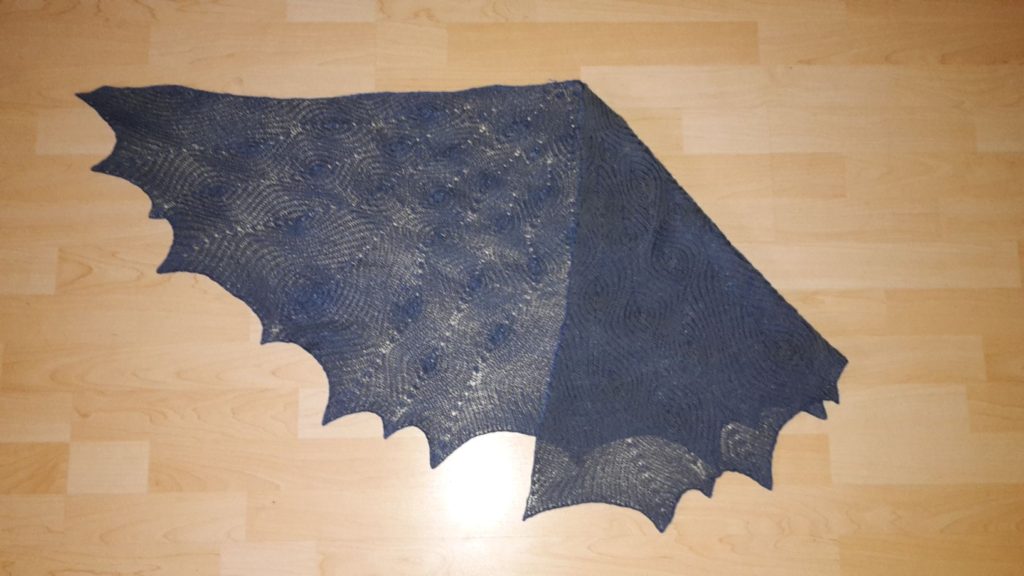
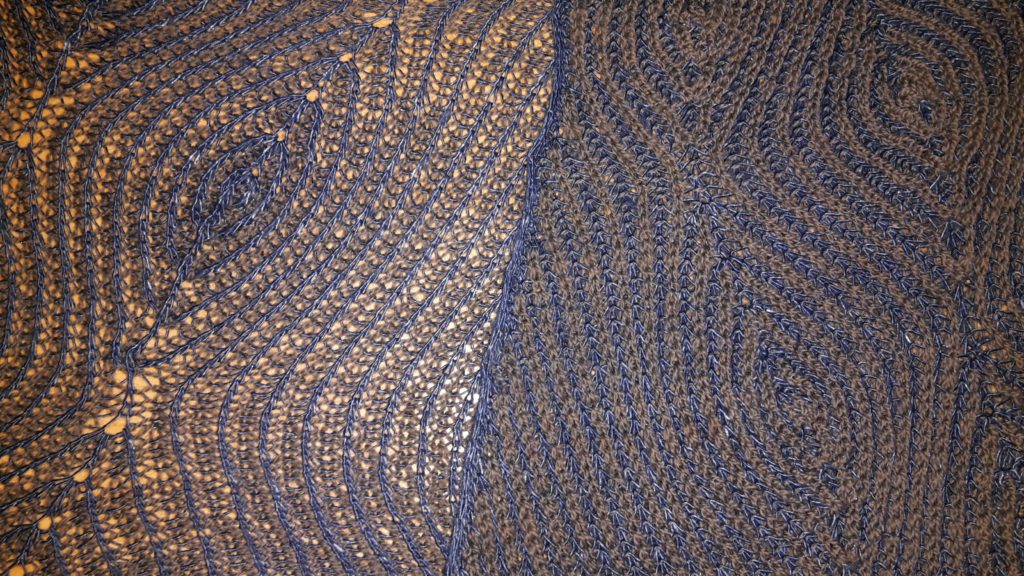
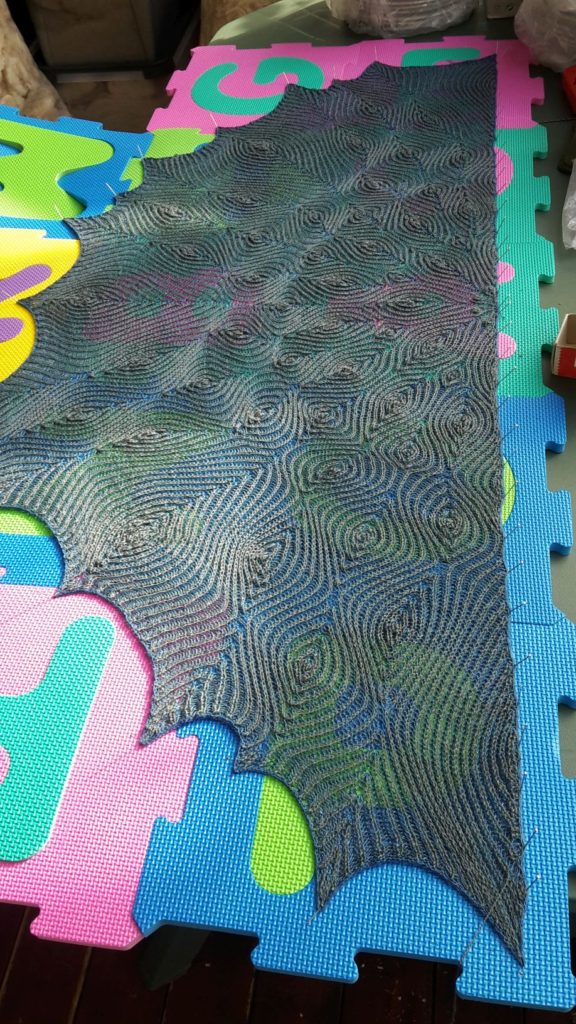
My Arabian Nights shawl is finished. I didn't knit it all to the end, as I want to have it more like a scarf than as a shawl, and since I used lace yarns, not sock yarns, it is a good bit smaller than the pattern states for the original - but I'm happy with the current size, and it definitely is very fluffy and very nice and warm.


Yarns were a two-ply fine wool yarn, dyed by Micky in a wonderful shade of grey, and a silk yarn, dyed with indigo by Margit.


It was my first venture into brioche knitting, and I did like it. The knitting itself was rather mindless, apart from doing decreases, which were a bit tedious, just the thing that I was looking for, though now I'm happy to have this finished and do something a little more exciting next. (Stranded knitting, just in case you are wondering. Time for some colour shenanigans.)

 
0
OKT.
22
0

Knitting Symposium Leiden

To my grand delight, I will be part of the Knitting Symposium taking place in Leiden on November 2 - which includes an adventurous train trip there (with a night train! Yay!). The symposium itself features a number of very interesting topics, including information about current research in knitting history, dye experiments in regard to the silk stockings found in Texel, the experience of wearing such (reconstructed, obviously) stockings, and Citizen Science (which is why I have gotten the opportunity to join in, as I've been involved in Citizen Science before that was a term, it seems).

In case you are in the area, or can get there, and want to join, it looks like there are still tickets available. The Symposium is organised by the Textile Research Centre; you can read more about it (and download the full programme) on their website. You also find instructions for registration there.

 
0
SEP.
16
1

Science News Article

There's a lot of wonderful colleagues in my field (and it's a small field, so you get to know most of them after a while). One of them is Eva Andersson Strand, who has been doing textile archaeology for a very, very long time now. She's also one of the people who feel strongly about the importance of practical work in textile research and reconstruction, and that tools and their use are a wonderful way for us to learn about the past processes in making textiles.

I've had a good number of discussions about spinning with her, which were always vastly interesting - even though we're not completely in agreement in regard to a few things. But I feel that discussions like these are one of the ways that we, together, as a field of science, can progress.

And by now you're probably wondering why I am writing this - well, Eva and her work are featured in a long and very nice article in Science News (for which I was also interviewed, about one of our favourite discussion topics - the influence of the craftsperson vs. the tool in spinning). The article is a well-deserved praise of her research efforts, on a variety of textile tools and techniques, and worth a read - I hope you'll enjoy it!
0

By accepting you will be accessing a service provided by a third-party external to https://pallia.net/

Kontakt