Latest Comments

Guest - Aislinn Dyestuff Citizen Science.
09. Oktober 2026
This is a great project. I look forward to the results. Thanks for letting us know.
Guest - Aislinn Time for...
09. Oktober 2026
Looks delicious!
Guest - Katrin Sprang Discussion
18. September 2026
Hi Rachel, I have looked for more photos of you, but that was not very successful. I found a link on...
Guest - Beatrix Sprang Discussion
15. September 2026
That lozenge pattern element is not a photograph, but a scan. So it should be to scale. But I pinned...
Guest - Katrin Sprang Discussion
15. September 2026
I was not referring to Rachel's reconstruction (is the reconstruction you refer to the one photograp...
MäRZ
01
2

Warping.

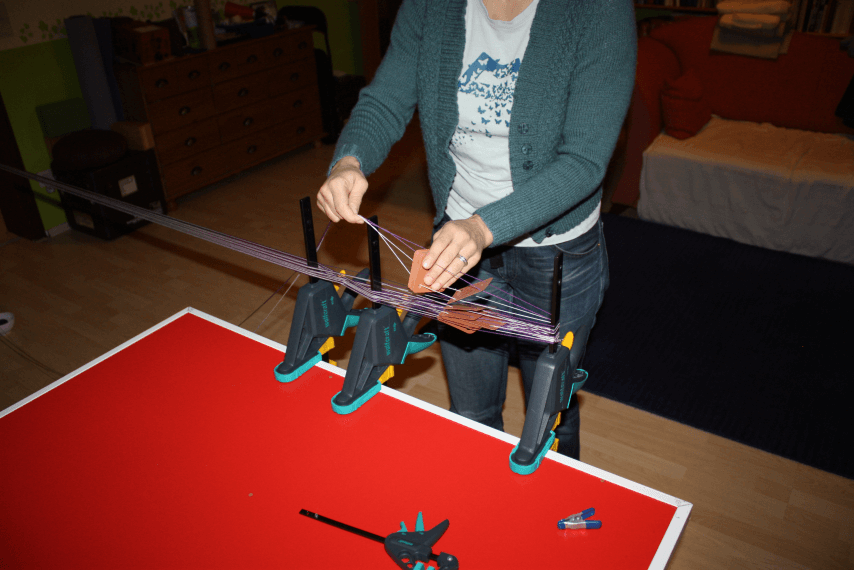
Because I'm busy with finishing up an article, and doing a bunch of other stuff in preparation of the fair season (which includes sorting through the goods inventory, and re-packing and re-organising things), you are getting a random tablet weave warping picture in lieu of a normal blog post:


I am easy to amuse or to make happy in some circumstances, and warping is one of them - I find it utterly satisfying to have the yarn flow out with even tension, and to have a nice, neat stack of tablets building up as I warp. (Which means, too, that my fingers itch to set tablets straight when someone else warps, and it's not a neat stack. Which, when you are showing how to warp to beginner weavers, is almost invariably the case...)
0
FEB.
21
0

Needles, Haystacks, Pins, Sighs.

One of the things on my list of things I would like to do is make a short overview article about the sources for the different kinds of goods I carry - for myself, for the crafters who make these things for me, and of course for my customers. It's one of the things, however, that are usually a) not urgent, b) not crucial for being able to carry on, and c) taking a lot more time than expected or readily available.

From time to time, though, something comes up that prods me into looking for more info, and trying to collect that, and this has happened recently. The things under my scrutiny? Pins and needles. And oh, I can tell you... it's an abyss.

As is often the case, there is a little bit of literature that is easy to find, and that does give some information. For Germany, it's Stefan Krabath's work Die hoch- und spätmittelalterlichen Buntmetallfunde nördlich der Alpen, and for Britain, Chris Caple has written a number of things about pins. In addition, some pins and needles are listed in the context of works about textiles or garments or textile/garment accessories.

Overall, though, this is a group of finds which is hard to find - and even if pins or needles are listed in some archaeological publication, there is often not much information about them. Ideally, I'd like to know the material (brass? bronze? copper? some other alloy?), the length, the thickness of the shaft, the date (which can be a real problem, as these things are typologically long-lived) and in addition, I'd like to have a drawing or at least a photograph. In many cases, there is none of this apart from the mention and a very rough date... which does not help me at all in looking for pieces to get someone to replicate.

Added difficulty: Germans like to use that "needle in a haystack" idiom, which means that it's a very good idea to put "-heuhaufen" in your searchwords (though that in turn might toss out valid results, the usual dilemma).

So I'm looking into articles and trying to get enough material together - to both write up a little info thing, and to decide on what I would like to have made (and then the next step is to find out if the metalworking people I've contacted can, and will, do it).

And this, of course, is where I segue into a bleg - if you have any nice documentation of pins (preferably high medieval, as the late stuff is way easier to get info about), please let me know - I might end up with replicas of these in my shop...
0
FEB.
14
0

More about Lightfastness Tests (part 2)

 
For the industry, which has a considerable interest in knowing if their products will stand the test of time (especially if stuff is intended for outdoor use), there are a variety of tests and testing apparatus available, from placing things into the Arizona desert (yes really!) to simulating direct sunlight with filtered special lamps. Even there, though, a lot of different parameters are not closely monitored or regulated (there's a nice German pdf here about the challenges, from a symposium on the topic of colour fastness).

So if even the industry has some trouble getting comparable results... well. Let's face it: Our household methods will always be squishy. It's like dyeing tests, or so many other experimental archaeology things using natural resources: a huge amount of variables, many of them not easily measurable or not measurable at all.

I had a chat with a conservator about just the topic of how reliable these tests are, or how helpful, because of anti-UV-coatings on windows, a while ago. Basically, what I remember her saying was that yes, some of the UV is filtered out - but as the coatings also degrade with time, it is hard to say what comes through, and how much of it.

However, these household method lightfastness tests usually serve one of two purposes - an absolute indication or an indication of relative lightfastness, compared between different dyes or procedures.

One, trying to get an "absolute", is of course difficult - but if we accept that the absolute is not necessarily comparable to other tests, or will not give a definite number, it can still be useful. A case for this could be: a dyer wants to know if she can use a specific dye method (type and amount of mordant, type and amount of dyestuff, and method of mordanting and dyeing) to get lightfast results. Or someone has fabric or yarn with unknown dye used on it and wants to figure out if the colour will last when used for a garment before investing knitting or sewing time. In that case, as most of the textiles will be used mostly indoors, having a fastness test inside a window will simulate real life nicely enough - and hanging stuff into a window for 3 or 4 months in summer should show if the fade is strong, or within tolerable limits for everyday use. This will, of course, have different results depending on how sunny the exposure time is, what place the test is taking place at, the humidity, the type of glass and so on, but it should still give an indication for the useability of the dye run.

The relative lightfastness, use number two, is our reason for the lightfastness tests. It's intended to give a direct comparison between different dyes or different procedures, in our case if there is any difference in fading between the samples that have a very similar colour to start with. I fully expect there to be fading, even significant fading, as birch leaf is not the most lightfast yellow to start with, and we used weak end-of-year birch to boot, but no matter how strong the fade will be - as long as there is noticeable fade, we will have the possibility to directly compare the fade between similar colours.

Another use for this relative test would be testing the relative lightfastness of different dyestuffs resulting in a similar colour, such as birch, weld, onion skins (widely famed for their rapid fading) and friends (much of what grows green dyes yellow, so there's no dearth of choice here), or testing the relative lightfastness when using different mordants, or different dyeing temperatures, or different lenghts of immersion, and so on. In these cases, as all the samples are stuck into a given place at the same time, and thus have the same conditions over the course of their test, it is again of little matter whether these conditions are normed or not.

So, to sun, er, sum it all up: Yes, lightfastness tests done by sticking stuff inside windows are not really comparable or give absolute numbers, and it's unknown how much bleaching actually takes place through the glass as compared to unfiltered light, but this very simple test still serves its purpose.

If there is a real necessity to make the results a little more comparable, and get something more in the direction of absolute values, there is a possibility - which is using a comparison scale with known lightfastness values as a benchmark. One of the things used for this is called the Blue Wool Standard, a card with textile strips on it that are dyed blue in progressing depths. These bleach out at a known number of megalux hours, so there is an absolute indication of lightfastness of your candidates. If you are a dyer or an experimental archaeologist who needs something like this, you can buy the scales, for instance here. (No, I'm not affiliated in any way.)
0
FEB.
13
0

More about Lightfastness Tests (part 1)

There's been comments about the lightfastness test setup which, in most cases for hobby and smallscale professional dyers, consists of picking a south-facing window and sticking stuff in there for a given amount of time... which is very obviously not a scientific way for evaluating lightfastness.

First of all, though - let's take a closer look at the things that happen when light hits that textile. I've brushed up my knowledge a little bit, but please note that I'm not an expert, and I'm going to put what happens, as I understood it, into very simple terms. If you want the nitty gritty details, you can check out "Chemical Principles of Textile Conservation" by Agnes Timar-Balazsy and Dinah Eastop (published 1998), where pages 88-92 and 225-232 will bring you many insights.
Basically, what happens is that the light hitting the fabric inserts energy, and this energy can cause chemical reactions on molecular levels. One of these processes is photolysis, where bonds in the dye molecules are destroyed, leading to a different chemical structre and thus a change or loss of colour.

The second process, and even more important than straight photolysis, is photo-oxidation. When this happens, a carbonyl group in the dye molecule changes to  carboxyl group, leading to a shortening of the dye molecule and thus a colour fade. This process is usually slower if humidity is very low, and can also be slowed down by an atmosphere with less oxygen (though some colours may fade faster in a vacuum - so you can't be sure if that is good or not). Metals including iron and copper, as well as their compounds, can aid photo-oxydation. Even nastier about this process is that it can result in active radicals such as hydrogen peroxide, which is a bleaching agent, speeding up the fading of the textile.

Different dye molecules are more or less prone to these reactions to light, which explains the varying lightfastness levels of dyes. Both UV light and visible light provide energy for these reactions, but the wavelengths do make a difference.

So... now that we all know, more or less precisely, what happens when the dyes fade, we can get back to testing.
0
FEB.
08
1

Knitting Stuff.

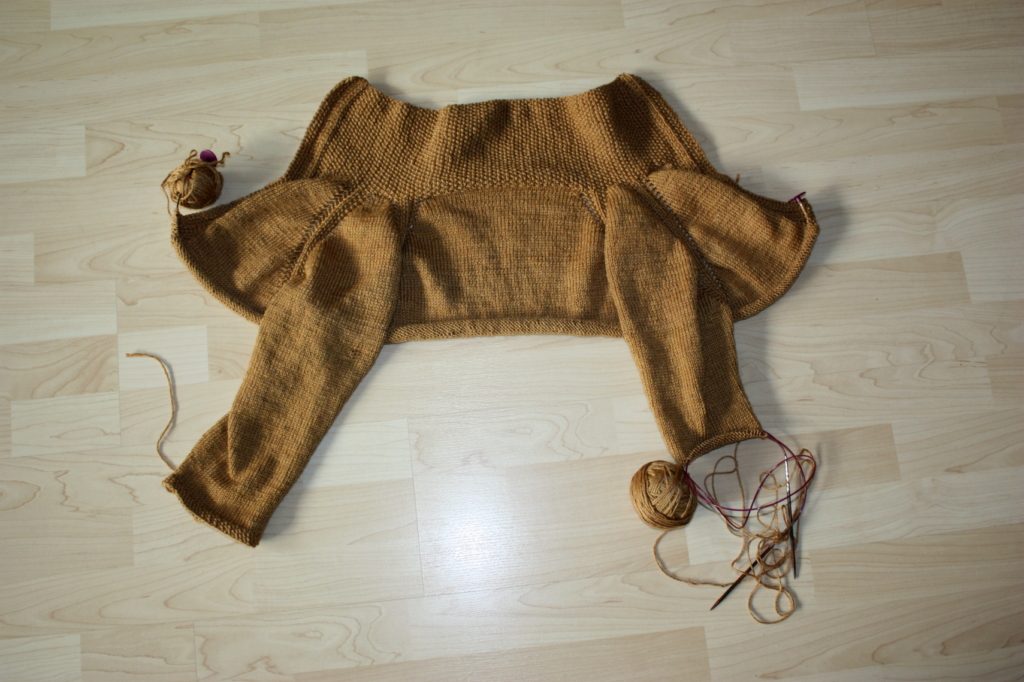
There has been a bit more knitting going on here - some on the train, some in the café, and some at home... which means my current project #1, Vodka Lemonade, does have almost two sleeves now:


I've opted to do the sleeves earlier than the pattern states (which, as usual, lets you knit the sleeves once the body is finished), as I was so annoyed about having the large, heavy rest of the thing hanging around when I was knitting the sleeves on Moyen Age. There's still a bit of residual annoyance with this now, but it's not as bad by far - and I'll find out how much the sleeves will annoy me when I knit the rest of the body.

The brioche stitch travel knitting needs some loving attention with an awake brain at the moment, as I have managed to drop a stitch and now need to figure out how to get it back up into line again... which is not as straightforward in two-colour brioche as it is in normal knitting.

While we're at the topic of knitting, here's the record of train delays as documented in a scarf by a woman commuting in Germany.
0
FEB.
07
3

Links!

It's time for a link roundup again - here you go:

In German: Why a bicycle manufacturer sends his bicycles in cartons with a TV printed on them.

There's a knitting card game on Kickstarter - where you can knit (virtually, and thus much faster than in real life) objects based on actual existing patterns, with actual existing yarns. The video doesn't show much about how the game is played, but if you are into knitting and card games, it might be interesting for you.

Medieval Histories has an article about Viking dress, more specifically: about royal Viking dress.

BBC has an article about women explorers in the 19th century craze for getting mummies and related artefacts out of Egypt and into museums and collections... and modern researchers as well.

Anne Marie Decker has put her presentation about "Charting the Nalbinding of the Nile" online. If you're interested at all in nalbinding, do take a look at this - if only for the pictures!
0
FEB.
06
0

Weaving.

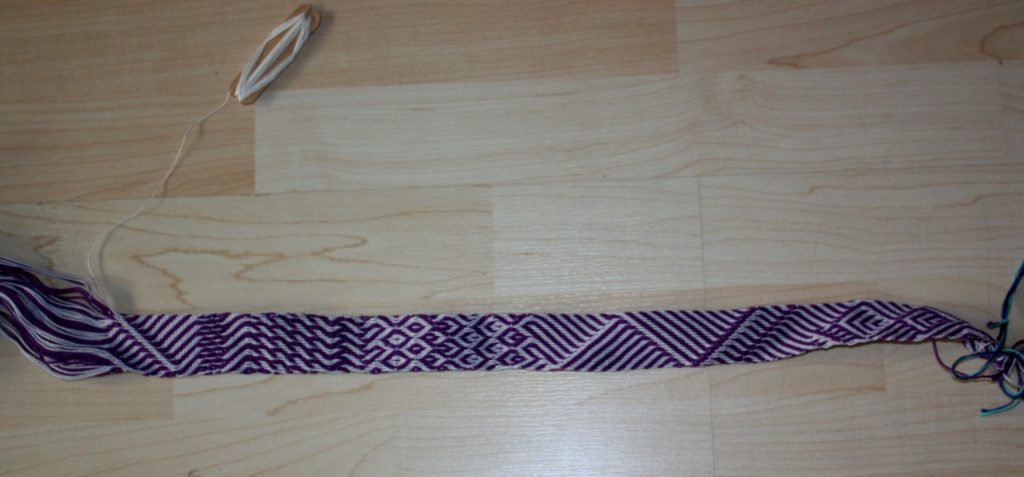
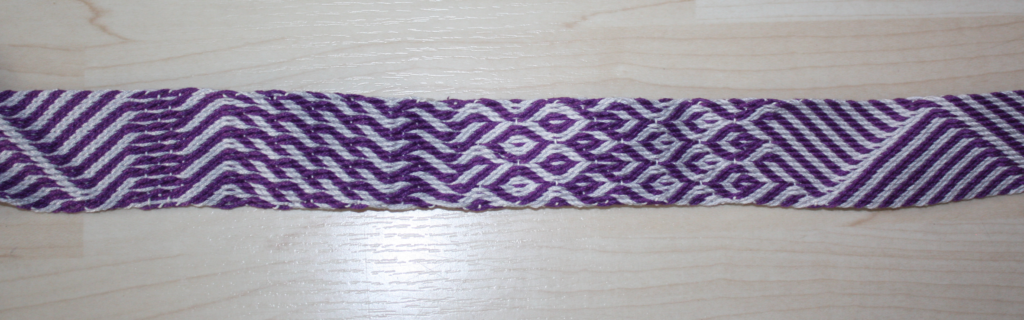
With the bonus warp, I've done some playing around - one thing I wanted to test was using a warp spreader (also known, in this testing instance, as "common comb") and see how this would work for me. Another thing on my list of stuff I'm itching to do was to play around with diagonals - when the ladies in the weekend weaving workshop in Belgium were in the diagonals stage, this desire suddenly jumped into my brain, and there it stayed.

So I spent a little time just fooling around - and I have some more ideas for the next bits.


I'm half pleased with some of the patterns and quite pleased with some others - and the overall impression would probably have been nicer with a purple weft thread instead of the white one, but ah, well, there's a few more metres to come...


... so I can fiddle with these eyes and peacock eyes and slanty bits some more.
0

By accepting you will be accessing a service provided by a third-party external to https://pallia.net/

Kontakt