Latest Comments

Guest - Aislinn Dyestuff Citizen Science.
09. Oktober 2026
This is a great project. I look forward to the results. Thanks for letting us know.
Guest - Aislinn Time for...
09. Oktober 2026
Looks delicious!
Guest - Katrin Sprang Discussion
18. September 2026
Hi Rachel, I have looked for more photos of you, but that was not very successful. I found a link on...
Guest - Beatrix Sprang Discussion
15. September 2026
That lozenge pattern element is not a photograph, but a scan. So it should be to scale. But I pinned...
Guest - Katrin Sprang Discussion
15. September 2026
I was not referring to Rachel's reconstruction (is the reconstruction you refer to the one photograp...
FEB.
04
2

Pfakofen - the answer...

Bruce's comment about the multi-spouted pot being maybe used as a lamp (thank you, Bruce!) was, it seems, not the first one. There's a German article about special forms, though, that comes to the conclusion that these multi-spout pots generally do not work well as a lamp. (See "Lampen im Barbaricum", p. 222, in Armbruester, Tanya, and Morten Hegewisch. Studien zur Archäologie Europas, edited by Joachim Henning, Achim Leube and Felix Biermann, vol. 11, Bonn 2010).
So... the spouty pot is probably not a lamp. Though it may have been used for some kind of drinking games, the one in Pfakofen was found in context with a spindle whorl, and there were cochineal lice inside the pot - placing it nicely in a textile work context.

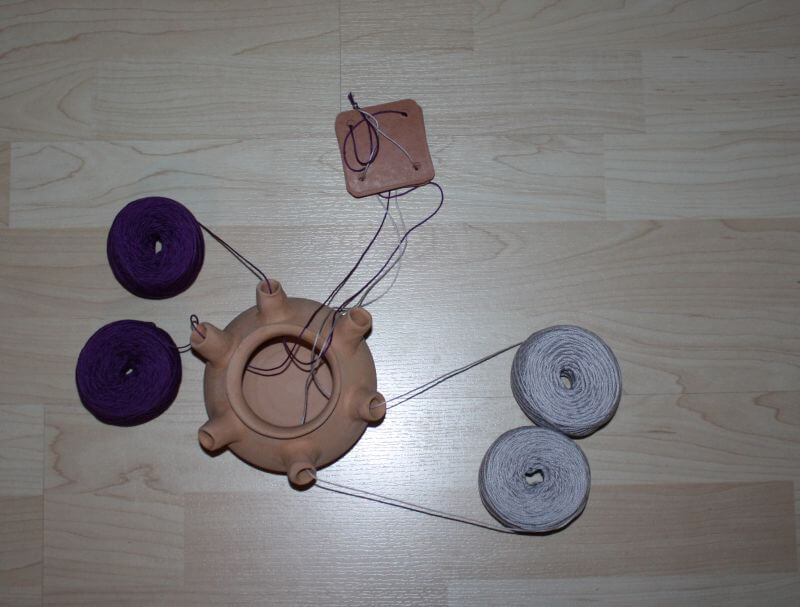
When we were in Eindhoven with the first Textile Forum, there was also one of these pots replicated - and Viktoria Holmqvist mentioned that she'd always wanted to try one as a warping helper for tablet weaving. And so she did - with very good success.

It works like this: You thread the yarn ends through the spouts into the pot and out the middle hole, and then thread your tablets with them.


Then you place the balls of yarn into bowls or similar containers, so they don't roll about the floor like crazy, and you can start warping.
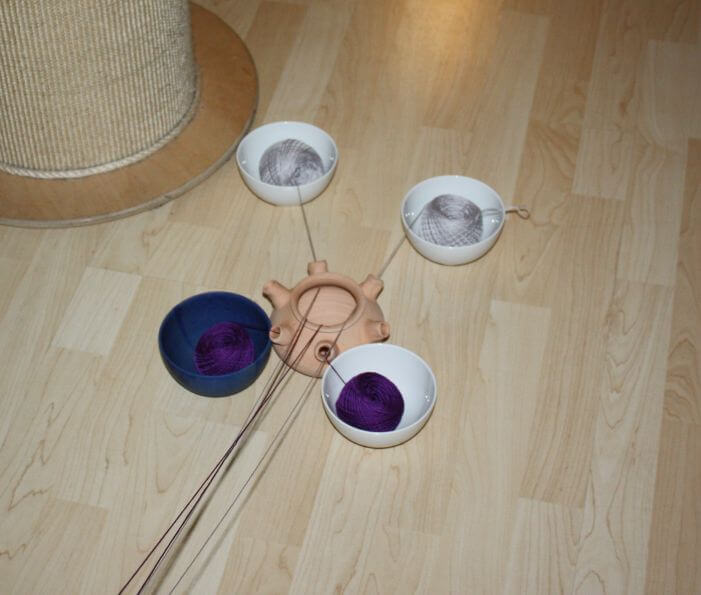


The trick is to pull upwards - if you do that, you will get a really smooth, evenly-tensioned flow of yarn from your spouty pot. I've tried this with a 5 m stretch between the warp end posts, and it still worked nicely, provided you pulled up (or as up as possible); for an even longer warp, I'd set a zigzag course instead of a straight line for warping, and then more length would not be an issue at all.

I've made quite a few warps, and pulling up is always a good idea, but using the pot makes things just... smoother, more evenly tensioned, and much, much more fun.

Bonus feature: It looks like dancing.
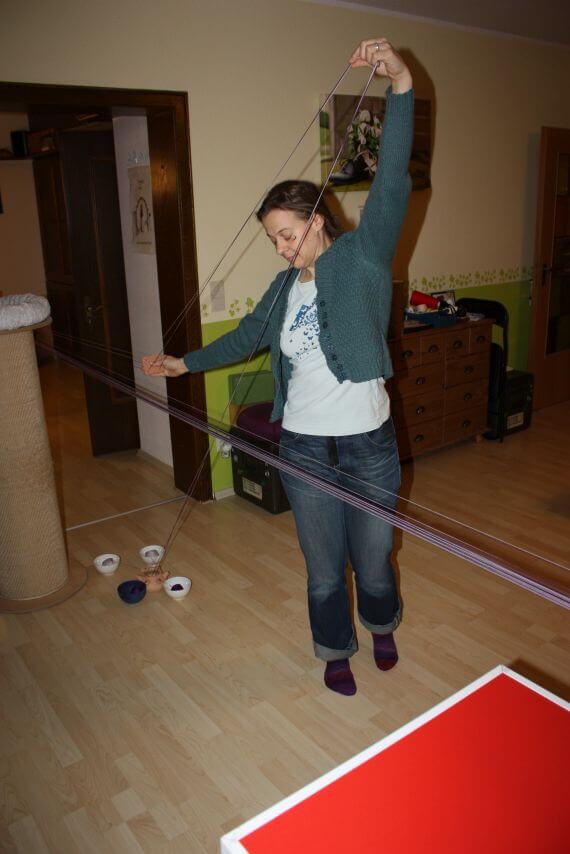


Second bonus feature: I now have a 5 metre warp with 20 tablets to play with...
0
JAN.
17
0

The Power of the Mantra.

Recently (as in "in the last few months"), while exploring new techniques and learning things and doing pattern weaving as well as teaching stuff, it occurred to me how much I mantra-mutter to myself when I am learning, or doing more complex things (or even not so complex things that are new).

When I have a new technique, even if it's an easy, repetetive motion, I find that it takes a good while for the thing to imprint itself in my brain deep enough so it runs on itself. Take sprang, for instance - I've been doing the basic interlinking often enough now that I don't have to pay much attention to it anymore. I know how it is supposed to look at each stage of the thread manipulation, so I just watch my fingers dancing their way across the threads, and in case something untoward happens, I can stop and fix it. Double-layer sprang, though, is still a different beast, so when I sit there doing it, I mutter (or at least thought-mutter) "front layer, back layer, front layer, back layer" all the time, all the way through.

The same with knitting. That brioche stuff is still so new to me that there is a little voice singing out to myself "yarnover and slip, brioche knit, yarnover and slip, brioche knit" all the time. I know, from experience, that at some time this voice will not be audible to my inner ear anymore, though it probably will go on somewhere in the back of my brain. Which means that should I mess up and drop out of the sequence, it will be noticed in a timely(-ish, hopefully) manner, so I can stop and fix it.

When I do tablet-weaving, there is a whole bunch of things to mutter to myself - the work sequence, where the main diagonal slants when I turn the tablets this way or that, whether this is a pattern block or background twill, where the edge of the tablets with two dark threads stands. (Top. Band. Bottom. Warp. Top. Band. Bottom. Warp.) If you could hear all the things I think to myself, over and over and over again, your ears would probably bleed. Hell, sometimes mine start to itch from hearing the same things over and over and over again.

I was wondering, at one point, why I do this. Surely it ought to be possible to work a simple thing without telling myself how to do it all the time, for hours and hours?

Turns out... this seems to not be the case. I have often joked (or, let's face it, half-joked) that I have trouble counting to two when working textile techniques. I don't know why I need the mantra-like mumbling to myself most - but I have found that it is keeping me concentrated on the simple, yet still not ingrained task at hand. It makes it easier for me to look and imprint on my mind, again and again, how my threads should look at each specific phase of the manipulation. Much later, this becomes a subconscious thing, but until then, the mumbling helps. A lot.

So I have decided that mantra-mumbling is a wonderful tool to use while learning. (Best, of course, not done loudly enough that your workspace neighbour can participate.) And I have come to terms with needing a while before the little voice goes quieter, and starts to recede, and only goes on unnoticed in some back corner of my head until my fingers make a mess by accident.

What about you? Are you a mumbler too? And has it ever felt weird to you?
0
JAN.
16
0

More Travel Knitting Stuff.

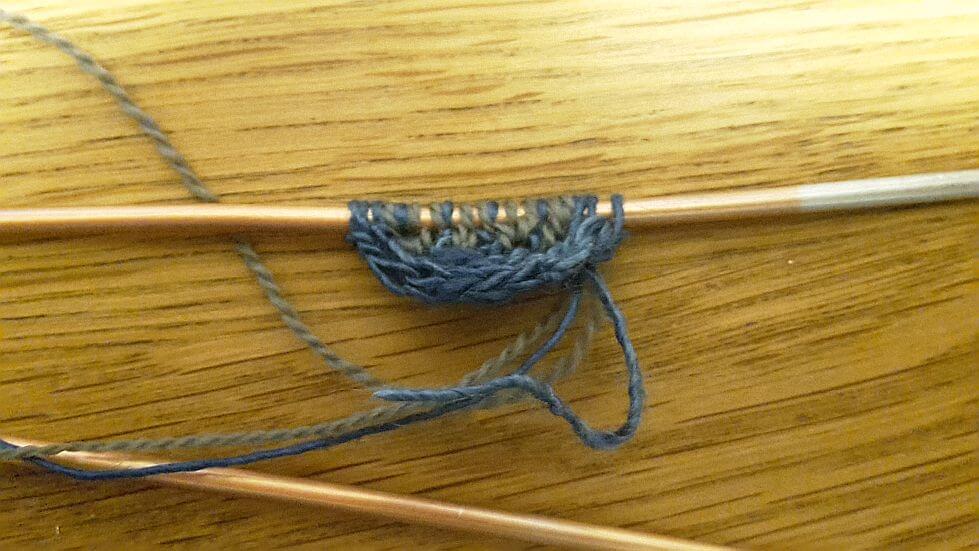
So... I've swatched (to get an idea of how to do the brioching thing), I've cast on, and I've made sure the travel project actually does fit the "travel project requirement" - which is, coincidentally, "fitting into the project bag".


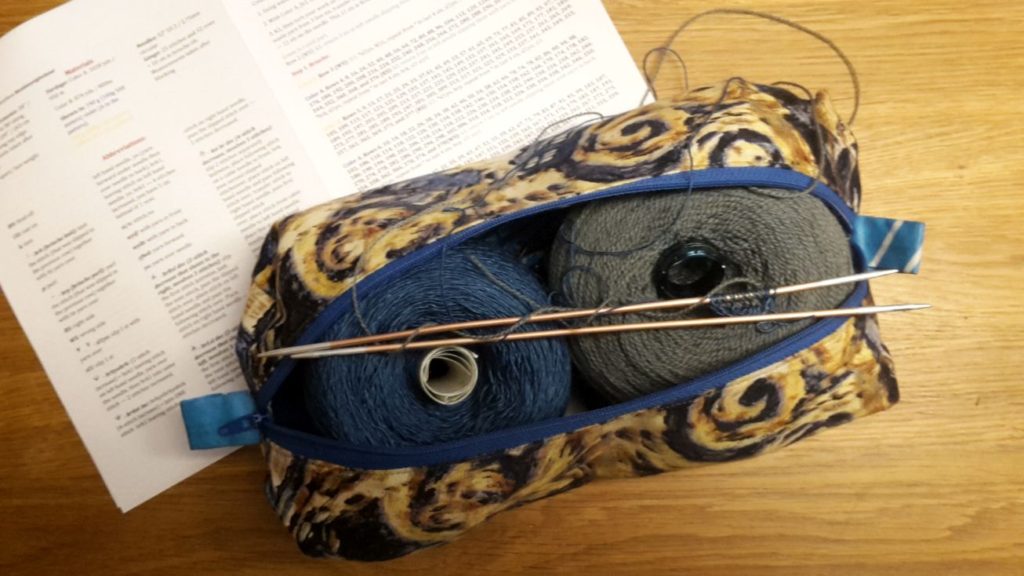
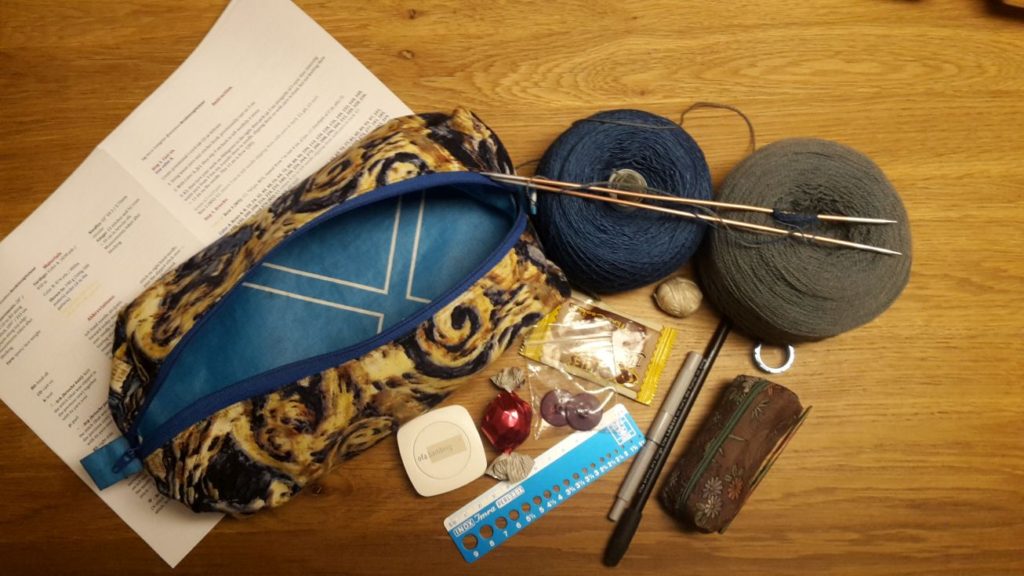
You can see all the stuff that lives in there, permanently or temporarily. Permanent inhabitants are: measuring tape, a pencil (with eraser endcap), a needle gauge/ruler, endcaps for the interchangeable needle cables, a bit of string, my row-counting ring, the little bag for stitch holders and darning needles and cable needles, and last but of course not least an emergency cookie and emergency chocolate. (You never know.)

Non-permanent residents are the needles for the current project, the yarns for it and the printed instructions (or in some cases, when the instructions are on my phone only, a bit of paper to scribble notes on).

Unfortunately, the bag is not bigger on the inside, probably because it's the Exploding Tardis motif and not the proper, normal, intact one.

In any case, to be deemed a travel project, the thing has to fit inside. In this case, it just does:


So. Train pastime - checked.


And since this is rather slow, meditative knitting, I will surely not run out!

 
0
JAN.
15
0

Knitting Links.

While my honeypot Vodka Lemonade is progressing nicely - I'm a bit below arm separation now, and it's mostly plain stockinette for the moment, nice, breezy, easygoing knitting - it really is too cumbersome to take along on a train trip now.

So I spent a little time on Ravelry in search of a nice portable project, preferrably some kind of scarf that would be reversible. (Speaking of reversible, here's a fun little article about how to make reversible cables. Which is sort of genius - I'll have to try this one day!) After a while of looking, I finally found a shawl pattern called "Arabian Nights"... something using two-colour brioche stitch, worked flat. Aaah. New things to figure out!

Brioche stitch, for those of you not clued into that yet, is a combination of slipped stitches and yarnovers. It makes a reversible, rib-like, cushy fabric. Worked in two colours, you get the one colour as knit-looking on one side and purl-looking on the other side... which is something I find very nice in general, and the Arabian Nights pattern looks mesmerizing to me with this effect. Here's a tutorial in case you are curious on how to knit brioche in two colours. The downside? Much as in illusion knitting, you need to work two rows to get one visible row, unless you do wild shenanigans.

Anyway, I'm now going to find out a bit more about this, and fiddle with it a little so I can have a project with me when I travel to Liège on Friday. One needs to fill one's work breaks somehow, right?
0
JAN.
09
0

Vodka! Lemonade!

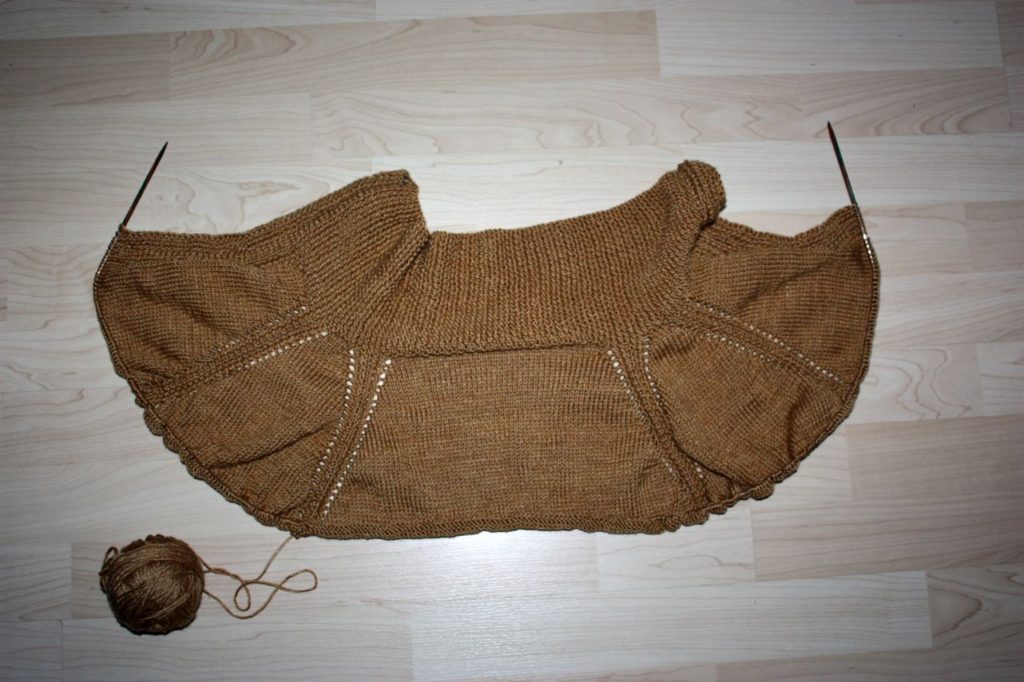
I mentioned knitting being done in those past days, right? Well, here is the current status of the result of knitting:


That is "Vodka Lemonade" by Thea Colman, a cardigan with raglan sleeves, knit from the top down. I'm using Margit's naturally-dyed "Understatement" yarn, and the colourway is called "Honigtopf" (honeypot).

I'm already looking forward to wearing this thing, both the feel and the texture are just so nice! There will, however, be need for something additional, small, for my needles for the upcoming travel to Méry, where I won't want to lug along a half-finished cardigan...

(There's still a very few spaces left, by the way - so if you want to join in at the Weekend Weaving Workshop, you still can!)
0
DEZ.
05
3

Library Day!

Today was a library day - I'm writing on an article about clothes on a ship depiction, and that needed some research (plus bringing back some due books I had loaned out for that article), so today was spent among books, with a nice lunch break to meet a friend.

Which means that you get a gratuitous, late-in-the-day textile picture:


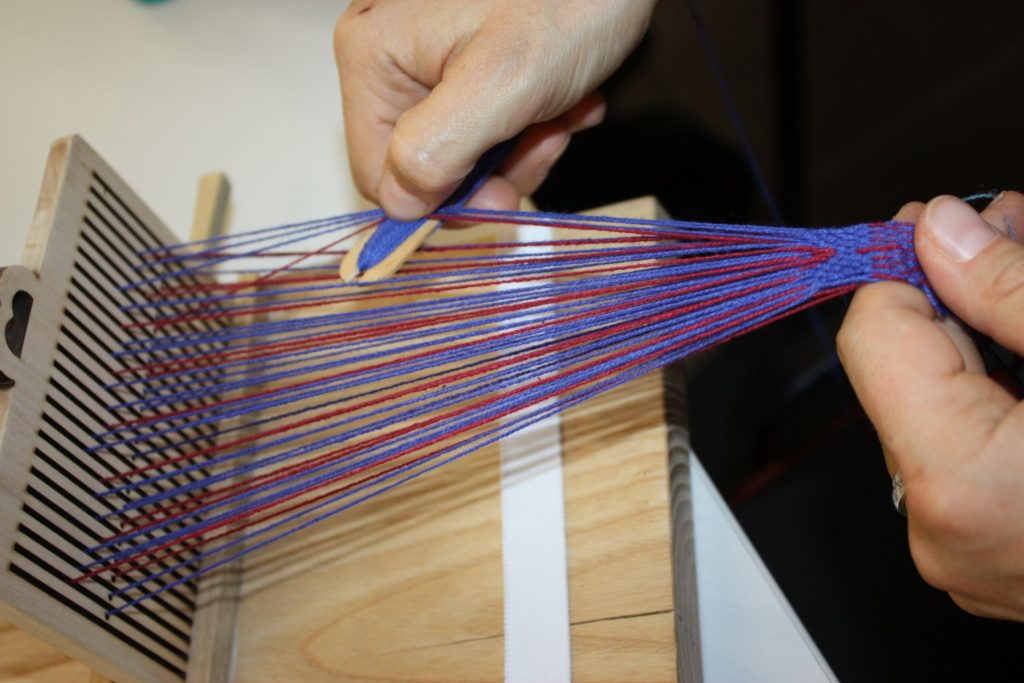
This is my try at weaving rigid heddle pickup patterns - something I had wanted to do for ages, and I finally got around to trying it at this year's Textile Forum. It was... not exactly what I had expected, and it is one of the techniques that are more "meh, don't need to do that" for me.

The basic principle is simple: You have threads in two colours, and you can let the non-background colour come do the surface by picking it up and suppressing the background colour threads between your pattern colour threads. Basically, this means you can do anything at any time (as opposed to twill tablet weave patterning, where the ground structure gives you a framework that you cannot break through). Which, it turns out, is a degree of freedom that I found awkward to handle... plus I did not really care for the many long floats on the back of the band.

That said - I was really happy to have finally tried this!
0
NOV.
30
2

It sprang from the frame.

With the sprang workshop at Rothenfels coming up, I have caught another instance of the sprang fever - so when there was a little time at the Forum, I made a very narrow but long-ish setup for sprang, and I did a few twists and turns on it now and then.

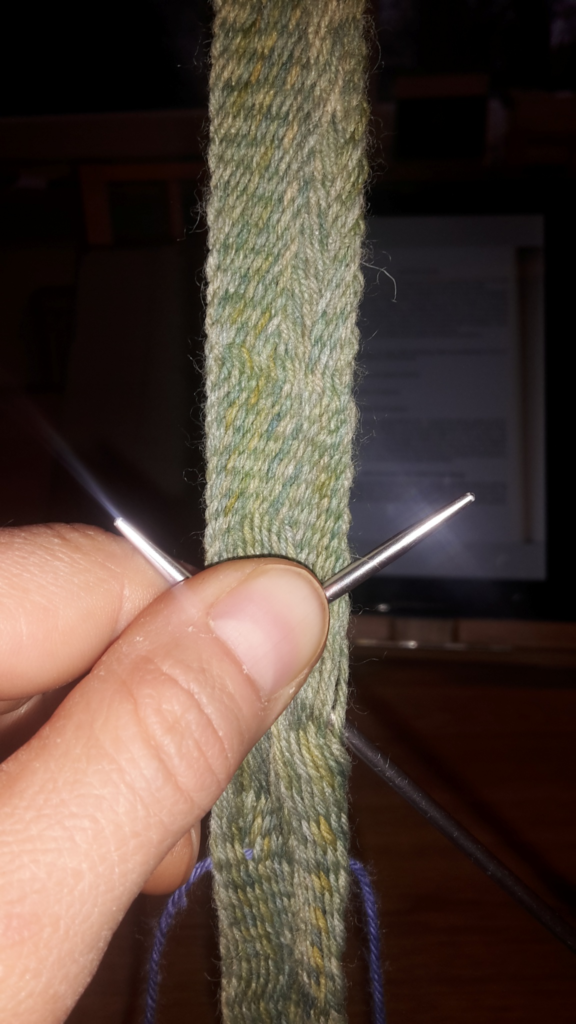
Today, during my lunch break, it came off the frame... finished, with some random patterning (and a few mistakes I was too lazy to fix). The patterning was made to explore transitions between s- and z-slanted interlinking, and to take a close look at how things look when they are right. I also got to test how alternating s- and z-interlinking makes a true braid in 1/1 oblique interlacing - the actual thing I did have in mind to try when I made this setup.

Towards the end, it looked like this:


I remember how utterly awkward it was when I tried the first time to work the last centimetres with knitting needles... but at one point, it sort of clicked, I found what kind of motions I need to make with the needles in order to sprang my way happily across the threads, and now it's actually comfortable. There is a point, in fact, where I find it much more awkward to still press my fingers into the shed, though still entirely possible, than to switch to nice thin pointy sticks.

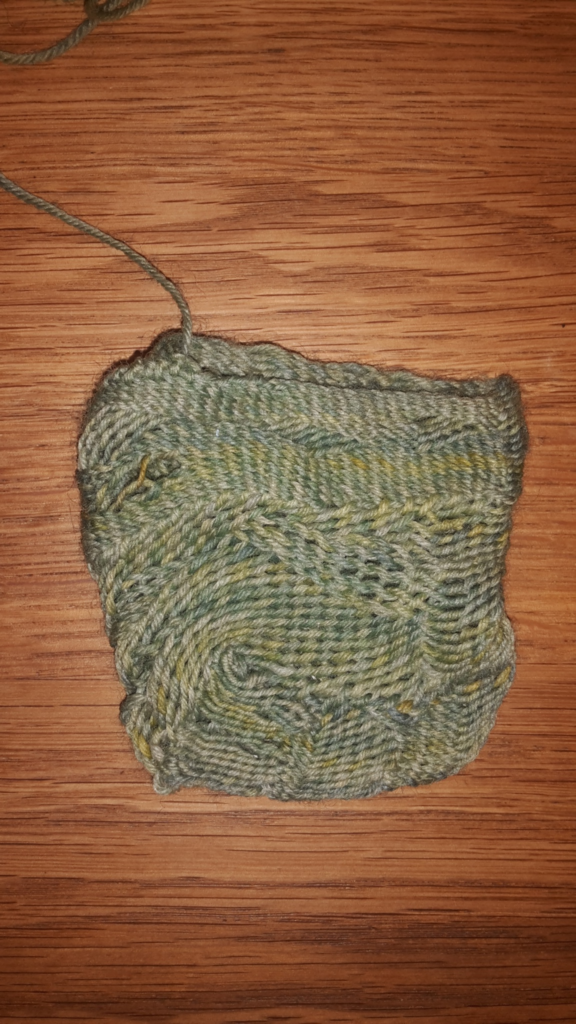
Anyway, I worked my way across, I tried (succesfully) combined s- and z-interlinking with the needles instead of my fingers, then finally chained up the thread bits in the middle... and then I sat there with one long, narrow strip of stuff.

Which I promptly coiled up, sewed together, and now I have a small, fancy-looking bag with an unstretchy top edge:


Now I only need an idea what to use it for...
0

By accepting you will be accessing a service provided by a third-party external to https://pallia.net/

Kontakt