Latest Comments

Guest - Aislinn Dyestuff Citizen Science.
09. Oktober 2026
This is a great project. I look forward to the results. Thanks for letting us know.
Guest - Aislinn Time for...
09. Oktober 2026
Looks delicious!
Guest - Katrin Sprang Discussion
18. September 2026
Hi Rachel, I have looked for more photos of you, but that was not very successful. I found a link on...
Guest - Beatrix Sprang Discussion
15. September 2026
That lozenge pattern element is not a photograph, but a scan. So it should be to scale. But I pinned...
Guest - Katrin Sprang Discussion
15. September 2026
I was not referring to Rachel's reconstruction (is the reconstruction you refer to the one photograp...
SEP.
12
2

I've done it.

For ages and ages, I have dreamt of this. Well, admittedly, my dreams were a little bit more spectacular, but still - I've done it.

I have woven an animal.


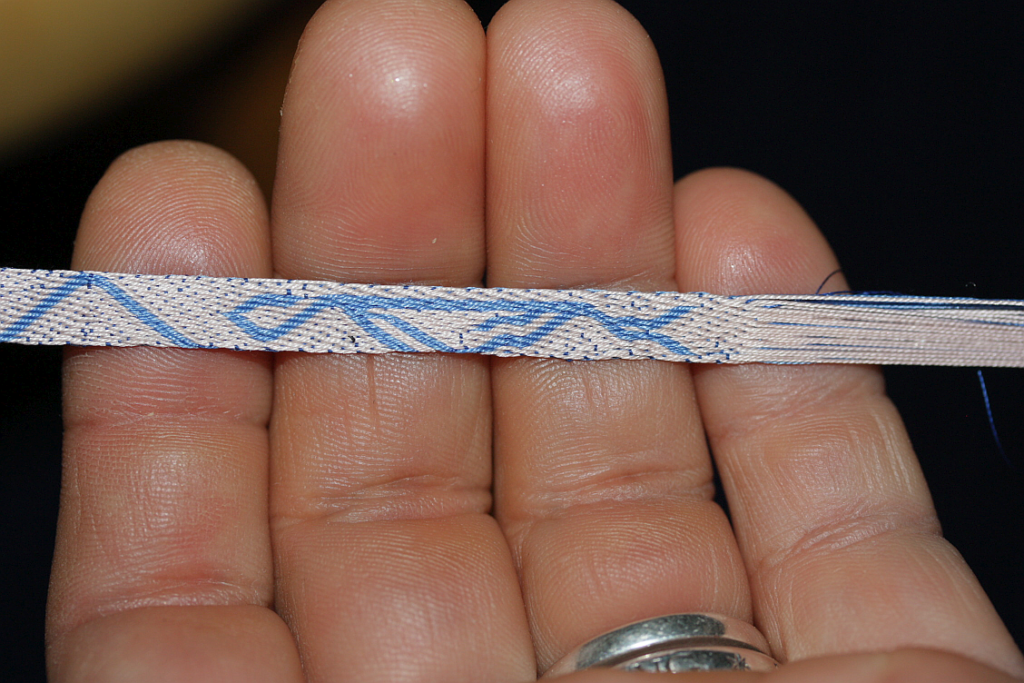
It's not looking very spectacular, and it's not a very complicated animal (which would actually be rather difficult to achive on only 12 tablets), but it is one. And I was utterly, utterly happy to have managed this...

... not because it is the most beautiful little animal that was ever woven (far from it!). But because it means that I have finally cracked that nut and figured out the system to weave patterns freehand on a twill background.

This was done without any pattern or sketch, starting from a base with all diagonals running into the same direction, using the newly-rediscovered system to change diagonal slants. It's a humble, ugly little animal that looks a bit like it is vomiting, but I'm very, very proud of it.

So... now I will progress. To more, bigger, more complex animals that might actually resemble real living beings so much that you might be able to recognise what it's supposed to be...
0
SEP.
11
2

More Tablet-Weaving Shenanigans.

I haven't progressed to the wide playband as quickly as planned - I got a little held up figuring out some more things with the narrow one, as there are (as always!) one or two little more details that need some more verification.

Making the direction change at the end of the pattern section, where the block of tablets turning together to form the different-coloured stripe serves as orientation, though, works very well. It also has the nice side effect of keeping appearances neater - probably because the slightly increased wonkyness of the fabric is counteracted by the firmer structure of the several-turns-in-one-direction band.

[caption id="attachment_4019" align="alignnone" width="640"] The two light triangles on the left are woven with the directional change at the start of the pattern, the ones to the right with the change at the end.
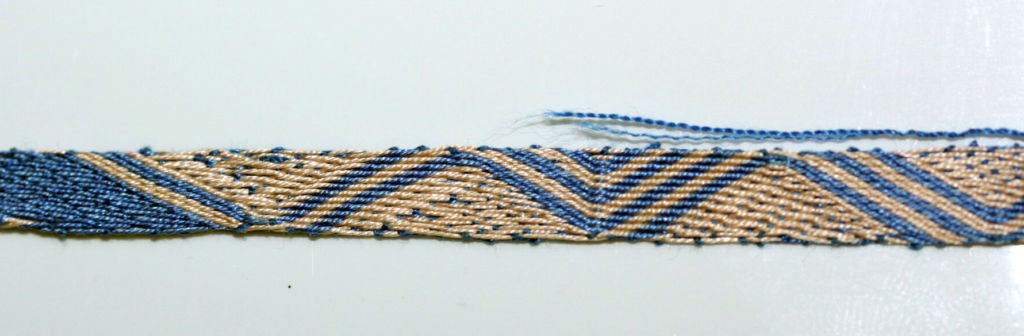

Or it was sloppier weaving on my part in the section before... or it was all the mistakes made. Hm. Whatever the reason - whether fewer mistakes or better weaving - it does look nicer now, and it is so, so much easier to work.

After figuring this out, I played around some more... and obviously I ran into some new, exciting (well, more or less exciting) problems. One of them was quickly solved, thanks to the input of the Most Patient Husband of Them All - I had accidentally done a second direction change after five picks instead of six. Odd numbers are, in this case, not a good idea, and five is right out. Aaaah. So you don't only have to tell left from right, count up to two (or multiples of two), and tell dark from light, you also have to tell odd from even.

That, though, is something I should be able to do. In fact, it's not hard at all - you just need to look at whether your shuttle is on one side or the other side of the band, and then remember that there is a "good side" and a "bad side" (which has no cookies, but horrible things in store for you) and only do direction change shenanigans when the shuttle is on the good side.

So next time I sit down at the band, there will be some Y shapes... and hopefully my current theory will work out.

Also up for getting solved? How to pour all these little rules and theories and things to know and keep track of into a format that will let others follow me when I talk about all this patterning craziness at the European Textile Forum...
0
SEP.
10
0

D'oh.

Sometimes, you puzzle over something and puzzle over it and try to find a good way to keep track of what is happening and how to count to two and keep right from left. At least that happened to me in the occasionally ongoing tablet weaving project, where I'm still trying to figure out how the weavers back then managed to weave those intricate patterns without swathes of graph paper.

So. I finally sat down once more and tried to count to two, keep track of those double-turns, start with double-turning the correct tablet, and keep left from right. Like so many times before, I was not able to do it. Again.

Short explanation of these semi-coherent ramblings: When tablet-weaving patterns on a twill base, you need to make sure your base slants in the correct direction. If your slant is wrong, the pattern comes out wonky.

This means that if you want to weave a triangle, you have to change base direction somewhere inside it, or the second side of the triangle will look really, really shitty.

There are two ways to change that slant, one more modern and one historical. The modern one is easy - you weave to the middle of your triangle (or triangular section of a larger pattern or motif), then swap the turn direction of all your tablets, done. This works, but gives you lots of float lines in the middle of the pattern.
For the historical one, you only change turn direction of every second tablet, and you do that sequentially. For this, you either let a tablet stand idle or double-turn it, and one of my problems was knowing which one to pick to start the sequence.

Sigh.

And then, suddenly, I was wondering about the rule to know which tablet to start with. Because there must have been a rule, depending on, probably, slant direction and number of tablets in the pattern part. And then I was thinking that this would mean thinking ahead and figuring out beforehand how many tablets would be involved in that pattern part... and that would mean even more counting, and more keeping track of things, so more brain work. Which is, according to my theory, something you want to avoid.

Not because I'm thinking folks back then were stupid. No, because you want to have as much brain capacity free for keeping track of the things you have to keep track of, and on making your pattern look nice and shiny. So my rule for the tablet weaving system is that everything that can be made a rule and shoved into the backbrain will be made a rule.

Such as the direction the tablets in their packs are turning (always towards each other) and the direction the stripes are running when I turn the whole pack into one direction. That does make things easy because I only need to look and I know what my base pattern slant is, for instance.

As I was wondering about these possible, yet still-unknown-to-me rules for the double-turn tablet, I suddenly thought about trying to do the direction change not at the start of the triangle... but at the end. After I have decided, spur-of-the-moment, that the thing is large enough now and I am going to close it.

Well. What can I say except "D'oh" and "why didn't I think of this much earlier". Turns out that this makes finding the tablets that need to double-turn so, so much easier - it basically reduces all the problem to "look at your tablets, check if they stand correctly, and if not, make it so". Which is totally fitting in with how I figure that a lot of the original weaving was done, and makes things much more relaxed and much more logical.

So now I'll be going for a little more practice with this stuff, first on my 12-tablet trial warp... and then on the larger, 42-tablet trial warp. Because sometimes you just need some room to play, right?
0
SEP.
03
0

Season's Delights, part four.

More apples. Well, to be precise: One apple.

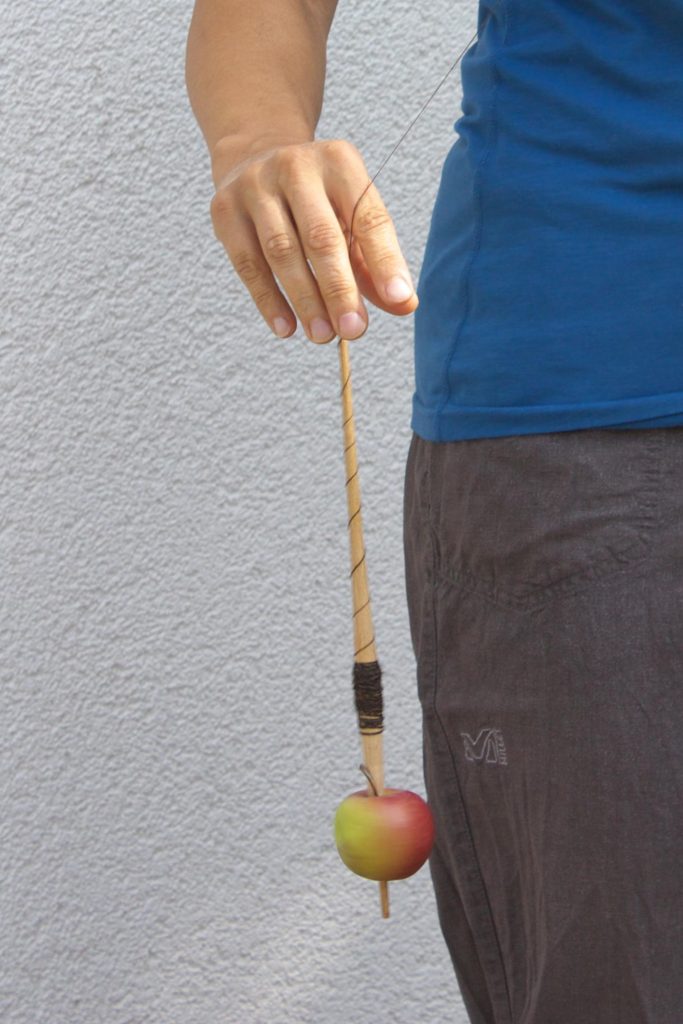
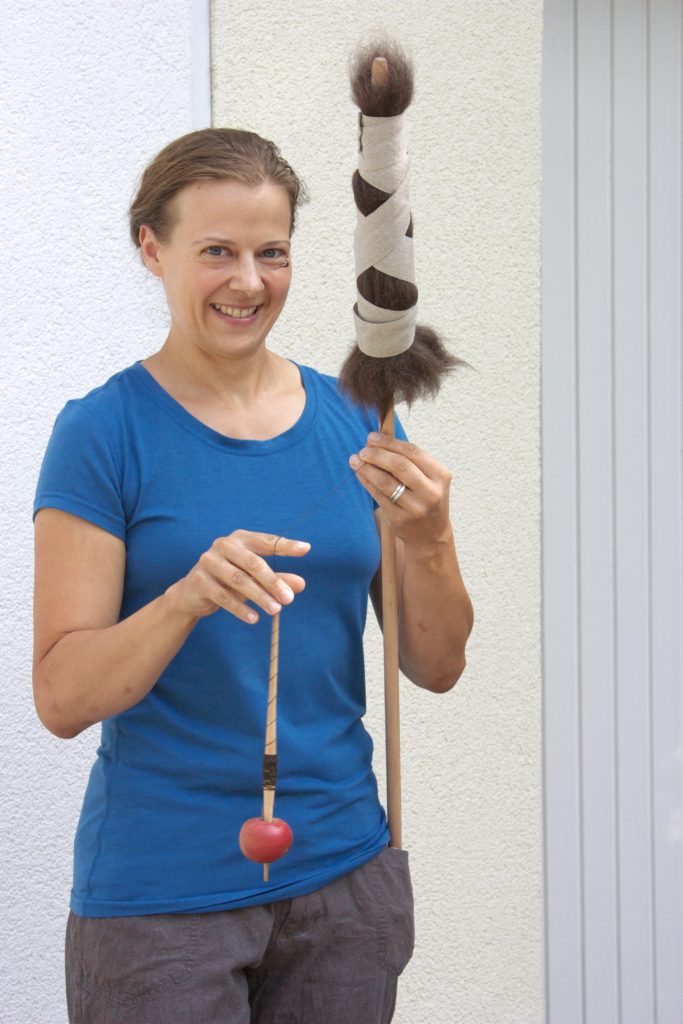
Remember the post about choosing whorl weights a few days ago? You can now also find that post on my main page, both in English and in German, as part of the spinning info material. And because things are always nicer when there are a few pictures to go with them, I asked one of the best neighbours of all time if she would take some photos... of me spinning.

With an apple on the spindle stick.


One apple to make the spindle weigh 50 grams. It spun nicely, even though it was a tiny bit lopsided, and actually a little heavier than I would have felt was necessary, but it was still no problem to spin my usual thickness with it.

Also... fun was had while doing it. Much fun. And if the spindle is too heavy, you could always make it lighter by carefully nibbling your way around the whorl!

0
AUG.
24
0

Whorl Weight Choices

"What whorl weight should I choose?" is one of the questions I get very frequently - and as with so many questions, there is no single clear answer.

In my experience, whorl weight and spindle weight are a very personal thing. I've made good experiences with whorl weights of about 25-35 g for beginning spinners, and that is also what I pack into my starter kits. There are, however, always a few people who feel better spinning with a lighter or a heavier whorl.

According to my experience over the years, and also to the results of the Spinning Experiment back in 2009, the only thing that the weight of the whorl will definitely mean for spinning is what I call a "running quality control". If your spindle weighs 40 g, you can be sure that the thread will, at any point, be able to sustain a 40 g load or tension (provided you spin suspended). For somebody who spins for a weaver, as most spinners, historically, will have done, this is a crucial thing. If the thread breaks while spinning, it's not something you rejoice over, but it's also no big deal. You pick up the spindle, fluff up the end of your thread, re-connect it to the fibre supply, and on you go. A thread breaking on the loom is an entirely different story and much less fun, plus much more work to fix, so the last thing a weaver wants are unreliable, breakage-prone threads. Hence a running quality control would be a very good thing. That does not mean a yarn spun on a lighter spindle may not be able to hold the required weight, but you don't have this running quality control built into the process.

The rest of the spindle weight is, within a rather large range, doing nothing to influence spinning in regard to thread thickness. This mostly happens in the head of the spinners, who have, in many cases, heard "light spindles for thin thread" so often it becomes a self-fulfilling prophecy. A lot of beginning spinners are also afraid the spindle will drop if the thread is thin. My advice is that you should pick a spindle weight (and a whorl shape) for something that feels good to you and that twirls nicely in your fingers. Here, biomechanics come into play. If the spindle is too heavy, or too light, it will not be as easy to flick into a quick rotation as one that is in your personal good weight range. It's a little like throwing a ball - if you want to hurl it a long distance, and the ball is very light, it will be awkward and hard to throw. If the ball is too heavy, it's also hard to throw for a long way; but inbetween, there is a range of weights that you will be able to throw far (and not hurting your shoulder in the process).

Personally, I tend to use heavy spindles, even for the relatively thin threads that I usually spin. As my spindle stick fills with yarn, there comes a point when I feel the spindle doesn't turn as nicely as at the beginning, and at this point I will exchange the whorl for a lighter, smaller one. For me, that results in maximum efficiency when spinning (and also in maximum pleasure).

So depending on what kind of yarn people want to spin, their biomechanics, what they are used to, their spinning style, preferred fibres and probably some other squishy factors, there is no firm rule or guideline to tell which spindle weight and whorl shape they will find best. The good thing about medieval spindles, though: You can stick on about anything that has a hole in it. So if you are unsure, get a spindle stick and try out random stuff as whorls - wooden toy wheels, glass beads large or small, stone beads, stone donuts, clay whorls, clay beads, things in different densities and shapes. Stick on a small apple if you feel like it. Or a potato (not for historically correct medieval spinning, though!). Then once you have an idea of what works for you, you can get exactly the whorl you want.

Or whorls. Spindle sticks and their knobbly companions, after all, are herd animals...
0
AUG.
22
1

Knitting News.

There's been some knitting in the past weeks - not insane amounts, mind you, but a little bit.

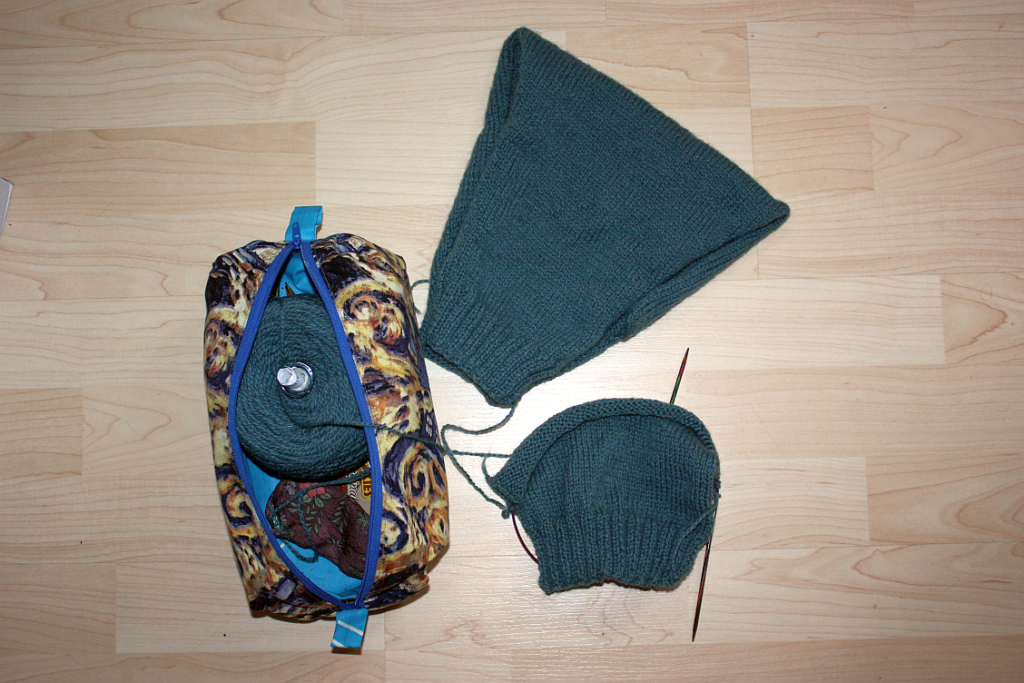
The Cushing Isle Sweater went on a little hiatus while we were on our paddling trip - I had almost finished the first sleeve, and I did not want to run out of knitting while on holidays, which would have been a distinct possibility... so something else needed to take over for a bit.

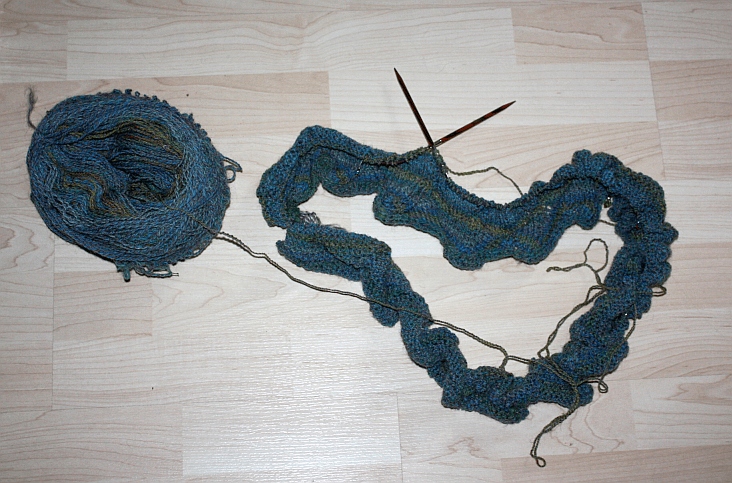
Enter Siren Song, a pattern for a scarf which needs an appropriate amount of yarn to make something out of the hand-spun mix I still had hanging out here, all 458 m of it:


And that was about all I managed to knit during the paddling trip. (It's more than it looks like, though, since the scarf is knit lengthwise...)

So now that we are back, the cardigan is back on top of my knitting list, and by now the first sleeve is finished and the second one is underway.


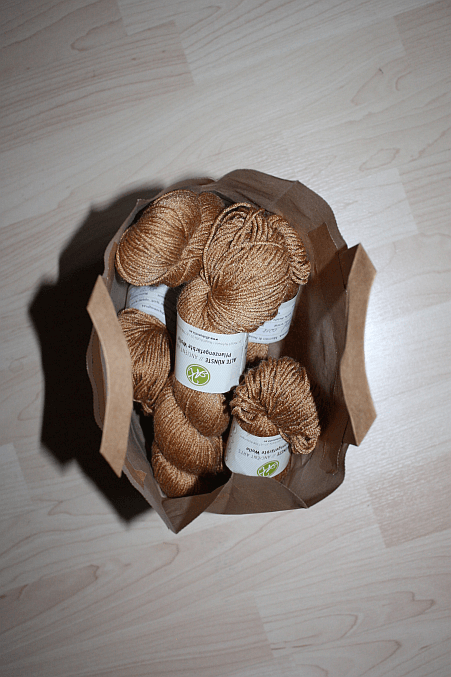
I've also done a little testing to make sure the buttonholes will fit the buttons I have for it, and I'm all excited to get this one all done and finished... also because there's another lovely pattern lined up and waiting to be knit: Vodka Lemonade.

There might have been a little accident this weekend where I happened to mix up left and right. I might have turned right into Margit's room instead of left into mine, and while getting my bearings, I might accidentally have picked up enough yarn for me to knit said Vodka Lemonade cardi.

Might.


(The colourway is called "Honigtopf", honey pot. How fitting.)
0
JULI
05
0

That's a different kind of fence...

There's been a hype (or something sort of like a hype) for knitting on big needles for a while, even extending to knitting huge, extra-thick blankets or rugs out of wool top (though why anyone would want such a dust-gathering blatant invitation to a moth infestation that is heavy and cannot be washed, totally eludes me). Now personally, I'm more a fan of small needles and small stitches, though I will make exceptions for nice lace patterns.

This, however, is pretty cool: A garden fence knitted in a lace pattern.

That, for me, would actually be a reason to take up fence poles (or curtain poles), dub them "knitting needles" and have a go. Luckily, we already have a fence, so there's no ral temptation for me... but if you are a knitter with a garden and in need of a new fence, maybe it's something for your next project?
0

By accepting you will be accessing a service provided by a third-party external to https://pallia.net/

Kontakt