Latest Comments

Guest - Aislinn Dyestuff Citizen Science.
09. Oktober 2026
This is a great project. I look forward to the results. Thanks for letting us know.
Guest - Aislinn Time for...
09. Oktober 2026
Looks delicious!
Guest - Katrin Sprang Discussion
18. September 2026
Hi Rachel, I have looked for more photos of you, but that was not very successful. I found a link on...
Guest - Beatrix Sprang Discussion
15. September 2026
That lozenge pattern element is not a photograph, but a scan. So it should be to scale. But I pinned...
Guest - Katrin Sprang Discussion
15. September 2026
I was not referring to Rachel's reconstruction (is the reconstruction you refer to the one photograp...
SEP.
26
3

...then I turned the cards...

...now I'm a Bee-Weaver...


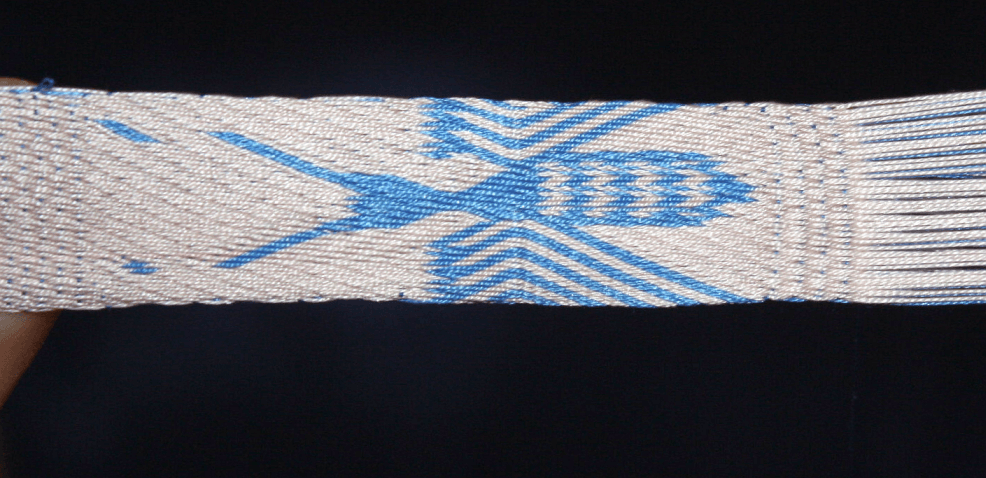
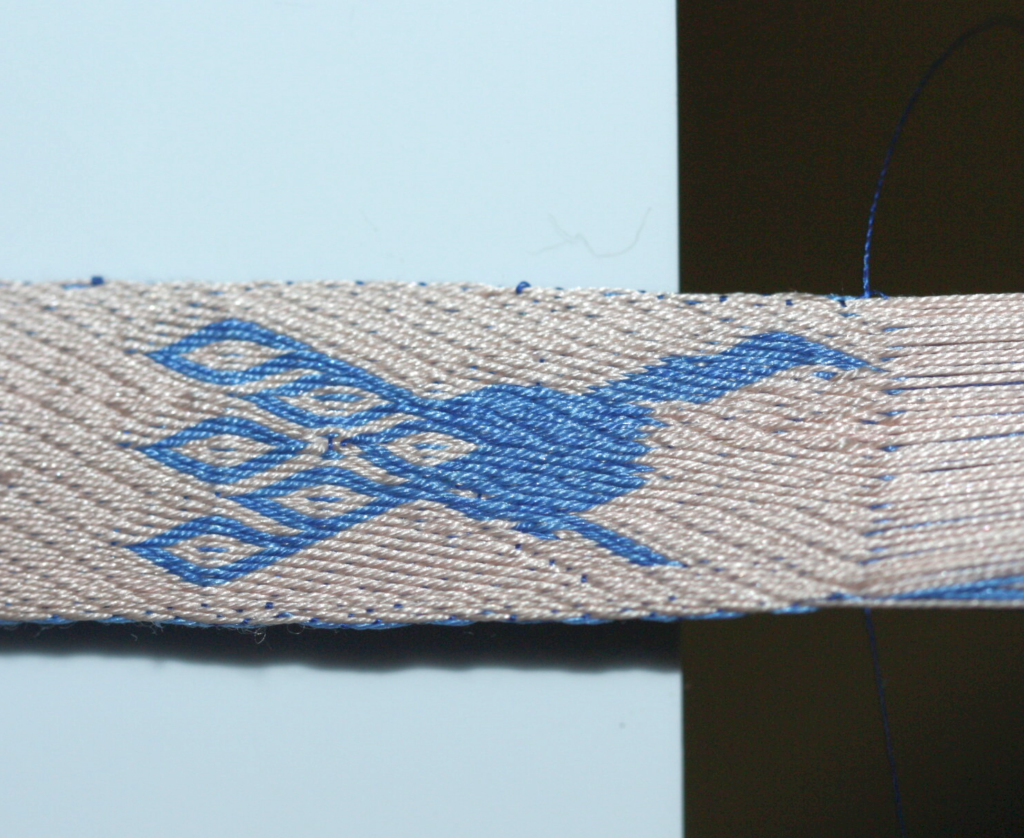
This thing gave me an ear-worm. A slightly, hum, changed one... as now I am a bee-weaver, having woven a bee. Or something that should look more or less like one. (Thanks for the prompt, Christa!)

As you can clearly see, I'm still not the Queen Of Counting Correctly - else the torso would have been in the middle of the band and the wings the same size. I'm also not yet the Queen Of Getting Started Properly Right Away, and the two blue spots before the antennae start bear testimony to that.

The rest, though? I'm okay with how it went, seeing as it was all, again, made up as I went along. (My plans were slightly different, but at one point they had a chat with reality. Hence no incision between torso carapace and striped abdomen.)

If you look closely, there are slight irregularities in the stripey bit, and these are due to different twill direction. I was aware of these switches in direction but chose to ignore them. You might also be able to see the difference in appearance depending on twill/weaving direction - one direction has a much clearer, cleaner appearance than the other, and that is due to the ply direction of the warp threads, and a very common (and unavoidable) effect in this technique.

This was fun to weave, and didn't take a gazillion years (only half a gazillion). I've also learned a few more things, and got more used to some others.

Finally I noticed that my warp tension had crept up and up... so I've remedied that for the next part (I had to move the band along the loom-thingie anyways to have more free warp to work with). While I was concentrating so hard on getting all the turns correct, and being on the brink of going crazy at what felt like all times, it was very seductive to just up the warp tension for easier mechanical turning of the tablets... and I didn't really think about it. I just gave in to temptation.

So... while a relatively high warp tension means it's easier to turn the tablets without them getting caught in a neighbour tablet's threads, and the shed opens nicely all on its own, the downside to this is not only more friction on the thread (no issue at my tension and with my warp threads, though) but also rather acute angles in the diagonals, and stretched-out patterns. Which is not so nice. So now that I am a little more relaxed with the pattern-inventing, I want to go back to lower warp tension to have prettier designs. I just have to get back into the good habits of how to handle the tablets when turning so the getting-caught-issues are minimised.

Next up: Some doggy inspired by a medieval tablet-woven band used as a seal tag. And I hope you're not all sick and tired of hearing about tablet weaving already!
0
SEP.
24
0

More brain-wrecking.

I'm trying to get down pat how to handle the different design elements that can occur in a tablet-weave, and it's half fun and half frustrating and half exciting. Or something like this.

Basically, there are only about 10 elements that you need to learn to do anything, with the most straightforward being a diagonal line running in the main direction of your twill background. That one is really easy, while other things that are twisting things away from that straightforward thing are, hm, let's call it "more demanding". There are ways to do curves, and horizontal and vertical lines, and diagonals running opposite to the current twill direction, and they aren't that hard - but the challenges grow when you are doing multiple things at once and have to keep track of all of them (plus decide on the fly how the pattern should move on).

Also not helpful at all? Having a little reference sheet to help keep track of how the tablets should stand, and then discovering, after a long while of wondering why things occasionally go totally pear-shaped with no good reason whatsoever, that there was a lovely little mistake in that reference sheet. Bah. Duh. I did about a gazillion facepalms in my mind when I found out what had brought me down there again and again. (I had mostly looked at the bits left and right of the erroneous point, which were a-ok and really helpful, and only occasionally referred to the faulty part.)

So. Current status?


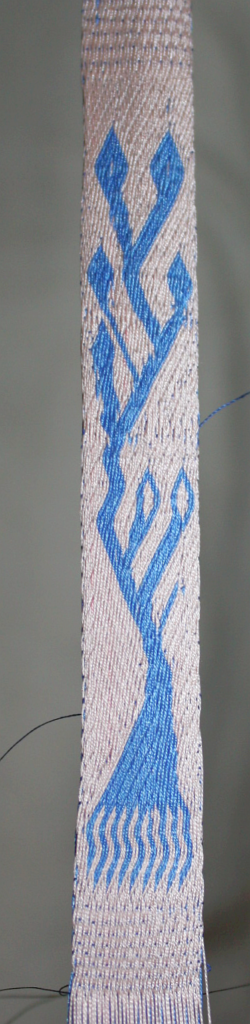
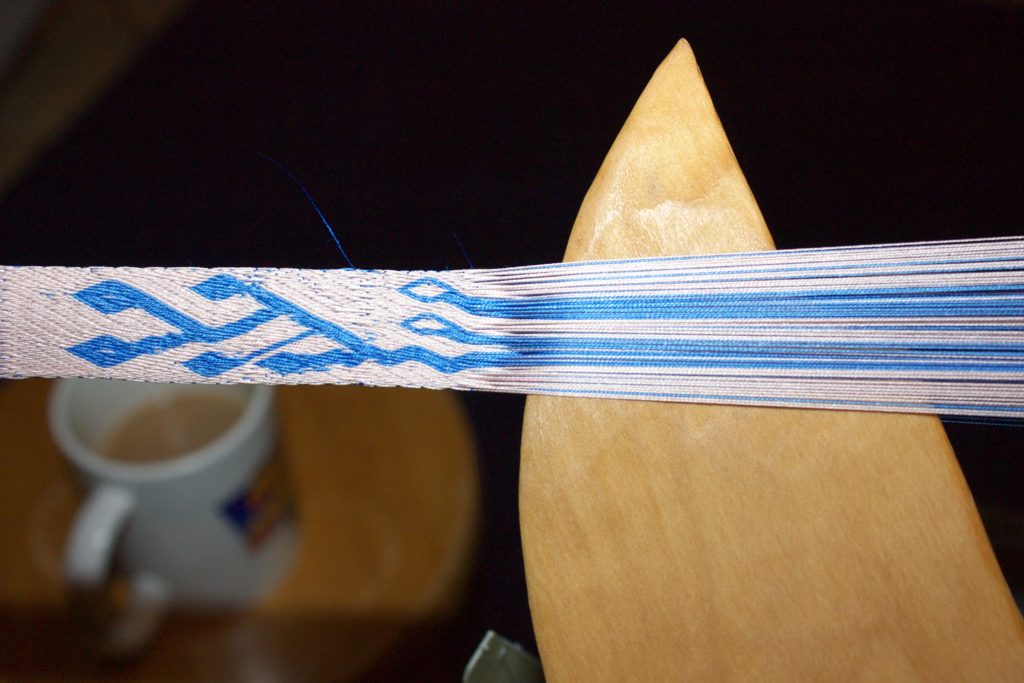
I have made a tree-like thing.

As you can clearly see, I'm still working on merging lines. I'm also still working on a lot of other things, such as starting diamond shapes out of nowhere in a timely fashion. Things are progressing, though, albeit slowly.

There is also still that occasional problem to keep left and right apart. It's getting better, though - having told myself so, so often by now that "towards the weft, slants up and left" that it starts to seep into the backbrain.

Next up: More new and exciting design elements - such as horizontal lines. Yay!
0
SEP.
21
0

Finding out things.

It's always nice to find out things... especially when they are connected to medieval textile tools. So when, a while ago, a colleague handed me a reproduction of a weaving knife (or beater, however you opt to call it) from Viking Age Dublin to try out, I was more than happy to do so. It fit in perfectly with my plans to do the tablet-weaving shenanigans... and so I sat down and wove and gave it a try.

Well. Before, I was firmly in the camp of "I just use my finger to beat in the weft, and that's good enough for me". Let me tell you, though: I am not ever going back to that. Well, maybe for a narrow, simple band, where weaving is fast and I'm handling the tablets with one hand and the shuttle with the other and it's more like just speed down the warp, and that's it. But for things like the twill patterning, or wide bands? Aaah. It does make such a difference - and it actually makes a huge difference, for me, to pressing the weft in with some other tool.

In the past, I had tried to use the shuttle edge, or a special small shuttle with a "beating sting" attached to it (which I have mislaid and cannot currently find, which tells you already how much I use it...), or a ruler, or a bone folding tool. None of them cut the mustard for me - they were one more thing to handle, and my finger did not need picking up and setting down in contrast to these all, and made about the same job.

The difference? Size and shape of the new thingie. This is how it looks:
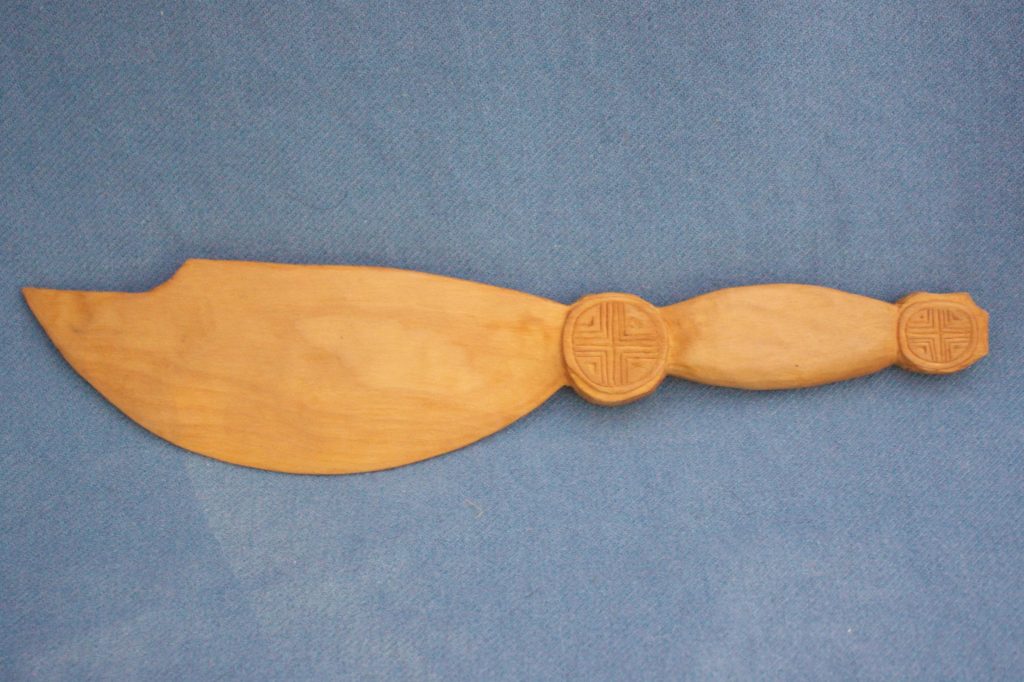


You will note the very broad, very curved blade with the curious indentation at the very tip - things that my colleague found slightly weird. There is a second find from Viking Age Dublin with this shape, so one might surmise that it's not a fluke, but that there is some reason behind it. I had no clue about this possible reason, only a guess regarding the curved blade: It might allow to press the weft in very precisely yet gently, using a rolling motion of the curve across the fell.

Well. That guess certainly proved correct - the tool's form is just perfect to roll it across the width of the band, making sure all the fell is pressed back firmly and evenly. As there is only a smallish contact point, it is easy to apply a little more pressure where necessary and a little less where the warp is softer. Calling this thing "beater" does it no justice at all, by the way - movement and action are all nice and soft and gentle, as befits a delicate tablet weave. With the warp under just enough tension to work well, but not more, beating in the shed would not be a good idea, as it might disorder the tablets. It also puts more stress than necessary on the warp, as well as on the tensioning method - so the curved blade is a total boon.

[caption id="attachment_4054" align="alignnone" width="640"] Gently pressing in the weft.

For this, a smaller tool would actually work for me - but I have also found it wonderfully useful for correcting mistakes.

When I need to go back a pick, I loosen up the last weft, pull it towards the tablets, and then I open the shed it runs through with my fingers. I then usually stuck something in there - my finger (which binds one hand, so not very good for longer or more complex corrections), some stick, or whatever (a bone folder, for instance). The purpose of this is to keep the old shed open to individually turn each tablet back the way it came, re-establishing the position before the mistake. Obviously, it's a) helpful if you see how the threads run over your tool, and b) important that it does not slip out too early. Both of these were, hm, let's call it sub-optimal with a stick or a bone folder.

With the almost 30 cm of total length, and the relatively long blade part, the tool easily accommodates my warp for these corrections. The back of the blade is wide enough to stretch the shed apart nicely so I can see what is happening, and the total length is just long enough to either set the handle's end on my knee or hold it between my legs, making sure it stays put.

[caption id="attachment_4051" align="alignnone" width="640"] Fixing a mistake by weaving back - the crossings from the previous turn are carried towards the tablets.
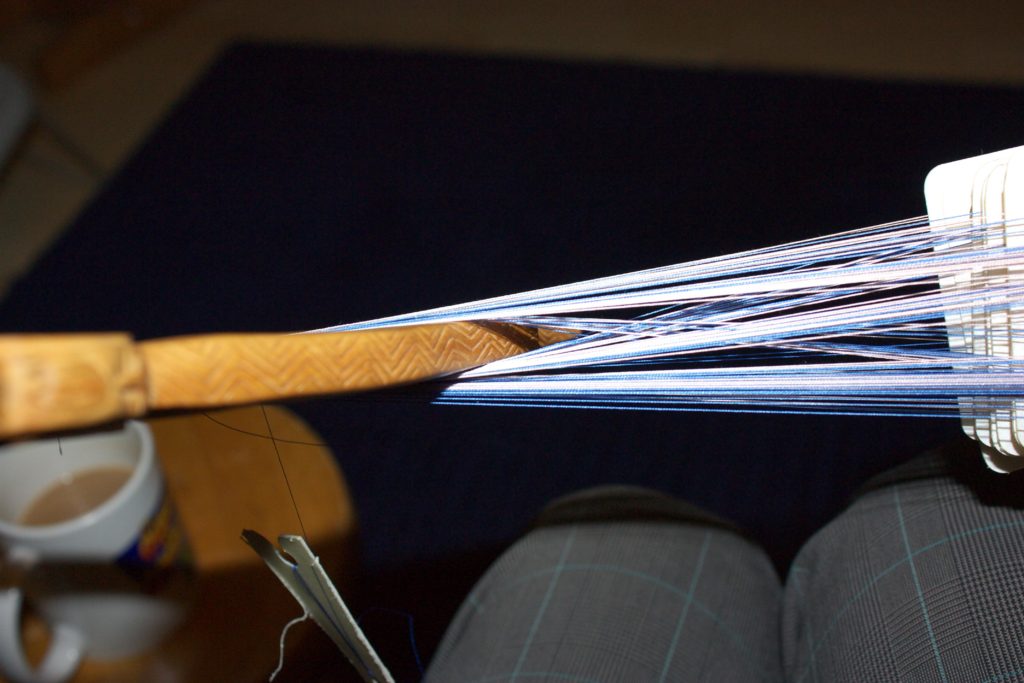

Most often (fortunately!) the mistakes are not so bad that I need to go back for the whole pick - they are just one or two tablets that accidentally turned into the wrong direction. Or sometimes, I'm not sure whether the edge of a pattern section is where it is supposed to be. In these cases, I pick out the tablet cord in question close to the fell and follow it back to the stack of tablets. For this, something more pointy and accurate than a finger is very helpful. Bone folders will work, as will needles... but, guess what works even better?

Yes. The pointy tip of the tool. With the indentation making the tip of the blade effectively a lot narrower than the curve would dictate, it is just perfect to pick out the offending place, stick it in and follow the yellow brick road, excuse me, the tablet cord in question back to its origin.

[caption id="attachment_4053" align="alignnone" width="640"] Catching the questionable pattern section edge to check whether the tablets stand correctly.
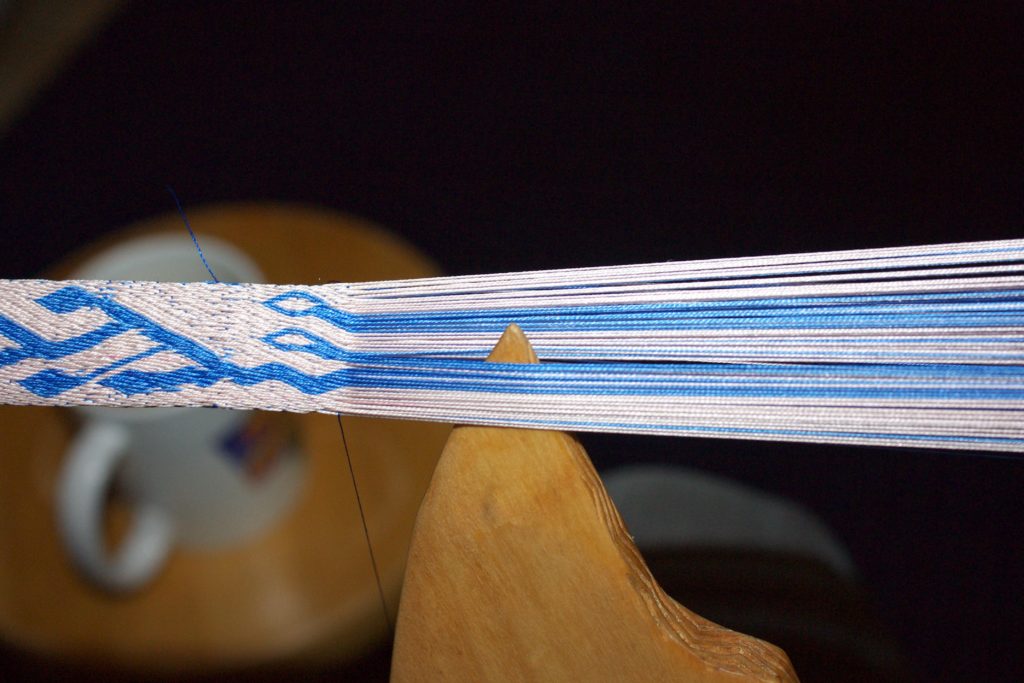

It works much, much better than the bone folder. Or a ruler. Or my finger.

It's also not a bad thing that this tool is totally beautifully made, and very smooth, and beautifully decorated with carvings, and made from service tree wood, which is my absolute favourite wood ever.

So worth the extra step of picking up the tool! And in the future, my fingers will not see that fell again... because I'm not going back, nothankyouverymuchindeed.
0
SEP.
20
0

They are back!

I'm still weaving. I'm also trying not to get completely sucked into that black hole eating all my brains and trying to eat all my time as well... because while things work really nicely on paper, and while I know what I want to do, some details still have not clicked yet. So the tree is not yet finished, and I'm not yet all happy.

Never mind that, though. There is something else going on too. Something delightful. Something... stony!

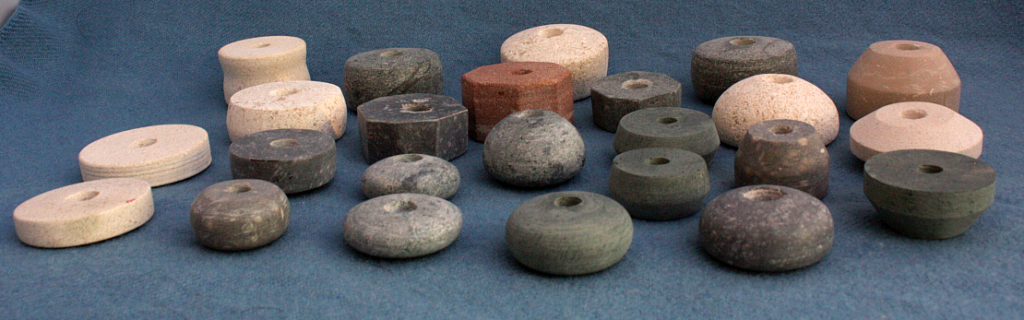
I have received a new delivery of stone spindle whorls, and they are beautiful, and they are going into the shop now. While you are getting a sneak preview of them here:

0
SEP.
19
0

Things going on here.

Things going on?

Prep for the Textile Forum - writing lists, making plans, figuring out stuff, and generally getting really excited.

Also... more weaving. Currently I'm trying to get merging lines down pat, so the idea was to weave a tree (inspired by one of the Arlon motifs) and follow that with a bee (which is perfect for trying a few other things that serve as design elements).

Well. Merging lines. That means you have one line coming from the left, and one from the right, and the main turning direction of these lines is not the same, so one basically has to eat the other one. In theory, I got this. In practice, I thought I had it at one point... and then I wanted to repeat it and I got horribly, horribly muddled up. Maybe it was too many things at once...


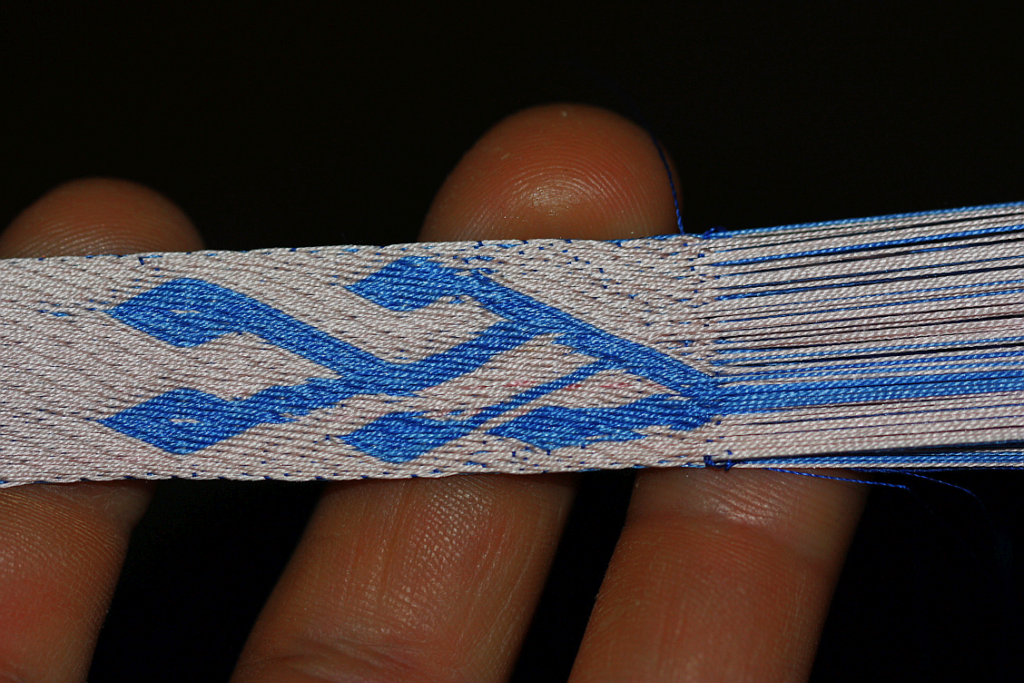
...because I wanted to try starting multiple diamonds at the same time on the free side of the band. Well. That did not go as planned.

You can see in the picture that things got really, seriously wonky. Ah well. I'll make the tree a little taller... and try again. (In theory, I know exactly what I have to do. In practice, somehow, things sort of get out of hand occasionally...)
0
SEP.
14
2

Aaaand... another one.

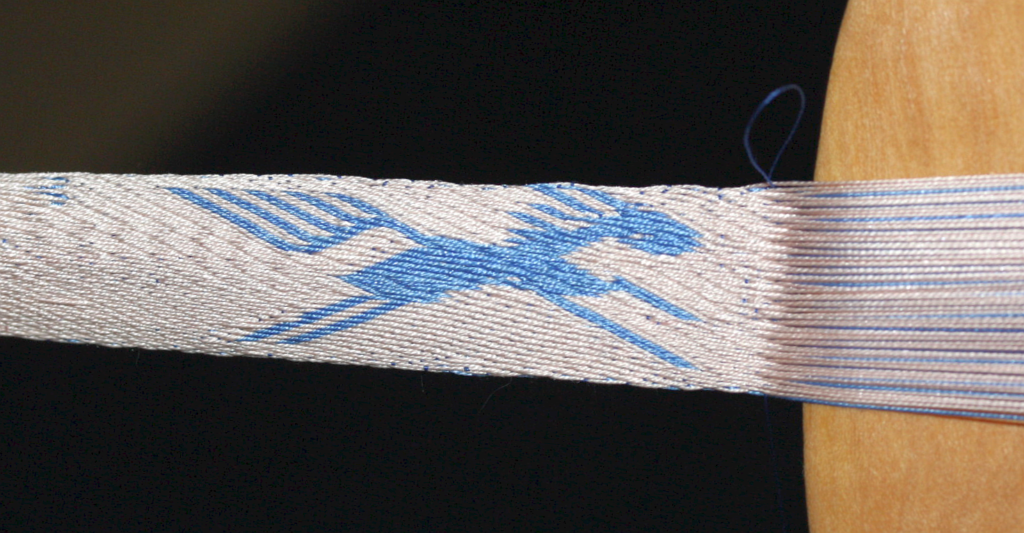
I hope you're not bored to death yet with my posting of tablet-woven animals but, well, you guessed it - I've made another one, and I have nothing better to do than share it here:


Starting this was a little bit more difficult than I had anticipated, if only because I was not able to tell left from right properly, and had originally planned something that does not work - so it took a few tries before I was able to set off.

I also learned that there are some things that have to be done in sets of four, not sets of two picks, which is why there is some wonkyness at the base of the neck (the bit at the bottom would have been avoidable, but I was too lazy to un-weave two picks).

Despite all of this, I managed to get out at the end with much less muddle than I had at the end of the horse, so things are getting better - and with the new rule to add to the set, there should be even less muddle next time.

And now I'm wondering what I should weave next... though I probably should do some other things first for a change. These critters eat a lot of time!
0
SEP.
13
3

I've done it again. Only bigger.

So after the success of the tiny wonky animal on the narrow band, obviously there was no other choice than trying out the new system on the wide band.

And, well, what shall I say? I was mostly successful, and I can now give you this:


Woven on a 42 tablet wide band, with no pattern drawing. Not even a sketch.

Actually, I did make several sketches, but in the end, I followed none of them. I was sitting there, weaving, and that certain part of my brain went "I think I should do this here" or "wonder if I can't give that horse a mane" or "this doesn't look wide enough yet".

Obviously, it did not go all smoothly all the time - I did botch up at a few different occasions, once so badly I actually had to un-weave two picks.  The tablets were a bit out of sync after one point (damn you, directional change at odd weft counts!) and that did make going on, and matching lines together, a lot harder than it should have been. So in the end, I had some parts that were running smoothly and some wonky places between them where I sort of just fudged it. The smooth parts were partly in sync and partly not, so the wonkyness went both ways, and it was rather a relief to find that the head blob had finally gotten long enough, as had the front legs, so that I could just turn everything pink again and call it a day. Or a horse.

However, being able to go on and actually finish the critter proves, to me, that the system does work very well - because the last times I got out of sync in a similar way, or even less direly, everything got so confusing that I basically gave up and restarted with a clean slate. This time, it was possible to muddle my way through, and the next critter will surely be less wonky again. I've also realised that there are some more hints (that can probably be turned into rules) to prevent things like this from happening again.

So. Achievement unlocked: Twill patterns without pattern.

And what kind of critter will I weave now?
0

By accepting you will be accessing a service provided by a third-party external to https://pallia.net/

Kontakt